- Home
- FPMT Homepage
Foundation for the Preservation of the Mahayana Tradition
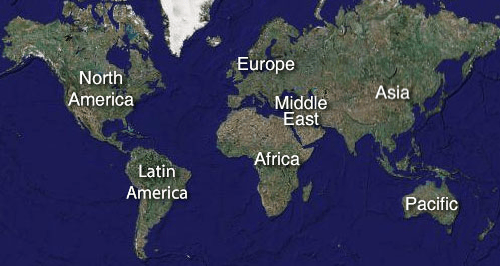
The FPMT is an organization devoted to preserving and spreading Mahayana Buddhism worldwide by creating opportunities to listen, reflect, meditate, practice and actualize the unmistaken teachings of the Buddha and based on that experience spreading the Dharma to sentient beings. We provide integrated education through which people’s minds and hearts can be transformed into their highest potential for the benefit of others, inspired by an attitude of universal responsibility and service. We are committed to creating harmonious environments and helping all beings develop their full potential of infinite wisdom and compassion. Our organization is based on the Buddhist tradition of Lama Tsongkhapa of Tibet as taught to us by our founders Lama Thubten Yeshe and Lama Thubten Zopa Rinpoche.
- Willkommen
Die Stiftung zur Erhaltung der Mahayana Tradition (FPMT) ist eine Organisation, die sich weltweit für die Erhaltung und Verbreitung des Mahayana-Buddhismus einsetzt, indem sie Möglichkeiten schafft, den makellosen Lehren des Buddha zuzuhören, über sie zur reflektieren und zu meditieren und auf der Grundlage dieser Erfahrung das Dharma unter den Lebewesen zu verbreiten.
Wir bieten integrierte Schulungswege an, durch denen der Geist und das Herz der Menschen in ihr höchstes Potential verwandelt werden zum Wohl der anderen – inspiriert durch eine Haltung der universellen Verantwortung und dem Wunsch zu dienen. Wir haben uns verpflichtet, harmonische Umgebungen zu schaffen und allen Wesen zu helfen, ihr volles Potenzial unendlicher Weisheit und grenzenlosen Mitgefühls zu verwirklichen.
Unsere Organisation basiert auf der buddhistischen Tradition von Lama Tsongkhapa von Tibet, so wie sie uns von unseren Gründern Lama Thubten Yeshe und Lama Thubten Zopa Rinpoche gelehrt wird.
- Bienvenidos
La Fundación para la preservación de la tradición Mahayana (FPMT) es una organización que se dedica a preservar y difundir el budismo Mahayana en todo el mundo, creando oportunidades para escuchar, reflexionar, meditar, practicar y actualizar las enseñanzas inconfundibles de Buda y en base a esa experiencia difundir el Dharma a los seres.
Proporcionamos una educación integrada a través de la cual las mentes y los corazones de las personas se pueden transformar en su mayor potencial para el beneficio de los demás, inspirados por una actitud de responsabilidad y servicio universales. Estamos comprometidos a crear ambientes armoniosos y ayudar a todos los seres a desarrollar todo su potencial de infinita sabiduría y compasión.
Nuestra organización se basa en la tradición budista de Lama Tsongkhapa del Tíbet como nos lo enseñaron nuestros fundadores Lama Thubten Yeshe y Lama Zopa Rinpoche.
A continuación puede ver una lista de los centros y sus páginas web en su lengua preferida.
- Bienvenue
L’organisation de la FPMT a pour vocation la préservation et la diffusion du bouddhisme du mahayana dans le monde entier. Elle offre l’opportunité d’écouter, de réfléchir, de méditer, de pratiquer et de réaliser les enseignements excellents du Bouddha, pour ensuite transmettre le Dharma à tous les êtres. Nous proposons une formation intégrée grâce à laquelle le cœur et l’esprit de chacun peuvent accomplir leur potentiel le plus élevé pour le bien d’autrui, inspirés par le sens du service et une responsabilité universelle. Nous nous engageons à créer un environnement harmonieux et à aider tous les êtres à épanouir leur potentiel illimité de compassion et de sagesse. Notre organisation s’appuie sur la tradition guéloukpa de Lama Tsongkhapa du Tibet, telle qu’elle a été enseignée par nos fondateurs Lama Thoubtèn Yéshé et Lama Zopa Rinpoché.
Visitez le site de notre Editions Mahayana pour les traductions, conseils et nouvelles du Bureau international en français.
Voici une liste de centres et de leurs sites dans votre langue préférée
- Benvenuto
L’FPMT è un organizzazione il cui scopo è preservare e diffondere il Buddhismo Mahayana nel mondo, creando occasioni di ascolto, riflessione, meditazione e pratica dei perfetti insegnamenti del Buddha, al fine di attualizzare e diffondere il Dharma fra tutti gli esseri senzienti.
Offriamo un’educazione integrata, che può trasformare la mente e i cuori delle persone nel loro massimo potenziale, per il beneficio di tutti gli esseri, ispirati da un’attitudine di responsabilità universale e di servizio.
Il nostro obiettivo è quello di creare contesti armoniosi e aiutare tutti gli esseri a sviluppare in modo completo le proprie potenzialità di infinita saggezza e compassione.
La nostra organizzazione si basa sulla tradizione buddhista di Lama Tsongkhapa del Tibet, così come ci è stata insegnata dai nostri fondatori Lama Thubten Yeshe e Lama Zopa Rinpoche.
Di seguito potete trovare un elenco dei centri e dei loro siti nella lingua da voi prescelta.
- 欢迎 / 歡迎
简体中文
“护持大乘法脉基金会”( 英文简称:FPMT。全名:Foundation for the Preservation of the Mahayana Tradition) 是一个致力于护持和弘扬大乘佛法的国际佛教组织。我们提供听闻,思维,禅修,修行和实证佛陀无误教法的机会,以便让一切众生都能够享受佛法的指引和滋润。
我们全力创造和谐融洽的环境, 为人们提供解行并重的完整佛法教育,以便启发内在的环宇悲心及责任心,并开发内心所蕴藏的巨大潜能 — 无限的智慧与悲心 — 以便利益和服务一切有情。
FPMT的创办人是图腾耶喜喇嘛和喇嘛梭巴仁波切。我们所修习的是由两位上师所教导的,西藏喀巴大师的佛法传承。
繁體中文
護持大乘法脈基金會”( 英文簡稱:FPMT。全名:Found
ation for the Preservation of the Mahayana Tradition ) 是一個致力於護持和弘揚大乘佛法的國際佛教組織。我們提供聽聞, 思維,禪修,修行和實證佛陀無誤教法的機會,以便讓一切眾生都能 夠享受佛法的指引和滋潤。 我們全力創造和諧融洽的環境,
為人們提供解行並重的完整佛法教育,以便啟發內在的環宇悲心及責 任心,並開發內心所蘊藏的巨大潛能 — 無限的智慧與悲心 – – 以便利益和服務一切有情。 FPMT的創辦人是圖騰耶喜喇嘛和喇嘛梭巴仁波切。
我們所修習的是由兩位上師所教導的,西藏喀巴大師的佛法傳承。 察看道场信息:
- FPMT Homepage
- News/Media
-
- Study & Practice
-
-
- About FPMT Education Services
- Latest News
- Programs
- New to Buddhism?
- Buddhist Mind Science: Activating Your Potential
- Heart Advice for Death and Dying
- Discovering Buddhism
- Living in the Path
- Exploring Buddhism
- FPMT Basic Program
- FPMT Masters Program
- FPMT In-Depth Meditation Training
- Maitripa College
- Lotsawa Rinchen Zangpo Translator Program
- Universal Education for Compassion & Wisdom
- Online Learning Center
-
- Prayers & Practice Materials
- Overview of Prayers & Practices
- Full Catalogue of Prayers & Practice Materials
- Explore Popular Topics
- Benefiting Animals
- Chenrezig Resources
- Death & Dying Resources
- Lama Chopa (Guru Puja)
- Lama Zopa Rinpoche: Compendium of Precious Instructions
- Lama Zopa Rinpoche: Life Practice Advice
- Lama Zopa Rinpoche Practice Series
- Lamrim Resources
- Mantras
- Prayer Book Updates
- Purification Practices
- Sutras
- Thought Transformation (Lojong)
- Audio Materials
- Dharma Dates - Tibetan Calendar
- Translation Services
- Publishing Services
- Ways to Offer Support
- Prayers & Practice Materials
-
- Teachings and Advice
- Find Teachings and Advice
- Lama Zopa Rinpoche Advice Page
- Lama Zopa Rinpoche: Compendium of Precious Instructions
- Lama Zopa Rinpoche Video Teachings
- ༧སྐྱབས་རྗེ་བཟོད་པ་རིན་པོ་ཆེ་མཆོག་ནས་སྩལ་བའི་བཀའ་སློབ་བརྙན་འཕྲིན།
- Podcasts
- Lama Yeshe Wisdom Archive
- Buddhism FAQ
- Dharma for Young People
- Resources on Holy Objects
- Teachings and Advice
-
-
*If a menu item has a submenu clicking once will expand the menu clicking twice will open the page.
-
-
- Centers
-
- Teachers
-
- Projects
-
-
Latest News
Animal Liberation Fund: Compassion in Action Across the World
Charitable Activities | September 24, 2026 -“Where there is a mind, there are feelings such as pain, pleasure, and joy. No sentient being wants pain; instead all want happiness. Since we all share these feelings at some basic level, we as rational human beings have an … Read more »
-
-
-
*If a menu item has a submenu clicking once will expand the menu clicking twice will open the page.
-
- Support
- FPMT
-
-
-
-
-
Tibetan Buddhism teaches you to overcome your dissatisfied mind, but to do that you have to make an effort. To put our techniques into your own experience, you have to go slowly, gradually. You can’t just jump right in the deep end. It takes time and we expect you to have trouble at first. But if you take it easy it gets less and less difficult as time goes by.
Lama Zopa Rinpoche
-
-
-
- Shop
-
-
-
The Foundation Store is FPMT’s online shop and features a vast selection of Buddhist study and practice materials written or recommended by our lineage gurus. These items include homestudy programs, prayers and practices in PDF or eBook format, materials for children, and other resources to support practitioners.
Items displayed in the shop are made available for Dharma practice and educational purposes, and never for the purpose of profiting from their sale. Please read FPMT Foundation Store Policy Regarding Dharma Items for more information.
-
-
30

The Great Stupa of Universal Compassion. Photo courtesy of the Great Stupa Facebook page.
As part of the Foundation for the Preservation of the Mahayana Tradition’s (FPMT) fiftieth anniversary celebration, we continue to gather stories from the pioneer students whose devotion and steady work helped build the organization we know today. Here, Ian Green shares an excerpt from his book Monumental – The Story of the Stupa on the founding of The Great Stupa of Universal Compassion in Bendigo, Australia, which he read aloud at the 2025 CPMT summit at Kopan Monastery. He recalls meeting Lama Thubten Yeshe in 1979, receiving Kyabje Lama Zopa Rinpoche’s guidance for the stupa’s design, and the nine-year world tour of the Jade Buddha for Universal Peace.
A First Meeting in Melbourne
I first met Lama Yeshe in 1979, at a public talk in Melbourne. After the talk there was a chance to meet him, and the queue shuffled slowly along. As I was nearly at the front, Ven. Konchog Donma, a nun who at the time was Director of Tara House in Melbourne, rushed up and introduced me to Lama Yeshe. He took my hands and looked at me, and as our eyes met I felt a little disconcerted by his direct, penetrating gaze. It felt as though Lama Yeshe saw me exactly as I was, with all my good and bad points — and that he accepted me completely, just as I was. Slowly I recognized a feeling I had experienced only once or twice before: it felt like falling in love. After meeting Lama Yeshe in Melbourne, I knew I had to go to Kopan.
Kopan and a Gift of Atisha
In November 1979, I attended the Kopan course. Right at the end of it, on the day I was leaving, Lama Yeshe called me over and spoke about a place where students could study and do retreat — a quieter, less stressful, good life in Victoria. He punctuated this serious discussion with bursts of laughter so loud I was sure they could be heard all over Kopan Hill. His eyes held such intensity of sweet kindness that I had no doubt he spoke from the heart. Without hesitation, I told him I would do my best to help Tara House in Melbourne become a suitable retreat place. As I rose to leave, Lama Yeshe signaled for me to wait. He reached into a bag and produced a small statue of Atisha as a gift to take back to Australia. Looking back, it seems that even then, Lama Yeshe had a vision for what I might be able to contribute.
The Land in Bendigo
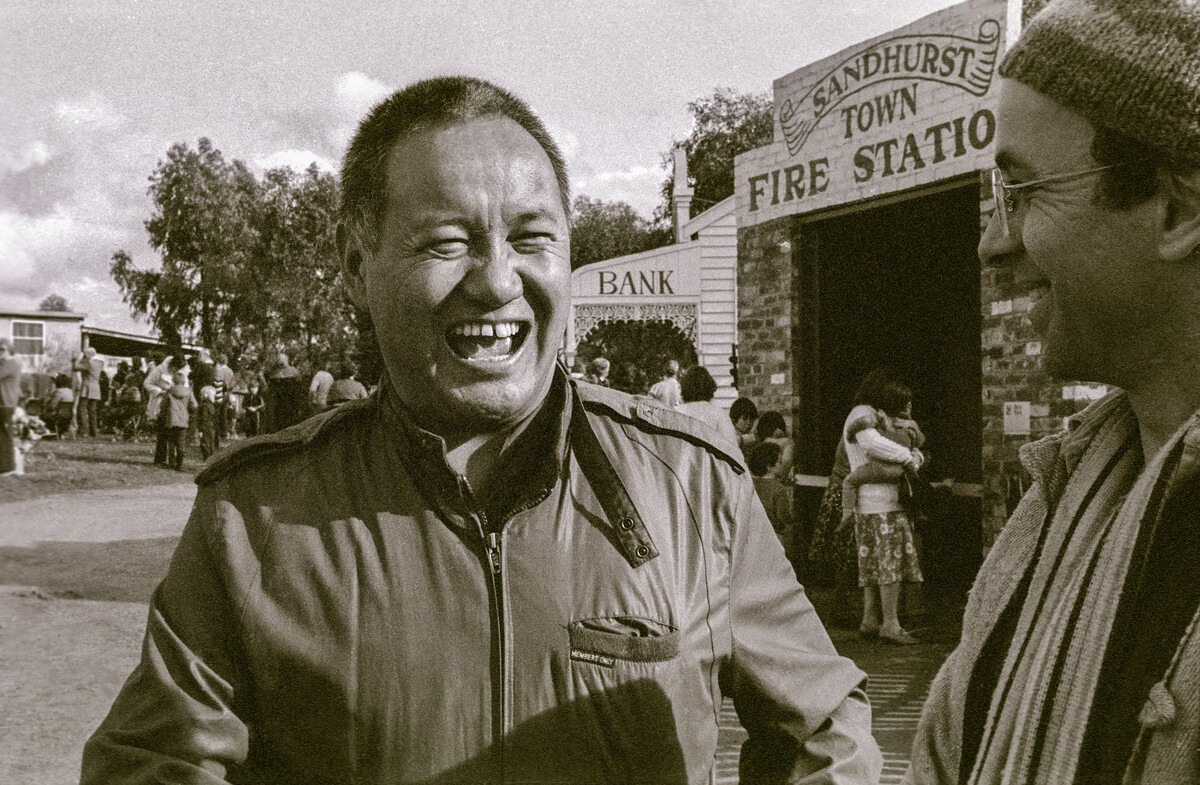
Lama Yeshe in Bendigo, Australia, 1981. Photo by Ian Green. Photo courtesy of the Lama Yeshe Wisdom Archive.
My father offered some acres of land near Bendigo, and in August 1981 Lama Yeshe came to see it. During that visit, Garrey Foulkes and I walked with him over the fifty acres adjoining Sandhurst Town that my father had offered. Lama presented us with a masterplan for a great stupa, encircled by a meditation center, monastery, aged-care facility, and a wider community. He spoke at length of his vision for a small Buddhist city that would care for people throughout their lives.
Drawing a Stupa in the Dirt
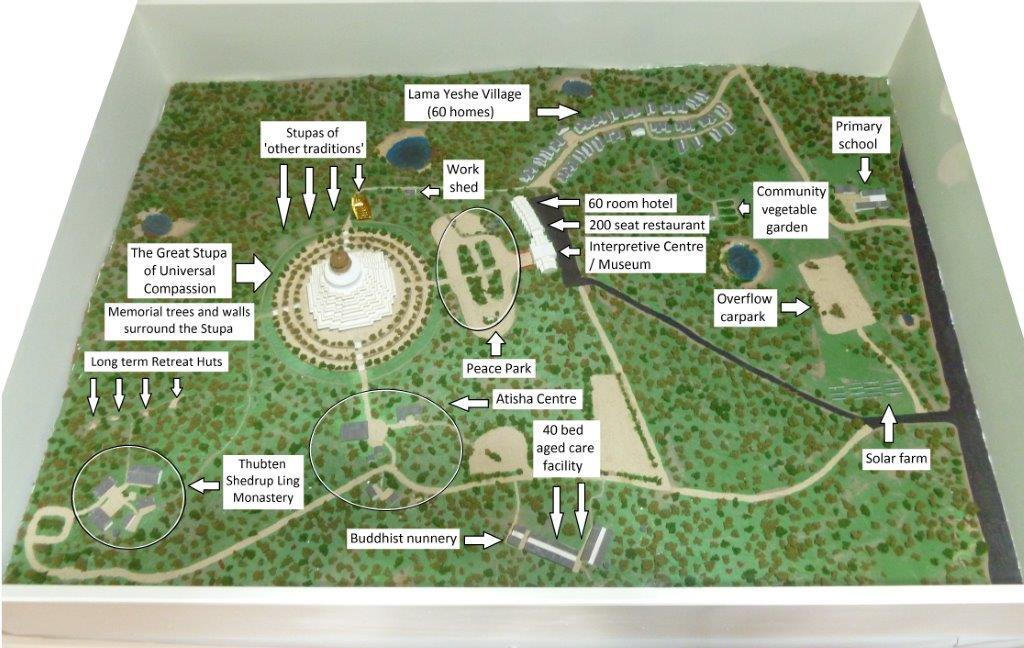
Three-dimensional model of master plan for development at Great Stupa. Image courtesy of Ian Green via Twitter. 2013
Walking on a bush track near where the current Quan Yin statue stands in its pond today, Lama Yeshe picked up a nearby stick and began to draw the outline of a stupa in the dirt. Pointing to a nearby hill, he said: “There will be a big stupa with a big gompa and a library inside it.”
We pushed aside head-high bush and trees to reach the hilltop that Lama Yeshe had indicated would be the center of the stupa, then walked on to another, slightly higher hill about 600 meters away — the site of the present-day monastery. I had the distinct feeling that Lama Yeshe could see clearly the whole of what was unfolding there for Garrey and me, as though it already existed as a reality. To my knowledge, he had never set foot on this part of the property before, yet he walked from one place to the next with complete confidence.
From that day we knew then that we had to build a very big stupa — but what would it look like? We had no idea.
Lama Zopa Rinpoche’s Blueprint
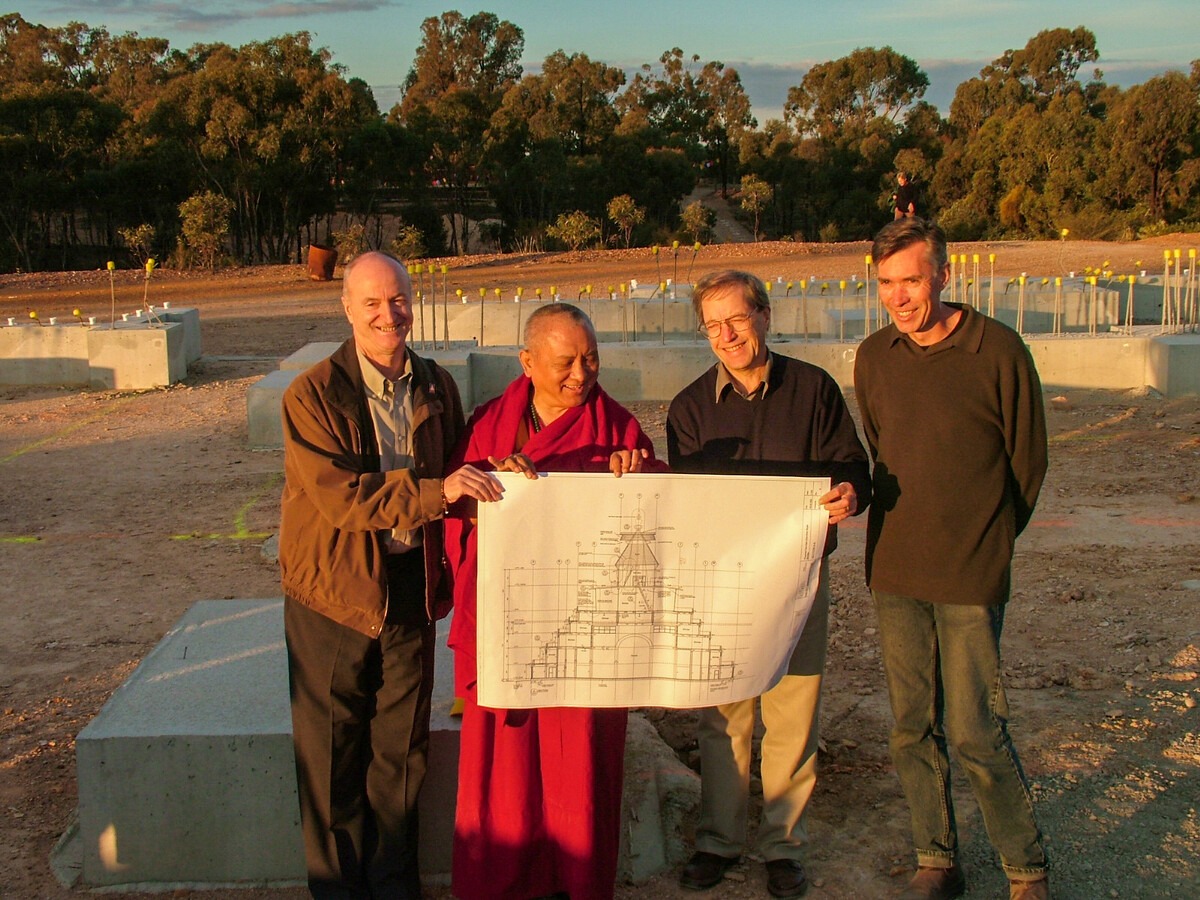
Lama Zopa Rinpoche with Ian Green, holding the blue print for the Great Stupa, Australia 2006. Photo of Ven. Roger
Kyabje Lama Zopa Rinpoche eventually solved this problem. Early in 1994, Alison Ribush — gave me a book called Photos of Tibet. Across a large double-page photograph of the Gyantse Kumbum, Rinpoche wrote: “This is my idea for the stupa in Bendigo.” I had never seen a picture of the stupa before, but I immediately felt it was the right choice. I could see that it was impressive in scale, yet still relatable on a human level.
The most important teaching I have received from Lama Yeshe and Lama Zopa Rinpoche, in regard to building the Great Stupa and creating the Jade Buddha, is that I should expect obstacles to arise. Rinpoche indicated that because building the Great Stupa and creating the Jade Buddha were such positive acts, it meant there would be some mighty obstacles to overcome.
The Jade Buddha’s Journey
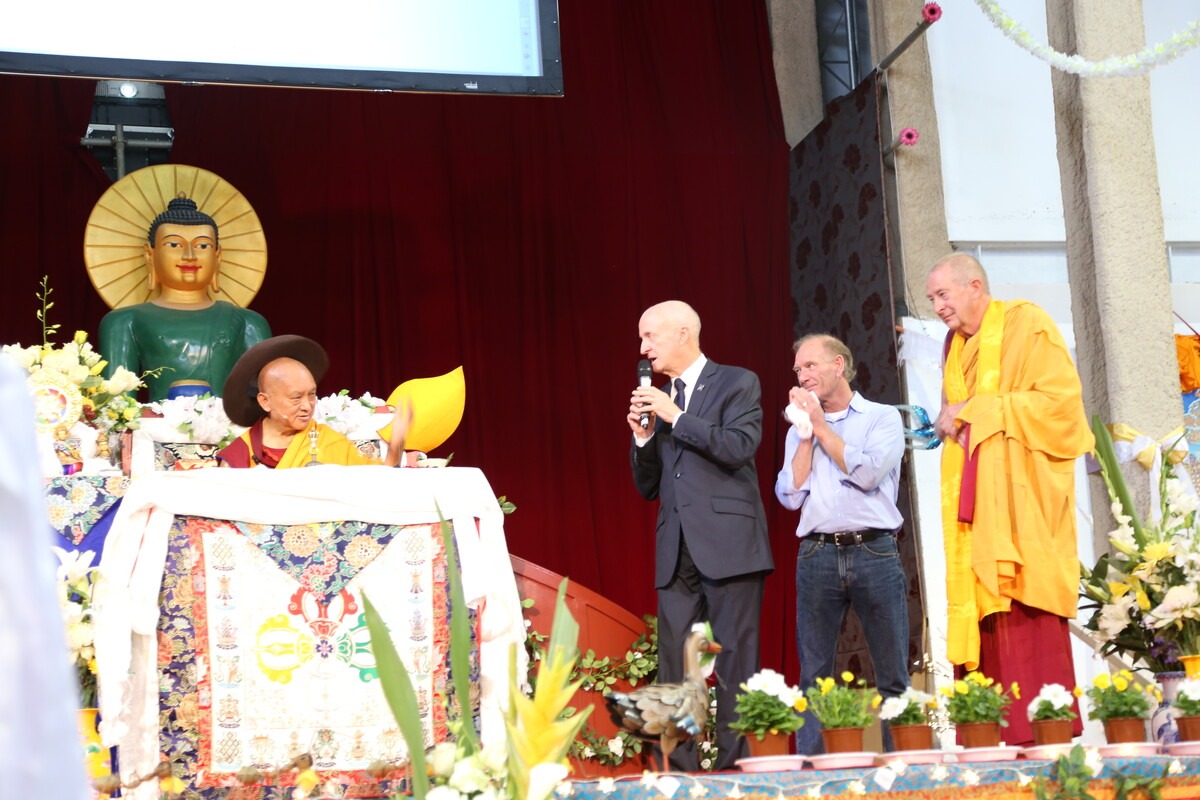
Jade Buddha behind Lama Zopa Rinpoche, with Ian Green, Liam, and Ven. Gyatso, Australia, 2014. Photo by Thubten Kunsang (Henri Lopez).
Lama Zopa Rinpoche was enthusiastic about the idea of taking the Jade Buddha on tour: “If you take the Buddha around the world,” he told me, “it makes it so easy to believe in the blessings of the Jade Buddha.” And so it was: over nine years, the Jade Buddha for Universal Peace traveled to more than 120 cities around the world, and an estimated 12 million people came to see it.
An Inspiring Example of Interfaith harmony
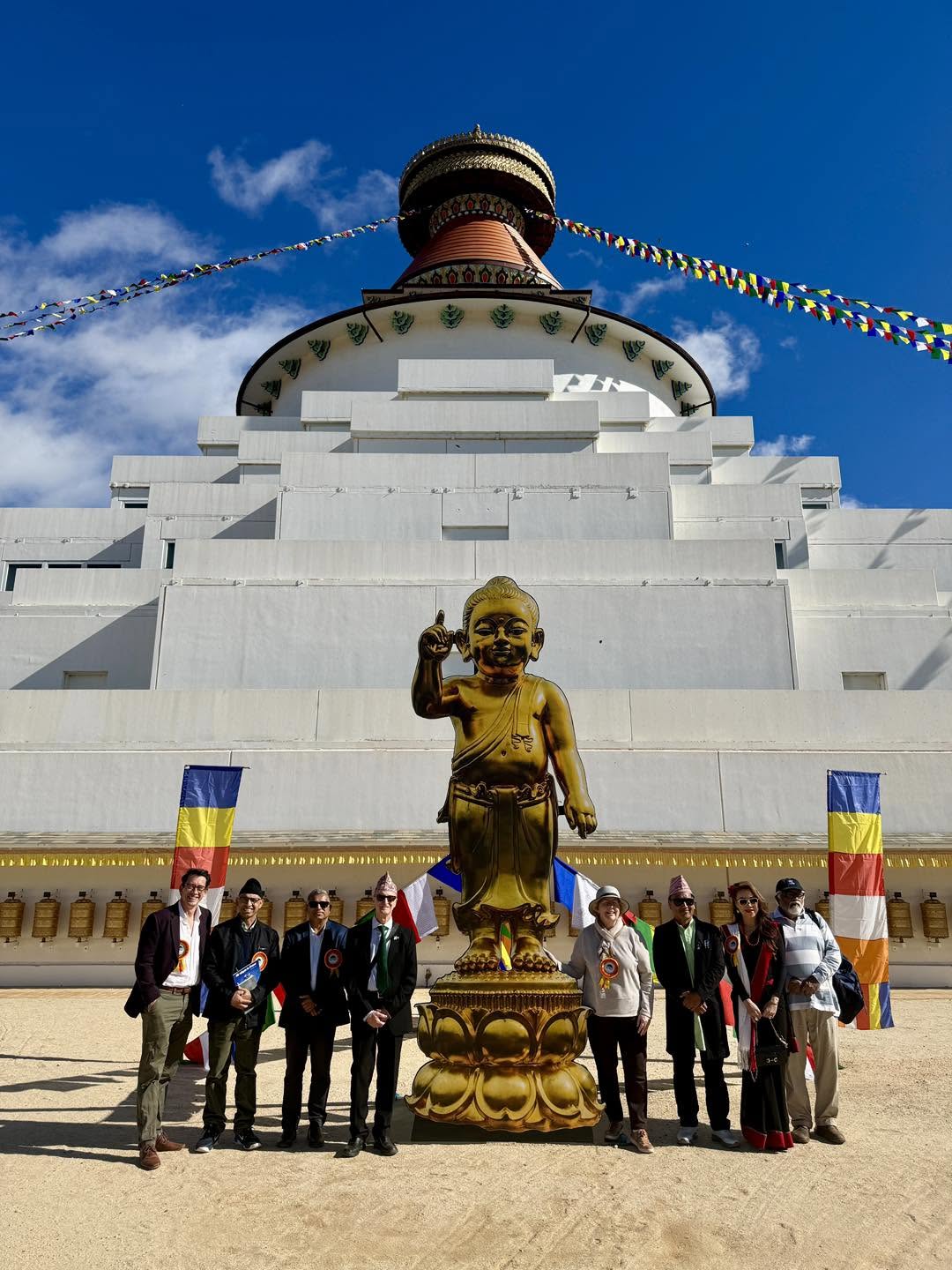
Lumbini International Festival at the Great Stupa, May 9, 2026. Photo courtesy of the Great Stupa Facebook page.
The Great Stupa is also a true champion of interfaith harmony, through the creation of a Peace Park where symbols of many of the world’s great spiritual traditions—Bahá’í, Buddhist, Christian, Hindu, Jewish, Indigenous, Islamic, and Sikh—stand side by side in mutual respect. This profound gesture of unity is a message to the world: that peace is possible when hearts are open and traditions walk together.
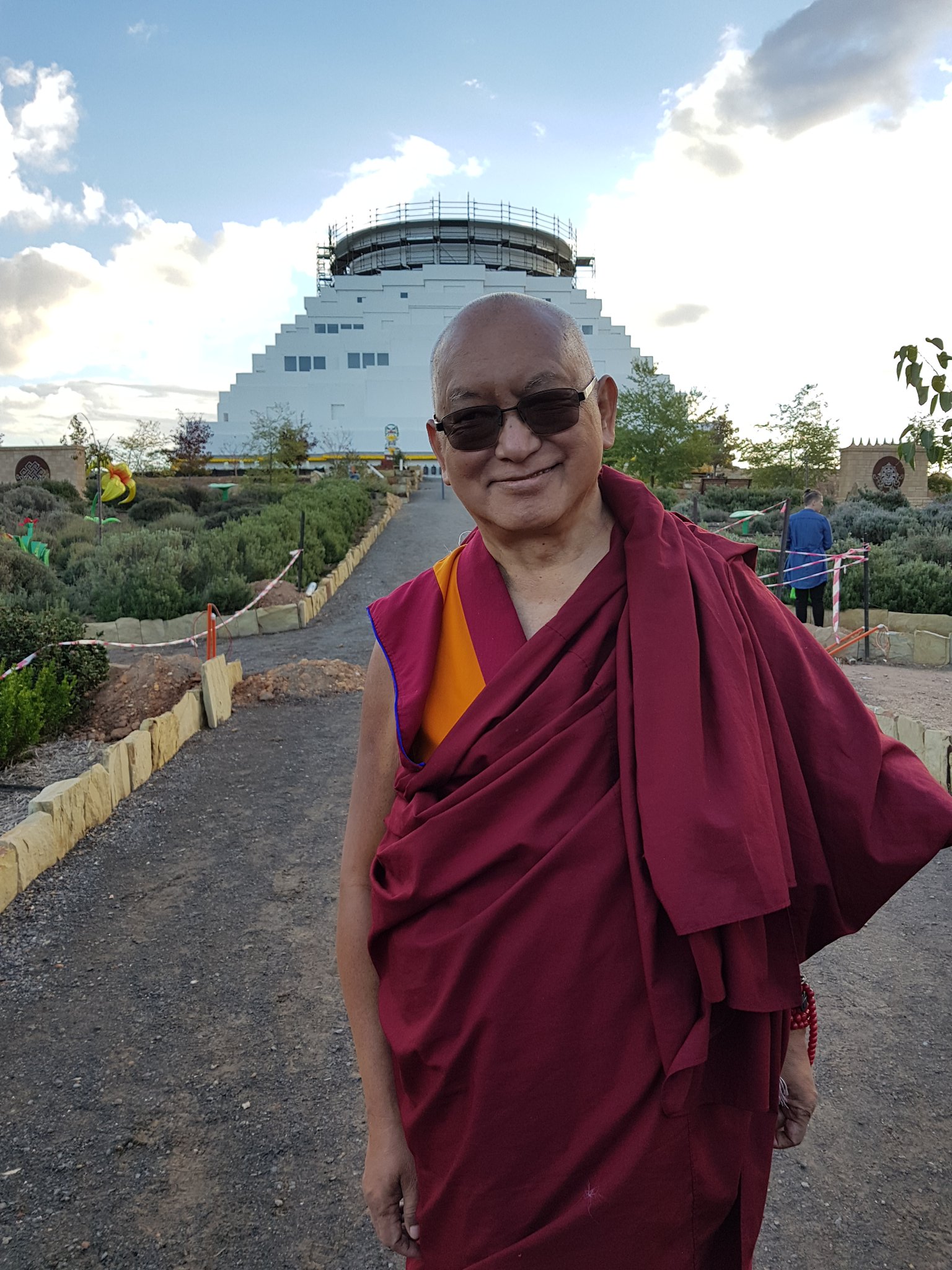
Lama Zopa Rinpche infront The Great Stupa of Universal Compassion, 2018. Photo Courtesy of Ian Green.
In fulfilling the aspirations of both Lama Thubten Yeshe and His Holiness the Dalai Lama, the Great Stupa has also established the Great Stupa Library, the only library of its kind in the world to focus on Buddhism, Interfaith, and Science—a testament to the harmony of wisdom, faith, and reason.
The shrines to Lama Yeshe and Lama Zopa
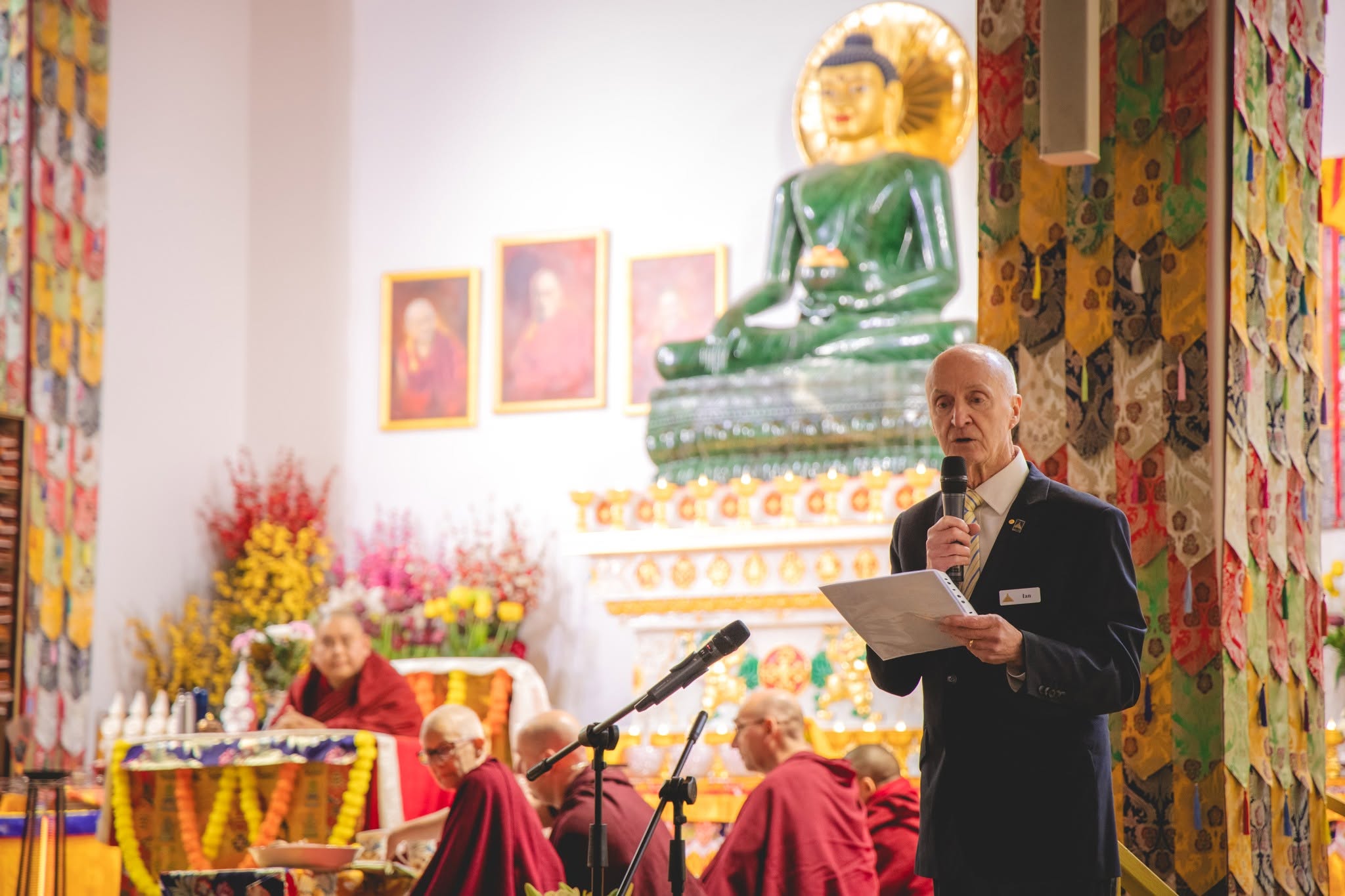
Ian Green during the visit of His Eminence Ling Rinpoche to the Great Stupa, August 2025. Photo courtesy of the Great Stupa Facebook page.
The Great Stupa team are currently working on shrine rooms for both Lama Yeshe and Lama Zopa Rinpoche.
These will be located on level three of the Great Stupa and will feature statues of the two Lamas and some of their holy relics. We considered various locations fir these shrines until His Eminence Ling Rinpoche helped us choose this location.
At the entrance to the shrine rooms will be a museum dedicated to the achievements of Lama Yeshe and Lama Zopa Rinpoche.
In conclusion, I want to say — these are the last words of my book — that even though Lama Yeshe and Lama Zopa Rinpoche are no longer with us, I feel blessed and grateful for the inspiration and the guidance I received from them both. It is due to their kindness that I have been able to do things with my life that will be of lasting benefit to others. Rinpoche left us decades of work to complete his own stupa, and that is exactly what I have reaffirmed I will keep doing with the rest of my life.
Ian Green is the founder of the Great Stupa of Universal Compassion in Bendigo, Australia, and the driving force behind the Jade Buddha for Universal Peace. We are grateful to him for sharing this story as part of FPMT’s fiftieth anniversary celebration, and we would love to hear from other pioneer students with memories of their own to share.
You can read more about Ian Green and the Universal Stupa in his book Monumental – The Story of the Stupa by Ian Green OAM. Foreword by His Holiness the Dalai Lama. This unique memoir gives readers a personal account of Green’s journey – from the world of Australian Advertising in the 70s, travel stories from many countries, the creation and tour of the Jade Buddha for Universal Peace and culminating in the building of the Great Stupa of Universal Compassion. “It’s a story that vividly illustrates the importance of dedication to a positive goal—it shows that if you persevere and never give up there is no end to the good things that you can do.” —His Holiness the 14th Dalai Lama
Please watch Ian reading an excerpt from his book, Monumental– The Story of the Stupa:
Discover more about The Great Stupa of Universal Compassion.
Are you an early student of FPMT who was there at the beginning? Do you have a story to share about how you met Lama Yeshe or Lama Zopa Rinpoche or the impact they have had on your life? Have you personally achieved or actualized a request, advice, practice accomplishment, or project given to you by Lama Yeshe or Lama Zopa Rinpoche? We want to hear from you!
Please explore all of the resources we have compiled related to FPMT history. We look forward to all of your creative ideas on how to bring this year-long celebration to your own local activities and personal practices! Please use the hashtag #50YearsFPMT in your social media posts so we can all be connected in this way.
Foundation for the Preservation of Mahayana Tradition (FPMT), is a Tibetan Buddhist organization dedicated to the transmission of the Mahayana Buddhist tradition and values worldwide through teaching, meditation and community service.
- Home
- News/Media
- Study & Practice
- About FPMT Education Services
- Latest News
- Programs
- New to Buddhism?
- Buddhist Mind Science: Activating Your Potential
- Heart Advice for Death and Dying
- Discovering Buddhism
- Living in the Path
- Exploring Buddhism
- FPMT Basic Program
- FPMT Masters Program
- FPMT In-Depth Meditation Training
- Maitripa College
- Lotsawa Rinchen Zangpo Translator Program
- Universal Education for Compassion & Wisdom
- Online Learning Center
- Prayers & Practice Materials
- Overview of Prayers & Practices
- Full Catalogue of Prayers & Practice Materials
- Explore Popular Topics
- Benefiting Animals
- Chenrezig Resources
- Death & Dying Resources
- Lama Chopa (Guru Puja)
- Lama Zopa Rinpoche: Compendium of Precious Instructions
- Lama Zopa Rinpoche: Life Practice Advice
- Lama Zopa Rinpoche Practice Series
- Lamrim Resources
- Mantras
- Prayer Book Updates
- Purification Practices
- Sutras
- Thought Transformation (Lojong)
- Audio Materials
- Dharma Dates – Tibetan Calendar
- Translation Services
- Publishing Services
- Ways to Offer Support
- Teachings and Advice
- Find Teachings and Advice
- Lama Zopa Rinpoche Advice Page
- Lama Zopa Rinpoche: Compendium of Precious Instructions
- Lama Zopa Rinpoche Video Teachings
- ༧སྐྱབས་རྗེ་བཟོད་པ་རིན་པོ་ཆེ་མཆོག་ནས་སྩལ་བའི་བཀའ་སློབ་བརྙན་འཕྲིན།
- Podcasts
- Lama Yeshe Wisdom Archive
- Buddhism FAQ
- Dharma for Young People
- Resources on Holy Objects
- Centers
- Affiliates Area
- Teachers
- Projects
- Support
- FPMT
- Shop
Translate*
*powered by Google TranslateTranslation of pages on fpmt.org is performed by Google Translate, a third party service which FPMT has no control over. The service provides automated computer translations that are only an approximation of the websites' original content. The translations should not be considered exact and only used as a rough guide.We are not compelled to meditate by some outside agent, by other people, or by God. Rather, just as we are responsible for our own suffering, so are we solely responsible for our own cure. We have created the situation in which we find ourselves, and it is up to us to create the circumstances for our release. Therefore, as suffering permeates our life, we have to do something in addition to our regular daily routine. This “something” is spiritual practice or, in other words, meditation.
The Purpose of Meditation
Lama Yeshe Wisdom Archive