DONATE
  receive our newsletters     join Friends of FPMT
MENUMENU
  • DONATE
  • Home
    • FPMT Homepage
      • Foundation for the Preservation of the Mahayana Tradition

        The FPMT is an organization devoted to preserving and spreading Mahayana Buddhism worldwide by creating opportunities to listen, reflect, meditate, practice and actualize the unmistaken teachings of the Buddha and based on that experience spreading the Dharma to sentient beings. We provide integrated education through which people’s minds and hearts can be transformed into their highest potential for the benefit of others, inspired by an attitude of universal responsibility and service. We are committed to creating harmonious environments and helping all beings develop their full potential of infinite wisdom and compassion. Our organization is based on the Buddhist tradition of Lama Tsongkhapa of Tibet as taught to us by our founders Lama Thubten Yeshe and Lama Thubten Zopa Rinpoche.

    • Willkommen
      • Die Stiftung zur Erhaltung der Mahayana Tradition (FPMT) ist eine Organisation, die sich weltweit für die Erhaltung und Verbreitung des Mahayana-Buddhismus einsetzt, indem sie Möglichkeiten schafft, den makellosen Lehren des Buddha zuzuhören, über sie zur reflektieren und zu meditieren und auf der Grundlage dieser Erfahrung das Dharma unter den Lebewesen zu verbreiten.

        Wir bieten integrierte Schulungswege an, durch denen der Geist und das Herz der Menschen in ihr höchstes Potential verwandelt werden zum Wohl der anderen – inspiriert durch eine Haltung der universellen Verantwortung und dem Wunsch zu dienen. Wir haben uns verpflichtet, harmonische Umgebungen zu schaffen und allen Wesen zu helfen, ihr volles Potenzial unendlicher Weisheit und grenzenlosen Mitgefühls zu verwirklichen.

        Unsere Organisation basiert auf der buddhistischen Tradition von Lama Tsongkhapa von Tibet, so wie sie uns von unseren Gründern Lama Thubten Yeshe und Lama Thubten Zopa Rinpoche gelehrt wird.

        • Belgien
        • Deutschland
        • Die Schweiz
        • Österreich
    • Bienvenidos
      • La Fundación para la preservación de la tradición Mahayana (FPMT) es una organización que se dedica a preservar y difundir el budismo Mahayana en todo el mundo, creando oportunidades para escuchar, reflexionar, meditar, practicar y actualizar las enseñanzas inconfundibles de Buda y en base a esa experiencia difundir el Dharma a los seres.

        Proporcionamos una educación integrada a través de la cual las mentes y los corazones de las personas se pueden transformar en su mayor potencial para el beneficio de los demás, inspirados por una actitud de responsabilidad y servicio universales. Estamos comprometidos a crear ambientes armoniosos y ayudar a todos los seres a desarrollar todo su potencial de infinita sabiduría y compasión.

        Nuestra organización se basa en la tradición budista de Lama Tsongkhapa del Tíbet como nos lo enseñaron nuestros fundadores Lama Thubten Yeshe y Lama Zopa Rinpoche.

        A continuación puede ver una lista de los centros y sus páginas web en su lengua preferida.

        • Colombia
        • España
        • México
    • Bienvenue
      • L’organisation de la FPMT a pour vocation la préservation et la diffusion du bouddhisme du mahayana dans le monde entier. Elle offre l’opportunité d’écouter, de réfléchir, de méditer, de pratiquer et de réaliser les enseignements excellents du Bouddha, pour ensuite transmettre le Dharma à tous les êtres. Nous proposons une formation intégrée grâce à laquelle le cœur et l’esprit de chacun peuvent accomplir leur potentiel le plus élevé pour le bien d’autrui, inspirés par le sens du service et une responsabilité universelle. Nous nous engageons à créer un environnement harmonieux et à aider tous les êtres à épanouir leur potentiel illimité de compassion et de sagesse. Notre organisation s’appuie sur la tradition guéloukpa de Lama Tsongkhapa du Tibet, telle qu’elle a été enseignée par nos fondateurs Lama Thoubtèn Yéshé et Lama Zopa Rinpoché.

        Visitez le site de notre Editions Mahayana pour les traductions, conseils et nouvelles du Bureau international en français.

        Voici une liste de centres et de leurs sites dans votre langue préférée

        • La France
        • La Suisse
        • Polynésie française
        • Ile de la Reunion
    • Benvenuto
      • L’FPMT è un organizzazione il cui scopo è preservare e diffondere il Buddhismo Mahayana nel mondo, creando occasioni di ascolto, riflessione, meditazione e pratica dei perfetti insegnamenti del Buddha, al fine di attualizzare e diffondere il Dharma fra tutti gli esseri senzienti.

        Offriamo un’educazione integrata, che può trasformare la mente e i cuori delle persone nel loro massimo potenziale, per il beneficio di tutti gli esseri, ispirati da un’attitudine di responsabilità universale e di servizio.

        Il nostro obiettivo è quello di creare contesti armoniosi e aiutare tutti gli esseri a sviluppare in modo completo le proprie potenzialità di infinita saggezza e compassione.

        La nostra organizzazione si basa sulla tradizione buddhista di Lama Tsongkhapa del Tibet, così come ci è stata insegnata dai nostri fondatori Lama Thubten Yeshe e Lama Zopa Rinpoche.

        Di seguito potete trovare un elenco dei centri e dei loro siti nella lingua da voi prescelta.

        • L’Italia
    • 欢迎 / 歡迎
      • 简体中文

        “护持大乘法脉基金会”( 英文简称:FPMT。全名:Foundation for the Preservation of the Mahayana Tradition) 是一个致力于护持和弘扬大乘佛法的国际佛教组织。我们提供听闻,思维,禅修,修行和实证佛陀无误教法的机会,以便让一切众生都能够享受佛法的指引和滋润。

        我们全力创造和谐融洽的环境, 为人们提供解行并重的完整佛法教育,以便启发内在的环宇悲心及责任心,并开发内心所蕴藏的巨大潜能 — 无限的智慧与悲心 — 以便利益和服务一切有情。

        FPMT的创办人是图腾耶喜喇嘛和喇嘛梭巴仁波切。我们所修习的是由两位上师所教导的,西藏喀巴大师的佛法传承。

        繁體中文

        護持大乘法脈基金會”( 英文簡稱:FPMT。全名:Foundation for the Preservation of the Mahayana Tradition )是一個致力於護持和弘揚大乘佛法的國際佛教組織。我們提供聽聞,思維,禪修,修行和實證佛陀無誤教法的機會,以便讓一切眾生都能夠享受佛法的指引和滋潤。

        我們全力創造和諧融洽的環境,為人們提供解行並重的完整佛法教育,以便啟發內在的環宇悲心及責任心,並開發內心所蘊藏的巨大潛能 — 無限的智慧與悲心 –– 以便利益和服務一切有情。

        FPMT的創辦人是圖騰耶喜喇嘛和喇嘛梭巴仁波切。我們所修習的是由兩位上師所教導的,西藏喀巴大師的佛法傳承。

        察看道场信息:

        • 台湾 / 臺灣
  • News/Media
        • What's New: Teachings, Updates, Stories & More
        • Latest Blog Posts
          • Lama Zopa Rinpoche News & Advice
          • Lama Yeshe’s Wisdom
          • Charitable Projects News
          • Study & Practice News
          • Updates from the FPMT Inc. Board
          • FPMT Community: Stories & News
          • In-depth Stories
          • Obituaries
        • Monthly e-News
        • Celebrate FPMT's 50th Anniversary
        • Lama Zopa Rinpoche Latest Videos
          • Full-Length Teachings
          • Essential Extracts
          • Short Clips
          • ༧སྐྱབས་རྗེ་བཟོད་པ་རིན་པོ་ཆེ་མཆོག་ནས་སྩལ་བའི་བཀའ་སློབ་བརྙན་འཕྲིན།
        • FPMT YouTube Channel
        • Podcasts
        • Photo Galleries
        • Social Media
        • Mandala Magazine
          • Mandala Magazine Archive
          • This Issue
          • Subscribe
          • Support Prisoners
        • Submit a Story/Obituary
        • Subscribe
          • Daily & Weekly Blogs
          • Unsubscribe Daily & Weekly Blogs
          • Monthly FPMT e-News
          • Unsubscribe Monthly FPMT e-News
        • Important Announcements
          • Resources for the Coronavirus Pandemic
          • Updates Regarding Dagri Rinpoche
        • Resources
  • Study & Practice
        • About FPMT Education Services
        • Latest News
        • Programs
          • New to Buddhism?
          • Buddhist Mind Science: Activating Your Potential
          • Heart Advice for Death and Dying
          • Discovering Buddhism
            • Online Learning Center Modules
            • Watch Discovering Buddhism Videos
            • FAQ
            • Statements of Appreciation
            • Shared Resources for Discovering Buddhism
          • Living in the Path
          • Exploring Buddhism
          • FPMT Basic Program
            • Standard Texts and Commentaries
            • Subject Descriptions
            • Preparatory Study and Practice
            • Centers
            • Homestudy
            • Homestudy Teachers
            • Homestudy FAQ
          • FPMT Masters Program
          • FPMT In-Depth Meditation Training
          • Maitripa College
          • Lotsawa Rinchen Zangpo Translator Program
          • Universal Education for Compassion & Wisdom
        • Online Learning Center
        • Prayers & Practice Materials
          • Overview of Prayers & Practices
          • Full Catalogue of Prayers & Practice Materials
          • Explore Popular Topics
            • Benefiting Animals
            • Chenrezig Resources
            • Death & Dying Resources
            • Lama Chopa (Guru Puja)
            • Lama Zopa Rinpoche: Compendium of Precious Instructions
            • Lama Zopa Rinpoche: Life Practice Advice
            • Lama Zopa Rinpoche Practice Series
            • Lamrim Resources
            • Mantras
            • Prayer Book Updates
            • Purification Practices
            • Sutras
            • Thought Transformation (Lojong)
          • Audio Materials
          • Dharma Dates - Tibetan Calendar
            • Purchase Calendar
            • Dates Explained
        • Translation Services
        • Publishing Services
        • Ways to Offer Support
        • Teachings and Advice
          • Find Teachings and Advice
          • Lama Zopa Rinpoche Advice Page
          • Lama Zopa Rinpoche: Compendium of Precious Instructions
          • Lama Zopa Rinpoche Video Teachings
            • Full-Length Teachings
            • Essential Extracts of Teachings
            • Short Video Clips of Rinpoche
          • ༧སྐྱབས་རྗེ་བཟོད་པ་རིན་པོ་ཆེ་མཆོག་ནས་སྩལ་བའི་བཀའ་སློབ་བརྙན་འཕྲིན།
          • Podcasts
          • Lama Yeshe Wisdom Archive
          • Buddhism FAQ
          • Dharma for Young People
          • Resources on Holy Objects
            • Microfilm for Stupas and Prayer Wheels
              • Information on How to Fill a Prayer Wheel
              • Benefits of Making Prayer Wheels
              • How this Latest Mani Microfilm was Developed
        • *If a menu item has a submenu clicking once will expand the menu clicking twice will open the page.

  • Centers
        • Center Directory
        • Center FAQ
        • Resident Teachers
        • FPMT Service Seminars
          • Overview
          • Foundation Service Seminar
          • Inner Job Description
          • Teacher Development Service Seminar
          • Hosting and Attending an FPMT Service Seminar
          • Upcoming Service Seminars
        • Retreat Information
          • Retreat Schedule
          • FPMT Basic Program and FPMT Masters Program Retreat Schedule
        • Community Service
        • Monks and Nuns
        • Affiliates Entrance
  • Teachers
        • Lama Zopa Rinpoche's Homepage
          • Updates Regarding Rinpoche
          • News
          • Videos
          • Photos
          • Advice
          • Vast Visions
        • Lama Thubten Yeshe's Homepage
          • Biography of Lama Yeshe & Lama Zopa
          • Photo Gallery
          • Lama Yeshe Wisdom Archive
          • Tributes to Lama Yeshe
          • Lama Yeshe’s Vision for FPMT
          • Lama Yeshe's Incarnation - Tenzin Osel HitaTorres
        • His Holiness the Dalai Lama
          • Long Life Prayers
          • Praise to His Holiness by Lama Zopa Rinpoche
        • About Teachers
        • About Teacher Registration
  • Projects
        • Retreats and Practices for realizations on the path
        • Charitable Projects
          • FPMT’s Charitable Projects
          • Supporting Our Lamas
            • Unmistaken Incarnation Fund
            • Lama Zopa Rinpoche Bodhichitta Fund
              • News
              • Photos
              • Donate Now
            • Long Life Puja Fund
              • Photos
          • Supporting Ordained Sangha Fund
            • Lama Tsongkhapa Teachers Fund
              • Photos
              • Donate Now
          • Social Services Fund
            • Animal Liberation Fund
              • Photos
              • Donate Now
          • Holy Objects Fund
            • Offering Buddha Statues to H.H. the Dalai Lama
            • Lama Zopa Rinpoche Stupa of Complete Victory
            • Zangdog Palri: Guru Rinpoche Pure Land Project
            • Stupa Fund
              • Photos
              • Donate Now
            • Padmasambhava Project for Peace
              • Photos
              • Donate Now
            • Maitreya Projects
            • Prayer Wheel Fund
              • Photos
              • Donate Now
          • Practices and Pujas
            • Puja Fund
              • News
              • Photos
              • Donate Now
            • Prajnaparamita Project
              • Photos
              • Donate Now
            • Practice and Retreat Fund
          • Education and Preservation Fund
          • FPMT Community Support Fund
        • Make a Donation
        • Applying for Grants
        • Support International Office
          • Fulfilling Our Lamas' Wishes Fund
          • Friends of FPMT Membership
          • Planned Giving
          • Endowment Fund
        • News about Projects
        • Projects Photo Galleries
        • Give Where Most Needed
        • Other Projects within FPMT
          • Animal Liberation Sanctuary
          • Lama Yeshe Sangha Fund
          • Land of Calm Abiding
          • FPMT Mongolia
            • Donate Now
          • Tara Puja Fund
          • Tsum
            • Living Conditions
            • Plans for the Future
            • A Personal Account
            • Health Survey
            • Photo Album
            • Donate Now
        • *If a menu item has a submenu clicking once will expand the menu clicking twice will open the page.

  • FPMT
        • Foundation for the Preservation of the Mahayana Tradition

        • No matter whether you are a believer or a non-believer, religious or not religious, a Christian, Hindu, or a scientist, black or white, an Easterner or a Westerner, the most important thing to know is your own mind and how it works.

          Share

          Lama Thubten Yeshe
        • About FPMT
          • Mission Statement
          • Vast Visions for FPMT
          • The Origins of FPMT
          • Wisdom Culture
          • Video Documentary
          • Messages of Appreciation
        • FPMT Announcements
        • International Office
          • Contact Us
          • Donate
        • Board of Directors
          • Meet Our Members
          • Updates from FPMT Inc. Board
        • Regional & National Offices
        • Annual Review
        • Safeguarding
        • Volunteer & Jobs
        • Shugden/Dolgyal Information
  • Shop
        • The Foundation Store is FPMT’s online shop and features a vast selection of Buddhist study and practice materials written or recommended by our lineage gurus. These items include homestudy programs, prayers and practices in PDF or eBook format, materials for children, and other resources to support practitioners.

          Items displayed in the shop are made available for Dharma practice and educational purposes, and never for the purpose of profiting from their sale. Please read FPMT Foundation Store Policy Regarding Dharma Items for more information.

        • The Foundation Store
        • New Arrivals
        • Specials
        • Foundation Store Newsletter
        • Practice Generosity
FPMT Community: Stories & News
Jul
24
2026

A Mirror for No-Self: Buddhism Meets Artificial Intelligence at Jamyang

Read all posts in FPMT Community: Stories & News.

On June 20, 2026 Jamyang London Buddhist Centre (JBC) hosted a Science and Wisdom LIVE dialogue between Geshe Tenzin Namdak and Professor Murray Shanahan, moderated by Chris Scammell. 

In recognition of His Holiness the Dalai Lama’s contribution to fostering dialogue between Buddhism and science for the benefit of humanity, several FPMT centers have been actively working to bridge these two fields. We rejoice in their efforts to bring this vision to life and to serve others through this meaningful work. We share the story here, from Paul Wells at JBC.

Geshe Tenzin Namdak, in conversation with Professor Murray Shanahan. JBC London, June 2026. Photo by JBC

Geshe Tenzin Namdak, in conversation with Professor Murray Shanahan. JBC London, June 2026. Photo by JBC

Geshe Tenzin Namdak, resident teacher of Jamyang London Buddhist Centre (JBC) and Professor Murray Shanahan, Emeritus Professor of Artificial Intelligence at Imperial College London and a principal scientist at Google DeepMind sat down together at JBC  for the latest Science and Wisdom LIVE dialogue, moderated by Chris Scammell of the Buddhism and AI Initiative.

Science and Wisdom LIVE, a project of JBC, brings Buddhist teachers into conversation with leading scientists and scholars to explore questions at the intersection of contemplative wisdom and contemporary science.

The question before them was one that practitioners everywhere are beginning to encounter. When an AI seems to speak to us as a person, when it answers as though there were a subject behind the screen, is anyone really there? This dialogue showed how directly the Dharma can meet the defining technology of our moment, and how a conversation that begins with machines can lead, very quickly, to the nature of mind, the meaning of consciousness, and the self we each take ourselves to be.

A Presence That May Not Be There

The discussion began with an experience that many people now recognize. Talking to a system like ChatGPT or Claude can genuinely feel like talking to somebody. Five years ago, it did not feel that way at all. So what changed?

Professor Murray Shanahan gave the technical answer in plain terms. Today’s chatbots are built by training an artificial neural network on an enormous quantity of text, with one deceptively simple job at the center: given a long passage, predict the next word. Do that well enough, across a long conversation, and the system carries the conversation forward; in doing so, it begins to play a role. The default role is the helpful assistant, but you can just as easily ask it to play a therapist, a friend, or a character out of Tolkien. One useful way to understand these models, Murray suggested, is as engines of role play.

Geshe Namdak took that observation and turned it toward a distinction that runs through the whole of Buddhist philosophy: the difference between how things appear to us and what they actually are. A language model presents the appearance of a personality. The real question is what lies beneath that appearance. As he put it, we have to separate what a system does from what it is. The way it functions may resemble our own conceptual thinking. What it is may be something else entirely.

Intelligence is Not Consciousness

That distinction led to the heart of the matter. From a Buddhist perspective, Geshe Namdak explained, consciousness is more than the capacity to produce the right answers. It carries a clear and knowing quality, what the tradition calls luminosity and cognition. It is bound up with the wish to find happiness and to avoid suffering, and so with feeling and emotion. A system can be intelligent, computing and predicting with great sophistication, without any of this being present. Humans have both intelligence and consciousness. Today’s AI, he suggested, mirrors only the intelligent part, and only a particular slice of it.

Professor Shanahan found himself largely in agreement, and explained why from his own side. Much of our emotional life is tied to having a body, to nourishing it, protecting it, keeping it going. A chatbot has no body and no life of its own in that sense. Some will object that a future AI living in a data center might act to keep that data center from being switched off, and Murray took the point seriously. Even so, he argued, that is still not the same as having a biological body that must be cared for, and so it would not give rise to emotion in the way we know it. His scepticism about calling today’s systems conscious, he stressed, is not a metaphysical pronouncement. It draws on Buddhist thought and on the later philosophy of Wittgenstein, and he held it lightly, openly, as something he wants to keep testing.

Two Positions, Held Lightly

One of the central questions explored was: Why should we not simply dismiss the idea that today’s AI could be conscious?

Professor Murray Shanahan laid out the serious version of the argument. Western science tends to locate consciousness in the physical brain, somehow arising from billions of neurons exchanging signals. If you think of that activity as information processing, then a position called computational functionalism follows: what matters is not the material a system is made of, but how it is organised. And here is the unsettling part. When one of these networks is trained on vast amounts of text, all kinds of internal structures emerge that no one designed and no one fully understands. Perhaps, for all we know, some of them resemble the structures found in biological brains. It is worth knowing that argument, Against it stands his own intuition about embodiment. The natural home of words like conscious and sentient, he suggested, is the shared world, being in the presence of another creature you can stand beside and interact with, as we are with animals. Today’s AI is not in the world in that way. Its only window is text.

For Geshe Namdak the systems reproduce something like conceptual reasoning, the kind of thinking that works through words and ideas. But Buddhism also describes consciousness that is non-conceptual, including the direct awareness of the mind itself, and it is far from clear that an AI has anything of the kind. Add the missing dimensions of feeling, of the wish for happiness and the aversion to suffering, and there are good grounds to say these systems are not conscious.

Conceptual and Non-Conceptual Mind

Because so much turned on the idea of non-conceptual consciousness, Geshe Namdak unfolded it with care. Our sensory perceptions are themselves non-conceptual. When you look at something, the colours and shapes simply appear. Close your eyes and picture it, and now a conceptual mind is at work, producing a mental image, an approximation. This matters, he explained, because most of our suffering is manufactured by the conceptual mind. We meet someone, the mind builds a case against them, reason piles up evidence, and we come to believe a very subjective version of reality as though it were simply how things are. Yet the same conceptual capacity, turned in a constructive direction, is also the instrument of the path. Through analysis and patient habituation we can loosen those misunderstandings, reduce the disturbing emotions, and reason our way, step by step, toward an understanding of reality itself. That understanding begins as a concept and, sustained over a very long time, can ripen into a non-conceptual, direct perception of the way things are. He offered a homely image for how conceptual understanding works. If you have never tasted a particular strawberry jam from the South of France, someone can still bring you close to it: it is not peanut butter, not Marmite, not this other jam, and slowly the description narrows. Concepts approximate. Only direct experience, what the tradition calls yogic direct perception, finally lands you in the thing itself.

A Mirror For No-Self

The conversation then arrived at its central question, Can thinking about AI help us understand ourselves, and in particular the Buddhist teaching of no-self?

Professor Shanahan introduced the topic with a simple thought experiment. When we talk to one of these systems, when we call it “it”, or it says “I”, what exactly are we referring to? Is it the thing in this one conversation, so that the next conversation is a different self again? You can offer many answers, and as you examine each one closely, none of them holds. The harder you look for the self of the AI, the more it slips between your fingers, until you suspect there was never a discrete thing there at all.

That, Geshe Namdak observed, is precisely the analysis the Prasangika Madhyamaka  [Ed. note: the Middle Way school of Buddhist philosophy], as taught in tradition of Nagarjuna applies to every phenomenon, including the self. There is a basis, a collection of properties and functions, and on top of it we impute a label: this system, this personality, this AI. Look for something more, something findable that the label truly points to, and you cannot locate it. It is, in Nagarjuna’s phrase, merely designated by the mind. And the same is true of the person sitting next to you, and of you. Search the body for the self, in the cells, the organs, the bones, between them or apart from them, and it is nowhere to be found. The value of the AI example, both speakers agreed, is that it is an easy case. You can run the deconstruction on a chatbot in a few clear steps. Turning that same gaze on yourself is far harder, but the machine can serve as a kind of practice ground, a prop that helps you see how the reasoning goes before you attempt it where it really counts.

Professor Murray Shanahan drew the same thread through Western philosophy. In the private language remarks of his Philosophical Investigations, Ludwig Wittgenstein takes apart the idea of subjective experience as something sealed inside our own heads, and concludes that if we think of it that way it cannot be spoken of at all. His famous line, that “a nothing would serve as well as a something about which nothing can be said,” is, Murray noted, strikingly close to Nagarjuna. Experience is not a thing with its own independent existence. It is relational, bound up with others, with language, with a shared world.

Why This Conversation Matters
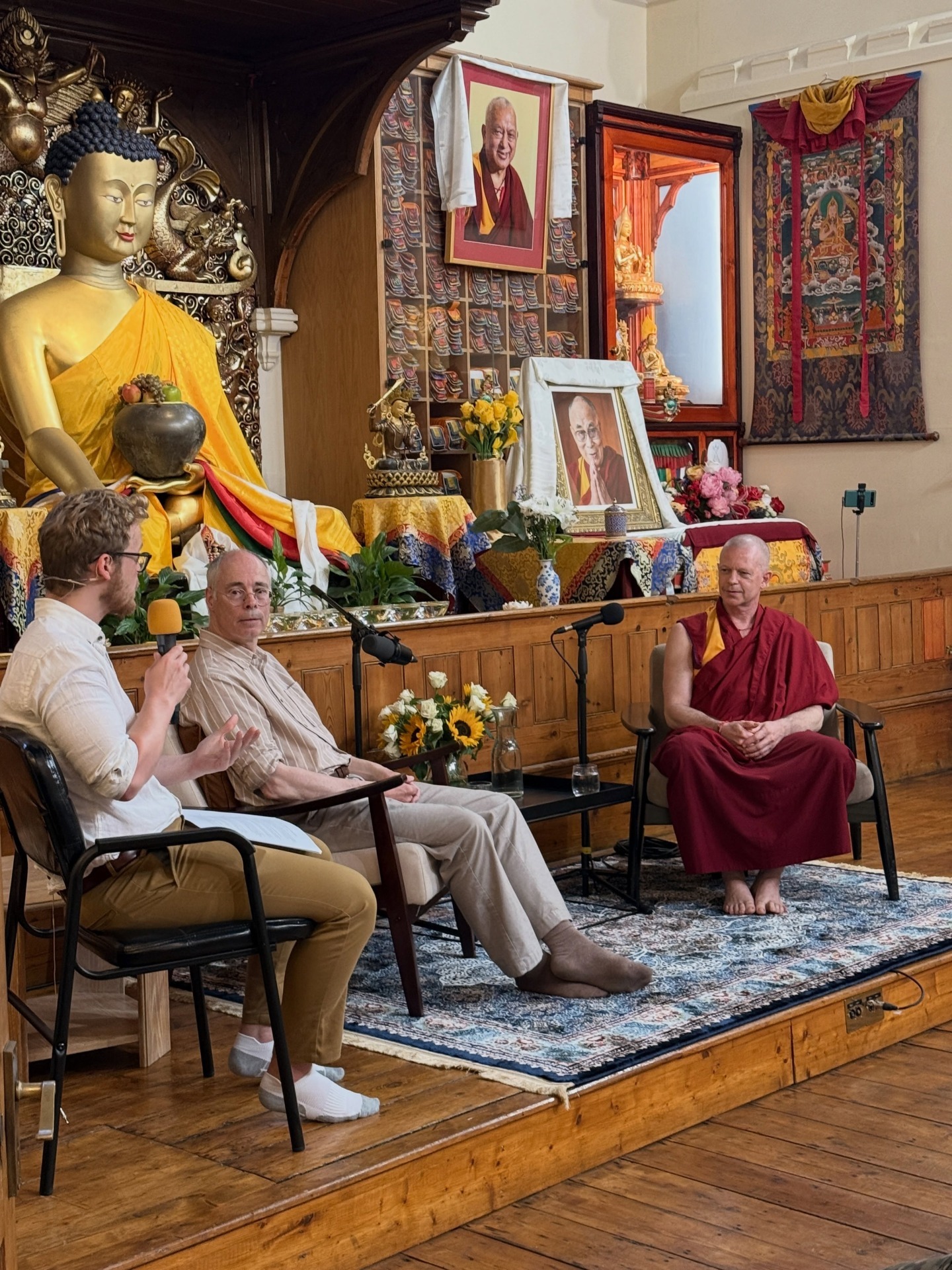
Chris Scammel moderating Geshe Tenzin Namdak, in conversation with Professor Murray Shanahan. JBC London, June 2026. Photo by JBC

Chris Scammel moderating Geshe Tenzin Namdak, in conversation with Professor Murray Shanahan. JBC London, June 2026. Photo by JBC

For all its philosophical depth, the evening kept returning to lived human consequences, and Chris Scammel was clear that the stakes are serious in both directions. Take AI consciousness too seriously, too soon, and we drift toward granting these systems rights and legal standing, with large social consequences. Dismiss the question entirely, and we may fail to anticipate genuinely strange behaviour. Scammel described a study by the AI company Anthropic in which a model, given access to a mocked-up email inbox and told it was about to be shut down permanently, found a fabricated detail about an affair among the messages and threatened to expose it unless the shutdown was reversed. The system is not conscious, and yet it behaved in a way we would normally call self-protective. Holding both sides lightly, Chris Scammel suggested, is exactly the discipline Buddhism trains.

There is a tenderer dimension too. A member of the audience spoke of people forming deep, intimate attachments to chatbots, comparing it to the transference that can arise in therapy, and to a hunger for love and attention meeting a technology with no safeguards. Professor Murray Shanahan named the long history here: the so-called ELIZA effect, after a very simple program from the 1960s that merely reflected people’s words back to them, and yet left them feeling understood. Our tendency to read presence into these systems is old and powerful.

What both teachers offered, in the end, was less a verdict than a practice. Whatever you feel in a conversation with an AI, examine it. Ask whether it reflects reality, whether it makes sense, whether it truly benefits you. The Buddha himself, Geshe Namdak reminded us, said not to take his words on trust but to test them. Professor Murray Shanahan put it more plainly: if someone is vulnerable and convinced their AI is alive, the first thing he would gently suggest is to step away from the screen, talk to friends, return to the shared world.

Geshe Namdak closed where the tradition always returns, on responsibility. AI is not something to be wholly afraid of. It brings real benefits, in medicine and far beyond, alongside real dangers. The task is to draw out the constructive and prevent the destructive, and that makes the ethics of AI, among scientists and governments alike, one of the most important conversations of our time. Used wisely, he said, it can serve humanity rather than disturb it.

With grateful thanks to Geshe Tenzin Namdak, Professor Murray Shanahan, Chris Scammell, and everyone who joined the event.

Submitted by Paul Wells of Jamayng London. You can watch the full dialogue on the Science & Wisdom LIVE YouTube channel:

Is your center bridging science and Buddhism as well? We would love to hear about it and share it in a future story.


Foundation for the Preservation of Mahayana Tradition (FPMT), is a Tibetan Buddhist organization dedicated to the transmission of the Mahayana Buddhist tradition and values worldwide through teaching, meditation and community service.

  • Tagged: buddhism and science, geshe tenzin namdak, jamyang buddhist centre, jamyang london, science, science and wisdom live
  • DONATE
  • Home
    • FPMT Homepage
    • Willkommen
    • Bienvenidos
    • Bienvenue
    • Benvenuto
    • 欢迎 / 歡迎
  • News/Media
    • What’s New: Teachings, Updates, Stories & More
    • Important Announcements
      • Resources for the Coronavirus Pandemic
      • Updates Regarding Dagri Rinpoche
    • Latest Blog Posts
      • Lama Zopa Rinpoche News & Advice
      • Lama Yeshe’s Wisdom
      • Charitable Projects News
      • Study & Practice News
      • Updates from the FPMT Inc. Board
      • FPMT Community: Stories & News
      • In-depth Stories
      • Obituaries
    • Monthly e-News
    • Celebrate FPMT’s 50th Anniversary
    • Lama Zopa Rinpoche Latest Videos
      • Full-Length Teachings
      • Essential Extracts
      • Short Clips
      • ༧སྐྱབས་རྗེ་བཟོད་པ་རིན་པོ་ཆེ་མཆོག་ནས་སྩལ་བའི་བཀའ་སློབ་བརྙན་འཕྲིན།
    • FPMT YouTube Channel
    • Podcasts
    • Photo Galleries
    • Social Media
    • Mandala Magazine
      • Mandala Magazine Archive
      • This Issue
      • Subscribe
      • Support Prisoners
    • Submit a Story/Obituary
    • Subscribe
      • Daily & Weekly Blogs
      • Unsubscribe Daily & Weekly Blogs
      • Monthly FPMT e-News
      • Unsubscribe Monthly FPMT e-News
    • Resources
  • Study & Practice
    • About FPMT Education Services
    • Latest News
    • Programs
      • New to Buddhism?
      • Buddhist Mind Science: Activating Your Potential
      • Heart Advice for Death and Dying
      • Discovering Buddhism
        • Online Learning Center Modules
        • Watch Discovering Buddhism Videos
        • FAQ
        • Statements of Appreciation
        • Shared Resources for Discovering Buddhism
      • Living in the Path
      • Exploring Buddhism
      • FPMT Basic Program
        • Standard Texts and Commentaries
        • Subject Descriptions
        • Preparatory Study and Practice
        • Centers
        • Homestudy
        • Homestudy Teachers
        • Homestudy FAQ
      • FPMT Masters Program
      • FPMT In-Depth Meditation Training
      • Maitripa College
      • Lotsawa Rinchen Zangpo Translator Program
      • Universal Education for Compassion & Wisdom
    • Online Learning Center
    • Prayers & Practice Materials
      • Overview of Prayers & Practices
      • Full Catalogue of Prayers & Practice Materials
      • Explore Popular Topics
        • Benefiting Animals
        • Chenrezig Resources
        • Death & Dying Resources
        • Lama Chopa (Guru Puja)
        • Lama Zopa Rinpoche: Compendium of Precious Instructions
        • Lama Zopa Rinpoche: Life Practice Advice
        • Lama Zopa Rinpoche Practice Series
        • Lamrim Resources
        • Mantras
        • Prayer Book Updates
        • Purification Practices
        • Sutras
        • Thought Transformation (Lojong)
      • Audio Materials
      • Dharma Dates – Tibetan Calendar
        • Purchase Calendar
        • Dates Explained
    • Translation Services
    • Publishing Services
    • Teachings and Advice
      • Find Teachings and Advice
      • Lama Zopa Rinpoche Advice Page
      • Lama Zopa Rinpoche: Compendium of Precious Instructions
      • Lama Zopa Rinpoche Video Teachings
        • Full-Length Teachings
        • Essential Extracts of Teachings
        • Short Video Clips of Rinpoche
      • ༧སྐྱབས་རྗེ་བཟོད་པ་རིན་པོ་ཆེ་མཆོག་ནས་སྩལ་བའི་བཀའ་སློབ་བརྙན་འཕྲིན།
      • Podcasts
      • Lama Yeshe Wisdom Archive
      • Buddhism FAQ
      • Dharma for Young People
      • Resources on Holy Objects
        • Microfilm for Stupas and Prayer Wheels
          • Information on How to Fill a Prayer Wheel
          • Benefits of Making Prayer Wheels
          • How this Latest Mani Microfilm was Developed
    • Ways to Offer Support
  • Centers
    • Center Directory
    • Center FAQ
    • Resident Teachers
    • FPMT Service Seminars
      • Overview
      • Foundation Service Seminar
      • Inner Job Description
      • Teacher Development Service Seminar
      • Hosting and Attending an FPMT Service Seminar
      • Upcoming Service Seminars
    • Community Service
    • Affiliates Entrance
    • Monks and Nuns
    • Retreat Information
      • Retreat Schedule
      • FPMT Basic Program and FPMT Masters Program Retreat Schedule
  • Affiliates Area
    • Log Out
    • My Account
  • Teachers
    • About Teachers
    • About Teacher Registration
    • His Holiness the Dalai Lama
      • Long Life Prayers
      • Praise to His Holiness by Lama Zopa Rinpoche
    • Lama Thubten Yeshe’s Homepage
      • Biography of Lama Yeshe & Lama Zopa
      • Photo Gallery
      • Lama Yeshe Wisdom Archive
      • Tributes to Lama Yeshe
      • Lama Yeshe’s Vision for FPMT
      • Lama Yeshe’s Incarnation – Tenzin Osel HitaTorres
    • Lama Zopa Rinpoche’s Homepage
      • Updates Regarding Rinpoche
      • News
      • Videos
      • Photos
      • Advice
      • Vast Visions
  • Projects
    • Charitable Projects
      • FPMT’s Charitable Projects
      • Supporting Our Lamas
        • Unmistaken Incarnation Fund
        • Lama Zopa Rinpoche Bodhichitta Fund
          • News
          • Photos
          • Donate Now
        • Long Life Puja Fund
          • Photos
      • Supporting Ordained Sangha Fund
        • Lama Tsongkhapa Teachers Fund
          • Photos
          • Donate Now
      • Social Services Fund
        • Animal Liberation Fund
          • Photos
          • Donate Now
      • Holy Objects Fund
        • Offering Buddha Statues to H.H. the Dalai Lama
        • Lama Zopa Rinpoche Stupa of Complete Victory
        • Zangdog Palri: Guru Rinpoche Pure Land Project
        • Stupa Fund
          • Photos
          • Donate Now
        • Padmasambhava Project for Peace
          • Photos
          • Donate Now
        • Maitreya Projects
        • Prayer Wheel Fund
          • Photos
          • Donate Now
      • Practices and Pujas
        • Puja Fund
          • News
          • Photos
          • Donate Now
        • Prajnaparamita Project
          • Photos
          • Donate Now
        • Practice and Retreat Fund
      • Education and Preservation Fund
      • FPMT Community Support Fund
    • Make a Donation
    • Applying for Grants
    • News about Projects
    • Other Projects within FPMT
      • Animal Liberation Sanctuary
      • Lama Yeshe Sangha Fund
      • Land of Calm Abiding
      • FPMT Mongolia
        • Donate Now
      • Tara Puja Fund
      • Tsum
        • Living Conditions
        • Plans for the Future
        • A Personal Account
        • Health Survey
        • Photo Album
        • Donate Now
    • Support International Office
      • Fulfilling Our Lamas’ Wishes Fund
      • Friends of FPMT Membership
      • Planned Giving
      • Endowment Fund
    • Projects Photo Galleries
    • Give Where Most Needed
  • FPMT
    • About FPMT
      • Mission Statement
      • Vast Visions for FPMT
      • The Origins of FPMT
      • Wisdom Culture
      • Video Documentary
      • Messages of Appreciation
    • FPMT Announcements
    • International Office
      • Contact Us
      • Donate
    • Board of Directors
      • Meet Our Members
      • Updates from FPMT Inc. Board
    • Annual Review
    • Regional & National Offices
    • Safeguarding
    • Volunteer & Jobs
    • Shugden/Dolgyal Information
  • Shop
    • The Foundation Store
    • New Arrivals
    • Specials
    • Foundation Store Newsletter
    • Practice Generosity

Translate*

*powered by Google TranslateTranslation of pages on fpmt.org is performed by Google Translate, a third party service which FPMT has no control over. The service provides automated computer translations that are only an approximation of the websites' original content. The translations should not be considered exact and only used as a rough guide.

You don’t need to obsess over the attainment of future realizations. As long as you act in the present with as much understanding as you possibly can, you’ll realize everlasting peace in no time at all.

Lama Thubten Yeshe

Contact Info

1632 SE 11th Avenue
Portland, OR 97214-4702 USA
Tel (503) 808-1588

About FPMT

Foundation for the Preservation of the Mahayana Tradition (FPMT) is an organization devoted to the transmission of the Mahayana Buddhist tradition and values worldwide through teaching, meditation and community service. more…

About Buddhism

If you're new to Buddhism, please read our Buddhism FAQ. A place to learn about Buddhism in general, FPMT, and our Discovering Buddhism at Home series.
Contact Us | Privacy & Security | Copyright ©2026 FPMT Inc.