Foundation for the Preservation of the Mahayana Tradition
The FPMT is an organization devoted to preserving and spreading Mahayana Buddhism worldwide by creating opportunities to listen, reflect, meditate, practice and actualize the unmistaken teachings of the Buddha and based on that experience spreading the Dharma to sentient beings. We provide integrated education through which people’s minds and hearts can be transformed into their highest potential for the benefit of others, inspired by an attitude of universal responsibility and service. We are committed to creating harmonious environments and helping all beings develop their full potential of infinite wisdom and compassion. Our organization is based on the Buddhist tradition of Lama Tsongkhapa of Tibet as taught to us by our founders Lama Thubten Yeshe and Lama Thubten Zopa Rinpoche.
Die Stiftung zur Erhaltung der Mahayana Tradition (FPMT) ist eine Organisation, die sich weltweit für die Erhaltung und Verbreitung des Mahayana-Buddhismus einsetzt, indem sie Möglichkeiten schafft, den makellosen Lehren des Buddha zuzuhören, über sie zur reflektieren und zu meditieren und auf der Grundlage dieser Erfahrung das Dharma unter den Lebewesen zu verbreiten.
Wir bieten integrierte Schulungswege an, durch denen der Geist und das Herz der Menschen in ihr höchstes Potential verwandelt werden zum Wohl der anderen – inspiriert durch eine Haltung der universellen Verantwortung und dem Wunsch zu dienen. Wir haben uns verpflichtet, harmonische Umgebungen zu schaffen und allen Wesen zu helfen, ihr volles Potenzial unendlicher Weisheit und grenzenlosen Mitgefühls zu verwirklichen.
Unsere Organisation basiert auf der buddhistischen Tradition von Lama Tsongkhapa von Tibet, so wie sie uns von unseren Gründern Lama Thubten Yeshe und Lama Thubten Zopa Rinpoche gelehrt wird.
La Fundación para la preservación de la tradición Mahayana (FPMT) es una organización que se dedica a preservar y difundir el budismo Mahayana en todo el mundo, creando oportunidades para escuchar, reflexionar, meditar, practicar y actualizar las enseñanzas inconfundibles de Buda y en base a esa experiencia difundir el Dharma a los seres.
Proporcionamos una educación integrada a través de la cual las mentes y los corazones de las personas se pueden transformar en su mayor potencial para el beneficio de los demás, inspirados por una actitud de responsabilidad y servicio universales. Estamos comprometidos a crear ambientes armoniosos y ayudar a todos los seres a desarrollar todo su potencial de infinita sabiduría y compasión.
Nuestra organización se basa en la tradición budista de Lama Tsongkhapa del Tíbet como nos lo enseñaron nuestros fundadores Lama Thubten Yeshe y Lama Zopa Rinpoche.
A continuación puede ver una lista de los centros y sus páginas web en su lengua preferida.
L’organisation de la FPMT a pour vocation la préservation et la diffusion du bouddhisme du mahayana dans le monde entier. Elle offre l’opportunité d’écouter, de réfléchir, de méditer, de pratiquer et de réaliser les enseignements excellents du Bouddha, pour ensuite transmettre le Dharma à tous les êtres. Nous proposons une formation intégrée grâce à laquelle le cœur et l’esprit de chacun peuvent accomplir leur potentiel le plus élevé pour le bien d’autrui, inspirés par le sens du service et une responsabilité universelle. Nous nous engageons à créer un environnement harmonieux et à aider tous les êtres à épanouir leur potentiel illimité de compassion et de sagesse. Notre organisation s’appuie sur la tradition guéloukpa de Lama Tsongkhapa du Tibet, telle qu’elle a été enseignée par nos fondateurs Lama Thoubtèn Yéshé et Lama Zopa Rinpoché.
L’FPMT è un organizzazione il cui scopo è preservare e diffondere il Buddhismo Mahayana nel mondo, creando occasioni di ascolto, riflessione, meditazione e pratica dei perfetti insegnamenti del Buddha, al fine di attualizzare e diffondere il Dharma fra tutti gli esseri senzienti.
Offriamo un’educazione integrata, che può trasformare la mente e i cuori delle persone nel loro massimo potenziale, per il beneficio di tutti gli esseri, ispirati da un’attitudine di responsabilità universale e di servizio.
Il nostro obiettivo è quello di creare contesti armoniosi e aiutare tutti gli esseri a sviluppare in modo completo le proprie potenzialità di infinita saggezza e compassione.
La nostra organizzazione si basa sulla tradizione buddhista di Lama Tsongkhapa del Tibet, così come ci è stata insegnata dai nostri fondatori Lama Thubten Yeshe e Lama Zopa Rinpoche.
Di seguito potete trovare un elenco dei centri e dei loro siti nella lingua da voi prescelta.
“护持大乘法脉基金会”( 英文简称:FPMT。全名:Foundation for the Preservation of the Mahayana Tradition) 是一个致力于护持和弘扬大乘佛法的国际佛教组织。我们提供听闻,思维,禅修,修行和实证佛陀无误教法的机会,以便让一切众生都能够享受佛法的指引和滋润。
護持大乘法脈基金會”( 英文簡稱:FPMT。全名:Foundation for the Preservation of the Mahayana Tradition )是一個致力於護持和弘揚大乘佛法的國際佛教組織。我們提供聽聞,思維,禪修,修行和實證佛陀無誤教法的機會,以便讓一切眾生都能夠享受佛法的指引和滋潤。
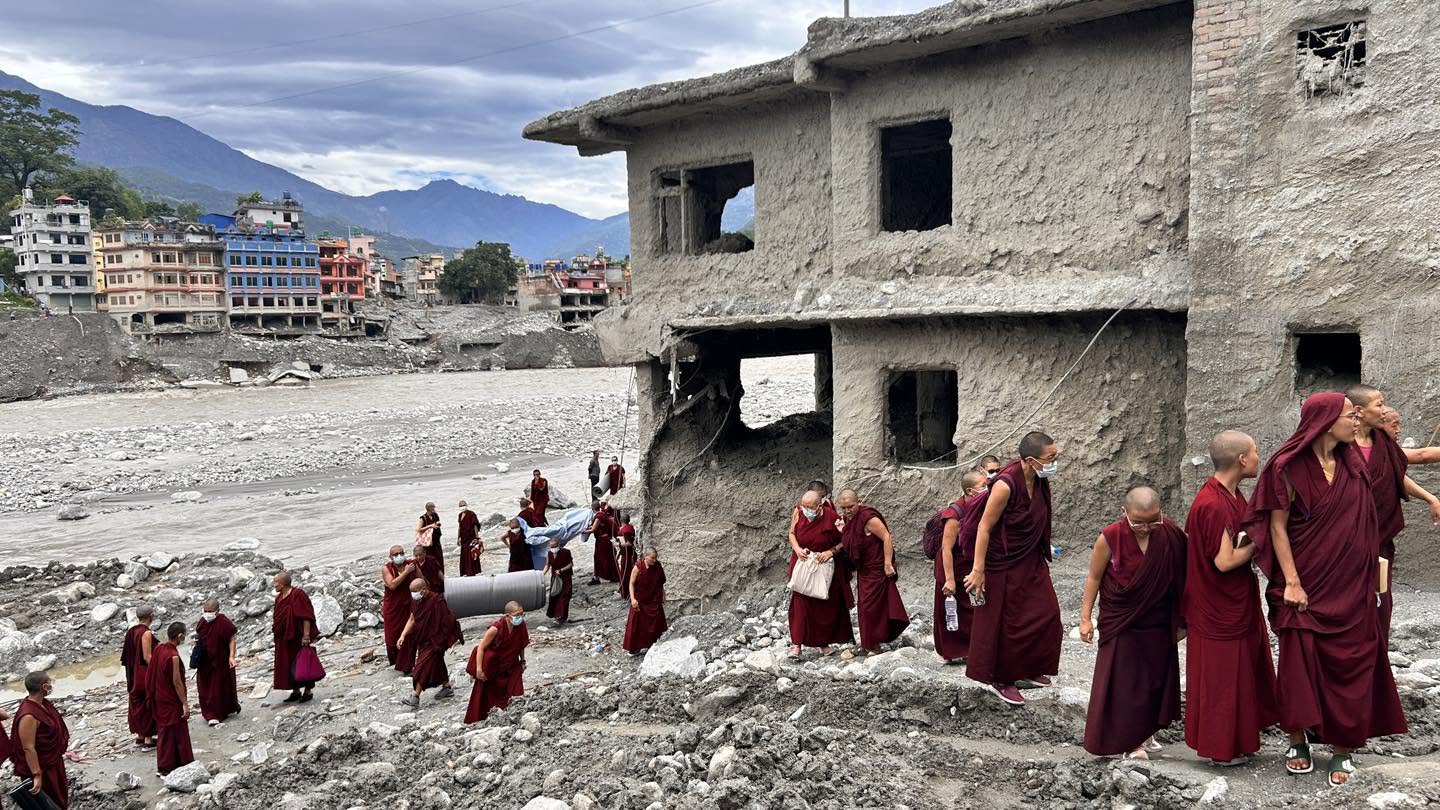
More than a month has passed since the devastating floods of August 26 in the Rasuwa-Bhotekoshi area, and the focus of humanitarian efforts has gradually shifted from search and rescue operations to relief, recovery, and helping families rebuild their lives. … Read more »
*If a menu item has a submenu clicking once will expand the menu clicking twice will open the page.
We are not compelled to meditate by some outside agent, by other people, or by God. Rather, just as we are responsible for our own suffering, so are we solely responsible for our own cure. We have created the situation in which we find ourselves, and it is up to us to create the circumstances for our release. Therefore, as suffering permeates our life, we have to do something in addition to our regular daily routine. This “something” is spiritual practice or, in other words, meditation.
The Foundation Store is FPMT’s online shop and features a vast selection of Buddhist study and practice materials written or recommended by our lineage gurus. These items include homestudy programs, prayers and practices in PDF or eBook format, materials for children, and other resources to support practitioners.
Items displayed in the shop are made available for Dharma practice and educational purposes, and never for the purpose of profiting from their sale. Please read FPMT Foundation Store Policy Regarding Dharma Items for more information.
His Eminence Jhado Rinpoche and the pilgrims in Anuradhapura Sri Maha Bodhi tree .
For many FPMT students, His Eminence Jhado Rinpoche needs little introduction. A former abbot of Namgyal Monastery — His Holiness the Dalai Lama’s own monastery in Dharamsala — and one of the most highly regarded lamas of the Gelug lineage, Rinpoche has for decades been treasured by Sanghas around the world for the clarity of his teaching and the warmth of his presence.
From July 18-25 2026, Rinpoche led a group of students from Mongolia, Singapore, Australia, and beyond on a pilgrimage to Sri Lanka — a country not usually associated with Mahayana Buddhist activity, but one whose place in the history of the Dharma runs far deeper than most of us realize. Over nine days, the pilgrimage brought Theravada and Mahayana practitioners together in ways not seen on the island for centuries. This is an account of that journey, told partly in the words of Venerable Tenzin Lekdron and partly in the words of fellow pilgrims and the Sri Lankan people who welcomed them.
Venerable Tenzin Lekdron met His Eminence Jhado Rinpoche briefly in Bendigo, Australia. Not long after, she was asked if she would be available to accompany Rinpoche and his Mongolian and Singaporean students on a pilgrimage to Sri Lanka — an invitation she was delighted to accept.
“I could see two great opportunities in this journey,” she recalled. “The first was to meet with the head of all Theravada Buddhist lineages in Sri Lanka, the Malwatte Mahanayaka Thero, and to further that relationship. The second was to offer the Sri Lankan people a rare and extraordinary chance to receive the Avalokiteshvara empowerment — a ceremony that had not been given on the island since the twelfth century.” Here we share the story of this pilgrimage from Ven. Lekdron:
His Eminence Jhado Rinpoche fulfilled both wishes, and many others, meeting every situation with extraordinary kindness and wisdom in a country as volatile as it is unpredictable. The Malwatte Mahanayaka Thero shared that he had visited Lhasa ten years earlier and, through what he saw there, had developed great admiration for Tibetan practitioners — for their courage and their commitment to the Dharma. “We cannot imagine organizing so many monks in a single monastery, thousands, what it takes to feed and educate them. I admire them very much,” he said. When His Eminence Jhado Rinpoche asked if he had any advice, the Mahanayaka Thero replied: “Unity is the most important thing among us. No matter what path we follow, we must be united.”
Most Venerable Thibbatuwawe Sri Siddhartha Sumangala Thera. The Malwatte Mahanayaka Thero, the chief prelate of the Malwatta Chapter of the Siam Nikaya in Sri Lanka.
His Eminence Jhado Rinpoche also shed light on just how special Sri Lanka has been in the history of Buddhism, explaining that the Buddha is said to have visited the island more than three times, with references to this found in the Kangyur and Tengyur. Sri Pada, one of the island’s most sacred mountains, is said to be a place where many teachers taught Sutra and Tantra — a rare glimpse into a past most of us can barely imagine.
Stephanie McGrane, a pilgrim from Atisha Centre in Bendigo, shared:
“On 18 July 2026, the day of Chökhor Düchen, His Eminence Jhado Rinpoche offered the oral transmission of Chapters 4 and 5 of The Sutra of Sublime Golden Light (31-chapter version) in Sri Lanka, in the peaceful garden setting of the Walpola Rahula Buddhist Institute. The Institute is renowned for welcoming people of all faiths to participate in its meditation programs, making it a particularly meaningful setting for this auspicious occasion. Approximately 80 people attended in person, while a further 750 joined online. It was truly an international gathering, with Sri Lankan nationals sitting alongside members of Jhado Rinpoche’s pilgrimage group from Mongolia, Malaysia, Ukraine, Singapore, Australia, New Zealand, Switzerland, and many other countries.”
Welcoming His Eminence Jhado Rinpoche.
Perhaps the most remarkable aspect of the event was that it had been confirmed only a week beforehand. Despite this short notice, the FPMT family spread the word with remarkable speed, enabling 750 people around the world to join the precious transmission online — a response that reflects the deep yearning people have to connect with authentic Dharma masters such as His Eminence Jhado Rinpoche, and to take part in activities that contribute to peace and harmony throughout the world, the very benefits traditionally associated with sutras such as The Sutra of Sublime Golden Light. Venerable Dhammananda, the Institute’s current resident teacher, called it an auspicious event, noting that its founder, Walpola Rahula Thero, was among the earliest monks to work for Buddhist unity. It was, she said, a fitting way to mark Chökhor Düchen before the group set out on pilgrimage to the island’s holy sites.
The Empowerment of 1000-Armed Chenrezig, Anuradhapura
His Eminence Jhado Rinpoche during the Empowerment of 1000-Armed Chenrezig, Anuradhapura
Hirushan, facilitator and translator for the Tara Lanka study group, offers the following account:
His Eminence Jhado Rinpoche bestowed the empowerment of 1000-Armed Chenrezig (Avalokiteshvara) at the historic Abhayagiri Stupa Monastery in Anuradhapura, Sri Lanka, on the twentieth day of the sacred Esala month, according to the Pali lunar calendar.
The ceremony brought together 120 people, including 53 pilgrims — Rinpoche’s students from Mongolia and devotees from Australia, Singapore, France, and Sri Lanka. Significantly, around 25 Sri Lankan Theravada monks also took part, together with local Sri Lankan devotees, with the coordination of Venerable Pepiliyawala Narada Thero, coordinator of the Pali and Sanskrit Exchange.”
His Eminence Jhado Rinpoche during the Empowerment of 1000-Armed Chenrezig, Anuradhapura
Sri Lanka has a profound and ancient connection with the Bodhisattva Avalokiteshvara. The Karandavyuha Sutra preserves two remarkable stories linking Avalokiteshvara with the island of Simhala, an ancient name for Sri Lanka, the Land of the Sinhalese. In one account, Avalokiteshvara manifests as a divine horse and helps the Bodhisattva Gautama Shakyamuni escape the Rakshasis who held him captive on the island. In another, Avalokiteshvara appears as a handsome prince, subdues the Rakshasis, and teaches them the Dharma.
Abhayagiri and the Bodhisattva Tradition
The Abhayagiri monastery holds significant archaeological evidence connecting it to the Mahayana and Bodhisattva tradition. A marble statue discovered at the summit of the stupa’s sanctum depicts Amitabha Buddha flanked by the Bodhisattvas Avalokiteshvara and Mahasthamaprapta, and a bronze statue of Avalokiteshvara has also been found at the site. Another notable structure, identified as an Abhisheka Mandapa, is thought by scholars to have been used for the ritual ablution (abhisheka) of Buddha and Bodhisattva statues — and possibly for ritual initiations or tantric empowerments.
Tales of Three Nuns
The story of this empowerment can also be traced through the lives of three remarkable Buddhist nuns whose histories, in different ways, connect Sri Lanka, the Buddhist monastic tradition, and Avalokiteshvara.
First, Arahant Sanghamitta Mahatheri, sister of Arahant Mahinda Thera — who formally introduced Buddhism to Sri Lanka in the third century BCE. Arahant Sanghamitta later travelled to Sri Lanka carrying the sacred sapling of the Sri Mahabodhi, still venerated today in the holy city of Anuradhapura. She established the bhikkhuni ordination lineage in Sri Lanka, which later spread as far as China at its height before eventually disappearing in later centuries.
Second, Bhikshuni Lakshmi, associated with the lineage of the 1000-Armed Avalokiteshvara practice and, through it, with the tradition of Nyung Nä retreat. According to the traditional account, she was born in Oddiyana and abandoned by her family after contracting leprosy. With profound faith in the Compassionate One, she undertook twelve years of intense Chenrezig practice, sustaining herself on one meal every two days, until she encountered Avalokiteshvara directly and attained enlightenment.
Third, Venerable Tenzin Lekdron, a Sri Lankan-born Australian nun, who requested that His Eminence Jhado Rinpoche bestow this sacred empowerment in Sri Lanka. She played a leading role in organizing the ceremony, with the support of the Tara Lanka Study Group.
A Tradition That Never Completely Disappeared
Although the Mahayana tradition institutionally declined and largely disappeared from Sri Lanka after the twelfth century, veneration of the Bodhisattvas — particularly Avalokiteshvara and Tara — continued for centuries, gradually becoming woven into mainstream Theravada culture. Avalokiteshvara survived on the island in a particularly distinctive form: the deity known today as God Natha, one of Sri Lanka’s most important Buddhist deities, is widely understood by scholars to be connected with Avalokiteshvara, although he is popularly identified with Maitreya.
Seen this way, the empowerment of 1000-Armed Chenrezig at Abhayagiri is more than an isolated, contemporary Buddhist ceremony. It marks a meaningful moment in the revival and reconnection of Sri Lanka with a strand of its own ancient Buddhist heritage — one in which Theravada, Mahayana, the Bodhisattva ideal, and the long veneration of Avalokiteshvara have intersected throughout the island’s history.
A young Sri Lankan student named Sahan summed up the day best:
“When I heard the Avalokiteshvara abhisheka was being given in Sri Lanka by a prominent Tibetan Rinpoche, I dropped everything and made my way to Anuradhapura. I am familiar with Avalokiteshvara practice and the mantra, as I join Tara Lanka events. What I saw in the Abhayagiriya hall was beyond anything I could have imagined — Theravada and Mahayana monks sitting side by side, a Tibetan lama offering empowerment with rituals unfamiliar to us, and all of us participating as though it were the most ordinary thing. I can say this was a miracle. I know Sri Lanka, and I know that for such an event to happen, and come to completion without incident, was a miracle. Please keep coming back, offering us opportunities to follow the Bodhisattva path. I am so very grateful to all of you. It’s not easy for us to travel, so please come to us.”
With special thanks to Venerable Tenzin Lekdron for sharing this story, to Amitabha Buddhist FPMT Centre in Singapore for sponsoring the Avalokiteshvara thangka used in the empowerment, to all the pilgrims for their offerings at the holy places visited, and to the Tara Lanka study group members for their hard work.
Jhado Rinpoche is currently on tour in Europe. Please see the full schedule to take advantage of the opportunities available.
Foundation for the Preservation of Mahayana Tradition (FPMT), is a Tibetan Buddhist organization dedicated to the transmission of the Mahayana Buddhist tradition and values worldwide through teaching, meditation and community service.
Basically, the human mind is mostly unconscious, ignorant, and gets so preoccupied with new experiences, that it forgets the old ones. Review the past month: exactly what happened, precisely what feelings did you have, every day? You can’t remember, can you? But if you practice this slowly, slowly, continuously checking within your mind, eventually, you’ll be able to remember more and more of your previous experiences.

 receive our newsletters
 join Friends of FPMT