- Home
- FPMT Homepage
Foundation for the Preservation of the Mahayana Tradition
The FPMT is an organization devoted to preserving and spreading Mahayana Buddhism worldwide by creating opportunities to listen, reflect, meditate, practice and actualize the unmistaken teachings of the Buddha and based on that experience spreading the Dharma to sentient beings. We provide integrated education through which people’s minds and hearts can be transformed into their highest potential for the benefit of others, inspired by an attitude of universal responsibility and service. We are committed to creating harmonious environments and helping all beings develop their full potential of infinite wisdom and compassion. Our organization is based on the Buddhist tradition of Lama Tsongkhapa of Tibet as taught to us by our founders Lama Thubten Yeshe and Lama Thubten Zopa Rinpoche.
- Willkommen
Die Stiftung zur Erhaltung der Mahayana Tradition (FPMT) ist eine Organisation, die sich weltweit für die Erhaltung und Verbreitung des Mahayana-Buddhismus einsetzt, indem sie Möglichkeiten schafft, den makellosen Lehren des Buddha zuzuhören, über sie zur reflektieren und zu meditieren und auf der Grundlage dieser Erfahrung das Dharma unter den Lebewesen zu verbreiten.
Wir bieten integrierte Schulungswege an, durch denen der Geist und das Herz der Menschen in ihr höchstes Potential verwandelt werden zum Wohl der anderen – inspiriert durch eine Haltung der universellen Verantwortung und dem Wunsch zu dienen. Wir haben uns verpflichtet, harmonische Umgebungen zu schaffen und allen Wesen zu helfen, ihr volles Potenzial unendlicher Weisheit und grenzenlosen Mitgefühls zu verwirklichen.
Unsere Organisation basiert auf der buddhistischen Tradition von Lama Tsongkhapa von Tibet, so wie sie uns von unseren Gründern Lama Thubten Yeshe und Lama Thubten Zopa Rinpoche gelehrt wird.
- Bienvenidos
La Fundación para la preservación de la tradición Mahayana (FPMT) es una organización que se dedica a preservar y difundir el budismo Mahayana en todo el mundo, creando oportunidades para escuchar, reflexionar, meditar, practicar y actualizar las enseñanzas inconfundibles de Buda y en base a esa experiencia difundir el Dharma a los seres.
Proporcionamos una educación integrada a través de la cual las mentes y los corazones de las personas se pueden transformar en su mayor potencial para el beneficio de los demás, inspirados por una actitud de responsabilidad y servicio universales. Estamos comprometidos a crear ambientes armoniosos y ayudar a todos los seres a desarrollar todo su potencial de infinita sabiduría y compasión.
Nuestra organización se basa en la tradición budista de Lama Tsongkhapa del Tíbet como nos lo enseñaron nuestros fundadores Lama Thubten Yeshe y Lama Zopa Rinpoche.
A continuación puede ver una lista de los centros y sus páginas web en su lengua preferida.
- Bienvenue
L’organisation de la FPMT a pour vocation la préservation et la diffusion du bouddhisme du mahayana dans le monde entier. Elle offre l’opportunité d’écouter, de réfléchir, de méditer, de pratiquer et de réaliser les enseignements excellents du Bouddha, pour ensuite transmettre le Dharma à tous les êtres. Nous proposons une formation intégrée grâce à laquelle le cœur et l’esprit de chacun peuvent accomplir leur potentiel le plus élevé pour le bien d’autrui, inspirés par le sens du service et une responsabilité universelle. Nous nous engageons à créer un environnement harmonieux et à aider tous les êtres à épanouir leur potentiel illimité de compassion et de sagesse. Notre organisation s’appuie sur la tradition guéloukpa de Lama Tsongkhapa du Tibet, telle qu’elle a été enseignée par nos fondateurs Lama Thoubtèn Yéshé et Lama Zopa Rinpoché.
Visitez le site de notre Editions Mahayana pour les traductions, conseils et nouvelles du Bureau international en français.
Voici une liste de centres et de leurs sites dans votre langue préférée
- Benvenuto
L’FPMT è un organizzazione il cui scopo è preservare e diffondere il Buddhismo Mahayana nel mondo, creando occasioni di ascolto, riflessione, meditazione e pratica dei perfetti insegnamenti del Buddha, al fine di attualizzare e diffondere il Dharma fra tutti gli esseri senzienti.
Offriamo un’educazione integrata, che può trasformare la mente e i cuori delle persone nel loro massimo potenziale, per il beneficio di tutti gli esseri, ispirati da un’attitudine di responsabilità universale e di servizio.
Il nostro obiettivo è quello di creare contesti armoniosi e aiutare tutti gli esseri a sviluppare in modo completo le proprie potenzialità di infinita saggezza e compassione.
La nostra organizzazione si basa sulla tradizione buddhista di Lama Tsongkhapa del Tibet, così come ci è stata insegnata dai nostri fondatori Lama Thubten Yeshe e Lama Zopa Rinpoche.
Di seguito potete trovare un elenco dei centri e dei loro siti nella lingua da voi prescelta.
- 欢迎 / 歡迎
简体中文
“护持大乘法脉基金会”( 英文简称:FPMT。全名:Foundation for the Preservation of the Mahayana Tradition) 是一个致力于护持和弘扬大乘佛法的国际佛教组织。我们提供听闻,思维,禅修,修行和实证佛陀无误教法的机会,以便让一切众生都能够享受佛法的指引和滋润。
我们全力创造和谐融洽的环境, 为人们提供解行并重的完整佛法教育,以便启发内在的环宇悲心及责任心,并开发内心所蕴藏的巨大潜能 — 无限的智慧与悲心 — 以便利益和服务一切有情。
FPMT的创办人是图腾耶喜喇嘛和喇嘛梭巴仁波切。我们所修习的是由两位上师所教导的,西藏喀巴大师的佛法传承。
繁體中文
護持大乘法脈基金會”( 英文簡稱:FPMT。全名:Found
ation for the Preservation of the Mahayana Tradition ) 是一個致力於護持和弘揚大乘佛法的國際佛教組織。我們提供聽聞, 思維,禪修,修行和實證佛陀無誤教法的機會,以便讓一切眾生都能 夠享受佛法的指引和滋潤。 我們全力創造和諧融洽的環境,
為人們提供解行並重的完整佛法教育,以便啟發內在的環宇悲心及責 任心,並開發內心所蘊藏的巨大潛能 — 無限的智慧與悲心 – – 以便利益和服務一切有情。 FPMT的創辦人是圖騰耶喜喇嘛和喇嘛梭巴仁波切。
我們所修習的是由兩位上師所教導的,西藏喀巴大師的佛法傳承。 察看道场信息:
- FPMT Homepage
- News/Media
-
- Study & Practice
-
-
- About FPMT Education Services
- Latest News
- Programs
- New to Buddhism?
- Buddhist Mind Science: Activating Your Potential
- Heart Advice for Death and Dying
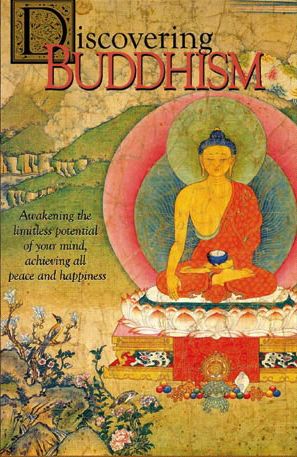
- Discovering Buddhism
- Living in the Path
- Exploring Buddhism
- FPMT Basic Program
- FPMT Masters Program
- FPMT In-Depth Meditation Training
- Maitripa College
- Lotsawa Rinchen Zangpo Translator Program
- Universal Education for Compassion & Wisdom
- Online Learning Center
-
- Prayers & Practice Materials
- Overview of Prayers & Practices
- Full Catalogue of Prayers & Practice Materials
- Explore Popular Topics
- Benefiting Animals
- Chenrezig Resources
- Death & Dying Resources
- Lama Chopa (Guru Puja)
- Lama Zopa Rinpoche: Compendium of Precious Instructions
- Lama Zopa Rinpoche: Life Practice Advice
- Lama Zopa Rinpoche Practice Series
- Lamrim Resources
- Mantras
- Prayer Book Updates
- Purification Practices
- Sutras
- Thought Transformation (Lojong)
- Audio Materials
- Dharma Dates - Tibetan Calendar
- Translation Services
- Publishing Services
- Ways to Offer Support
- Prayers & Practice Materials
-
- Teachings and Advice
- Find Teachings and Advice
- Lama Zopa Rinpoche Advice Page
- Lama Zopa Rinpoche: Compendium of Precious Instructions
- Lama Zopa Rinpoche Video Teachings
- ༧སྐྱབས་རྗེ་བཟོད་པ་རིན་པོ་ཆེ་མཆོག་ནས་སྩལ་བའི་བཀའ་སློབ་བརྙན་འཕྲིན།
- Podcasts
- Lama Yeshe Wisdom Archive
- Buddhism FAQ
- Dharma for Young People
- Resources on Holy Objects
- Teachings and Advice
-
-
*If a menu item has a submenu clicking once will expand the menu clicking twice will open the page.
-
-
- Centers
-
- Teachers
-
- Projects
-
-
Latest News
Supporting Practice and Rejoicing Across the FPMT Mandala
Retreats and Practices | October 2, 2026 -Across the FPMT mandala, students are creating the causes and conditions for Dharma practice to flourish — from long-term intensive solitary and group retreats to the construction and preservation of retreat centers where students can dedicate themselves to the path. … Read more »
-
-
-
*If a menu item has a submenu clicking once will expand the menu clicking twice will open the page.
-
- Support
- FPMT
-
-
-
-
-
One must practice with the bodhisattva attitude every day. People can’t see your mind, what people see is a manifestation of your attitude in your actions of body and speech. Pay attention to your attitude all the time, guard it as if you are the police, or like a maid cares for a child, like a bodyguard, or like you are the guru and your mind is your disciple.
Lama Zopa Rinpoche
-
-
-
- Shop
-
-
-
The Foundation Store is FPMT’s online shop and features a vast selection of Buddhist study and practice materials written or recommended by our lineage gurus. These items include homestudy programs, prayers and practices in PDF or eBook format, materials for children, and other resources to support practitioners.
Items displayed in the shop are made available for Dharma practice and educational purposes, and never for the purpose of profiting from their sale. Please read FPMT Foundation Store Policy Regarding Dharma Items for more information.
-
-
30
Inspired by the vision of His Holiness the Dalai Lama, the University of Pisa has developed a long-term collaboration with Tibetan Buddhist institutions to investigate consciousness through a neurophenomenological approach. Since 2018, research campaigns at Sera Jey Monastic University in South India have brought portable neuroscience laboratories into the natural environment of highly trained meditators, some with tens of thousands of hours of contemplative practice. Beyond showing how different types of meditation affect the brain, this work proved something deeper—Tibetan monasteries aren’t just subjects to be studied but can be real scientific partners. In this article, Istituto Lama Tsongkha (ILTK) board member Prof. Bruno Neri highlights the bridge being built between Western technologies and the ancient contemplative technologies of training and exploring the mind.
More than thirty years ago, His Holiness the Fourteenth Dalai Lama articulated a clear and far-sighted vision: the dialogue between Buddhism and modern science should not remain an occasional exchange of ideas but should develop into genuine collaborative research. Although their methods differ, both traditions share a fundamental aspiration: to deepen our understanding of reality and, above all, of the nature of the mind.
At the University of Pisa, this vision became an opportunity not simply to study meditation, but to reconsider how consciousness itself should be investigated. Neuroscience has achieved extraordinary success in describing the brain’s electrochemical activity in physical terms. Yet the relationship between those processes and subjective experience remains one of science’s greatest unresolved questions.
Since the 1990s, growing recognition that first-person experience cannot be excluded from consciousness research has encouraged collaboration with people trained over decades in the systematic observation of their own minds. The story that follows is therefore more than that of a research project. It is the account of a long-term partnership between the University of Pisa and Tibetan monastic institutions, above all Sera Jey Monastic University, made possible by the bridge created by FPMT through its Italian center, ILTK.
Looking back, I realize that the most valuable outcome of these years has not been a particular result or publication, but the gradual construction of trust between two communities that might initially seem to belong to very different worlds.
Encouraged by His Holiness the Dalai Lama, the University of Pisa began developing partnerships with institutions that have preserved the Tibetan contemplative tradition. The Lama Tsong Khapa Institute played a decisive role in extending this relationship to Sera Jey in South India. More broadly, the FPMT’s international network created a cultural and organizational environment in which Western researchers and Tibetan practitioners could meet as partners rather than as observers and subjects.
Why conduct consciousness research in a Tibetan monastery rather than in a conventional laboratory? Neuroscience can measure electrical signals, blood flow, and functional connectivity with remarkable precision, but these measurements do not by themselves reveal what a person is experiencing. Francisco Varela [1] proposed addressing this limitation by combining third-person neurophysiological observation with disciplined first-person descriptions from trained observers of their own mental states. He called this approach Neurophenomenology.
For this methodology to be scientifically meaningful, first-person reports cannot be improvised. They require practitioners able to recognize subtle changes in consciousness, describe them consistently, and use a shared conceptual framework developed through sustained training. This is what makes Sera Jey an exceptional research environment. ù
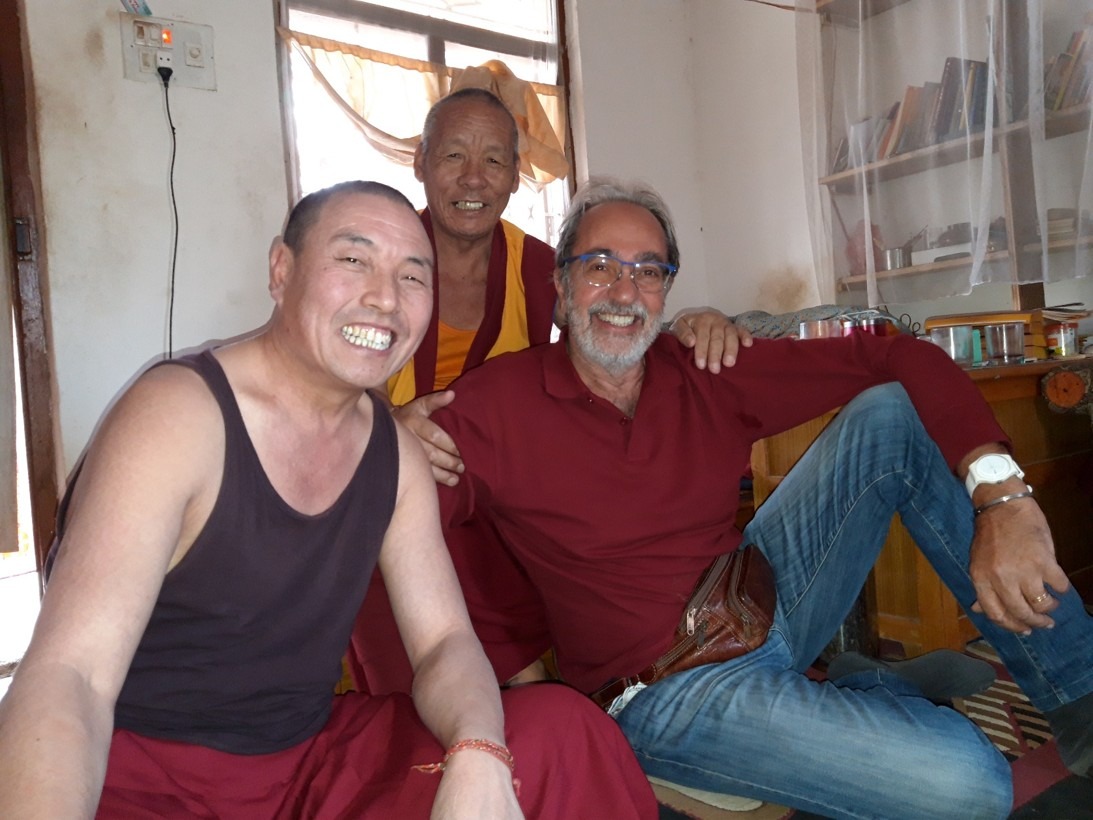
Prof. Neri together with two geshes in the retreat area of Sera Jey Monastery
Since 2018, our team traveled regularly to the monastery with portable neurophysiological equipment, bringing the laboratory into the setting where contemplative practice naturally takes place. At Sera Jey we found a community sharing a common educational background, philosophical framework, contemplative vocabulary, and decades of disciplined practice. Some volunteers had accumulated more than 40,000 hours of meditation during long-term retreats.
Interviews before and after each recording helped us interpret not only what was occurring in the brain, but also what the practitioner reported experiencing. The monastery thus became more than a site for data collection: it became an active scientific partner in a genuinely neurophenomenological investigation of consciousness.
After several years of field research at Sera Jey, I am often asked what we have actually discovered. The most important answer is not the confirmation of a single hypothesis, but the demonstration that this collaborative model is scientifically feasible. Rigorous neurophysiological research can be conducted in a Tibetan monastery while respecting contemplative practice and preserving its natural setting. The first results have appeared in leading journals, with University of Pisa researchers and geshes and monks from Sera Jey Monastic University working together as co-authors [2-4].
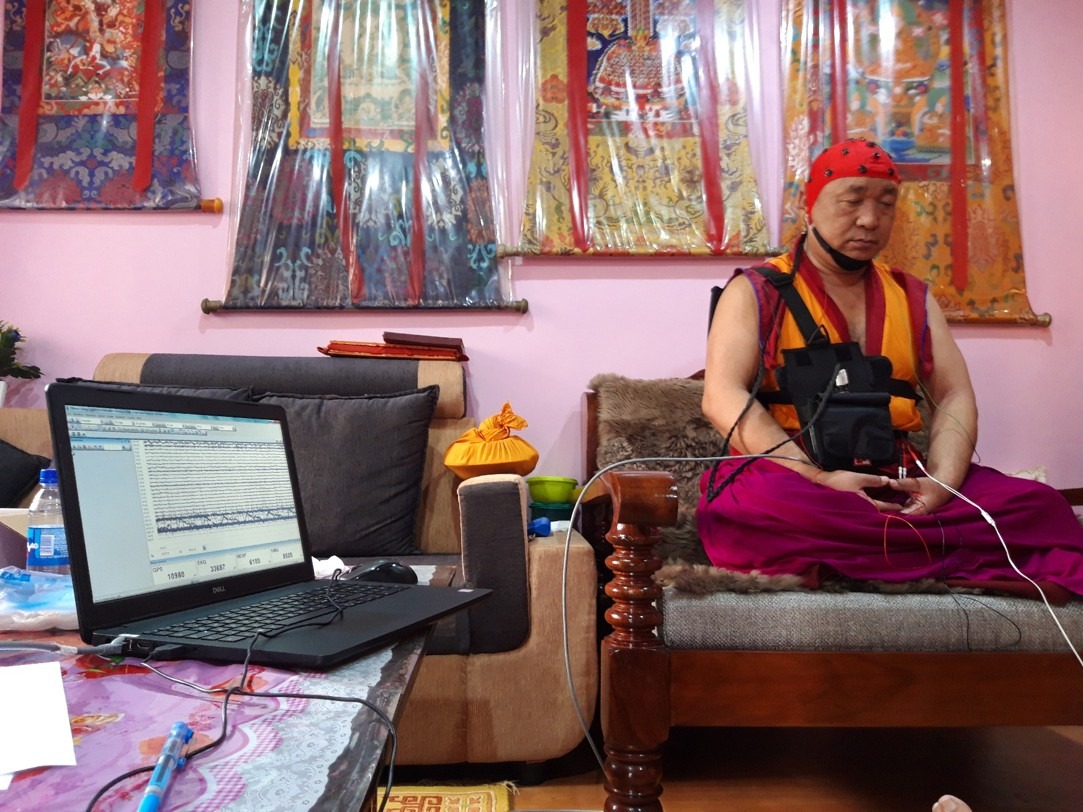
Geshe Gonpo during an EEG recording session at Sera Jey.
Our studies have focused mainly on concentrative and analytical meditation. Using portable EEG systems, we combined physiological recordings with structured interviews before and after meditation, documenting intentions, methods, experiences, and possible disturbances. These reports were an essential part of the protocol, allowing physiological and phenomenological data to be interpreted together. A detailed description of these findings can be found in references [2–4].
One recurring observation is that the two forms of practice are associated with different neurophysiological patterns. Concentrative meditation frequently showed a progressive increase in alpha-band activity relative to baseline, whereas analytical meditation displayed a different temporal evolution. These findings do not explain meditation or consciousness, but suggest that distinct contemplative practices engage different functional brain dynamics.
These results matter because they show that dialogue between neuroscience and contemplative science can generate meaningful, testable questions. Individual EEG findings will inevitably be refined or superseded. The more durable achievement is the research platform itself: a stable relationship in which contemplative practitioners contribute not merely as participants, but as knowledgeable collaborators.
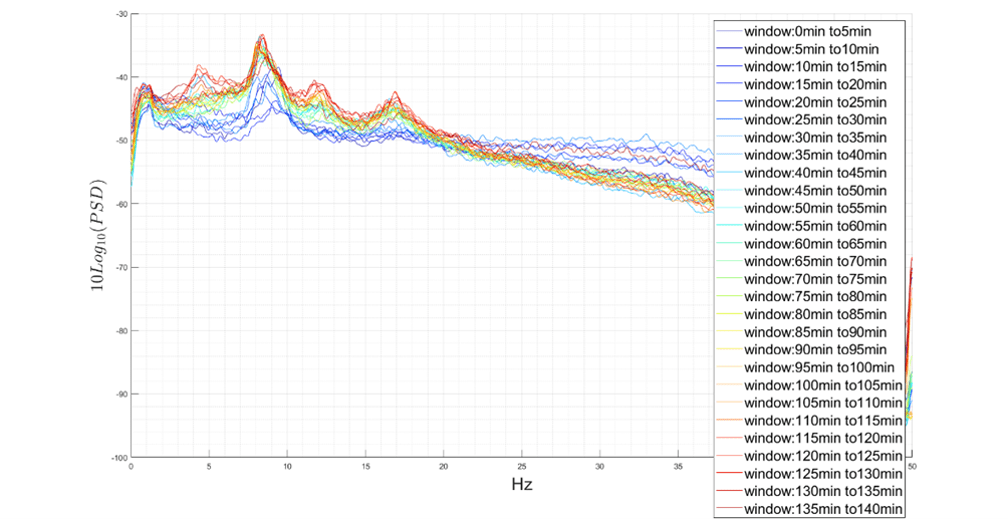
EEG recording result
The evolution of the energy distribution of brain activity during a concentrative meditation session lasting more than 2 hours. Blue line represents the initial condition (0-5 min), whereas different colors represent the evolution (a color each 5 min. window) up to the red line.
What began at Sera Jey as an experimental collaboration has become a stable platform for consciousness research, grounded in the trust and shared understanding that now make more advanced studies possible. Sera Jey will remain at the center of this program, while recent contacts with Thiksay Monastery in Ladakh may open opportunities for work with practitioners engaged in advanced training and in practices concerning the subtle relationship between mind and body.
More than any single experimental finding, this collaboration demonstrates how the vision encouraged by His Holiness the Dalai Lama can become concrete scientific practice: not by reducing one tradition to the other, but through a disciplined partnership in the study of consciousness.
Perhaps the FPMT’s most distinctive contribution has been to sustain a bridge between two technologies developed across very different historical timescales: the advanced instruments of Western neuroscience and the ancient, highly refined technology of training and exploring the mind preserved in the Tibetan contemplative tradition.
With grateful thanks to Prof. Bruno Neri, who authored this blog and shared the results of this research.
Prof. Bruno Neri is Full Professor of Electronics at the University of Pisa. He also teaches in master’s and advanced professional training programs on Mind Sciences, Contemplative Practices, and End-of-Life Studies. He serves as Director of the Summer School “Consciousness and Cognition.” These initiatives arise from the collaboration between the University of Pisa and the Istituto Lama Tzong Khapa, where he served on the Board of Directors since 2025.
The story of this encounter between modern science and the Tibetan contemplative tradition is told in the documentary Clearlight, by Prof. Bruno Neri and Letizia Renzini, produced with support from Italy’s National Recovery and Resilience Plan (PNRR).
References
[1] Varela, F.J., 1996. Neurophenomenology: a methodological remedy for the hard problem. J. Conscious. Stud. 3, 330–349.
[2] Neri, B., et al. (2024). Report from a Tibetan Monastery: EEG neural correlates of concentrative and analytical meditation. Frontiers in Psychology, 15, 1348317. https://doi.org/10.3389/fpsyg.2024.1348317
[3] Rho, G., et al. (2026). Dynamic causal modeling of low-density resting-state EEG in long-term meditation practitioners. Scientific Reports, 16, 8691. https://doi.org/10.1038/s41598-026-41310-y
[4] A. Callara et al. “Integrated central and autonomic signatures of concentrative and analytical meditation in expert practitioners” to be published on Scientific Reports
Is your center also working to bring Science and Buddhism into dialogue? We would love to hear about your initiatives and celebrate these efforts by sharing them with the wider FPMT community.
Foundation for the Preservation of Mahayana Tradition (FPMT), is a Tibetan Buddhist organization dedicated to the transmission of the Mahayana Buddhist tradition and values worldwide through teaching, meditation and community service.
- Home
- News/Media
- Study & Practice
- About FPMT Education Services
- Latest News
- Programs
- New to Buddhism?
- Buddhist Mind Science: Activating Your Potential
- Heart Advice for Death and Dying
- Discovering Buddhism
- Living in the Path
- Exploring Buddhism
- FPMT Basic Program
- FPMT Masters Program
- FPMT In-Depth Meditation Training
- Maitripa College
- Lotsawa Rinchen Zangpo Translator Program
- Universal Education for Compassion & Wisdom
- Online Learning Center
- Prayers & Practice Materials
- Overview of Prayers & Practices
- Full Catalogue of Prayers & Practice Materials
- Explore Popular Topics
- Benefiting Animals
- Chenrezig Resources
- Death & Dying Resources
- Lama Chopa (Guru Puja)
- Lama Zopa Rinpoche: Compendium of Precious Instructions
- Lama Zopa Rinpoche: Life Practice Advice
- Lama Zopa Rinpoche Practice Series
- Lamrim Resources
- Mantras
- Prayer Book Updates
- Purification Practices
- Sutras
- Thought Transformation (Lojong)
- Audio Materials
- Dharma Dates – Tibetan Calendar
- Translation Services
- Publishing Services
- Ways to Offer Support
- Teachings and Advice
- Find Teachings and Advice
- Lama Zopa Rinpoche Advice Page
- Lama Zopa Rinpoche: Compendium of Precious Instructions
- Lama Zopa Rinpoche Video Teachings
- ༧སྐྱབས་རྗེ་བཟོད་པ་རིན་པོ་ཆེ་མཆོག་ནས་སྩལ་བའི་བཀའ་སློབ་བརྙན་འཕྲིན།
- Podcasts
- Lama Yeshe Wisdom Archive
- Buddhism FAQ
- Dharma for Young People
- Resources on Holy Objects
- Centers
- Affiliates Area
- Teachers
- Projects
- Support
- FPMT
- Shop
Translate*
*powered by Google TranslateTranslation of pages on fpmt.org is performed by Google Translate, a third party service which FPMT has no control over. The service provides automated computer translations that are only an approximation of the websites' original content. The translations should not be considered exact and only used as a rough guide.Anybody who dedicates their life to achieving lam rim realizations with the goal to liberate numberless beings from the oceans of samsaric suffering and to bring to enlightenment, this is what I regard as the most important thing in the world.