
 receive our newsletters
 join Friends of FPMT


The early Kopan courses brought together students from many backgrounds who came to Nepal seeking different things. For some, the teachings changed the course of their lives. Others were drawn to Lama Yeshe and Lama Zopa Rinpoche through their unique qualities, wisdom, and compassion.
The recollections gathered here were originally published in Mandala magazine: in the April–June 2009 issue in “Intimate Reflections,” and in the April–June 2004 issue in “The Kopan Experience.” Republished here as part of our celebration of the fiftieth anniversary of the Foundation for the Preservation of the Mahayana Tradition (FPMT), these personal stories offer a glimpse into the formative years at Kopan Monastery and the experiences that would shape the lives of many early students.

The third Kopan Course group photo, 1972. Photo courtesy of the LYWA.
Suzi Albright, who attended the sixth Kopan course and later became a nun and did a twelve-year retreat, remembers:“ I only went to Kopan to see a friend. I was not interested in Buddhism. In fact, I was completely turned off by the whole scene. Many of the people there seemed unhealthy, both mentally and physically. I thought if this is meditation, who needs it? I was really only an observer and refused to prostrate. However, my first sight of Lama Yeshe changed all that. I immediately sensed he knew things most people don’t. I’d met a lot of highly educated people, but none who were wise. Lama Yeshe was as wise as you could get. His compassion and wisdom were so apparent that one was really struck by his presence. I regarded him as a buddha, because if he wasn’t, I don’t know what he could be. After seeing him, I began doing prostrations.”
Lois Greenwood-Audant, an early student, recalled:” I had the privilege of taking the fourth course in March ’73 with my fiancé, Gabriel Audant. The course deeply resonated with our mutual thirst for understanding the dissatisfied mind and how to achieve happiness. Lama Yeshe and Lama Zopa became our root teachers from that time forward, and they have always served as strong guiding forces for our lives. Throughout our 30-year marriage, whenever the inevitable relationship conflicts would arise, the foundational teachings at Kopan always served as skillful means for finding our ways back to compassion and love for one another. The Dharma in our family was further strengthened when Lama Yeshe kindly agreed to “baptize” our only child, Gabriel (Gabe) Michael, ten years later. When I returned to U.C.-Berkeley to complete a doctorate degree focusing on workforce development issues, I was able to support the early growth of Vajrapani Institute as its second director, and I continue to be an active member of its Dharma community. The lamas have given us thousands of teachings to appeal to the various levels of our minds. For me, Lama Yeshe’s teachings on distilling the universal qualities of Buddhism “without the religious trappings” as an effective way of helping people in the West had the most impact and have guided my Dharma efforts throughout my life. I have successfully experimented with integrating universal wisdom values from Buddhism into business training programs as the director of a business and workforce development training center at University of Hawaii’s Maui Community College for over 15 years. This experience has led me to the writing of a book on Managing Destructive Emotions”
Another early student, Carol Royce-Wilder, recalled: “[I] burst in on Lama Yeshe, sobbing hysterically. His eyes widened and he looked very concerned. I just blubbered, out of control, a real spectacle. “What is it dear?” he asked, taking my hands in his and drawing me close to him. Looking around he found flowers someone had given him and said: “Here dear, these are for you.” I said, “No, no, Lama, it’s me who should be offering them to you!” He handed me some fruit and said to take it, too. “No, Lama, you don’t understand, nothing helps. Not fruit, not flowers, it’s useless! I’m totally isolated and alone. I can’t feel anything. I’m dead. Nothing means anything to me, not even you, Lama!” I shrieked and sobbed. He said: “Not even me? Impossible, impossible!” Then he opened his eyes very wide and drew my eyes to his, and what felt like my whole being went… somewhere. I haven’t the words to describe what happened. I felt like he took me into the deepest recesses of his being, and I saw, I knew, that there was nothing there. Absolutely nothing at all. There was just an empty silence, a black hole. There was simply no person called “Lama” inside. It was awesome. In that moment I realized that the friendly, smiling, personable Lama Yeshe I knew was a figment, a persona he’d created solely for our benefit; that behind the charismatic exterior lay unbounded empty space. Lama had allowed me to catch a glimpse of that for one brief, but eternal, moment.”
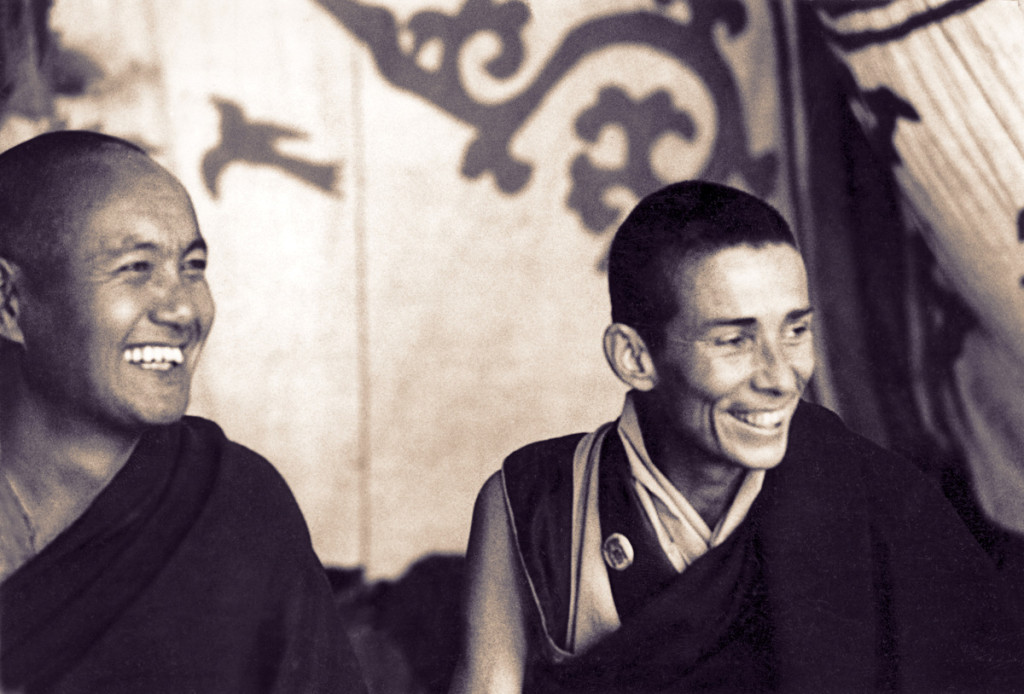
Lama Yeshe with Anila Ann (Ann McNeil), Kopan Monastery, Nepal, 1974. Photo courtesy of the Lama Yeshe Wisdom Archive.
Ven. Ann McNeil, one of the first ordained Westerners and a former director of Chenrezig and Vajrapani Institutes, recalled: “I attended every Kopan Lam-rim Course from the first to the sixth, but I never sat completely through one from beginning to end. I had many duties under strict orders from Lama Zopa Rinpoche and Lama Yeshe. The enrollment seemed to double for every course, so the logistics were a challenge. Lama Zopa Rinpoche worked so hard. Hardly slept. Not only did he attend and give all the teachings of the lam-rim, he also attended all the meditation periods and led them, the early morning ones to the last one at night. He was truly with us all the way. We were so fortunate in those beginning years. He was literally spoon-feeding us the Dharma. In that way we learned how to study and meditate and actualize it. He forced us to internalize our own suffering so we could recognize it in others. But first thing, every morning, he would go on and on about, ‘What Shantideva says, compassion, compassion,’ and then every afternoon for three weeks, ‘Suffering, suffering, suffering.’ Did we get it? To apply compassion to our own suffering? To heal ourselves? And at the crucial moment where our minds were overloaded with everything under the Golden Sun of the Mahayana Thought Training, like a magic genie Lama Yeshe would appear and kiss our minds all better with his delightful joy for the Dharma and us, his golden flower students. Lama could slip right in under our skin and noses and read us like a book, totally disarming us with a line about our “fickle mind” by saying, “I am just a medieval monk. No, I am just a Tibetan anthropologist studying the West.” Now, he had our attention and the mental overload was gone. “What’s our problem, Lama?” Like little birds with our mouths open for wisdom. “You can’t get no satisfaction!” he chanted. A great enlightened howl would go up, and we were in love with this lama.”
Another early student, Steve Pearl, recalled: “I was committed to the Dharma and living and working at the center [Kopan]. I was building my house there, the three-story tower, Dechen Potrang (“Blissful Palace”) and helping in the construction of the first gompa. I was thinking about becoming a monk by then and was interested in doing lots of retreat. The Dharma had hit home, and I was in the process of rising to the challenges and opportunities that would be coming, knowing that this would be my path for the rest of this life and many, many more lives to come. I had been looking for such a path since I could remember and was afraid that they had ceased to be. Lama Yeshe had shown me that there were still saints in the world, and Lama Zopa deftly showed that the path, the way to follow them, still existed as well.”
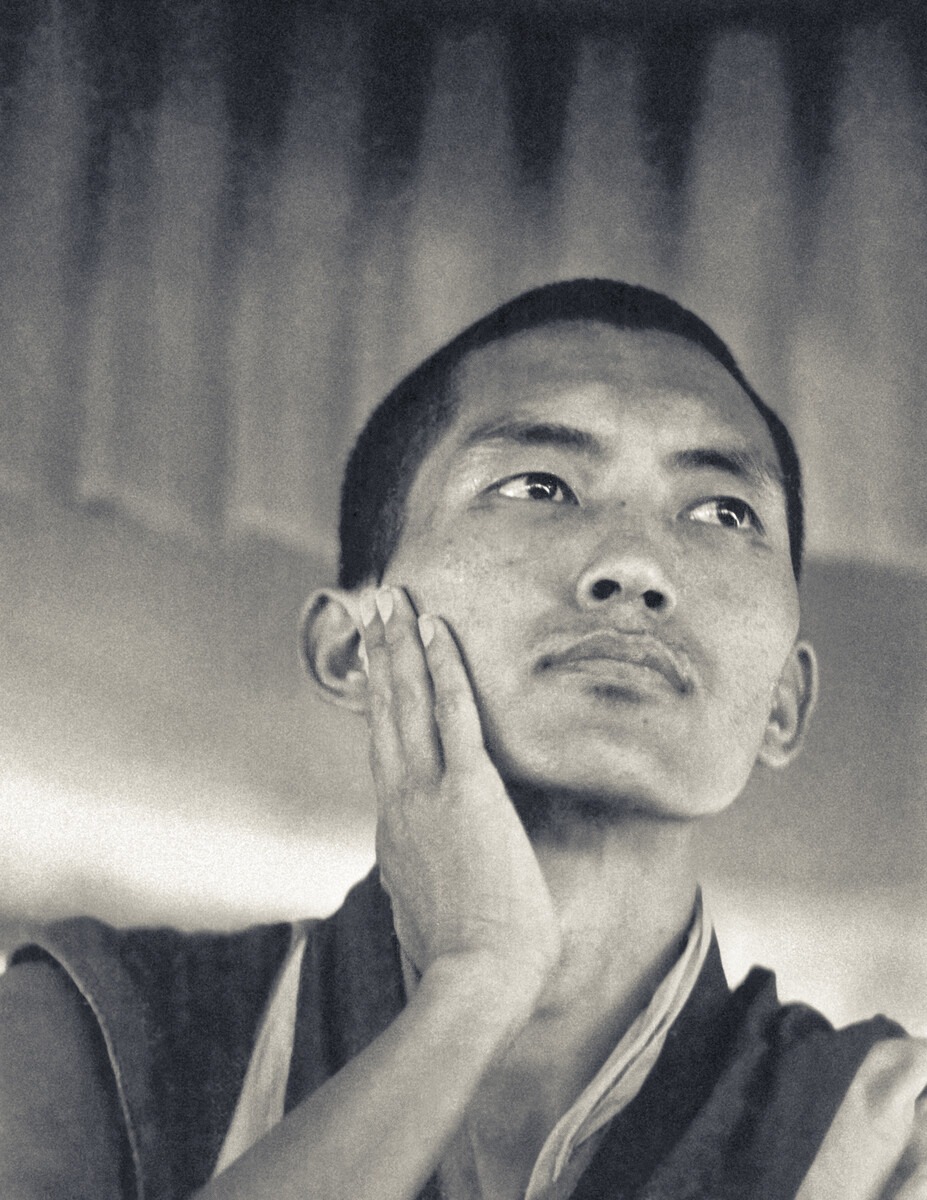
Lama Zopa Rinpoche teaching at the Sixth Meditation Course, Kopan Monastery, Nepal, 1974. Photo by Ursula Bernis. Courtesy of the Lama Yeshe Wisdom Archive (LYWA).
Ven. Connie Miller, writer, editor, early student, and early organizer of Universal Education (now FDCW), recalled: “Lama Yeshe and Lama Zopa Rinpoche were the perfect pair. Extrovert and introvert, outrageous and traditional, heavy and light, relaxed and disciplined, wrathful and gentle (but always compassionate!). And yet that’s altogether too simplistic It is impossible to categorize them concretely as in “Lama was like this and Rinpoche was like that.” Both of them embodied all qualities, all polarities, just in different measures at different times, according to the needs of different people. In their relationship to each other, however, the love and respect and care and deference that each showed the other – and thereby demonstrated to us – was enormous, inexpressible in words”
Ven. Karin recalled: “I attended my first Kopan course in November 1974. It was the first time I’d heard Buddhist teachings. Lama Zopa Rinpoche and Lama Yeshe taught the course. Nick Ribush was leading it, making the course great fun, with his warm sense of humor. My feeling is that although the place itself has changed over the years, the courses have not changed. It has become so much more comfortable and clean at Kopan, but the feeling of the courses is the same. At the beginning we didn’t have even electricity or running water or beds. We slept on straw mats. Pits dug in the ground were toilets, and we used the spring down the hill in the local village. Meals were taken on the hillside. Now we have single and double rooms with bathrooms, as well as dormitories with solar showers, a huge dining room, a cyber café, a restaurant, a shop, a clinic with overnight facilities, and clean water, which is purified at Kopan itself. The most wonderful thing about the course is that the people come and receive the theory and immediately are able to put it into practice; it has an immediate effect on their minds. You see this. When they leave, they are not the same as when they came. This hasn’t changed over all the years. Until Lama Yeshe’s passing away, Lama Zopa Rinpoche would teach the entire course; now Rinpoche comes for the last ten days or so. He appoints a course teacher every year, an incredible variety of course leaders. The leader sets the tone of the course. That is the only thing that makes the courses slightly different. ”
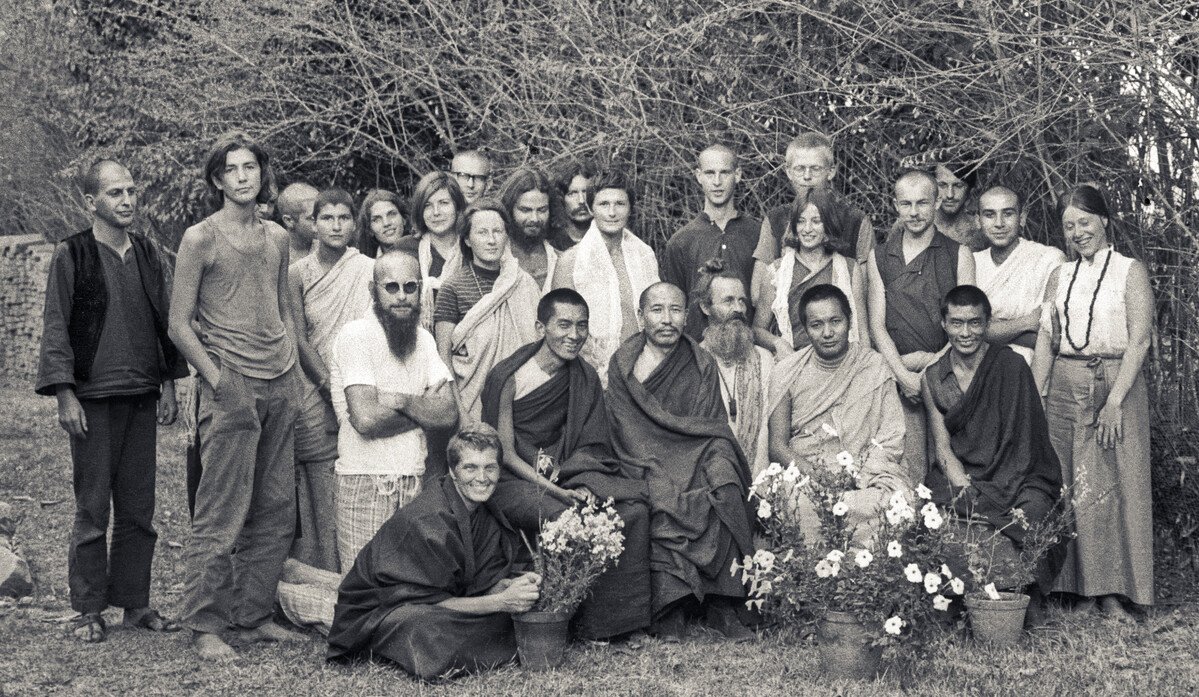
Group photo from the first meditation course held at Kopan Monastery, April, 1971. Photo courtesy Fred von Allmen.
Artist Andy Weber, describing his first commission from Lama Yeshe, a large Manjushri thangka for a new center in England, recalled: “It took three months to complete and changed my life. Lama didn’t want it painted in the traditional style, where you have the lineage holders at the top and bottom of the painting. He wanted just the one single image of Manjushri, which was an unusual request. He wanted it to be huge. He was always telling me, “Think big! Big paintings for big places!” Since then I have continued painting just one deity in thangkas. We Westerners have to learn to communicate with these on a one-to-one basis before we try and deal with many figures at once.”
Sharon Gross, one-time director of FPMT, Inc., recalled:“ In 1974, under the haze of the projected great comet Kahoutec, amidst one hundred thousand or so people shuffling about in the dust as they assembled in Bodhgaya from various parts of the globe, many particularly coming out of Tibet for the first time, I was introduced to His Holiness the Dalai Lama and was present as the Kalachakra initiation was conferred, over a week-long period. My presence there was at the insistence of my teacher, the most kind Lama Thubten Yeshe, whom I had met in the previous months in Nepal. My husband had wanted to go trekking in Nepal, so in September of 1973, we left our usual life in upstate New York as graduates of Syracuse University and headed off with our math professor on an overland trek from Holland to the mountains of Nepal. In looking back I laugh as I mentally picture Lama Yeshe reeling in his students, as if with a nylon fishing line, to re-unite with things much more precious in life than mountain climbing or degrees. At this fifth course in Nepal I met numerous people among the 250 assembled, many of whom are my dear friends to this day. From the moment of hearing the very young precious Lama Zopa Rinpoche say, “The mind is beginningless,” I was hooked by the “velvet glove of Dharma,” as our guide Ven. Ann McNeil described it. I remain a student of awakening, though perhaps the laziest and weakest of the crowd. I am ever grateful for the words of Dharma that were showered upon us as we were immersed in the philosophy of universal responsibility and the good heart over the course of those months. My true north was found, and all that has followed is directed by that guiding star.”
Jon Landaw, early student, writer, editor, and Discovering Buddhism teacher, recalled: “Lama Yeshe had a unique teaching style. Instead of saying, “Do you understand me?” he’d ask, “Are we communicating?” He acted out what he was saying, which was so helpful, because not all of his students spoke English. Even those who did speak English often couldn’t understand him properly until they caught on to his unusual rhythms of speech. Lama communicated way beyond the meaning of the words, using facial expressions and sometimes just silences. When editing his teachings, I could only use the words he said and always felt there was something missing.”
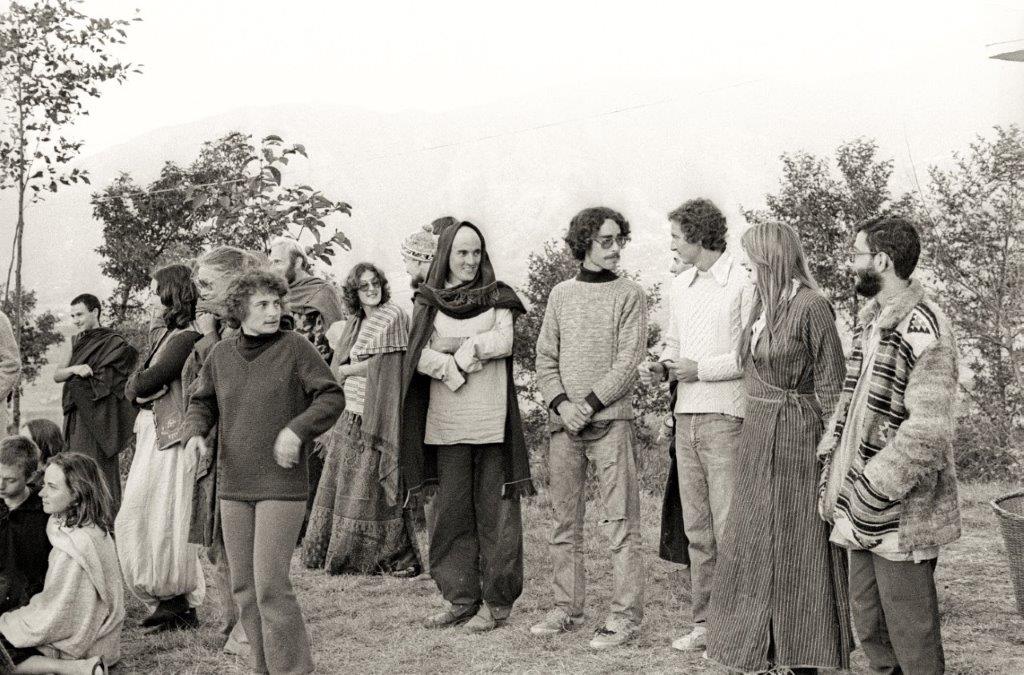
Students celebrating at the end of the 1978 Kopan November Course. Photo courtesy of Michelle Le Dimna. Courtesy of the Lama Yeshe Wisdom Archive (LYWA).
Ven. Fran recalled: “When I came to Kopan for the November course in 1991, it was to get ordained at the suggestion of Lama Zopa Rinpoche. I will never forget the first sentence that Lama Zopa said in his first teaching that time: “The purpose of our life is to work for others!” That was it for me; that made it all clear. Ven. Marcel was leading the course, with Lama Zopa Rinpoche and Kirti Tsenshab Rinpoche teaching every day. It was intense. What I do remember is the kindness of the people I met here at Kopan. How helpful Lama Pasang was when he helped me get my robes straightened out during the ordination. The incredible atmosphere, sitting there in the Chenrezig gompa (just barely finished) with so many monks and lamas receiving initiations from Lama Zopa Rinpoche. At that time there were about 140 monks here and maybe 25 nuns. It was a small village. Now the village is much bigger, a village in the true sense. In another huge difference from earlier years, when most of the students were young people in their twenties, quite a few middle-aged people make the journey to Nepal to meet Buddhism, meet a teacher, and receive teachings. In another very interesting trend, the children of these very early students are coming back to do the November course, just as their parents did twenty or so years ago. From talking to many of the participants, the Kopan experience is still there, still working its magic.”
Marcel Bertels, early student and former director of many early FPMT businesses, shared:” Rinpoche was the most unusual and mystical being, and the fact that Rinpoche was still so young (maybe around 27) made it even more special. Those were the days when Rinpoche was doing almost 24 hours of formal meditation each day, with almost 24 hours of formal meditation each day, with short breaks for meals and occasional teachings. Rinpoche was also available for interviews between 4:00 P.M. and 5:00 P.M., 15 minutes maximum per interview. Many were shorter, and I can’t remember Rinpoche engaging in any small talk with his students. The conditions were spartan; I was staying on the first floor of the school building at the bottom of Kopan Hill. With regularity the floor would give way, and one of the students would crash through and try to hold on for dear life not to fall to the floor below. I made so many enduring friendships during the course. My immediate neighbor in the gompa was Paula de Wijs. Nick Ribush was by far the smartest of the attendees and often engaged in debate with Rinpoche. The course became the most important experience in my life. Within a matter of days I was totally convinced and satisfied that Buddhism was for me, and I couldn’t conceive of ever doing anything else.”
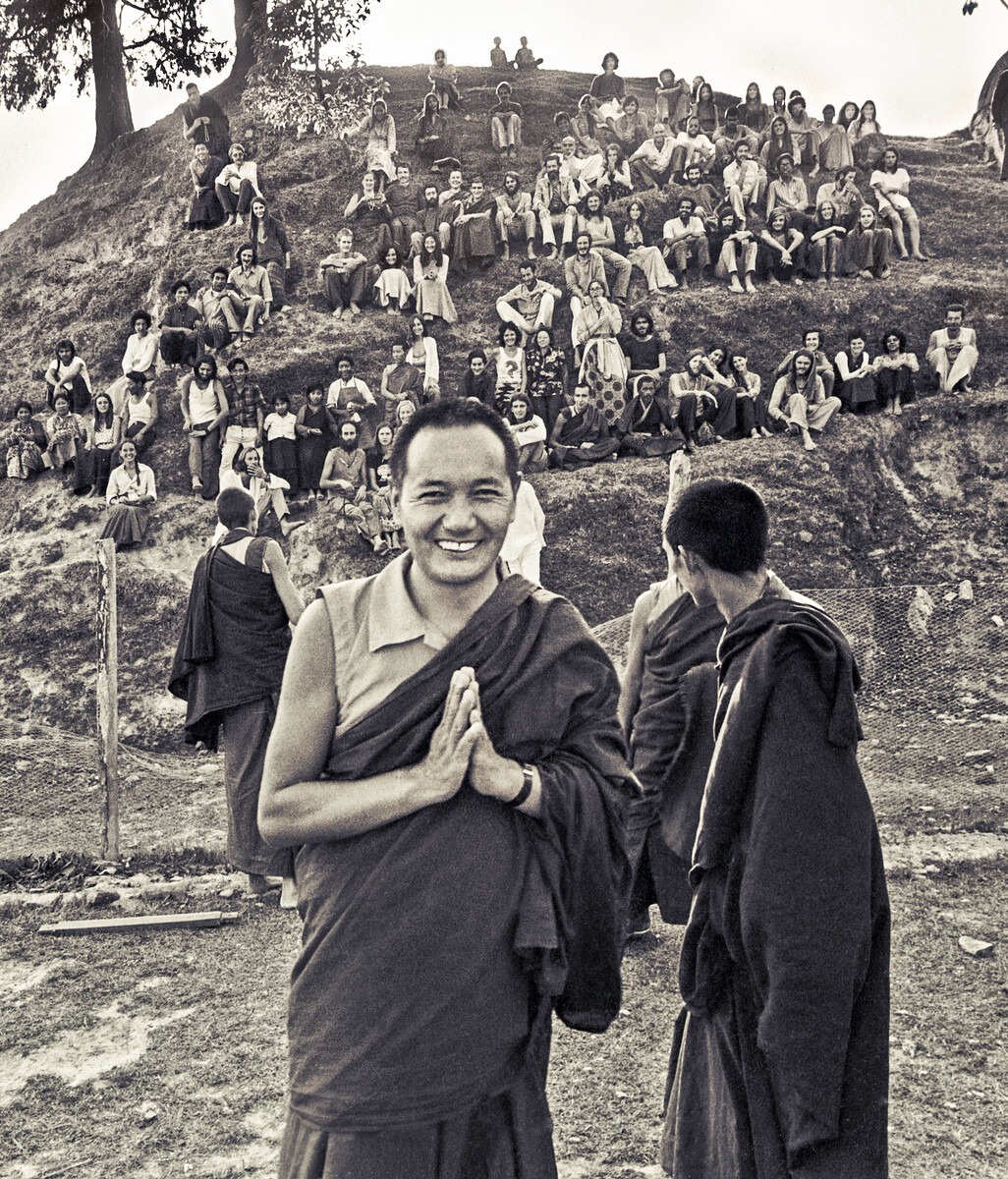
Lama Yeshe in group photos from the Fourth Meditation Course, Kopan Monastery, Nepal 1973, Photo by Brian Beresford. Courtesy of the Lama Yeshe Wisdom Archive (LYWA).
Gareth Sparham, an early student, remembered: “Lama Zopa went on and on about the negative mind. I remember that it was based on misplaced selfishness and that he explained it in the language of the so-called eight worldly dharmas. There was the devil, and you would stay up all night, if necessary, to poke it with its own pitchfork. Fine guru, fine teacher of the guru, fine message, and fine earlier students who worked selflessly to help make those earlier courses a reality.”
Judith Weitzer, an early student, remembered: “Often, at the end of a meeting with Lama Yeshe, he would mention something that he would like you to do. He might ask you to be director of a center, organize a course, or start a school or project. In 1976, one of his requests changed the course of my career and my life. He simply said, “It makes my heart break to see how old people are treated.If you can, do something about it.” Frankly, I didn’t have a clue about how I might work on this problem. After a year in Asia, I returned to my job as a social worker in the Bay Area. I had lost my seniority and had to take whatever position was assigned. When a memo came across my desk, seeking people interested in staffing the newly formed Office on Aging, I remembered Lama’s words and felt I owed it to him to apply for the job even though it was outside of my field of expertise. I remember walking up to the County Offices for my oral examination, thinking: “I don’t know a thing about this, so Lama, if you want me to do this work you had better take care of this interview.” Well, he did! I was surprised how easily answers came to me – it was really as if he was whispering in my ear. I was offered the job. Thus began my long (40-year) career in the field of aging.”
Ngawang Chotak, early student and former director of Wisdom Publications, recalled: “We did a lot of cooking together, Lama teaching me how. For breakfast he liked French toast with lashings of butter and syrup, as well as sausage or bacon and strong coffee with whipped cream. If Anila Ann had seen that she would have gone nuts. She was always on at me about his diet. I agreed with her at the time but Lama claimed nobody knew his body like he did. “I need strong food to keep it going – steak and milk.” He made these big momos but wouldn’t let me buy ground beef for them, it had to be the best steak and he’d chop it up himself. He didn’t like ground beef: “You don’t know what’s in that!” He loved his coffee. He started adding half and half but said it wasn’t strong enough, so moved on to whipping cream.”
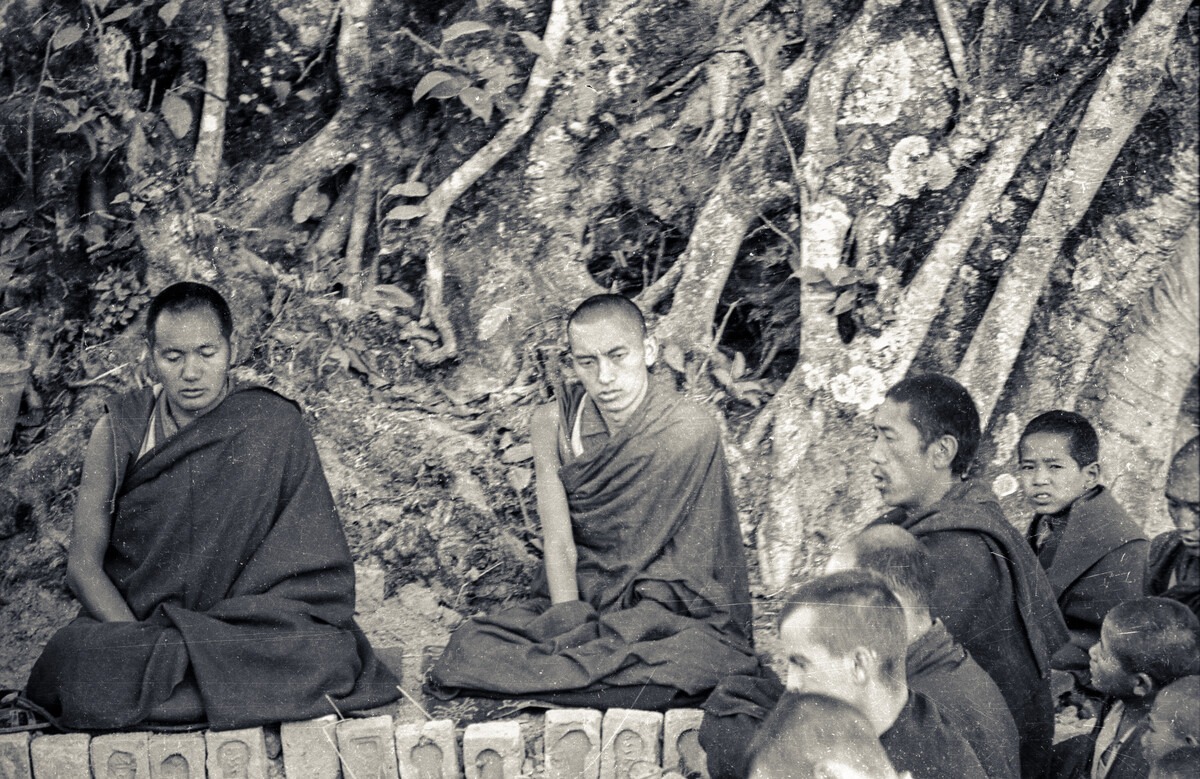
Lama Yeshe and Lama Zopa Rinpoche with students from Mount Everest Centre and Pasang Tsering Lama, 1974, Kopan Monastery. Photo by Ursula Bernis. Courtesy of the Lama Yeshe Wisdom Archive (LYWA).
John Schwartz, Lama Yeshe’s attendant in 1980 and former director of Vajrapani Institute, recalled: “I was always amazed at the amount of food Lama could eat, with all his physical problems. He’d often hold the palm of his open hand on a spot down near his waist and say: “Oh my heart!” I’d say, “Lama, your heart isn’t down there.” But he said it was. I don’t know what he meant by that He always had breakfast and I’d lay out a whole spread for lunch He called it his “California lunch,” with salads and lots of pastrami, salami, cheeses – all the fatty foods. He just loved it. Then he’d have his nap and two hours later he was calling out: “John Shore, where’s my snack!” He loved cold cuts, even with tea, and at night he’d eat a big dinner. We’d just finished one of these “California lunches” one day when he gets a call from this married Mongolian lama who lived nearby. This guy constantly did pujas and Lama always attended them when invited. So this lama rang to say that his wife just made momos. Well, that was the magic word! So he starts putting away these momos, looking up at me with sheepish eyes, like a kid caught with his hand in the cookie jar, as they brought him plate after plate of them. Most of the time Lama ate good food. He was one of the few Tibetan lamas to understand about salads and fresh vegetables. He made a garden out the back of the house as soon as he got there, to maximize the growing time. He really had the touch – you never saw vegetables grow so big in just two months. People would come over and say, “I’ve lived in Berkeley all my life and I’ve never seen anyone grow stuff like this.” He gave it away, a lettuce here, tomatoes there, supplying his students all summer. Lama knew about good food, but he ate junk too.”
Beatrice Ribush, Nick Ribush’s mother, described what awaited her in 1977: “When I returned I noticed this wonderful smell. There was Lama, towel around his waist and laughing loudly, with every saucepan I possessed on the table, under the table, on the stove the mess was indescribable. We sat down to a magnificent vegetarian lunch of many different dishes. Peter [Kedge] had taken him shopping in Chinatown for the ingredients.”
Foundation for the Preservation of the Mahayana Tradition (FPMT) is a Tibetan Buddhist organization dedicated to the transmission of the Mahayana Buddhist tradition and values worldwide through teaching, meditation, and community service.