 receive our newsletters
 join Friends of FPMT
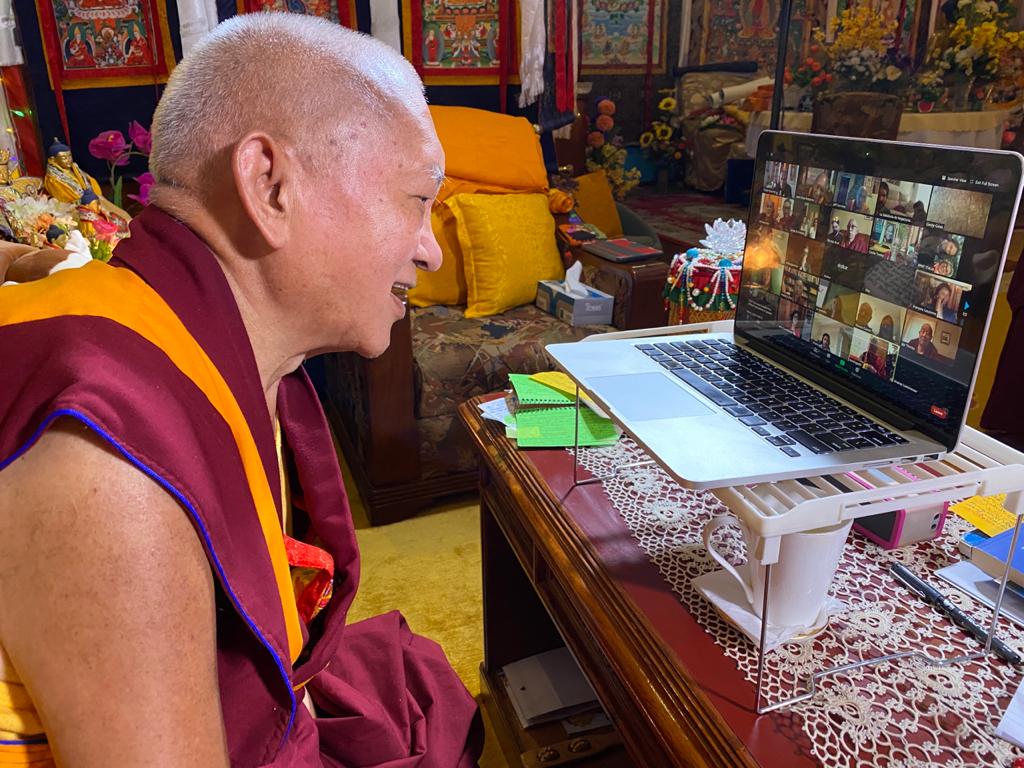
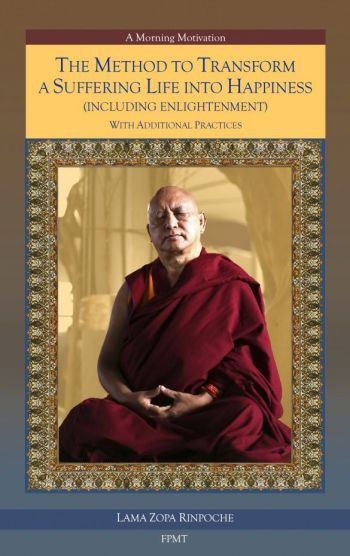

Merry Colony at Sera Monastery, July 1980. Photo courtesy of Merry Colony.
Merry Colony met the Dharma in Santa Cruz in 1979 and ordained the following year at Kopan Monastery. She served as Lama Yeshe’s secretary from 1981 to 1982, primarily organizing accommodations and teaching facilities for the first Enlightened Experience Celebration (EEC1). She later directed Dorje Pamo Monastery in France, where the nuns elected her as nunnery director before she disrobed.
Merry went on to serve as co-director and then director of the Maitreya Project (1992–1995), organized the 1998 long life puja for His Holiness the Dalai Lama, and directed the Lotsawa Rinchen Zangpo Translator Program (LRZTP) from 1998 to 2000. She spent twelve years as Director of FPMT Education Services, followed by roles managing Buddha Amitabha Pureland’s development (2014–2016) and directing Milarepa Center in Vermont (2016–2018). Since 2018, she has been living in Colorado with her partner, Harry Sutton, where she completed a three year retreat and continues trying to comprehend the vast Nalanda tradition of her teachers.
Merry wrote this piece in April 2023, shortly after Lama Zopa Rinpoche’s passing. We are honored to share it now as part of our yearlong celebration of FPMT turning fifty in December 2025.
Beginnings. The Road to Lama Zopa Rinpoche and Lawudo. Spring 1979 – Summer 1980
It was spring 1979, atop Santa Cruz Island, high on magic mushrooms when an old craggy Live Oak tree changed the direction of my life. I was about to graduate from UCSC with a degree in Environmental Studies. All my friends were getting ready to either move to Alaska and save the last frontier or get into politics or law so they could change the course of environmental breakdown that was clearly inevitable already in ’79. My inclination was to get into environmental education, but I wasn’t convinced. Something else was brewing deep inside that needed attention.
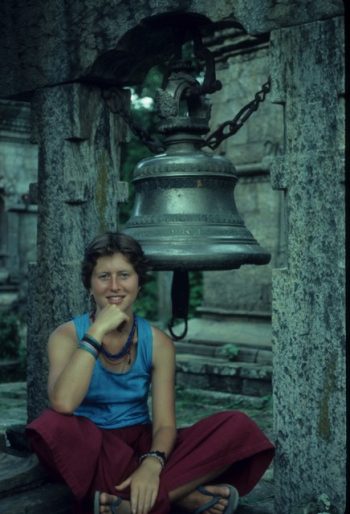
Merry Colony at Pashupatinath, February 1980. Photo courtesy of Merry Colony.
So it was there, on that very green island surrounded by blue ocean, that I wandered away from my boyfriend Adam and lay my head upon the old oak. What happened next had never happened before and hasn’t happened since, but it happened that day and it was crystal clear. I understood that I had to leave my family, my country, everything I knew and find a spiritual path.
When I returned to Adam I was crying, all I saw in the ocean below, which just an hour ago had been so blue and vibrant, was death. Everything was pulsing with the message of death, impermanence, nothing to hang on to, life is ever changing.
We walked some and then sat down together looking out over the vista of steeply rising hills cut by canyons and waterfalls. Looking at the scene I suddenly said to Adam the word Nepal. I said, “this looks like Nepal and that’s where I have to go.” Why I said that is a cosmic mystery as I knew nothing about Nepal. I’m not even sure how I knew the name. Maybe I’d heard of Mt Everest. But for whatever reason I knew that’s where my journey was at least going to start.
Now that I knew where I was going, I needed to figure out what I was going for. Santa Cruz, hippie capital of the country at the time, had it all so I started checking out various spiritual things on offer: OM circles, Kundalini ecstatic dance classes, a hug by the beloved Ram Dass … and then one day Adam’s housemate, Dean Alper, told me about a weekend teaching with a Tibetan Lama. Far out, I thought, something else I can check out. It was there, at that weekend teaching that I was led to my root guru, Lama Zopa Rinpoche.
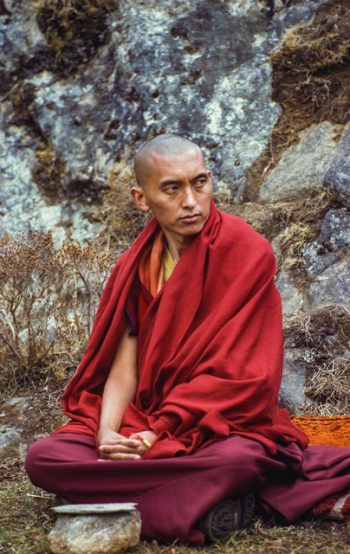
Lama Zopa Rinpoche pictured on the poster that first caught Merry Colony’s eye at a weekend teaching in Santa Cruz, 1979. Photo by Ueli Minder.
Not because he was the teacher. He wasn’t. Zasep Tulku was the teacher. And not because I met him in person or heard his voice or knew his name, but because of a poster. On the wall was a poster with a picture of a skinny monk with a mountain in the background. It was advertising a Nyung Nä retreat at Lawudo Gompa in Nepal. When I saw that poster tears welled up and I asked Dean and his friends (Tom Waggoner and a few others from Vajrapani Insitute) if they knew who that was on the poster. They told me that was Lama Zopa Rinpoche, and they told me about a Kopan Monastery in Nepal and how there were Buddhist courses in English. That was it. Now I knew where I was going and who I was going to meet.
However, finding my spiritual path didn’t mean I was going to STAY in Nepal. No, I was going to go, do one of the courses, figure out my path and then travel. My friend Eric and I were going to then meet in Indonesia, eat fruit and hang out on the beach. And from there the world was my oyster.
I left the US on January 2, 1980. First stop was a deserted beach on the big island of Hawaii where my friend Jody was studying spinner dolphins. She lived in a leaf shack that she had built and shared the beach with a Filipino fisherman and his one hundred feral goats. She adopted one and named her Lama (interesting…) who used to sleep on her chest at night. It was a perfect start of the journey. She swam with her dolphins, and I lay on the beach reading Wisdom Energy, teachings by Lama Thubten Yeshe and Lama Zopa. I was in heaven. I loved these guys already. Loved everything they said.
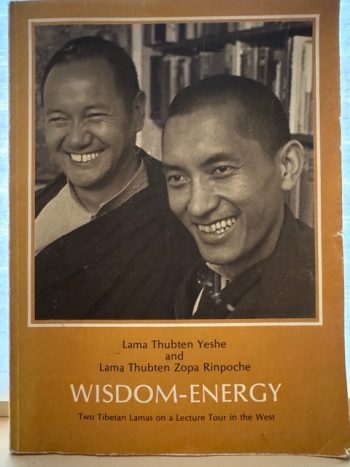
Merry’s original copy of Wisdom Energy.
Next were stops in Thailand and Burma and then on to Nepal. I arrived in February, in time to play a little and eat cake in Kathmandu before heading up to the famed Kopan for the month-long course in March. The course was taught by a western nun, Yana, and I drank it up. It filled in all the blanks. My environmental education had laid the perfect foundation for understanding interdependence and cultivating respect for all life forms, but it had left me hating people. All those horrible people that were destroying our beautiful planet. I couldn’t reconcile how to love the earth and human beings at the same time. Until Yana taught us about karma, future lives, lower realms and compassion. Then it all fit together.
After the course I played around some more, had a little love affair with a Nepali and thought about becoming a goat farmer on his land beneath the Annapurna range, but the teachings had already captured my mind and I knew I had to get back to Kopan. And when I heard that The Great Lama Zopa Rinpoche, who I still hadn’t met, would be going to Lawudo to lead a Nyung Nä retreat, there it was…the poster…the tears…the place I had to go and the being I had to meet. Clearly, I was headed next to Lawudo.
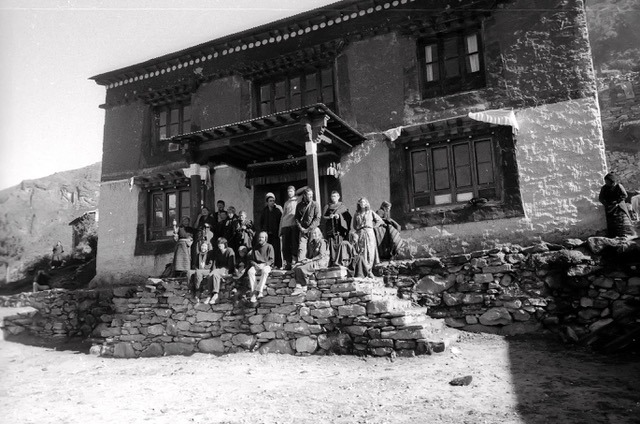
Merry Colony at Lawudo, May–June 1980. Photo courtesy of Merry Colony.
It was there, in the Lawudo Gompa, that I first lay eyes on Lama Zopa Rinpoche and it was there that I first heard his holy speech. And it was there, when he broke down, sobbing on his throne when talking about the suffering of sentient beings that I realized there would be no Indonesia, no traveling the world. I was sitting at the feet of someone the likes of whom I’d never met or even dreamed of, and I wanted to sit there forever. There was just one nagging question that needed answering……should I marry Adam??
So, I asked Rinpoche’s attendant, Ani-la Jampa Chokyi, if I could meet with Rinpoche as I had a very important question to ask. She gruffly and without hesitation said, “no,” but added that I could write my name and my question and she’d get back to me. I told her she didn’t understand that Lama Zopa didn’t even know me and I had a life-shattering question to ask. She said if I wanted an answer I’d have to write it down. So I did. My name and my question: “should I marry Adam or devote my life to the Dharma”? To my amazement the answer came back quite quickly. It was written. I don’t know if it was Rinpoche’s writing or Jampa Chokyi’s. I don’t remember that part. But I remember with crystal clarity what the note said. It said, “medium benefit to marry Adam if we both spend five years in a cave first and excellent to devote the life to Dharma.” Option one: not happening; option two: my life course was now set. All I had left to do was tell Adam. And I still hadn’t met Lama Zopa face to face!
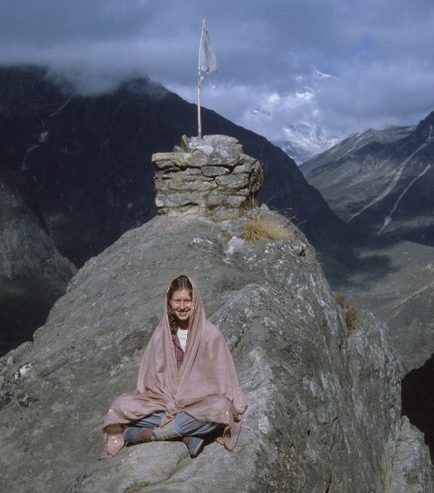
Merry Colony at Lawudo, May–June 1980. Photo courtesy of Merry Colony.
Walking down from Lawudo another cosmic thing happened. I was told there was a great meditator, Gomchen Rinpoche, living in a cave above the village of Benkar, and now that I was on the path of the great meditators I thought I must meet this lama. So, I bought a pound of butter as an offering and made my way to a hermitage that I saw under a rock near the village of Benkar. There was a meditator in the cave, and I offered him my butter only to find out after I left and rounded the bend to Benkar that that wasn’t Gomchen or Gomchen’s cave. Instead, some villagers pointed up an impossibly steep hill behind the village and told me that is where Gomchen lives. By now it was raining hard, and I didn’t have an offering, so I bought another chunk of butter and headed up what felt like the Matterhorn. Halfway up I slipped on the wet grass, dropped my backpack and the butter went rolling down the mountain. I couldn’t show up empty-handed so retrieved the now totally dirty butter and continued up the mountain. And there I met the great Gomchen Rinpoche who smiled and laughed and offered me all kinds of food that he pulled from an old burlap bag. But here’s the cosmic part: There were a few small windows in Gomchen’s cave that were covered with rice paper to keep out the cold and when I looked out those windows, I saw the scene I had seen on Santa Cruz Island. The scene that I had remarked to Adam looked like Nepal. This Buddhist stuff was blowing my mind!
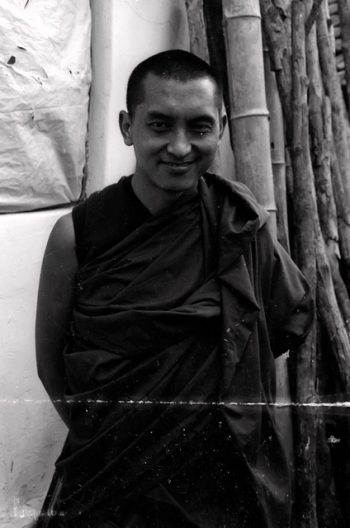
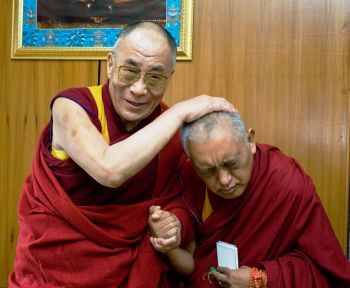
Lama Zopa Rinpoche at Sera Monastery, July 1980. Photo courtesy of Merry Colony.
When I got back to Kathmandu a friend, Robyn Castles, asked me if I wanted to go to Sera Monastery with her. She said His Holiness the Dalai Lama would be there and more importantly (to my ears at that time) Lama Zopa Rinpoche was there too. I immediately said yes. It took us days to get there, bus after bus after train after train and at long last we landed at Sera in South India. Piero Cerri and Ani-la Zia were taking care of Rinpoche, and I asked if I could meet with him. This time I got a yes.
I have no memory at all of what Rinpoche said to me, but I remember the vajra hook that went into my heart when he smiled at me. The smile that communicated a total knowing, a single gesture that made everything up to that moment make sense; the oak tree, the poster, leaving my previous life behind, traveling around the world, it was all to bring me to that room at that moment to meet that being. And at that moment there was not an iota of doubt. Not a cell in my body that was holding back. I had met my root guru and from now on my life would be in his hands.
With grateful thanks to Merry Colony for this precious personal account
Please read more of Merry’s story which we published in Mandala in 2012 when Merry left FPMT International Office.
Please also read Harry Sutton’s Road to Kopan story, “Tibet, Tibet, I have to go to Tibet!”
Are you an early student of FPMT who was there at the beginning? Do you have a story to share about how you met Lama Yeshe or Lama Zopa Rinpoche or the impact they have had on your life? Have you personally achieved or actualized a request, advice, practice accomplishment, or project given to you by Lama Yeshe or Lama Zopa Rinpoche? We want to hear from you!
Please explore all of the resources we have compiled related to FPMT history. We look forward to all of your creative ideas on how to bring this year-long celebration to your own local activities and personal practices! Please use the hashtag #50YearsFPMT in your social media posts so we can all be connected in this way.
Foundation for the Preservation of Mahayana Tradition (FPMT), is a Tibetan Buddhist organization dedicated to the transmission of the Mahayana Buddhist tradition and values worldwide through teaching, meditation and community service.