
 receive our newsletters
 join Friends of FPMT

In 1974, Tom and Kathy Vichta helped organize the first lamrim course held in the West, at Diamond Valley in Queensland. From that course came Chenrezig Institute, bringing Tibetan Buddhism to Australia and becoming the first FPMT Center, now celebrating fifty-two years of service. As a continuation of our yearlong celebration of the FPMT organization turning fifty in December 2025, we are delighted to share the story of Tom and Kathy Vichta, one of the first couples among the early students of FPMT! We rejoice in Tom and Kathy’s lifelong service and share their story here, in Kathy’s own words.

Lama Yeshe and Lama Zopa Rinpoche with Tom Vichta, Kathy Vichta, and baby Goodie. Yeshe Khadro and Ann McNeil also appear in the photos. Mooloolaba, Australia, 1974. Photo Credit Lama Yeshe Wisdom Archive.
Kathy, Tom, and Baby Goodie on Their Road to Kopan
Lama Yeshe used to say that we should really be grateful to the Chinese because they were the condition for Tibetan Buddhism to leave its isolation in Tibet and spread far and wide, even to this remote area of Australia. An interesting thought and one that could be discussed for a long time. But really, I think the best thing for me to talk about is my own experience of how Buddhism, or more specifically the Tibetan Buddhism taught by my teachers, Lama Yeshe and Lama Zopa Rinpoche, was planted and nourished outside India and Nepal, the countries the Tibetan refugees had, for the most part, fled to from 1959 onwards.
In late 1969, my husband Tom and I escaped from Melbourne and its busy city life for a more natural country life. We found a run-down property in Diamond Valley on the Mooloolah River, where we set ourselves up to grow food, build a house, and raise a family. Many people visited wanting to do the same thing, but for most it was impossible because of the land prices, and they went home disappointed. Tom and a friend found 140 acres (about 57 hectares) of land in Yandina (a town nearby), and were able to divide it into fourteen different sized plots and sell it to fourteen happy people at $100 per acre — thus Starlight Community was born and more than fifty years later it is still running.
Two friends, Nick Ribush and Marie Obst (later Ven. Yeshe Khadro), used to visit from Brisbane on weekends, and one day Nick and Tom went off in their beach buggies through the bush and ended up at a lovely property with a view to the sea. They thought this would be a good place to try the same process that had worked so well at Starlight Community. A farmer walked by, who just happened to own the land, which was 160 acres (about 65 hectares), and when they asked if he wanted to sell it and, if so, how much he’d like for it, it turned out they had enough to buy it, together… and a couple of days later they did. The land didn’t turn out to be quite as easy to divide in the same way as Tom had been able to do in Yandina, and soon Nick and Marie were planning an overseas trip, which would eventually take them through Indonesia and Thailand to Nepal and Kopan Monastery. That was in 1972; we had a young baby, Goodie, and life was very full and happy.
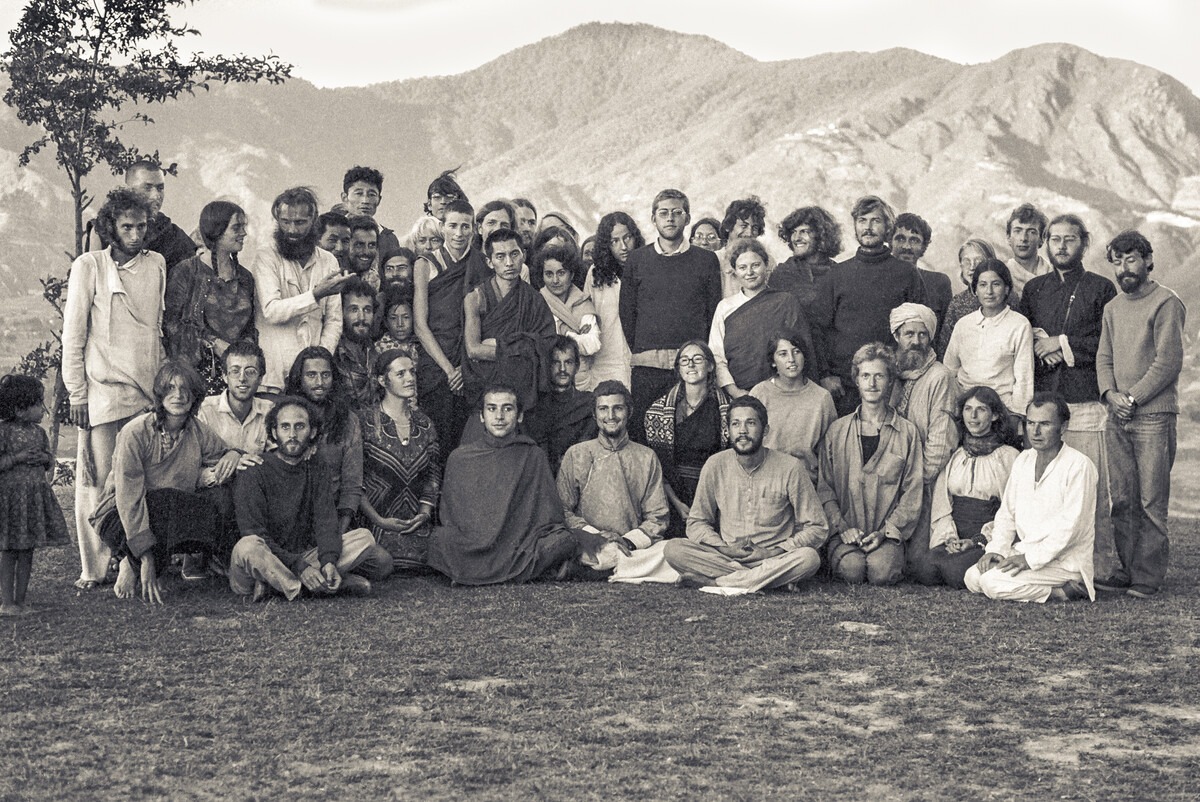
Third Kopan Meditation Course Participants. Nepal. December 1972. Photo Credit Lama Yeshe Wisdom Archive.
So… Nick and Marie arrived at Kopan just in time for the third course (November 1972) that two amazing Tibetan Lamas had started to offer to Western students, and decided to stay. During that course Nick began writing enthusiastic letters to friends in Australia, telling them they must come immediately to Nepal — it was the most important thing they could do! We received our letter in Sydney as we were travelling south in our Kombi with baby Goodie, and, quite frankly, it seemed there was no choice — Nick was persuasive, but also it felt as if this was fate… it was something we were supposed to do. Tom had been in Kathmandu in about 1966–67 and already felt some affinity with the Tibetan monks he saw there.
We headed to Canberra, had the baby added to our passports, and planned how to get to Nepal, the cheapest route being via Indonesia, Thailand, and India, with a side trip to Nepal from there. The journey was not easy. Goodie turned one in Indonesia, and I managed to pick up bacterial dysentery along the way, but we made it into Kathmandu — and amazingly ran into friends from Melbourne that first day. Nick’s letters had brought about twelve friends and his lovely mother, Beatrice Ribush, to Nepal to do the next course at Kopan, in April 1973.
I personally had no plan to attend the course — I had a baby to care for, after all — and really no interest in taking on a spiritual path; Tom had always been interested in spiritual questions and had investigated Buddhism. I set myself up for a month near Boudhanath stupa in a house Max Matthews had lived in, planning to visit Kopan from time to time and have a peaceful month in relative comfort. Almost immediately, there was some kind of currency crisis, and the Nepalese banks stopped changing Australian dollars — and that was all we had! The only place I could afford to stay and eat was Kopan Monastery, where they accepted our Australian money. So, I headed up to ask for help, and it was as if they knew I was coming. Tom had found a little house (actually an upstairs room above where the animals were kept in a little mud-brick house belonging to a Nepalese family). Another lady at Kopan had a little boy about the same age as Goodie, and she had already arranged a Nepali babysitter, so… I had no excuse not to attend the course (although I was excused from the 4:30 a.m. precept sessions).
Lama Zopa Rinpoche taught long sessions about lamrim twice a day, and the approximately 180 students were pretty supportive for the most part, but Kopan was hard going for a Western girl with a baby, no running water, no electricity, and food that was probably quite good, but not suitable for a feeding mother with a colicky child. Goodie was quite ill twice with gastroenteritis, and when I eventually took her down to the hospital outside Kathmandu, I had so little money I had to choose between staying to wait for her tests, or getting transport back to Kopan. That evening I sat in the little library room at Kopan feeling quite miserable, but a tap on the door revealed Lama Yeshe peering in, asking if he could help. I cried and told him what was going on, and he cuddled Goodie and told me to just give her black tea for a couple of days and let her eat some biscuits he blessed and gave me — simple sugar tea biscuits…Of course, Goodie was better almost immediately. Goodie met Lama Yeshe and Lama Zopa Rinpoche at the age of one at Kopan and remained quite close with them when she was small. There is a lovely story Lama Yeshe told (and then it was retold many times, much to my daughter’s embarrassment). He said that one day, when they were eating lunch together, Goodie interrupted Lama to tell him not to speak with his mouth full, that she couldn’t understand him and she could see the food in his mouth. Lama thought this was fabulous: a little child (I think she was three at the time) teaching him something that was actually a vinaya instruction.
Soon I went back to attending Lama Zopa Rinpoche’s teachings, and with Lama Yeshe’s blessing, the teachings came alive for me! I remember we were hearing about the qualities of the Buddha, and I really saw that for me Lama Yeshe WAS a Buddha.
So, we finished the one-month course, took refuge with Lama Yeshe and received our Buddhist names, and we attended our first initiation without knowing much about what was going on, except that it had something to do with Chenrezig…
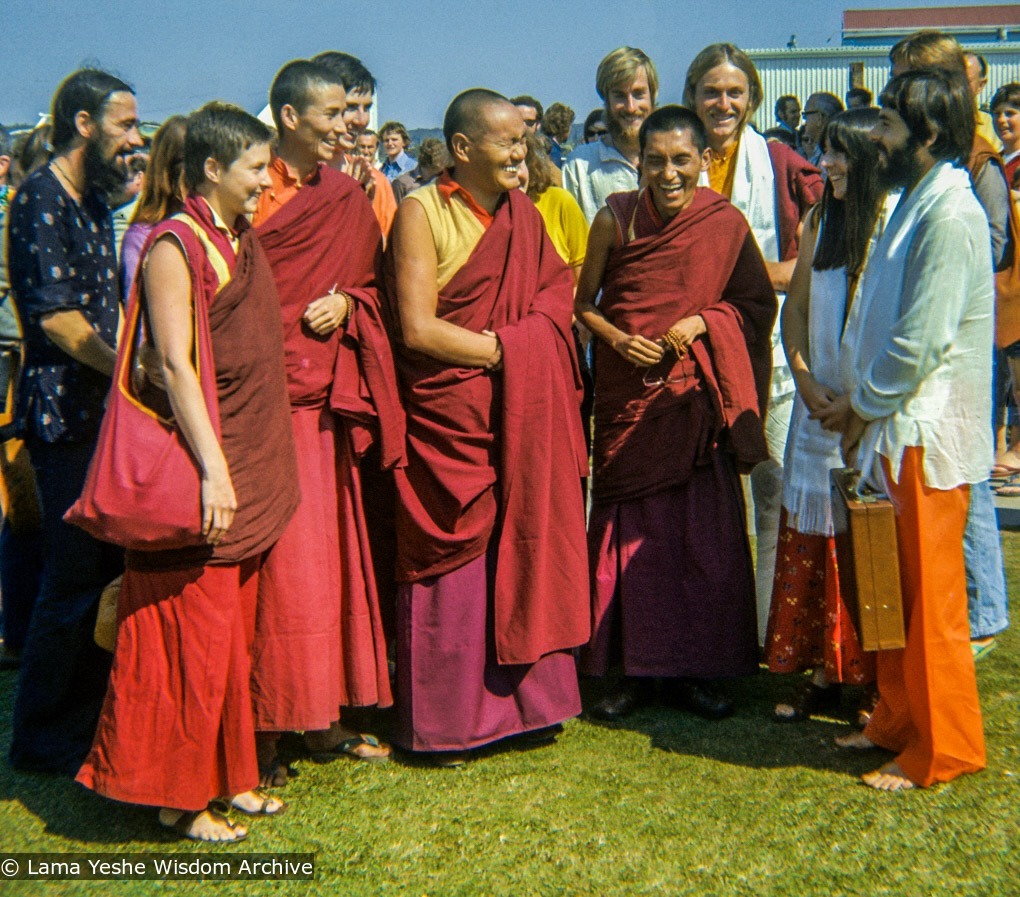
Lama Yeshe and Lama Zopa Rinpoche arriving at Maroochydore airport, welcomed by Tom and Kathy Vichta. Queensland, Australia, 1974. Photo by Wendy Hobbs. Photo courtesy of Lama Yeshe Wisdom Archive.
Bringing the Dharma to Australia: Peace, Love, and the Lamas’ Teachings by the River
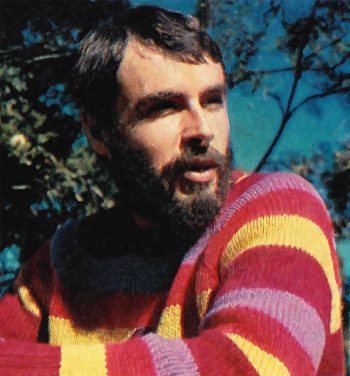
Tom Vichta at Chenrezig Institute, August 1976. Photo courtesy of Chenrezig Institute.
We travelled a little more and went home exhausted, but wanting to continue to follow the path we had found. Tom, in particular, wanted to learn more and to see whether this Eastern wisdom would relate to the Western lifestyle. He returned to Nepal alone for the fifth course in November 1973 and really got into it.
After the course, Lama Yeshe sent him off to Tushita Meditation Center in Dharamsala for a retreat in his own cabin there, and then he travelled to Bodhgaya to meet up with the group coming from Kopan for teachings and Kalachakra Initiation with His Holiness the Dalai Lama. It became very important to Tom to check whether these Buddhist teachings would be applicable in Western life. It was during those special days in Bodhgaya that Tom asked Lama Yeshe to come to Australia and was quite surprised when Lama Yeshe immediately said, “Give me a ticket, dear, and I’ll come!”
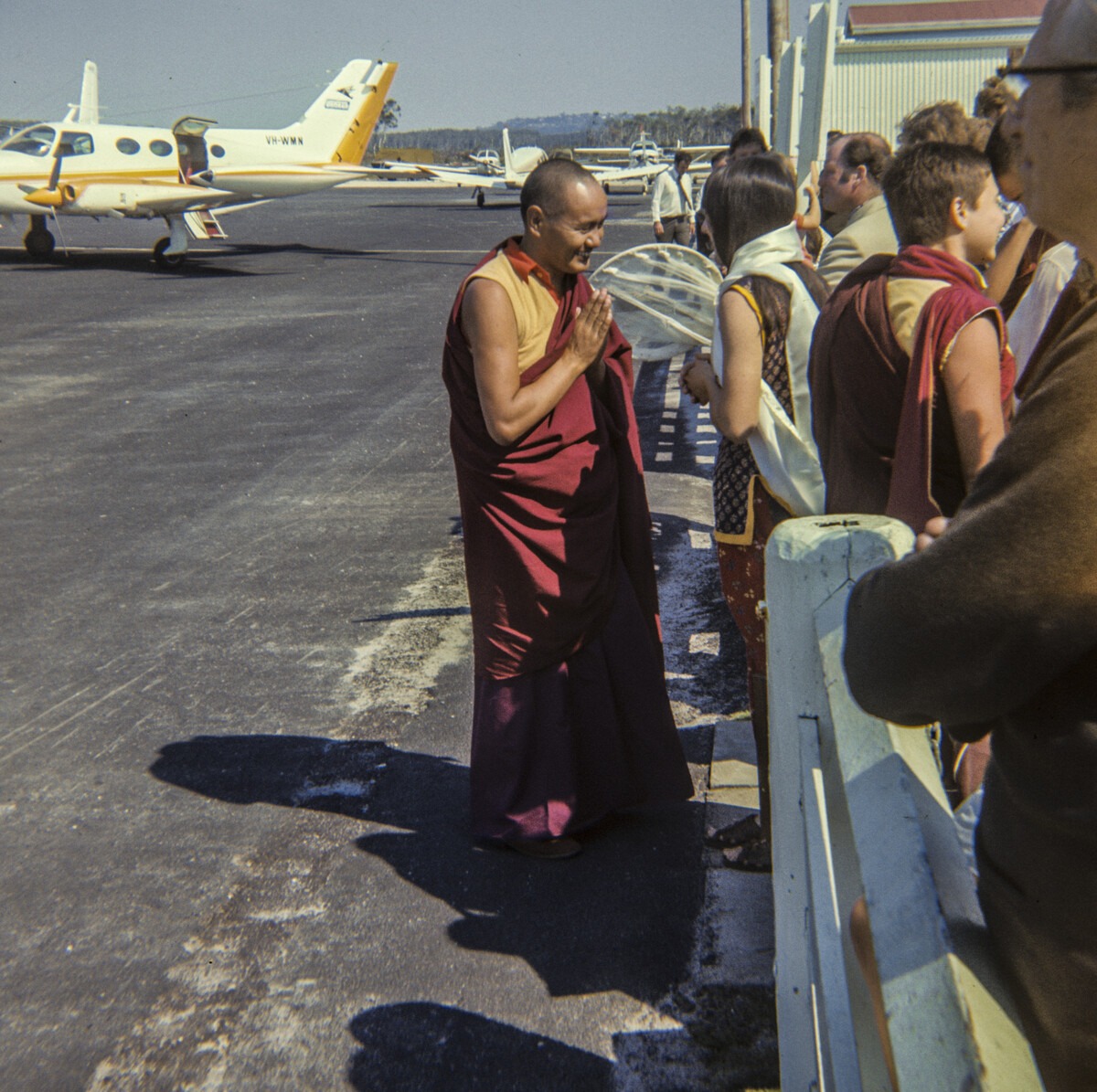
Lama Yeshe arriving at Maroochydore airport, welcomed by Kathy Vichta. Queensland, Australia, 1974. Photo Credit Lama Yeshe Wisdom Archive.
I hadn’t heard from Tom for ages, but then, in mid-January, I received a phone call at the friend’s place where I was staying in Brisbane — an excited call from Varanasi. Lama Yeshe and Lama Zopa Rinpoche were coming to Australia in August 1974, and we were to organise a Kopan-style meditation course in September!
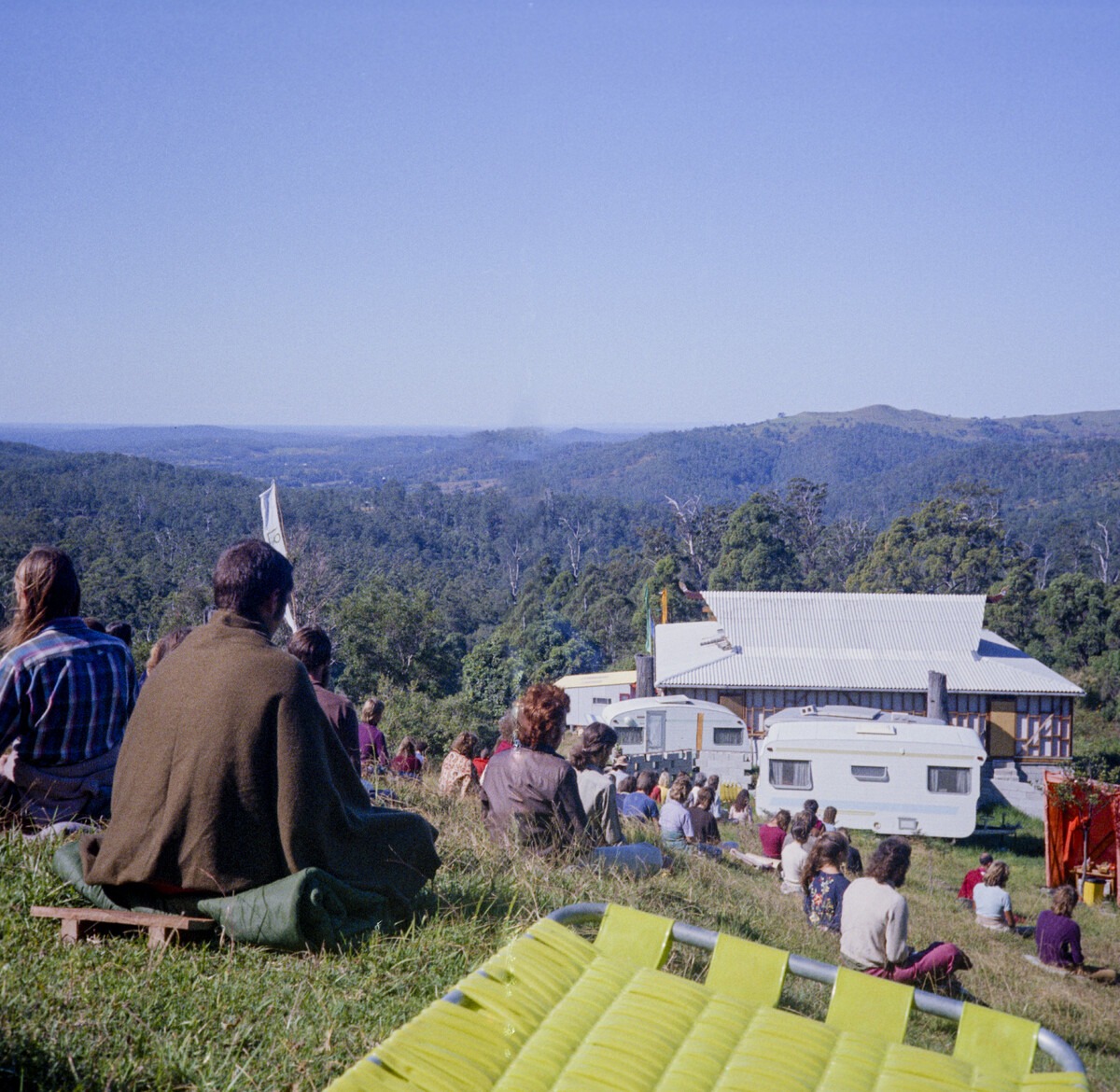
Chenrezig Institute, Australia, 1975. Photo Credit Lama Yeshe Wisdom Archive.
We lived on a farm in the bush five miles (about eight kilometers) from the nearest very small town (with a river that often flooded our road, keeping us in or out). We had electricity, but of course there were no computers in those days, no emails… and we had no phone and quite frankly no money. Tom had sold our second car to be able to go back to Kopan the second time. We had to go to the local post office to receive or make a phone call. And yet, once Tom arrived home, we started planning. Across the river from our farm was a lovely big flat paddock next to a beautiful clear river — cow pasture, quite lush and green. We called it Magic Valley (because lots of magic mushrooms grew there). Tom approached the local family who leased it from a timber company to run their cattle there, and asked if we could use it for a month. Amazingly, with a few instructions about leaving it the way we found it, they agreed!
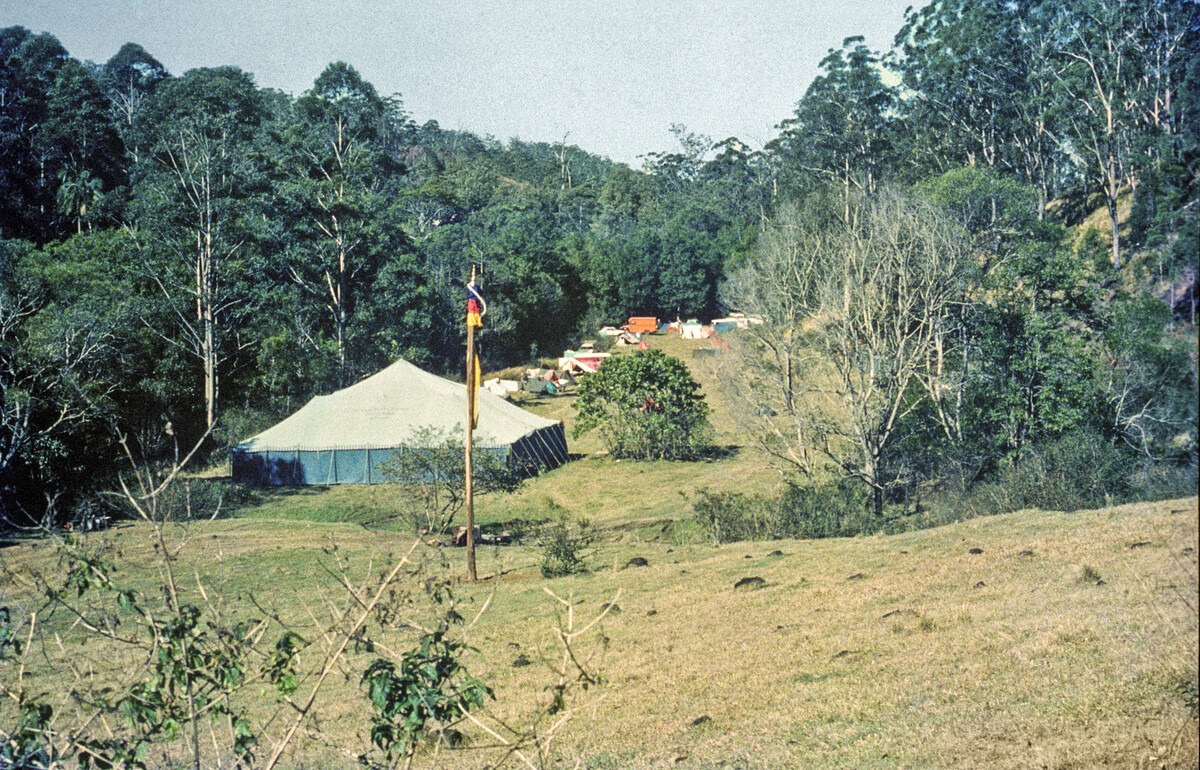
The circus tent, later the gompa, hired at Diamond Valley. The lamas taught their first retreat in Australia at Diamond Valley in southeast Queensland, August 1974. Photo Credit Lama Yeshe Wisdom Archive.
It was the decade of pop festivals, and really the plans started that way. We built simple cabins for Lama Yeshe and Lama Zopa Rinpoche on the hill. We hired a huge circus tent — big enough to hold two hundred people or more — and another, smaller army tent to use as a field kitchen, and made arrangements for providing vegetarian meals for up to 200 people, grinding our own soy coffee and having a local baker provide hundreds of healthy rolls a day. The portable toilets of the ’70s were somewhat more primitive than today’s portaloos, but these were hired and placed in a row in the valley, as well as a tin shed which served as office and shop (and my sleeping quarters from time to time). There was no power on the site and everyone brought (or even built) their own accommodation. We truly had no experience and very little money and yet somehow it came together.
Ven. Yeshe Khadro came ahead early and helped us get ready, especially to prepare the text which Lama Zopa Rinpoche and Nick Ribush had put together for Kopan courses and that we printed for the people coming to Diamond Valley using the ‘Roneo Machine’ at the local school.
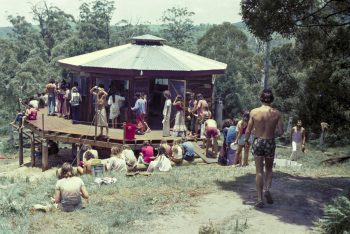
The kitchen/dining area, Chenrezig Institute, Australia 1975. Photo Credit Lama Yeshe Wisdom Archive.
Without a phone or social media or much advertising, somehow the word got out, and by the end of August, around two hundred people made their way to Diamond Valley to camp in the bush, wash in the river and sit in a tent listening to teachings that most of them knew nothing about for a whole month! People volunteered to help cook and clean, and one amazing man even came every day with his four-wheel drive and trailer, to remove the “buckets” from the toilets! So incredibly kind! After a quick trip to the US and some time in Melbourne, Lama Yeshe and Lama Zopa Rinpoche finally landed in the tiny Maroochydore airport in Queensland at the end of August 1974, with a tall Canadian nun called Ann McNeil, in time to start the first–ever lamrim course in the West, in Diamond Valley, in the Sunshine Coast hinterland. They were met by people who had come early to help with the preparations, a group that included people who are still involved today, like Colin Crosbie (a previous director who is still living at the Institute and currently chairs the executive committee), Krissie and Garrey Foulkes (another previous director), and Elli and Lindsay Pratt (yet another previous director who lives nearby). They were greeted at the valley by others, many of whom had met them at Kopan and were to go on to open centers in other parts of Australia.
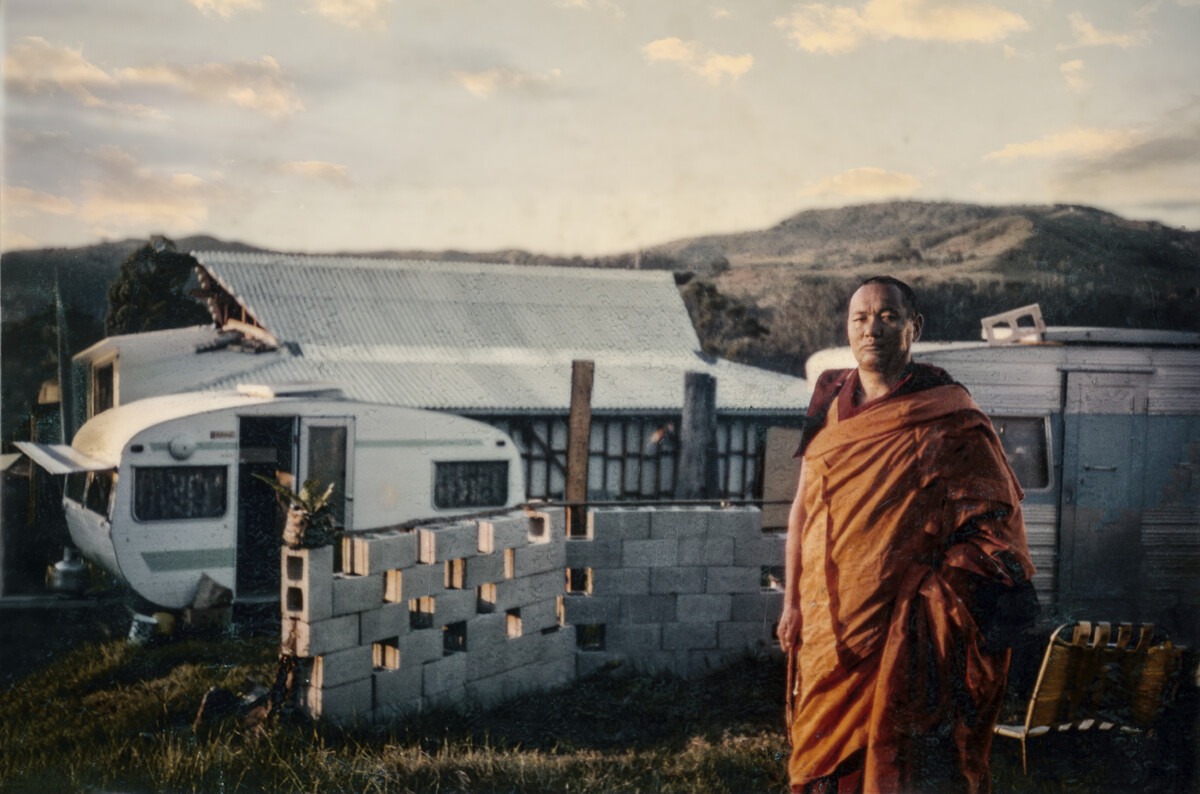
Lama Yeshe at Chenrezig Institute, Australia, 1975. Photo courtesy of Chenrezig Institute.
After a few frantic, incredibly busy days, Lama Yeshe and Lama Zopa Rinpoche settled into the rather primitive rooms that had been built for them on the hillside, the kitchen started providing nourishing meals, and we all settled into many hours of teachings and meditations in the tent.
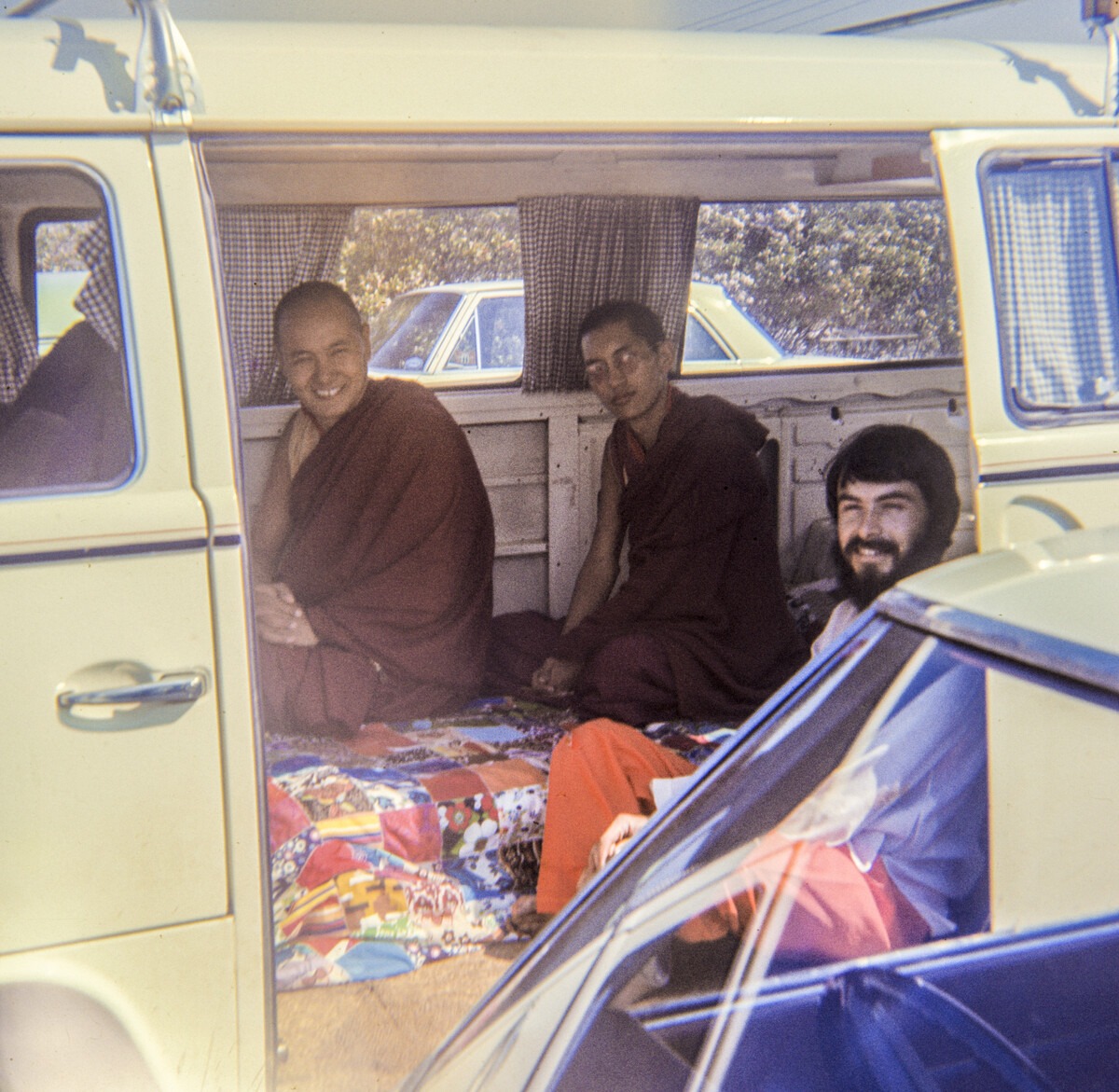
Lama Yeshe, Lama Zopa Rinpoche, Tom Vichta, Chenrezig Institute, Australia, 1974. Photo of Wendy Hobbs. Photo Credit Lama Yeshe Wisdom Archive.
Lama Zopa Rinpoche would teach lamrim from the text that had been prepared, The Wishfulfilling Golden Sun, twice a day, and Anila Ann McNeil would lead discussions and meditations. Then, when people were feeling a little overwhelmed — like they couldn’t take any more — Lama Yeshe would come to give a special talk and have us all in stitches, inspired and happy, and able to go on!
I found it all very full-on, with a two–year-old at my feet, and begged my mother for help. She very kindly came up from Melbourne to look after Goodie for over two weeks, bearing the primitive living remarkably well. A British monk, Phra Khantipalo, who had spent twelve years in Thailand, was staying with us, and it was quite an advantage for him to be able to drop in for a cuppa and explain a little about Buddhism to my Presbyterian Scottish mother. She loved the lamas, of course, especially Lama Yeshe, but found them quite difficult to comprehend. Even Tom’s mother dropped in with a partner, and they parked their caravan in the valley for a few days — and were similarly delighted by dear Lama.
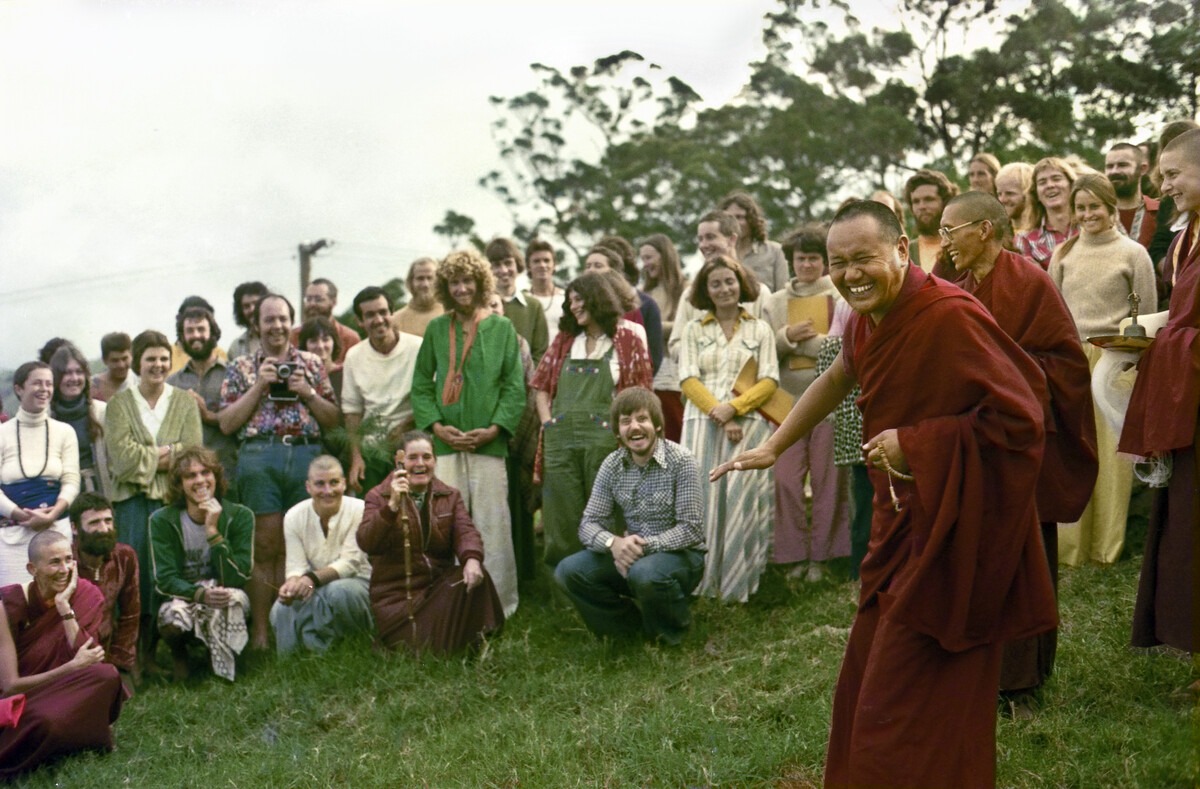
Lama Yeshe and Lama Zopa Rinpoche with Yeshe Khadro and Ann McNeil, blessing the prayer-flag pole, Chenrezig Institute, Australia, 1976. Photo Credit Lama Yeshe Wisdom Archive.
Moving Forward: Building the First FPMT Center
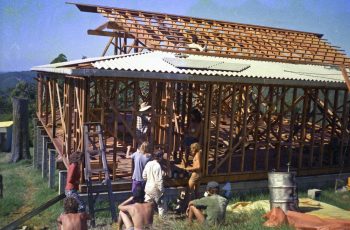
Construction of the gompa at Chenrezig Institute, 1975. Photo Credit Lama Yeshe Wisdom Archive.
About two–thirds of the way through the course, Ann McNeil called a big meeting in the tent to see what people wanted to do after the course. A great number said they really wanted to continue to learn and practise what Lama Yeshe and Lama Zopa Rinpoche had been offering them so generously; they wanted something to continue after Lama Yeshe and Lama Zopa Rinpoche had left. Three pieces of land were suggested — our own farm in Diamond Valley, a property near Maleny, and the 160 acres (about 65 hectares) in Eudlo that Tom and Nick had found in 1972. Money was pledged and we started to think in earnest about how to move forwards. Lama Yeshe was quite definite that it would not be on our farm — that was our home, and the Institute would be HIS! He checked carefully with one of His Holiness’s tutors, Trijang Rinpoche. Then Lama Yeshe and Lama Zopa Rinpoche visited the Eudlo land that Tom and I (and Nick and Ven. Yeshe Khadro) had offered. At that stage it was an unused dairy farm, with no access or facilities but a great view of the sea. Tom was feeling very uncomfortable that this was not such an appropriate place, but Lama Yeshe noticed his discomfort and, with a big hug, assured him it was absolutely perfect.
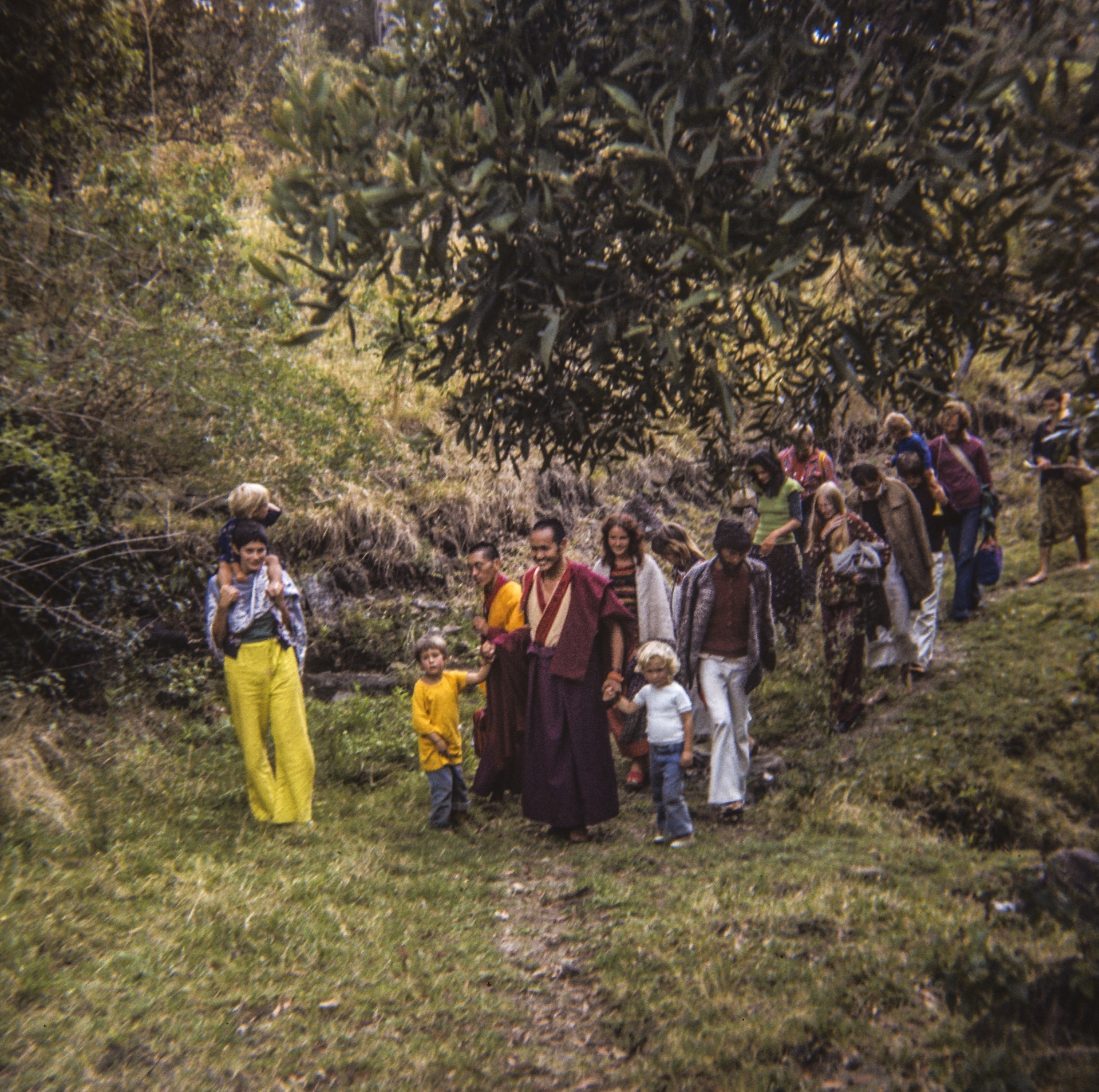
Lamas and students walking to the land, Eudlo. Australia, 1974. Photo Courtesy of Kathy Vichta.
At the end of the course, in September 1974, students walked a few kilometers along the river and up to the new land with Lama Yeshe and Lama Zopa Rinpoche (others made the precarious drive in with tables and cushions and tsog). On the lawn where Nick and Tom had first decided to buy the 160 acres (about 65 hectares) of bushland, on the spot where the Chenrezig Gompa now stands, a moving puja was offered by Lama Yeshe and Lama Zopa Rinpoche accompanied by our visiting Theravadin monk Phra Khantipalo. The land was consecrated and blessed and named “Chenrezig Institute for Wisdom Culture.” Lama explained that, just as a culture is used to turn milk into yogurt, the wisdom taught at the Institute would be the catalyst for Buddhism to grow and bless countless beings. Many years later I was asked to transcribe a talk that Lama Yeshe had given about what a country center should be like. It was as if he was describing Chenrezig Institute: a little difficult to access, distant from towns, an expansive view, peaceful surroundings, with room to develop a diverse community, etc.
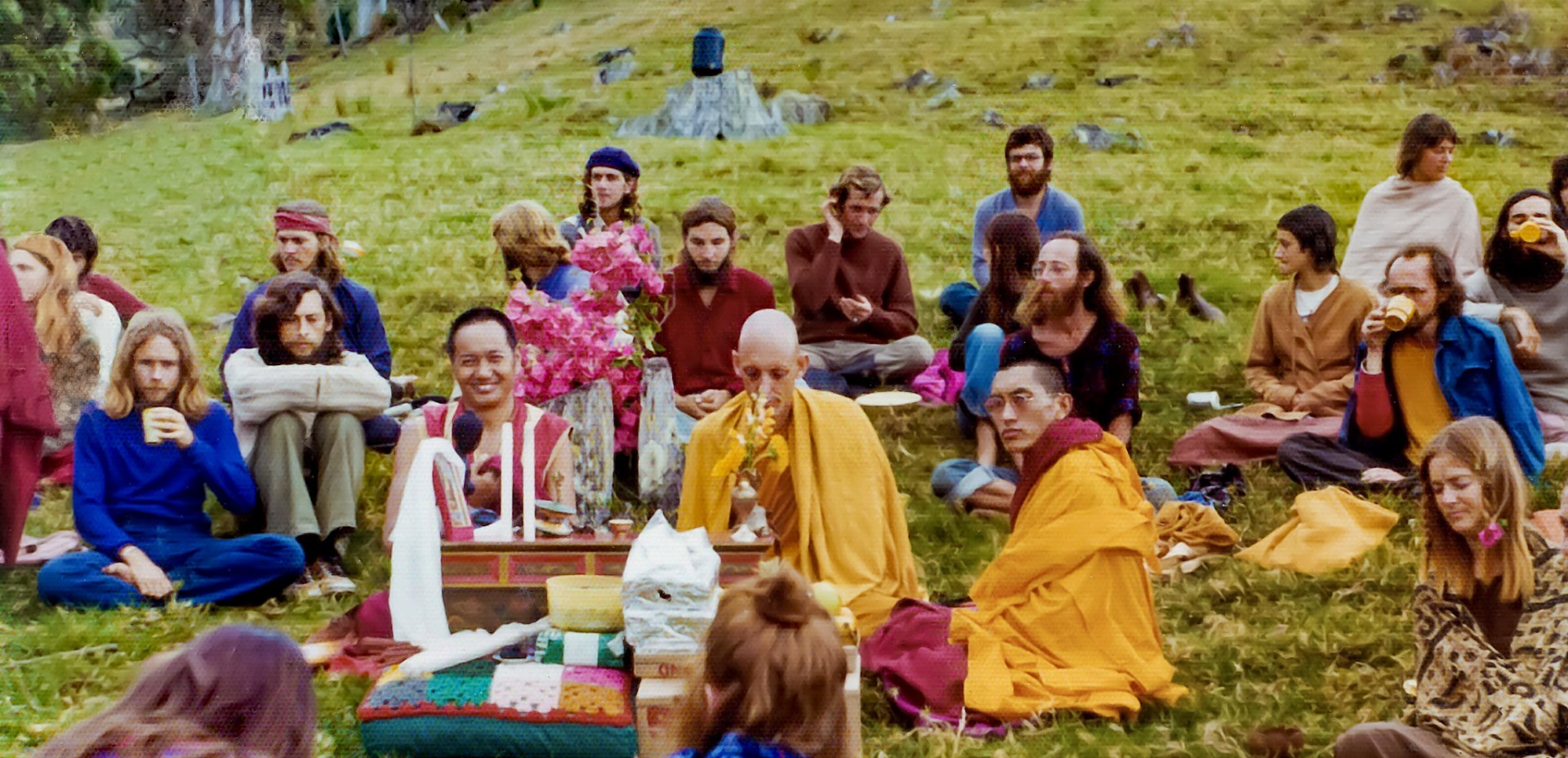
Lama Yeshe, Lama Zopa Rinpoche and Phra Kantipalo, a Theravadin monk , during the consecration puja of the Chenrezig Insitute, 1974. Photo Courtesy of Chenrezig Institute.
At the beginning we just worked day by day, happily following Lama Yeshe and Lama Zopa Rinpoche’s wishes. Honestly, I usually felt that we were just following a natural path laid out by our teachers and didn’t think of the “bigger picture” very much. But Lama Yeshe told us to plan for a long time — I don’t remember if it was fifty or five hundred years, but to us, in our early twenties, it seemed very long. In retrospect, years later, we could see that there were centers growing all over the world and that was exciting and inspiring!
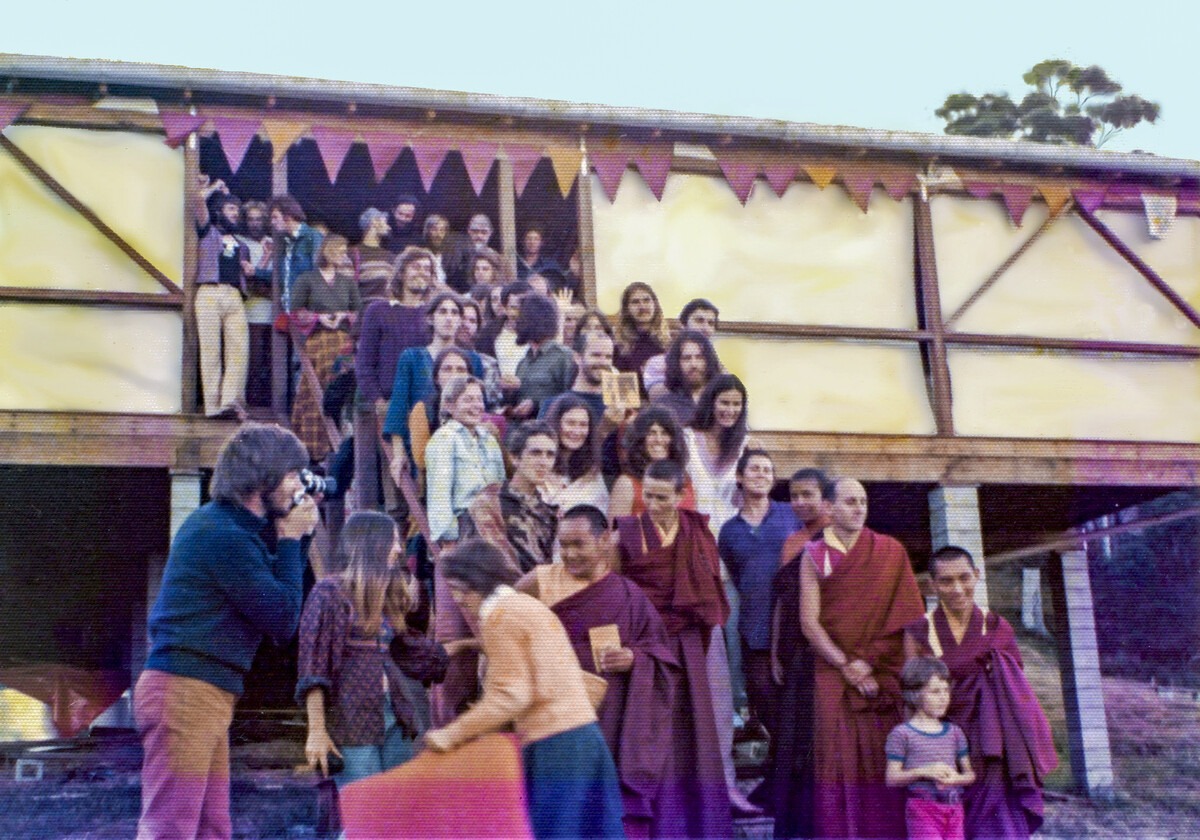
Lama Yeshe and Lama Zopa Rinpoche at the entrance of the gompa with Ven. Ann McNeil, Ven. Max Mathews, and Dr. Nick Ribush. Chenrezig Institute, 1975. Photo Credit Lama Yeshe Wisdom Archive.
To her surprise, after the consecration of the land, which would become Chenrezig Institute, Lama Yeshe and Lama Zopa Rinpoche announced that Anila Ann McNeil would stay to help establish the new Institute, and we all sadly said goodbye to Lama Yeshe and Lama Zopa Rinpoche…
Anila Ann and a group of the Diamond Valley students stayed on with us at Diamond Valley at first. The group planned and meditated together and went up to the land to clear and plant as often as they could. First they managed to build a small hut where the old farmhouse had originally stood. After some time Anila Ann announced that she simply had to move up to the property or it would never really get going. So, in January of 1975, she moved in, together with a student who arrived on the road as we were taking her up there: Eion Meades, the first resident! Tom and the others staying with us still went up every day on Tom’s trusty tractor, and gradually things started to grow.
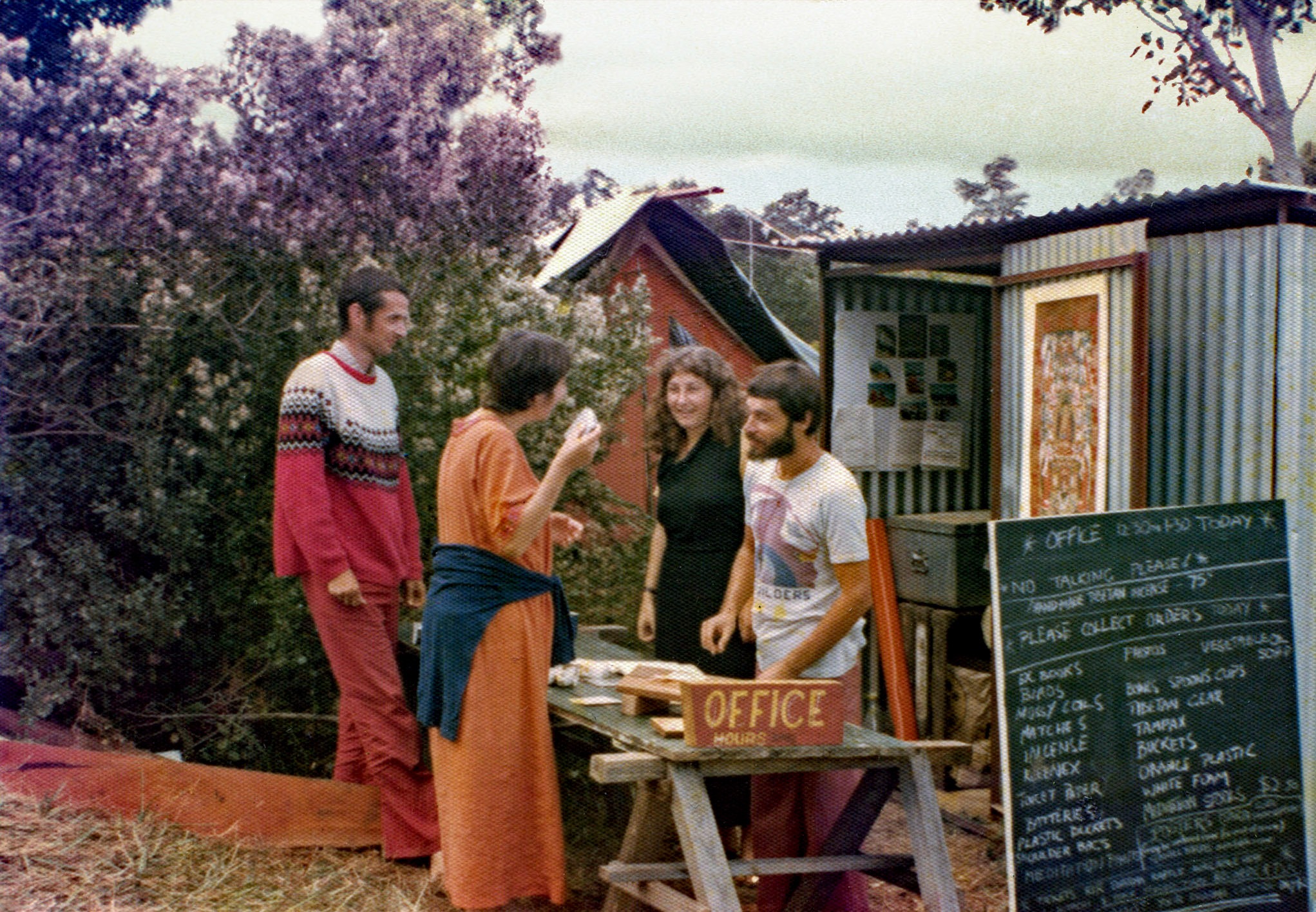
Tom Vichta with Elli Pratt, Nigel, and Yana Bowen at the first open-air office at Chenrezig Institute, set up for the first course, 1975. Photo courtesy of Chenrezig Institute.
Miraculously, by May 1975, the gompa had been built… The land, high on the slopes, was in danger of slipping, so it was decided to build on secure brick piers. Inside, on a large wooden floor (lovely hardwood bought from the local Eudlo mill), posts made from trees cut on the property held up a soaring roof, and the back wall was completed with small rooms built in on each side. It was an amazing feat. All the materials, including huge beams, joists, and rafters, had been carried by hand up the hill from the only area a truck could access — carried by many hands. When everyone was getting concerned about their lack of building experience, Steve, a long-haired builder, walked up the road offering to help; these kinds of things happened often.
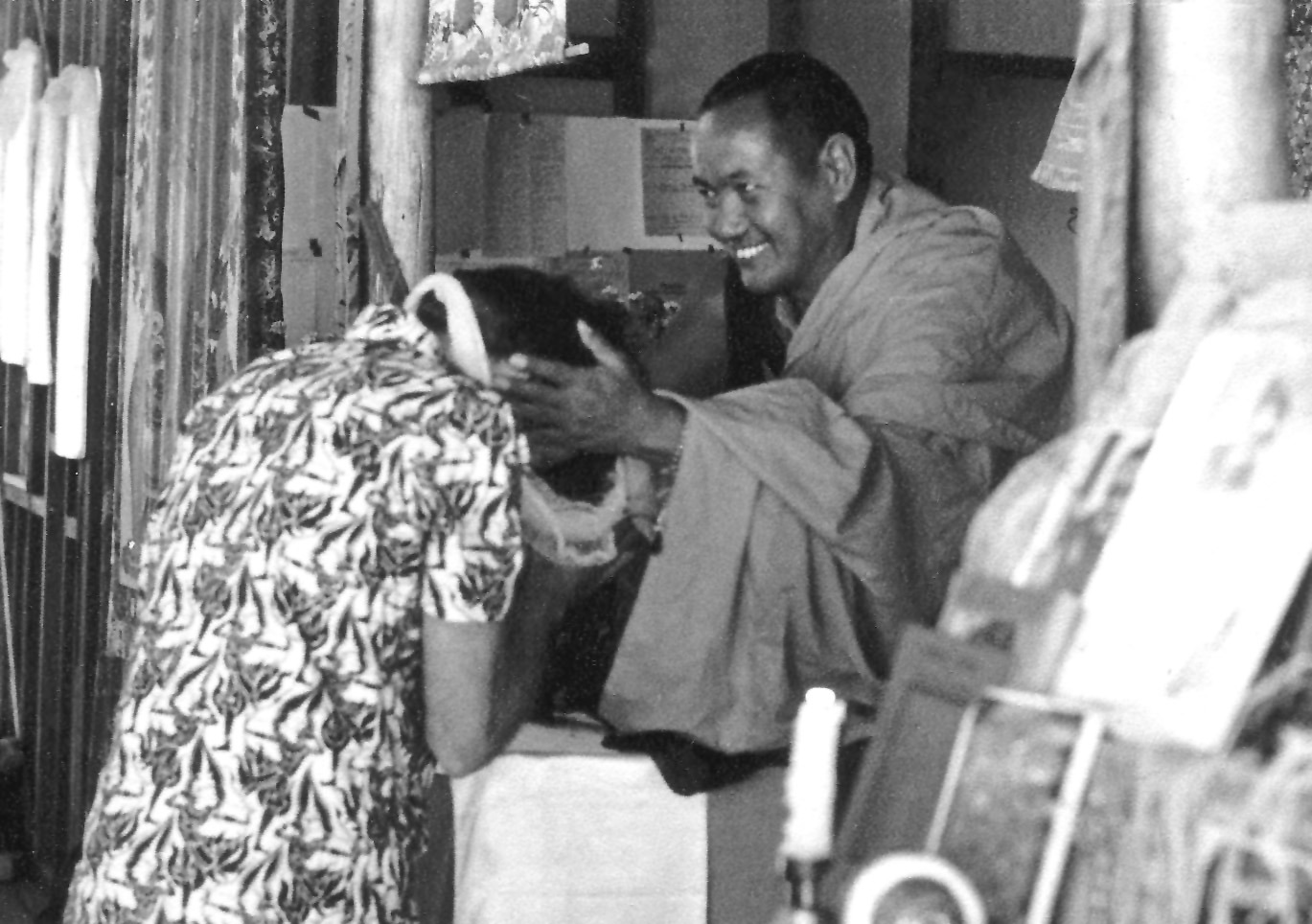
Lama Yeshe thanking Tom Vichta, 1975. Photo coutesy of Chenrezig Institute.
At first, with a small child, I was not so closely involved in the day-to-day happenings. Of course, when Lama Yeshe and Lama Zopa Rinpoche came to Queensland I found a way to be with them as much as possible, but Tom was the one who worked with Anila Ann McNeil and really got the Institute going. To raise funds for the Institute, I started small businesses, things I could do at home with Goodie at my feet: first, a clothing business, because people didn’t have comfortable clothes for sitting in meditation, which developed into a huge range of clothes and accessories; then the sale of second–hand gorgeous jackets and kimonos sent by a student who had moved to Japan; and, most successfully, porcelain wind chimes that I designed and made, block printed with Tibetan symbols and mantras. Years later we would see these in homes all across Australia and the world.
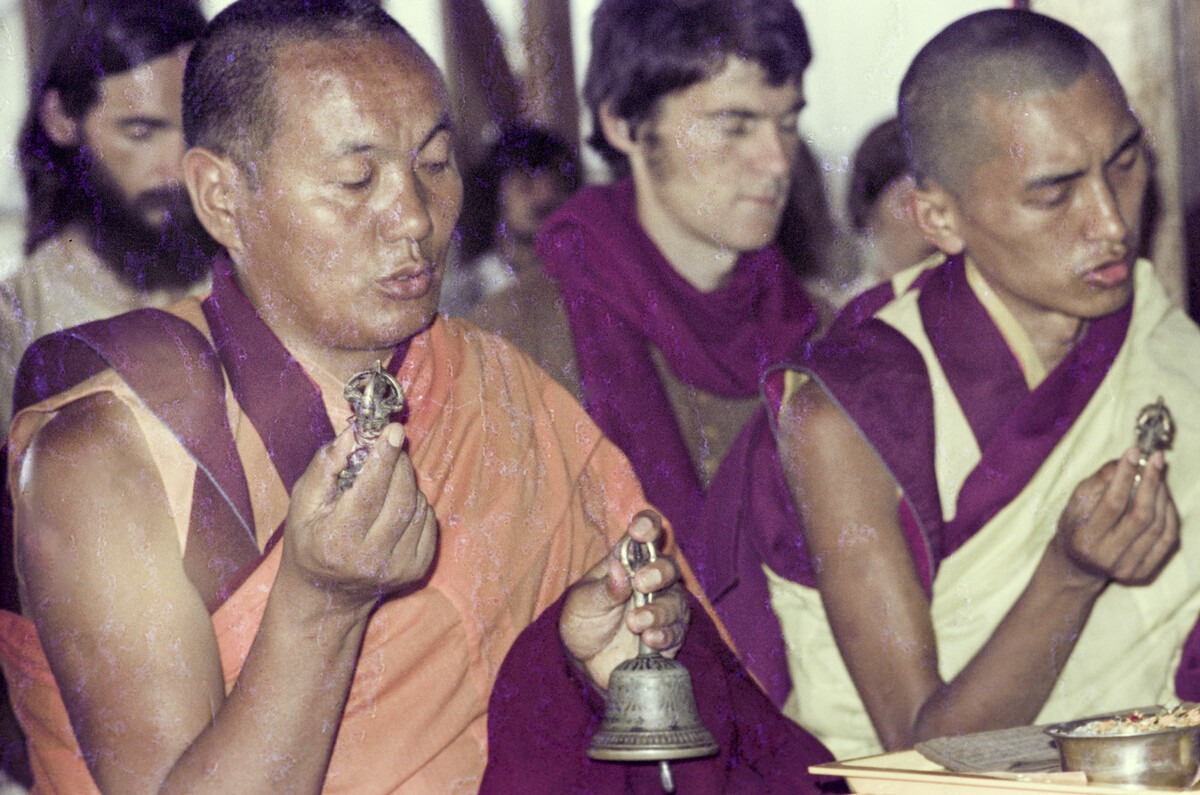
Lama Yeshe, and Lama Zopa Rinpoche leading a puja. Chenrezig Institute, Australia, 1975. Photo Credit Lama Yeshe Wisdom Archive.
By the time Lama Yeshe and Lama Zopa Rinpoche returned in May 1975, the gompa was ready for them to teach — roll-down blinds had been erected to keep out the wind and rain, and I still laugh when I remember the new altar being painted and brought in at the back of the gompa just in time for Lama Yeshe and Lama Zopa Rinpoche arriving at the front. Anila Ann now moved into one of the back rooms of the gompa, and the first little cabin was made into a kitchen which, with outside areas roofed by orange builders’ plastic, fed nearly two hundred people for the four weeks of the first course at the new Institute!
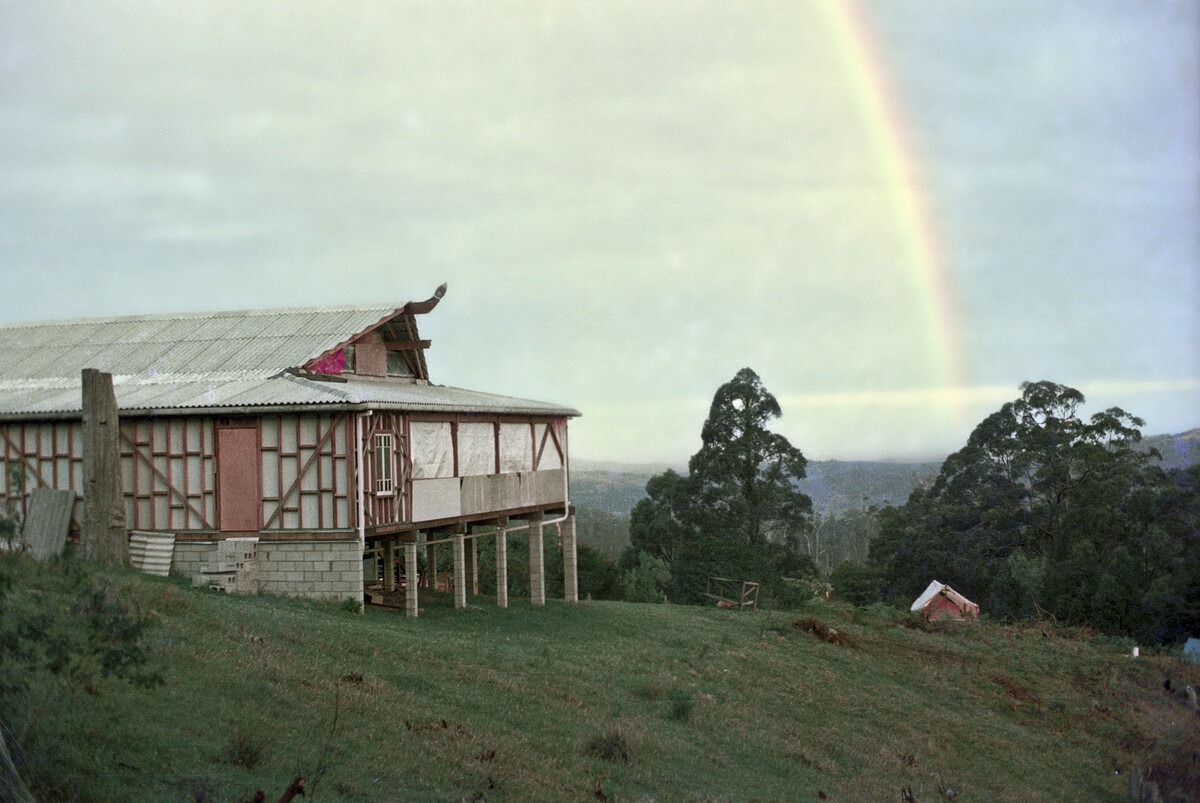
Rainbow over the gompa, Chenrezig Institute, Australia, 1975. Photo Credit Lama Yeshe Wisdom Archive.
Under the Guidance of the Lamas
Both Lama Yeshe and Lama Zopa Rinpoche visited us often during the early years, and these were very special times when they would give many instructions about how to develop the Institute. There would be meetings with the director(s), the committees, and many of the longtime students and residents, at which the lamas gave advice about the education programs, the creation of holy objects and even the family life of students. These instructions were recorded and, although completion sometimes took many years, they were followed. We had to make development plans for the local council regularly and always tried to run major plans past Lama Zopa Rinpoche. It gave us so much more confidence in our plans.
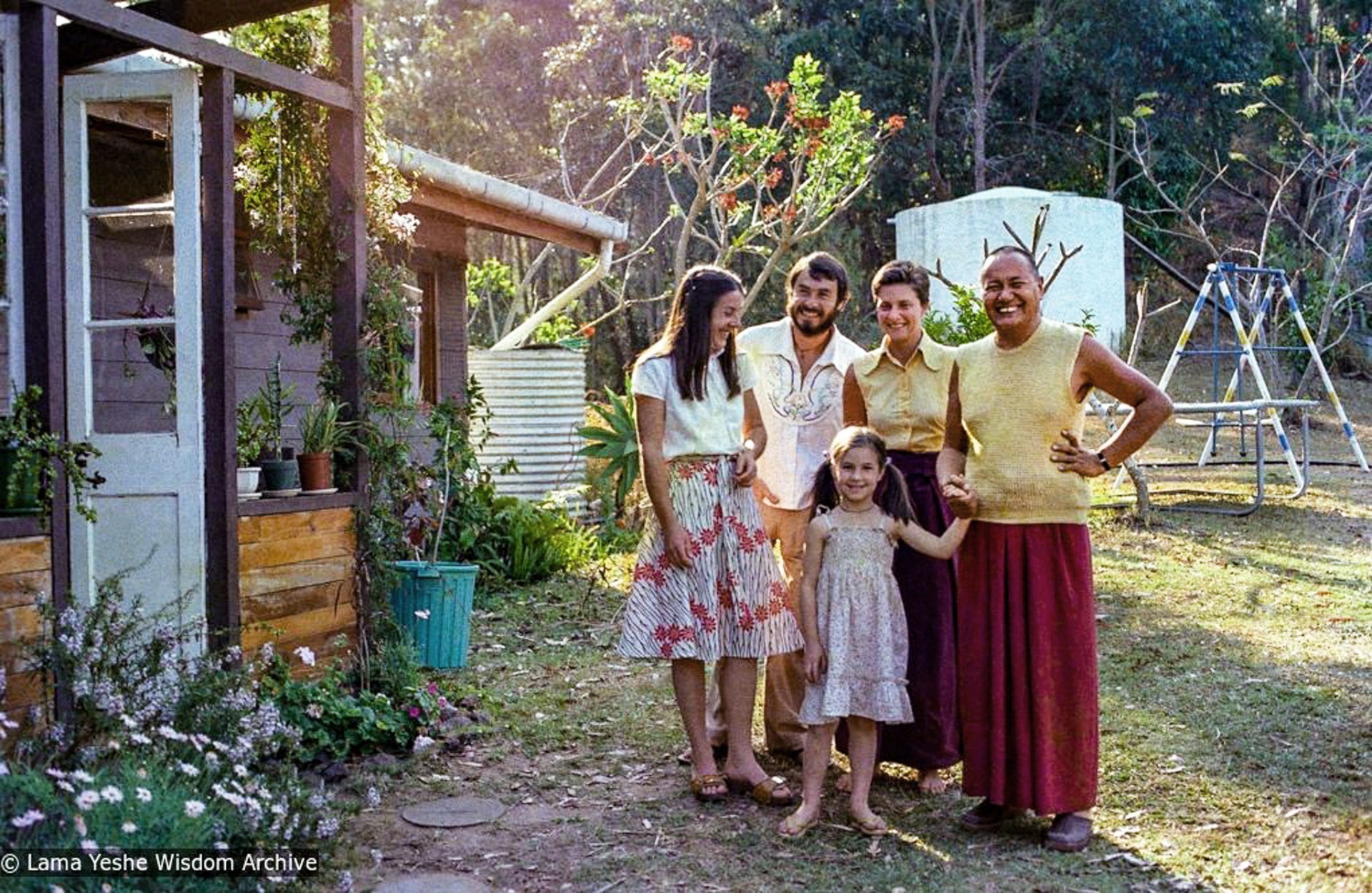
Lama Yeshe and Yeshe Khadro with Tom and Kathy Vichta and Goodie. Chenrezig Insitute 1981. Photo Credit Lama Yeshe Wisdom Archive.
There would also be joyful days of fun and celebration. The children loved to perform for the lamas! Lama Zopa Rinpoche wrote a whole script around the twelve links, and it was performed to much hilarity. One year Geshe Lama Konchog tried to train a group to perform Cham dances. Costumes were sewn long into the night, and the performance was one we will always remember!
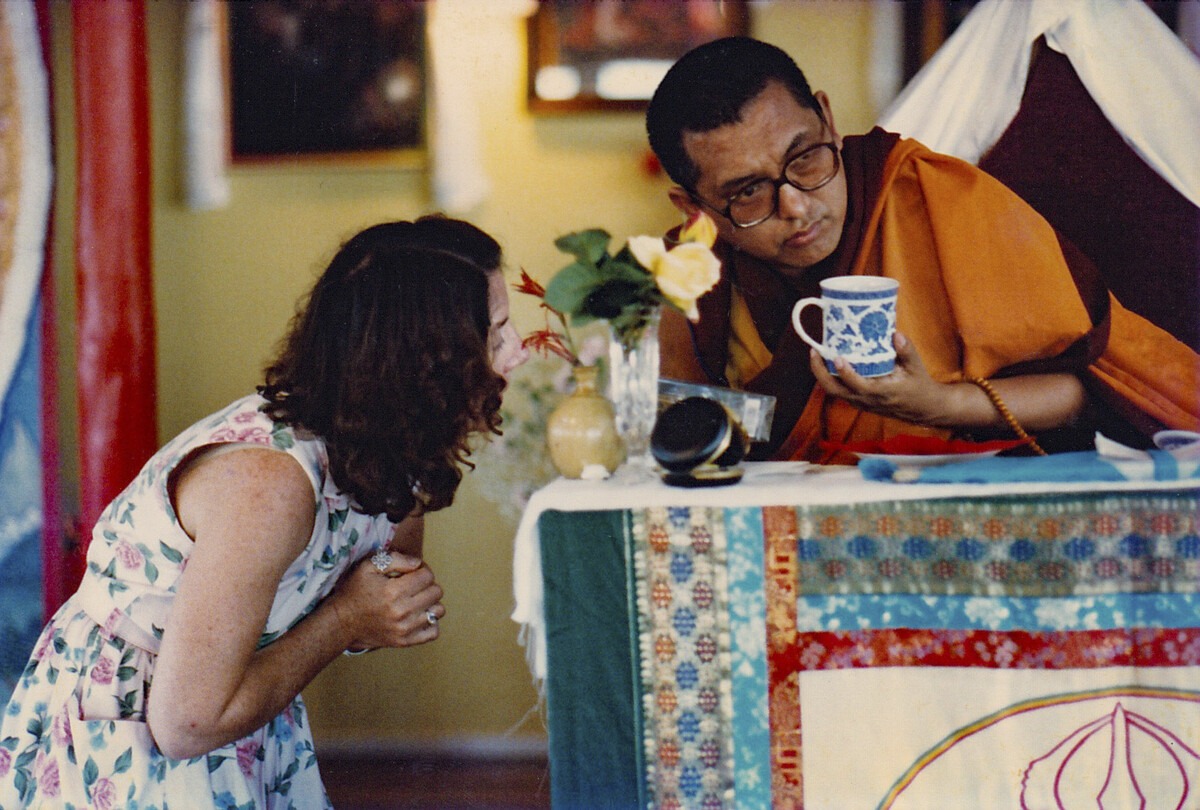
Lama Zopa Rinpoche speaking with Kathy Vichta in the gompa, Chenrezig Insitute, Australia,September 1987, Photo Credit Lama Yeshe Wisdom Archive.
It was wonderful to see how people took Lama Zopa Rinpoche’s advice to heart and involved themselves in these projects joyfully: for example, the beautiful Namgyalma Stupa dedicated to Lama Yeshe and completed in 1992; the Twenty-one Taras statues which are now in a special Tara Shrine room under the main gompa; the very large Chenrezig thangka painted by Peter Iseli and requested by Lama Zopa Rinpoche (he was very specific with details, and he also designed and donated it to be hung on holy days and during celebrations); the glorious Garden of Enlightenment — one central stupa surrounded by seven smaller ones — where smaller stupas containing blessed ashes rest in beautiful tropical gardens, inspired by Lama Zopa Rinpoche and blessed by His Holiness the Dalai Lama in 2011; and, most recently, in 2026, the magnificent new Thousand-Arm Chenrezig statue.
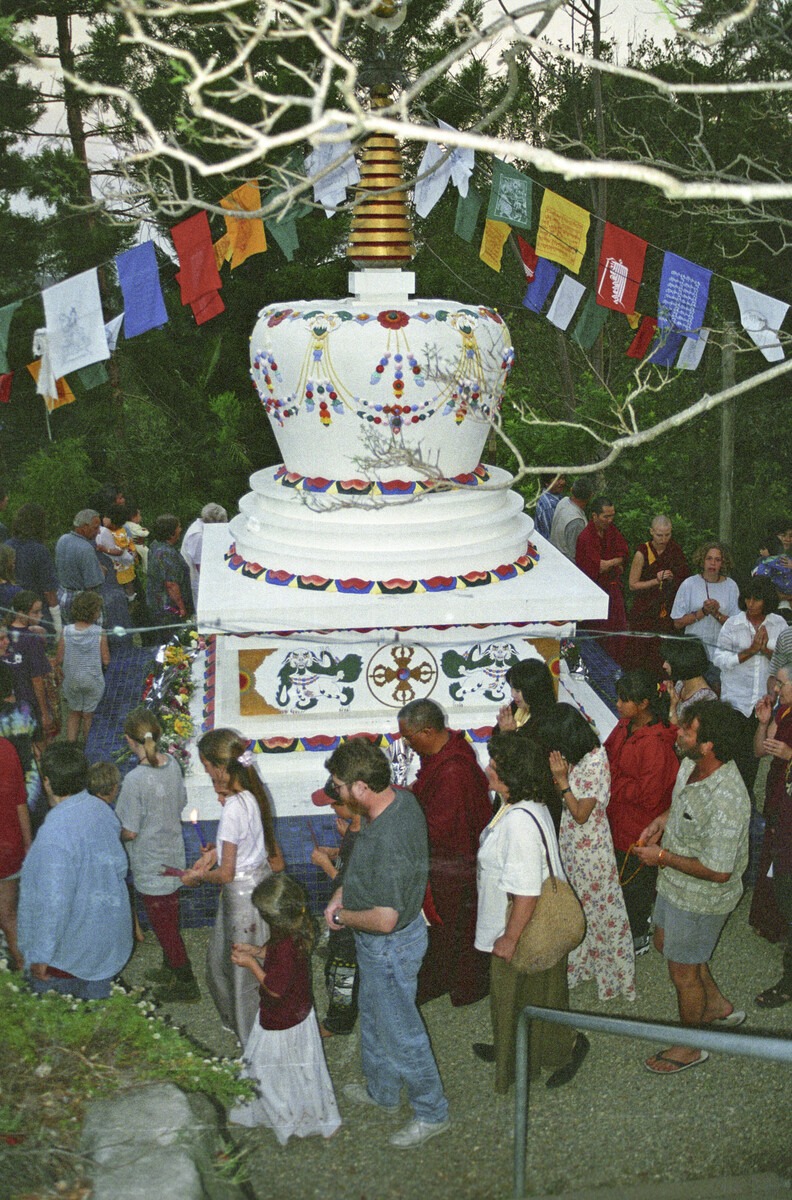
Lama Zopa Rinpoche and students circumambulating Namgyalma stupa at Chenrezig Institute, 1987. Photo Credit Lama Yeshe Wisdom Archive.
To be perfectly honest, not everything was smooth sailing, and harmony was not always maintained as we would have hoped. Groups of people with strong energy do have disagreements from time to time. But the connection to Lama Zopa Rinpoche and FPMT was always very important. We tried to make sure Lama Zopa Rinpoche continued to visit whenever we could arrange it, inviting him very often, and praying he would come. When there were many people at the Institute who had not met Lama Zopa Rinpoche, keeping that connection was very important, and the older students worked hard to keep it strong.
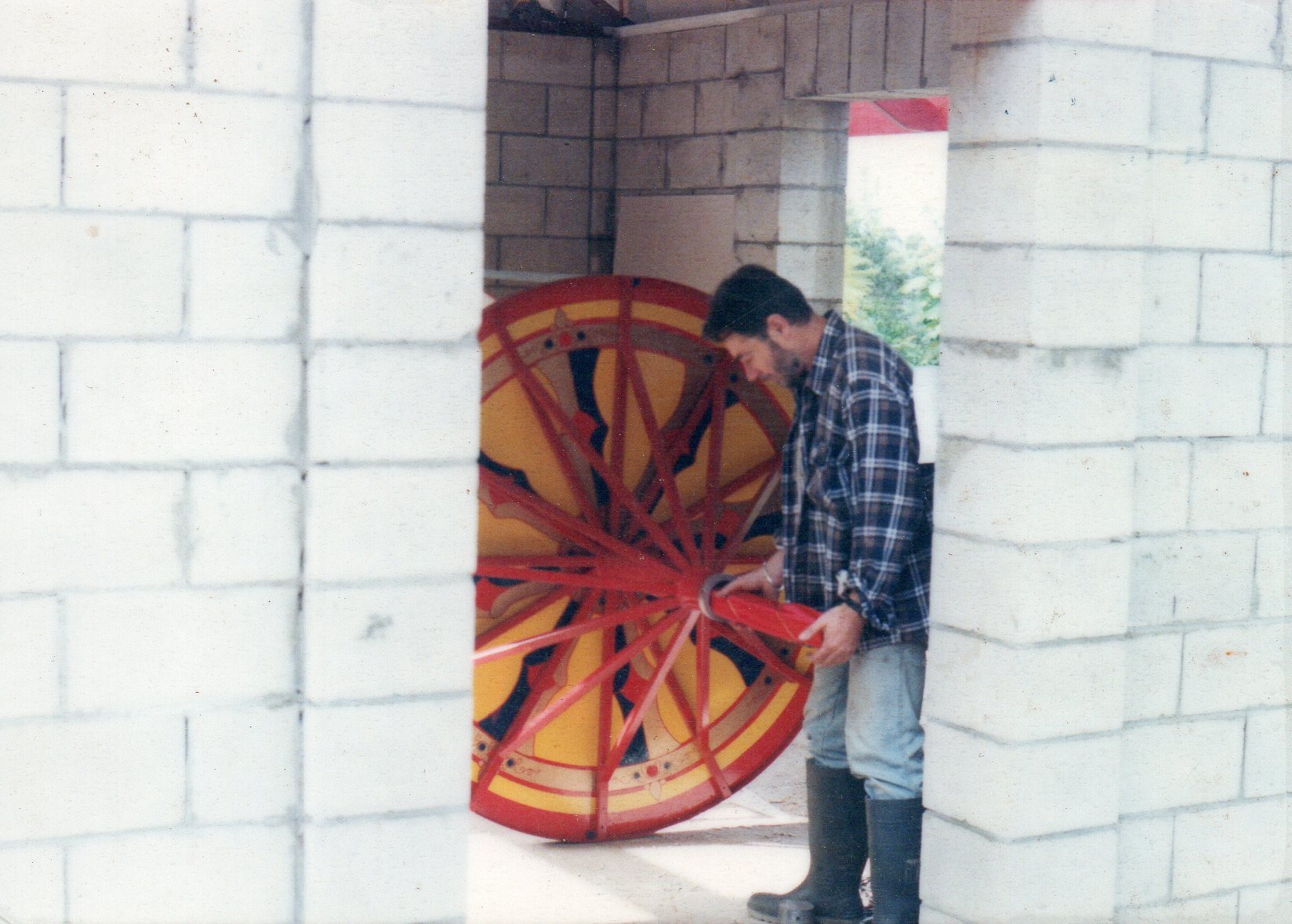
Tom Vichta assembling the base of the large prayer wheel at Chenrezig Institute, 1994. Photo courtesy of Chenrezig Institute.
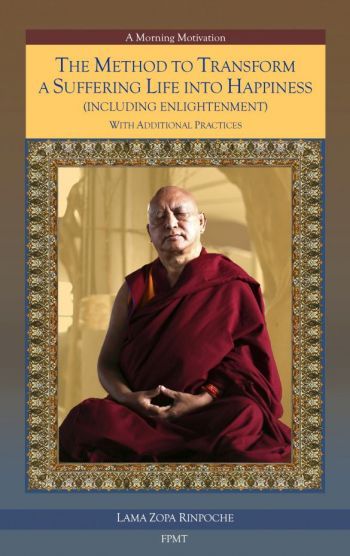
Teachings with Lama Zopa Rinpoche were always powerful. It was like a light shining directly into my heart. Even in those times when I really didn’t understand what he was teaching, the faith that he and Lama Yeshe were perfect teachers would mean that I would investigate not whether what he said was true, but how it was true. I can say that the most life-changing teaching I received from Lama Zopa Rinpoche is in his little book Transforming Problems into Happiness. He has taught this lojong method many times, but in the 1980s, I used to carry the early version of this little book with me and sometimes just let it fall open and take that page as my lesson for the day. So profound then and still now…
Balancing Dharma Life and Family
In late 1984, Lama Zopa Rinpoche asked me to take on the role of director. I was quite overwhelmed; I was a housewife and mother with no organisation experience, but he assured me I’d be fine, and I really loved the close connection. In 1984, Tom’s mother very unexpectedly gave us some money, and, without much deliberation, we used it to travel to Kopan to take part in the Vajrasattva retreat Ven. Gyatso was leading after the passing of Lama Yeshe. On arrival, we hired a motorbike and drove straight up to the front of the Kopan Gompa. I saw Lama Zopa Rinpoche coming out and Ven. Roger rushing out, seemingly trying to stop our meeting… It turned out that Rinpoche was actually doing the preparation for an initiation and not speaking, but he seemed to know we were coming. We were led upstairs to the roof of the old gompa (on the way stopping to meet a very young Tenzin Zopa) and sat down with Lama Lhundrup and Geshe Lama Konchog. Afterwards Ven. Roger explained that I was to be asked to be director at Chenrezig Institute — it felt like the venerable lamas on the roof were ‘checking me out’. I have always suspected that this was all set up in advance.
I remember going to my first CPMT meeting as director in 1985, being amazed and delighted by the wonderful family of students of Lama Yeshe and Lama Zopa Rinpoche, and the fabulous things they were already achieving all over the world!
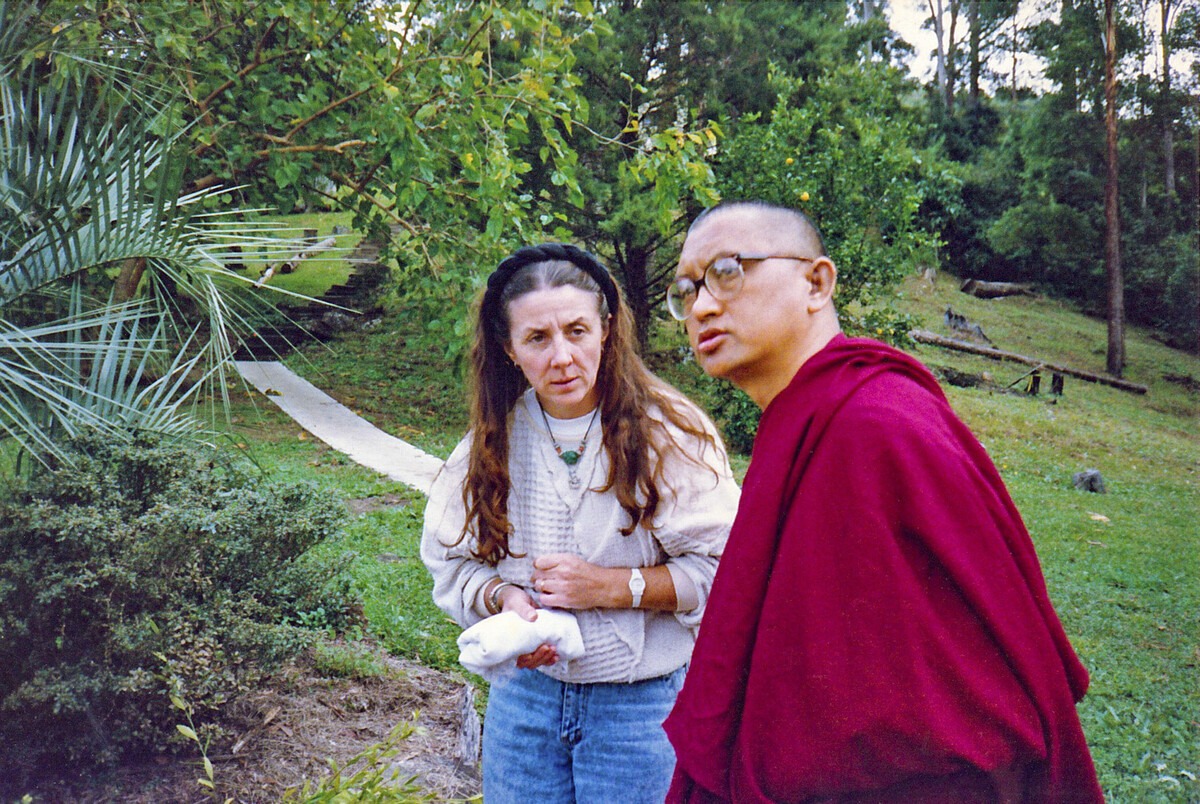
Lama Zopa Rinpoche with Kathy Vichta, Chenrezig Institute, Australia, 1991. Photo Credit Lama Yeshe Wisdom Archive.
I was director for about ten years and felt a very strong and precious link to Rinpoche, especially during those years. There were many times when I felt he directly answered my prayers (sometimes immediately) and “knew” exactly what I was going through. It was also beautiful that Goodie could “hang out with” Lama Yeshe and Lama Zopa Rinpoche as she grew up, and with other wonderful lamas like Geshe Thinley, Geshe Sopa, Geshe Lama Konchog (and later his incarnation, Phuntsok Rinpoche), Lama Osel, Ribur Rinpoche, and many more. I can see that many of her beliefs have been formed by those meetings during her formative years. My husband was, of course, a great support both financially and emotionally. He often had to take over running the home and family when I went off to meetings or became so busy I would sometimes have to stay at the Institute.
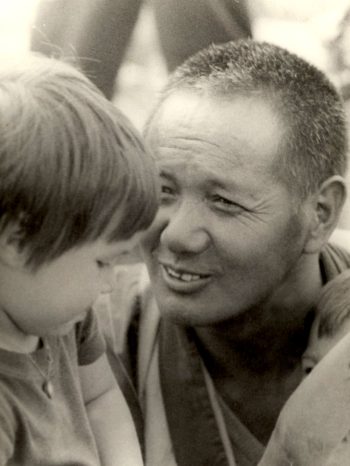
Lama Yeshe with Gudrun (Goodie) Vichta, Tom and Kathy’s daughter. Chenrezig Institute 1974. Photo Credit Lama Yeshe Wisdom Archive.
It was interesting that my Dharma practice became much stronger during those hectic years, in spite of how busy and stressed I would sometimes become — I felt it was important to attend pujas, teachings, and special events, and to do retreats, and somehow I managed. Later, when my daughter was away studying herself and I had stopped being director, I was able to take up full-time study of the FPMT Basic Program and soon became the coordinator of the program at Chenrezig Institute, which grew in an amazing way. We were very fortunate to have an extremely learned geshe, Khensur Rinpoche Geshe Tashi Tsering, along with a very well-educated Western monk, Ven. Jampa Ignyen (who came to us after fifteen years at Sera Monastery), and a star of the FPMT Translator Program, Voula Zarpani, come together to create something very precious. Khensur Rinpoche Geshe Tashi Tsering was resident teacher at Chenrezig Institute from 1990 to 2009, when His Holiness requested him to go to Gyudmed Tantric College, first as Gegur and then abbot — a very special opportunity!
For young people who want to raise a family and stay connected to the Dharma, I can only show them the example of how to live a Dharma life as well as they can and share those values with their children. Lama Yeshe was very clear in one of the talks he gave at Chenrezig in the early days that parents should NOT neglect their children in order to attend teachings — that was their first responsibility… Lama Zopa Rinpoche has given some wonderful advice about how to care for and “educate” children, and many centers (including Chenrezig Institute) have special children’s programs.
Spreading Love and Compassion Since 1974
I could go on and on — it is now more than fifty years’ history, but what I am trying to express mostly is that the inspiration and pure teachings of our precious lamas lived on in us, and in the amazing effort of those early people and the thousands since… Through their efforts, we have been able to make our gompa, kitchen and grounds glorious, especially with the many holy objects advised by Lama Zopa Rinpoche bringing inspiration to our many visitors. A monastic community has been established and supported, and we have provided a rich teaching program and accommodation and meals for many.
The physical situation, the roads, and the buildings have certainly changed. Life was very primitive at first. The property had great potential but no entry road, no electricity, no easy water supply, and of course no gompa and no accommodation. Over the next fifty years the Institute was transformed through the generous donations and incredible hard work of many hundreds of devoted students.
And that energy has continued throughout the fifty years I have been involved at Chenrezig Institute. Literally thousands of people have given their time and effort — and their donations — to enable this beautiful Institute to continue. They have attended teachings, attended and led retreats, meditated and taught meditations.
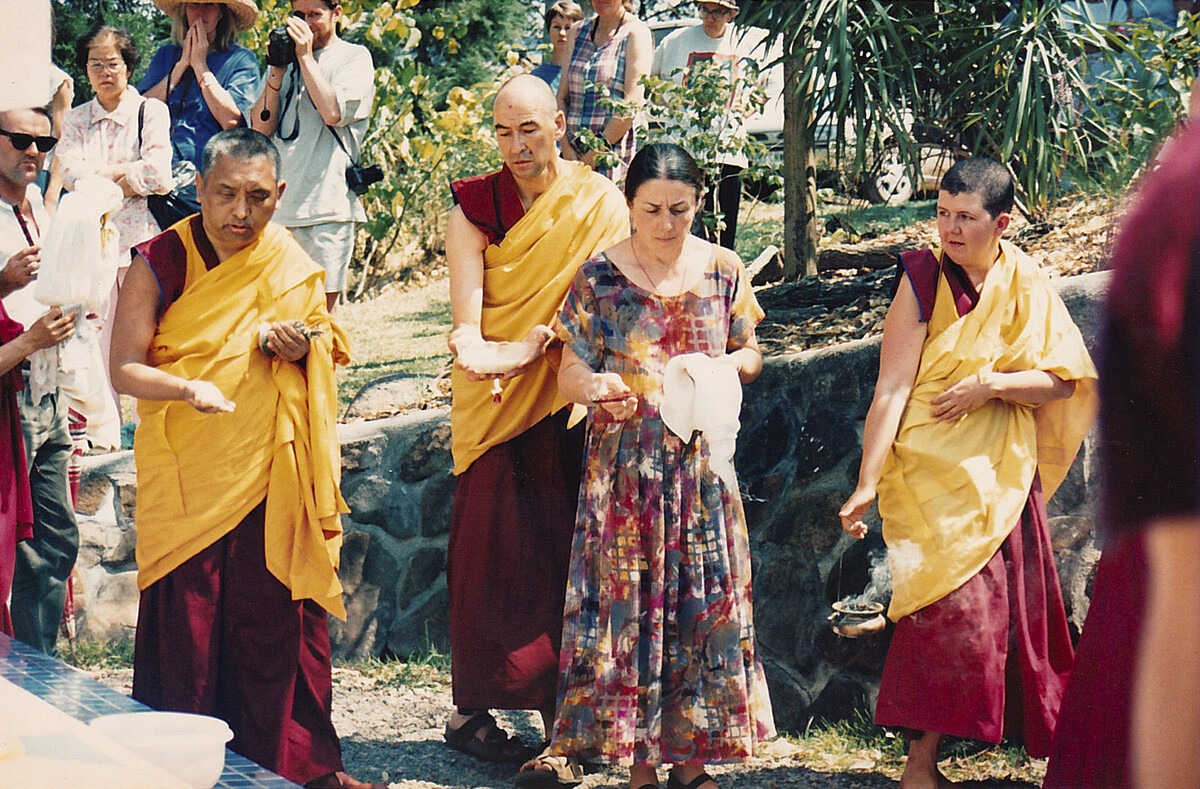
20th Anniversary celebrations at Chenrezig Institute. Lama Zopa Rinpoche and Kathy Vichta at Namgyalma stupa. September 1994. Photo Credit Lama Yeshe Wisdom Archive.
We celebrated the twentieth anniversary in 1994 with great excitement, with teachings and pujas and the consecration of our second prayer wheel. Lama Zopa Rinpoche taught a four-week course as he had in 1974 and invited all the geshes from the region to join him in pujas, consecrations and celebration for a week afterwards. Smaller celebrations were held on the thirtieth and fortieth anniversaries (again with dear Lama Zopa Rinpoche), and then a huge celebration again on the fiftieth anniversary. I think a great way to show what wonderful development was achieved over this time is the photobook I prepared for that big fiftieth anniversary of the founding of the Institute in September 2024.
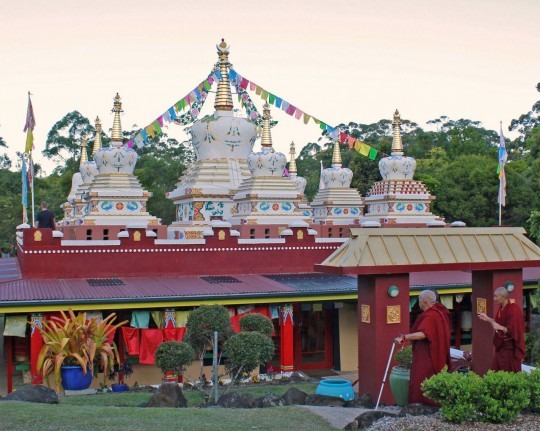
Lama Zopa Rinpoche and the eight stupas that are part of the Garden of Enlightenment at Chenrezig Institute, Queensland, Australia, September 2014. Photo by Ven. Lobsang Sherab.
All these things have been accomplished through the immeasurable blessings of Lama Yeshe and Lama Zopa Rinpoche. They generously gave us the teachings and encouraged us to follow them, but, so much more than that, they inspired us; they showed us their perfect example of pure, immeasurable love and compassion and their endless energy to help all sentient beings every minute of every day.
More than fifty years later, we sincerely rejoice in all the years of dedication and truly joyous effort which has brought us to this point. May all the teachers and students and centers of FPMT flourish forever!
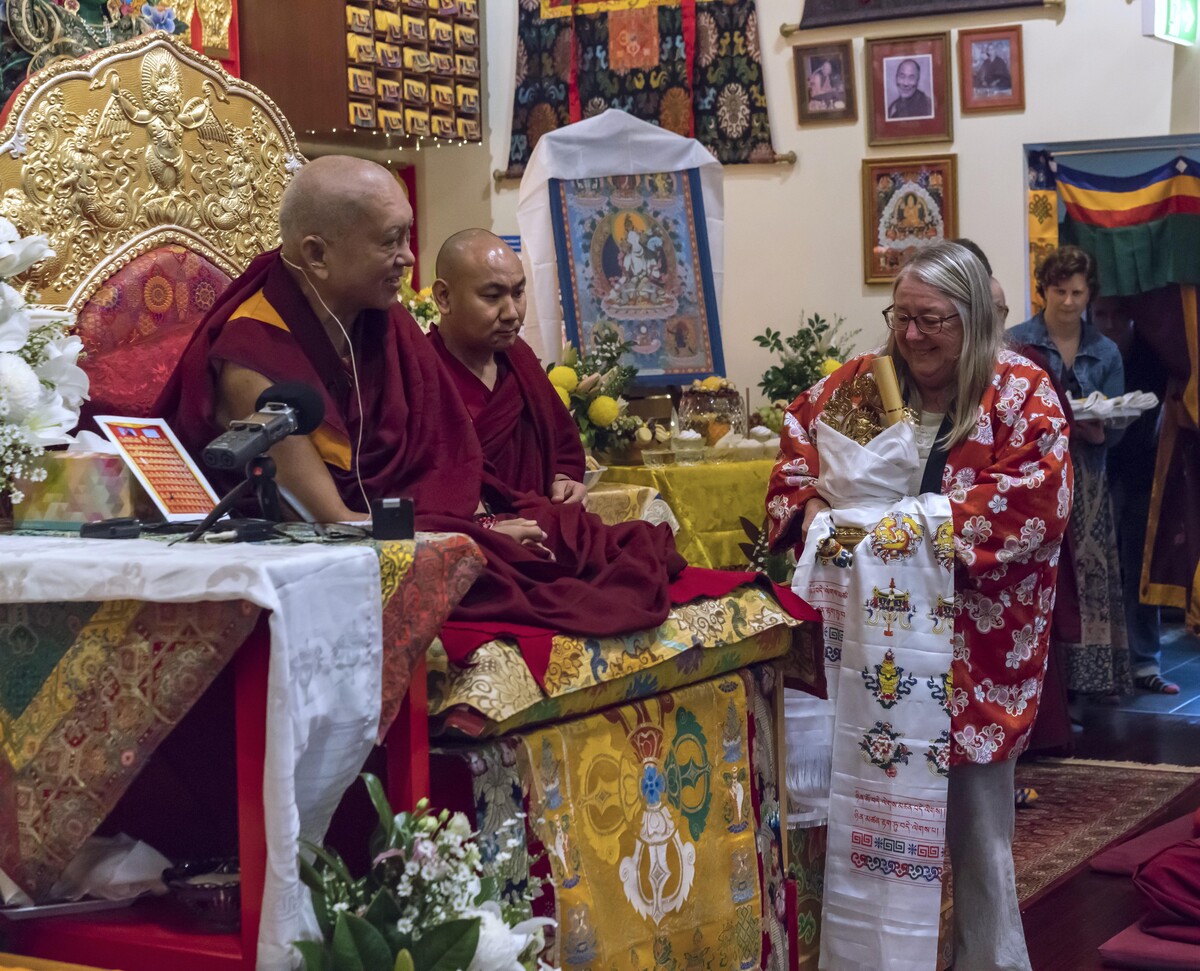
Kathy Vichta offers a statue and a request to Lama Zopa Rinpoche at the end of the event at Chenrezig Insititute. June 2018.
With heartfelt thanks to Tom and Kathy Vichta for sharing this precious personal account.
Watch the history of Chenrezig Institute in this beautiful documentary by Ben Philipps.
Read more about The Origin of Tibetan Buddhism in Australia, a documentary made by independent filmmaker Małgorzata Ola Dobrowolska when she was volunteering at Chenrezig Institute.
The photobook of the center’s development, prepared by Kathy Vichta for the huge fiftieth anniversary celebration, can be viewed here
Discover the story of Chenrezig Institute
To read more about Chenrezig Institute, please visit FPMT’s stories and news about Chenrezig Institute.
Are you an early student of FPMT who was there at the beginning? Do you have a story to share about how you met Lama Yeshe or Lama Zopa Rinpoche or the impact they have had on your life? Have you personally achieved or actualized a request, advice, practice accomplishment, or project given to you by Lama Yeshe or Lama Zopa Rinpoche? We want to hear from you!
Please explore all of the resources we have compiled related to FPMT history. We look forward to all of your creative ideas on how to bring this year-long celebration to your own local activities and personal practices! Please use the hashtag #50YearsFPMT in your social media posts so we can all be connected in this way.
Foundation for the Preservation of the Mahayana Tradition (FPMT) is a Tibetan Buddhist organization dedicated to the transmission of the Mahayana Buddhist tradition and values worldwide through teaching, meditation, and community service.