
 receive our newsletters
 join Friends of FPMT

FPMT Community: Stories & News
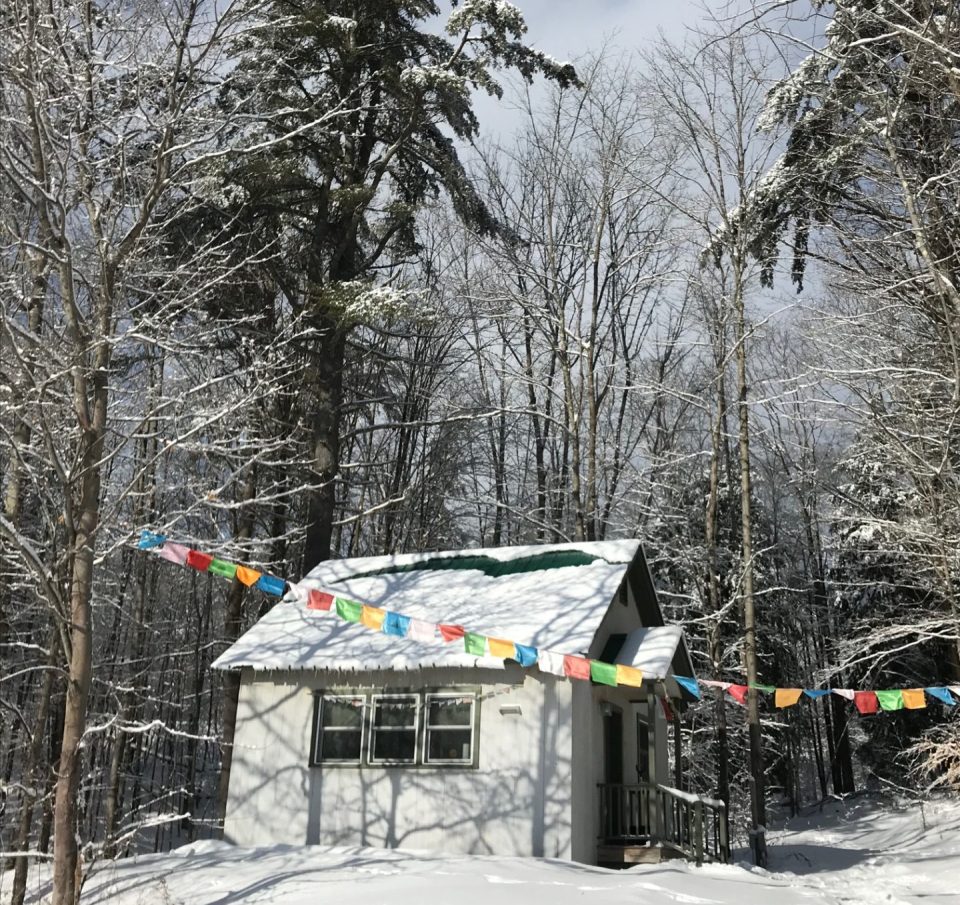
One of the retreat cabins at Milarepa Center in the snow.
Milarepa Center is an FPMT retreat center located in rural Barnet, Vermont, in the United States. The center is situated on 275 acres of serene Vermont beauty with a Stupa of Many of Doors, a set of 10 prayer wheels, and forest trails for walking/hiking. Director Dawn Holtz reflects on the importance of solitary retreat, the obstacles that may be keeping us from engaging in this practice, and offers encouragement for those considering solitary retreat as a way to progress on the path:
Lama Zopa Rinpoche explains in Heart Advice for Retreat, “Retreat helps draw your consciousness away from hallucination and into reality. It helps you discover your inner self. Only by recognizing the hallucinations that have been catching the mind and learning to distinguish between what is true and what is false is it possible to change our lives for the better. All such development of the mind comes from doing retreat. So retreat is the foundation of true development.”
Solitary retreat practice is so incredibly important for advancement on the path but how does one make it happen while living a life? Besides financial obstacles, most students have jobs, children, spouses, and all sorts of other things that may pose obstacles to engaging in the practice of solitary retreat. After 10+ years of supporting private solitary retreats here at Milarepa Center, as well as conducting many solitary retreats myself over the years, I have come to understand that the biggest obstacle is the mind. One simply needs to let go of romantic ideas of being in retreat for months or years at a time in some remote location and begin with making retreat a regular ongoing part of daily life.
Over the years, I have heard students comment that they are not able to set aside “enough time” for solitary retreat so they delay the practice. What is “enough time” and what exactly is the measure for this? Sadly, most will end up never engaging in retreat practice and/or when they are ready to try, they may have other obstacles from health issues due to aging, stress, overworking, unhealthy eating, etc. There seems to be a common belief among practitioners that retreat is not as valuable unless it is a “long-term” retreat and this is simply not true! A short weekend retreat done with proper motivation and commitment can yield realizations. There will always be obstacles and distractions, Western culture is designed that way, but if one starts building a private retreat practice from where they are, little by little a long-term practice is created.
Personally speaking, my service here at Milarepa Center for the last nine years had, (in my mind), been an obstacle to my ability to conduct long-term retreat until I shifted my thinking. I realized I simply needed to change my mindset and ideals about what retreat looks like. In the past few years, solitary retreat practice has grown to be the main aspect of my life and practice and in between retreat sessions I work to make the money I need, see friends/family, take care of personal things, etc. It took careful planning and time to get myself set up to live in this way and to get friends, family, and coworkers used to the idea of me not being readily available for stretches of time but it has all worked out and has been a continual process of learning and adjusting. There are also several people who come here to Milarepa Center regularly for private retreats and in between their retreats they take care of their life responsibilities.
Many religious traditions beyond Buddhism incorporate the practice of retreat and emphasize its importance in one’s spiritual practice and advancing on the path. Episcopal priest and teacher Margaret Guenther wrote in Holy Listening, “Retreat time helps in maintaining a healthy perspective. A retreat is not synonymous with a vacation; the former has an intentional austerity. The radically simplified environment discourages inner clutter. In most religious houses there is “nothing to do”—no games, no distractions, no loud noises, no TV, no busyness. Instead, there is silence, simple food, adequate space, and the security of being surrounded by a praying community.”
Financial challenges are another big obstacle for students who wish to conduct retreat. While Milarepa Center keeps retreats very affordable the reality is, here in the West, we do not have a culture that supports meditators in retreat. There are students who have been able and fortunate enough to find benefactors and that is wonderful but reliance on this can lead to difficult situations, obligatory strains on relationships, and not to mention having to leave retreat if the money stops coming in. Taking time in between retreat sessions to make money is a very real and reasonable way to support one’s own retreat practice as well as bringing the fruits of the practice off the cushion and into the world from time to time. Planting seeds in this way can begin to normalize regular retreat and create a culture of new yogis and yoginis here in the West supporting one another inside and outside of retreat by inspiring each other and showing others that it is possible to have a regular retreat practice rather than it being reserved for the chosen few with good connections. Supporting one’s own retreat also strengthens the commitment and relationship to a long term retreat practice and way of life and may even create the causes and conditions for a benefactor to manifest!
A collective individuation process is taking place and metaphorically speaking, Milarepa Center has become a hive for the activities of many individual bees doing their part to feed the whole. As each of us are individual cells within the larger body of humanity, we can choose to feed the whole with love or with sickness. With light or with darkness. With Buddha-nature or with ego. The only way to be liberated from suffering is to suffer. To sit with it, know it, feel it,. The only way through it, is through it. Having a safe and sacred container to do this work is crucial and Milarepa Center is a container for this. We are here, making sweet Buddha-nature honey one retreat at a time!
Milarepa Center, located in rural Vermont, offers reasonably priced space and support to students who wish to conduct solitary retreat (application and approval process required). The center offers fully equipped private cabins, grocery deliveries, access to the library and gompa, and ongoing support as needed during your retreat. A retreat scholarship fund is available by application for those with financial obstacles. Please learn more about retreat at Milarepa Center and also explore other FPMT retreat centers which may be located near you!
Dawn Holtz has served Milarepa Center in various capacities since 2012. She returned as Center Director in 2017 with the blessings and guidance of Lama Zopa Rinpoche to focus on creating a space for students to conduct solitary retreats. Dawn engages in solitary retreat practice regularly and regularly offers assistance to those who wish to begin a retreat practice. Dawn has a background in Renewable Energies & Sustainable Business Management as well as a Professional in Human Resources Certification from the Human Resource Certification Institute. While also serving as the Director of Milarepa Center, Dawn works as a Consulting HR Business Partner for a variety of businesses and is continuing to expand her studies through a Jungian Psychology & Spiritual Direction certification program.
For Further Exploring
Lama Zopa Rinpoche: The Importance of Retreat
Please enjoy an interview on the importance of retreat with Paula Chichester from the “How to Train a Happy Mind” podcast with Scott Snibbe. Paula Chichester spent five years and six winters at Milarepa Center preparing for and completing a deep four-year solitary retreat in our forest, without electricity or running water.
The Challenges and Joys of Retreat: Stepping Away from this Busy World with Paula Chichester was hosted online by Tse Chen Ling Center for Tibetan Buddhist Studies, June 2025.
Foundation for the Preservation of Mahayana Tradition (FPMT), is a Tibetan Buddhist organization dedicated to the transmission of the Mahayana Buddhist tradition and values worldwide through teaching, meditation and community service.
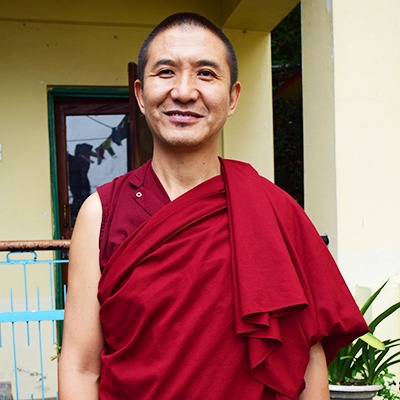
Geshe Tenzin Wangdak at LRZTP, 2015.
Geshe Tenzin Wangdak passed away from cancer on September 8, 2025 in Dharamshala, India.
Lotsawa Rinchen Zangpo Translator Program (LRZTP)’s dear teacher, Geshe Tenzin Wangdak touched the hearts of so many students and all who knew him. Dr. Filip Majkowski, Heidi Minx, and Julia Wilson shared a moving obituary and testament to Geshe-la’s many wonderful qualities:
It is with deep sadness that we share news of the passing of LRZTP’s beloved teacher Geshe Tenzin Wangdak (1972-2025) after a long and courageous battle with cancer. Geshe-la left this life on September 8, 2025 surrounded by friends and students while being cared for in Delek Hospital Dharamshala. His friendly guidance will be sorely missed by all of us at LRZTP and all others who were close to him.
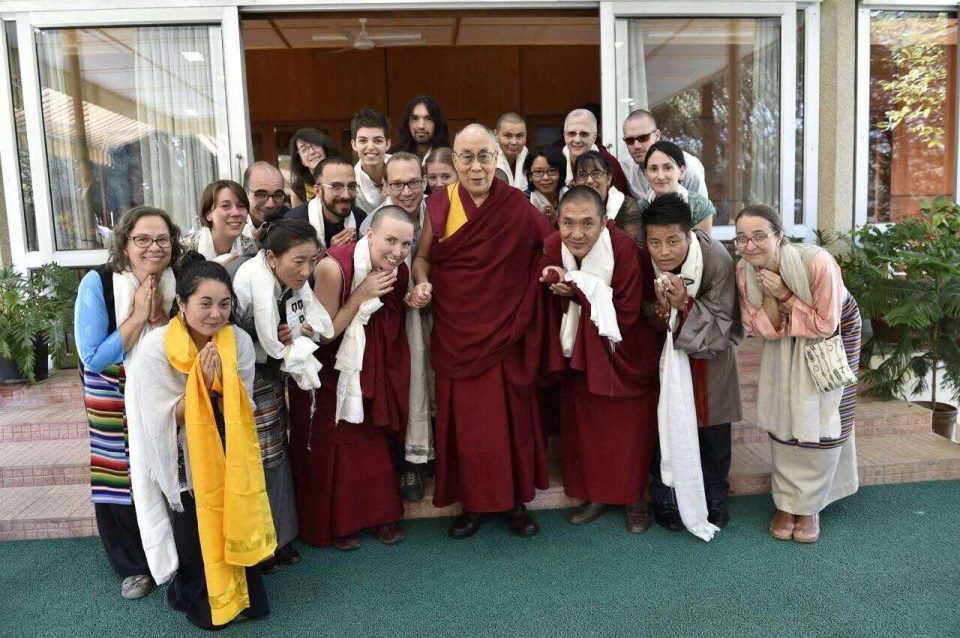
LRZTP 7 cohort audience with His Holiness the Dalai Lama, 2017 (Geshe Tenzin Wangdak is just right of HHDL).
Geshe Wangdak joined LRZTP in 2013 and eventually became one of the main Tibetan language and dharma teachers at LRZTP. Over the years he tirelessly worked creating new materials and updating the content and structure of the LRZTP two-year program of studies. His main concern was creating a friendly and learning-conducive environment for non-Tibetans to quickly learn colloquial Tibetan language and essential Dharma terminology, and in this he made himself ever available to eager students – even his lunch breaks would somehow morph into an impromptu Tibetan language lesson.
In more recent years he was heavily involved with refurbishing the school after the Covid pandemic and managing the two-year intensive program. During the last year and even up to the final month of his life he still remained involved with school through offering regular guidance to the program coordinator and helping appoint other geshe teachers to fill his positions.
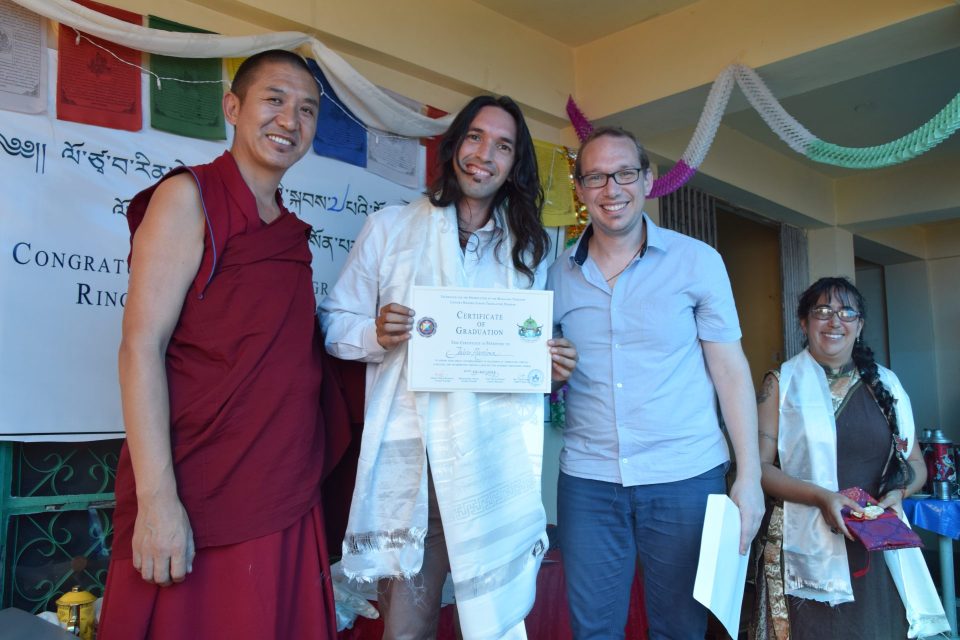
Geshe Wangdak in 2017 with Jairo, Yaron, and Martha during the LRZTP 7 graduation ceremony.
We would also like to share a couple memories of Geshe-la from Dr Filip Majkowski (a colleague from LRZTP) and from Heidi Minx (one of Geshe Wangdak’s early English language teachers and longtime friend).
Memories of Geshe Wangdak from Dr Filip Majkowski
I have known Geshe Tenzin Wangdak since 2017, when I first started working at LRZTP. From day one Geshe-la was very helpful and open minded about everything. He was always ready to reach out and help, he always had ideas and was a problems solver. He did everything with compassion and humor. By then he had already devoted so much of his time to LRZTP and the students. He had passion for his work and a big heart to all students. Much later, during the pandemic, he put the same heart and passion into teaching Tibetan online. He taught until his declining health allowed him to continue. In that he was a true inspiration to teachers and students alike.
The period of his sickness was a very sad time for LRZTP and everyone who knew him. After several months of fighting the disease in 2022 he was healthy again and it seemed he was winning. Then, in early 2024 suddenly things got worse. It was really sad to watch him lose energy and not be able to do what he loved. He could not teach, nor was he able to do house repairs, which was also his passion – in LRZTP he always had his kit with drills, hammers, screwdrivers etc. He loved that. But he still loved meeting people and give advice as much as possible.
I saw him last at the end of June, before I left for Europe. When he passed, I was back in Dharamsala, quite nearby, but unfortunately not able to see him. I regret that. I feel blessed I had this wonderful opportunity to meet Geshe-la in my life. I know we will meet again in some other life. Until then, may the blessings of all Buddhas and Bodhisattvas be with you, Geshe-la. We miss you.
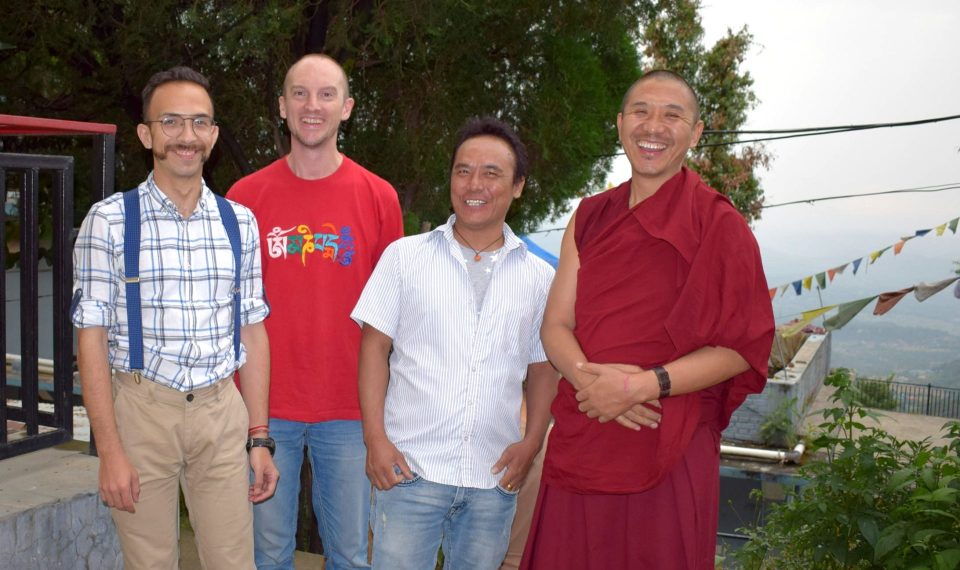
Geshe Wangdak (far right) in 2018 with (from left) Alex, Filip and Thupten of LRZTP.
Memories of Geshe Wangdak from Heidi Minx
In 2009, a program was started by the Dalai Lama Trust for a select group of geshes – a foreign language program so that when His Holiness’s office received requests for Dharma teachers, students from this group could teach in either English or Chinese. Geshe Wangdak was one of two students in the advanced English class. Geshe-la understood the nuances of learning – that it wasn’t just a written exercise based on books, but also discovering and experiencing cultural nuances. The abundance, or lack of direct translations of many words would lead us to interesting debates. The Tibetan word for weasel, neuli, led us to the western scientific naming system for rodents, and then into evolution, back to dinosaurs. Gently debating became a regular theme – and I remember his earnest surprise that there were not “single words” in English for words used commonly in debate — “the book is on the table, so the table supports the book, and the book supports the table – what is the single word for each of these items?” Our classes weaved through traditional vocabulary and writing to the methods of how to teach western students.
One assignment centered on teaching the Four Noble Truths; and as they began to teach, I asked, “What is karma?” Geshe-la’s face lit up, first in confusion that his English teacher didn’t know what karma was, to then a look of disbelief that a concept so deeply understood in his studies and culture might need to be explained more deeply. He grasped that moment – and I believe it is just one example of what made him an excellent teacher, the wisdom to understand that even the smallest concepts needed to be taught and explained with the same importance as deeper concepts. We discussed the differences and similarities between Buddhism as a science, philosophy and religion and how that intersected with western science, philosophy and religion.
Geshe Wangdak was a deeply committed friend as well. His dedication to our friendship was evidenced in so many ways – whether waking up early to stand in line at Yeshe Dhondup’s office when I was sick to make sure I got an early appointment so I could return to class quickly — making sure I had a seat saved with him at His Holiness’s teachings, bringing me to his aunt and uncle’s for huge family meals, seeing me happy after feeding puppies at lunch then coming to love and care for dogs for many years. He loved being a teacher, and in our free time after classes took it upon himself to begin to teach me Tibetan — buying children’s primer books and getting me my first fountain pen that he cut the tip off of for best letter structure. He said, “You will learn letters first, like I did.” Several years later Geshe-la and I worked together on a program to teach the students of a local Thangka school (ITTA) English with the intention that they be able to talk about and share their art with others outside the Tibetan community. Geshe-la was an excellent friend. When my cat died, when I lost my job, when it was my “obstacle year” – Geshe-la would say prayers, and have his khangtsen say prayers. His smile and sense of humor made him an excellent friend and teacher as well. The day his class graduated the teacher translation program at IBD, we had a private audience with His Holiness. At the end of the audience, we all walked out to the steps for the celebratory photo with His Holiness. His Holiness was looking at my tattoos and talking with me as we were walking. As we got to the steps, His Holiness noticed the sengye tattoos on my arm, he clasped my arm and began clapping his hand against it laughing, “yah bobdhuk!” The students all looked up a bit in shock. As we walked slowly to Dharamkot for a pizza party, Geshe-la said, “We thought you were getting scolded – but how do you say? You got beat up by the Dalai Lama, very good blessing!” making us both laugh more as I explained the nuance of the phrase “beat up.”
Geshe-la truly embodied the intent of His Holiness’s program, going on to support Julia with her interpreting at the Tibetan Library, and later with the LRZTP program teaching Tibetan language and Buddhism to western students, planting innumerable seeds of karma that will ripen and unfurl in all corners of the world for generations. In his last week, I witnessed the deep devotion of his students, calling and visiting – imparting to him the deep care that they have for him, as he had for them. His quick and bright smile, his nurturing and genuine care for others, his warm yet direct nature, his powerful yet gentle voice and his deep but unassuming knowledge will be deeply missed by so many who were lucky to have had the karma to know him in this lifetime.
With grateful thanks to Dr. Filip Majkowski, Heidi Minx, and Julia Wilson for this moving tribute.
Please pray that Geshe Wangdak may never ever be reborn in the lower realms, may he be immediately born in a pure land where he can be enlightened or to receive a perfect human body, meet the Mahayana teachings and meet a perfectly qualified guru and by only pleasing the guru’s mind, achieve enlightenment as quickly as possible. More advice from Lama Zopa Rinpoche on death and dying is available, see Death and Dying: Practices and Resources (fpmt.org/death/).
To read more obituaries from the international FPMT mandala, and to find information on submission guidelines, please visit our new Obituaries page (fpmt.org/media/obituaries/).
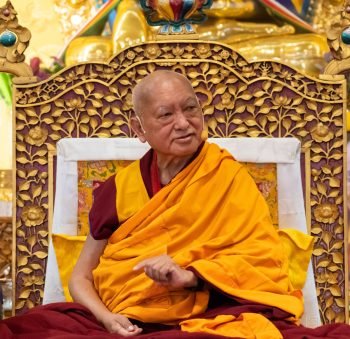
Lama Zopa Rinpoche teaching at the Kopan lamrim meditation course, Kopan Monastery, Nepal, December 9, 2022. Photo by Ven. Lobsang Sherab.
Our October e-Newsletter is now available and we are sharing news, resources, and causes for rejoicing including:
- Teachings from Lama Zopa Rinpoche and Lama Yeshe
- News about His Holiness the Dalai Lama
- Information about Lhabab Duchen approaching on November 11
- Grants offered to holy object projects
- News and stories from FPMT centers, projects, and services
- Resources and opportunities for study and practice
- Job opportunities in the FPMT organization
- A call for submissions
And much more!
Please read this month’s e-news in its entirety.
Have the e-News translated into your native language by using our convenient translation facility located on the right-hand side of the page.
Visit our subscribe page to receive the FPMT International Office News directly in your email inbox.
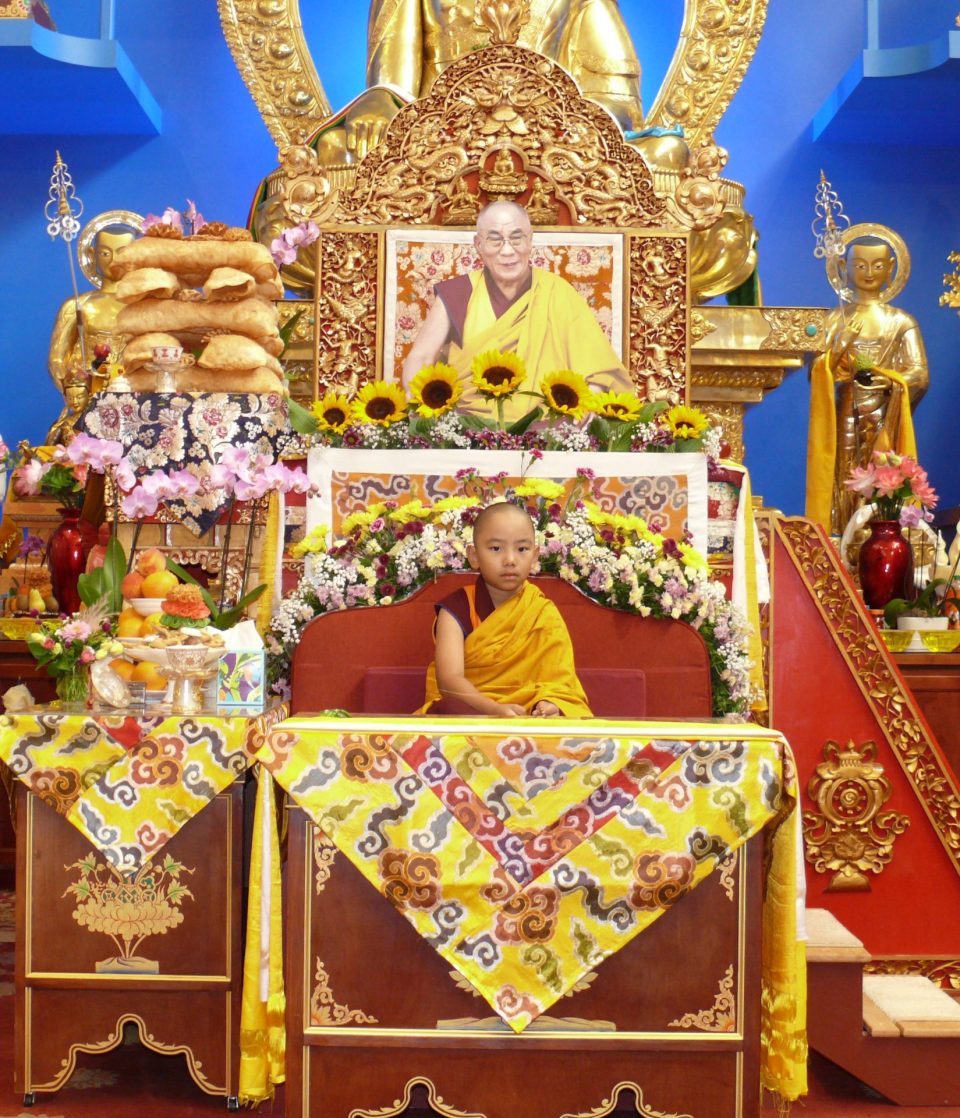
Tenzin Nawang Rinpoche on the occasion of his enthronement, Dear Park, Center, Oregon, WI, USA. Photo by Kalleen Mortensen.
By Namdrol Miranda Adams
In late September 2025, a historic event took place at Deer Park Buddhist Center in Oregon, Wisconsin: the enthronement of Tenzin Nawang Rinpoche, a seven-year-old boy recognized by His Holiness the Dalai Lama as the reincarnation of Geshe Lhundub Sopa. The occasion drew hundreds of attendees—monks, lay students, and members of the Tibetan and Western Buddhist communities—who gathered to honor the return of one of the most influential figures in the spread of Tibetan Buddhism to the United States.
Geshe Sopa’s Enduring Legacy
Geshe Lhundub Sopa (1923–2014) was among the first generation of Tibetan monastics to teach in the West after 1959. Having fled Tibet after the Chinese invasion, Geshe-la was invited to the University of Wisconsin at Madison, where he became the first Tibetan to receive tenure at an American university. Through decades of teaching, Geshe Sopa trained a generation of scholars, introducing Western students to the depth of Buddhist philosophy while founding Deer Park Buddhist Center as a locus of authentic study and practice near Madison.
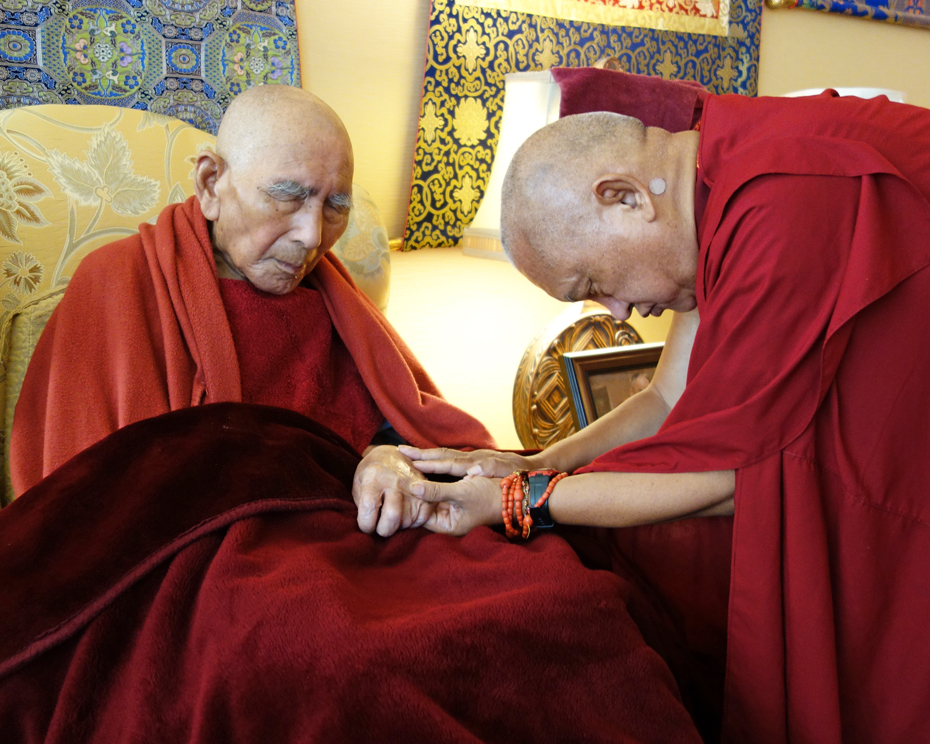
Lama Zopa Rinpoche doing prayers with Geshe Sopa Rinpoche a month before Geshe Sopa passed into clear light meditation, Deer Park Buddhist Center, Wisconsin, US, July 2014. Photo by Ven. Roger Kunsang.
Geshe Sopa’s legacy extends deeply into the global FPMT community. Besides training many of the most influential American Buddhist Studies scholars of the 20th Century, Geshe-la was an early teacher and mentor of Lama Zopa Rinpoche. Their relationship exemplifies the lineage continuity that FPMT upholds. For the FPMT mandala, the recognition of Geshe Sopa’s reincarnation carries not only historical but also spiritual significance: it represents the renewal of a karmic relationship foundational to the spread of Dharma in the modern world.
The Ceremony: Tradition in the Heartland
The enthronement ceremony, held at Deer Park, was presided over by senior monks and the Dalai Lama’s representative to North America, Namgyal Choedup.
For the local and Tibetan communities, the event symbolized both continuity and homecoming. Geshe Sopa had been instrumental in establishing Deer Park as one of the first monasteries and Buddhist centers in the United States, and the temple at Deer Park remains a sacred site for all.
The young tulku, Tenzin Nawang, lives with his family in Toronto. The ceremony combined ritual solemnity with moments of simple humanity, as the young Rinpoche sat among senior monks and community elders—at one point quietly turning a Rubik’s Cube in his hands with the same focus as others gave their prayers. This gentle contrast between childlike presence and the profound spiritual significance of this time embodies the living continuity of Tibetan Buddhism in a new cultural context, where ancient lineage and modern life meet with ease and authenticity.
A Global Gathering of Students
The enthronement drew a remarkable international assembly of students and disciples who had studied with Geshe Lhundub Sopa over the decades. Many traveled from across North America, Taiwan, Mexico, and beyond to Deer Park to honor their teacher’s reincarnation. Their presence reflected the global reach of Geshe Sopa’s influence and the deep respect his students continue to hold for his scholarship and compassion. For these practitioners, the recognition of Tenzin Nawang Rinpoche was not only a joyful reunion but also a living affirmation that lineage endures—not as an abstract idea, but as an ongoing transmission of wisdom from teacher to student, and now, across lifetimes.
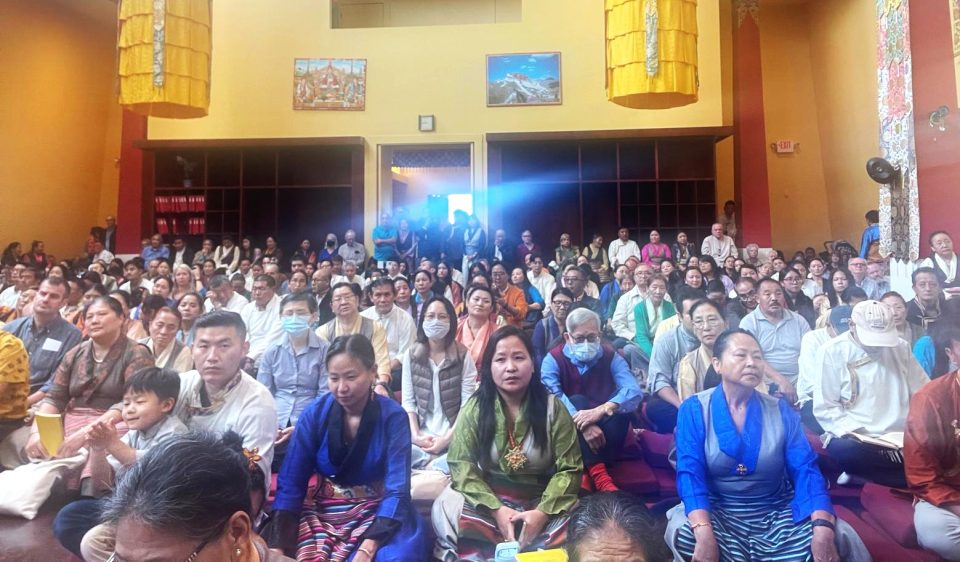
The Tibetan community was in “full strength” at the enthronement of Tenzin Nawang Rinpoche. Photo by Alfredo Pineiro.
The Tibetan community was also present in full strength, bringing with them the characteristic warmth, sweetness, and gentle humor that define their gatherings. The atmosphere, while reverent, was filled with laughter and ease—children moved freely among rows of elders, smiles were shared without reserve, and the flow of tea never ceased. This balance of devotion and lightheartedness created a space where sacred ceremony and ordinary human connection met naturally, embodying the heart of the Dharma in daily life.
Within all of this, the young Rinpoche held the throne, at times absorbed in the ceremony’s gravity and at others quietly turning his Rubik’s Cube.
As Namgyal Choedup, the Dalai Lama’s representative to North America, explained, the purpose of a reincarnation such as this is to continue the life and work of the previous master. The young Rinpoche’s path will blend traditional monastic study with modern education, preparing him to serve both Buddhist and secular communities in the years ahead. Plans were announced for Tenzin Nawang to travel to India soon to begin his formal training, marking the next step in the continuation of Geshe Sopa’s enduring legacy.
A Bridge Between Worlds
The enthronement also represented the unique integration of Tibetan Buddhist tradition within contemporary American society. Local officials from Dane County were present to extend greetings and recognize the event’s cultural importance—an acknowledgment of the decades of bridge-building initiated by Geshe Sopa himself in Wisconsin.
For the FPMT mandala, the enthronement of Tenzin Nawang Rinpoche is both a cause for rejoicing and a moment of reflection. Geshe Sopa’s connection with Lama Zopa Rinpoche situates this recognition within FPMT’s living lineage—a reminder of the intricate web of relationships that sustain the transmission of the Mahayana tradition.
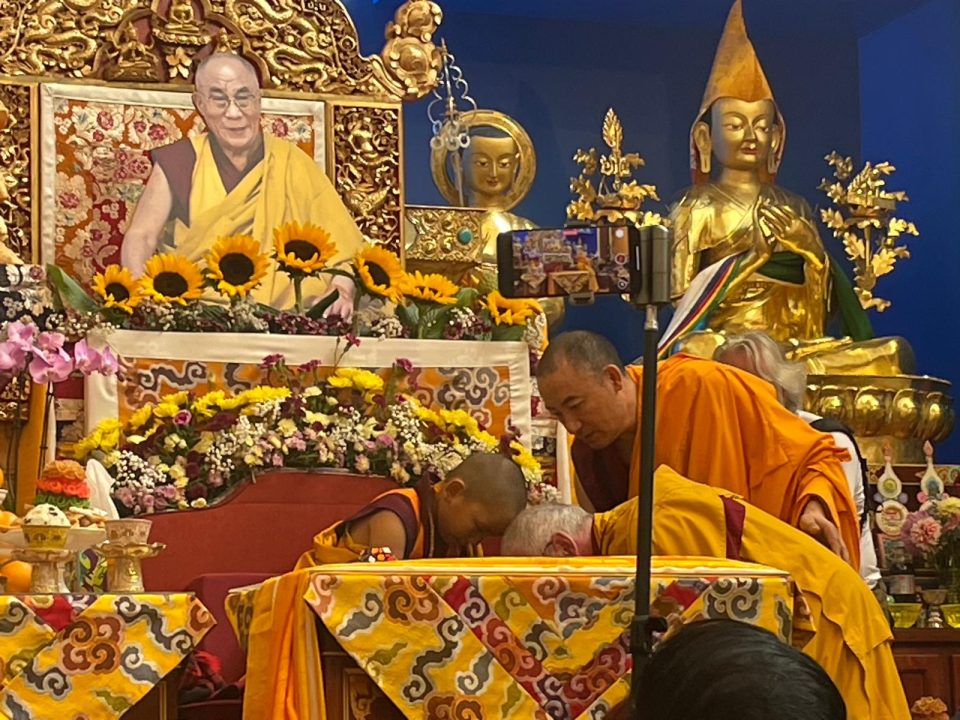
Ven. Roger Kunsang offering to Tenzin Nawang Rinpoche on behalf of the FPMT organization during the enthronement. Photo by Alfredo Pineiro.
FPMT’s CEO, Ven. Roger Kunsang, attended the ceremony on behalf of the organization, extending the mandala’s prayers and respect to the young tulku and his family. His presence symbolized the ongoing link between Deer Park, FPMT, and the wider international community that Lama Zopa Rinpoche helped to build.
During this event, it was evident and overwhelming to understand how Geshe Lhundub Sopa was, in every sense, a bridge—linking worlds, traditions, and hearts. Geshe-la bridged the vast distance between Tibetan monastic scholarship and Western academic inquiry, translating profound Dharma into forms that could be understood and lived by new generations. He bridged cultures, embodying humility and warmth that allowed Western students and Tibetan elders alike to meet in mutual respect. And he bridged eras—carrying the wisdom of pre-1959 Tibet into the modern world, ensuring that it could take root in places as unexpected as the American Midwest.
In his life and teaching, and now through his reincarnation, Geshe-la continues to show how compassion and understanding can span every divide.
As the final prayers concluded and the afternoon light filled the grounds, the moment seemed to embody a teaching I’ve heard often: that the Dharma flows where causes and conditions ripen, carried forward by the steady devotion and aspiration of those who practice it. From Tibet to India to the American Midwest, the stream of this lineage endures—alive, luminous, and present to guide generations yet to come.
Namdrol Miranda Adams is Dean and a Founder of Maitripa College, in Portland, Oregon. She teaches Buddhism, contemplative pedagogy, and engagement with faith and service at Maitripa. She practiced and studied as a Buddhist nun for seven years, and completed her doctoral work in Education at the University of Portland in 2021. She met Lama Zopa Rinpoche and Yangsi Rinpoche in 1998, and since then has dedicated herself to their projects. Namdrol has been Chair of the Board of the FPMT North America Regional Office since 2024.
Foundation for the Preservation of Mahayana Tradition (FPMT), is a Tibetan Buddhist organization dedicated to the transmission of the Mahayana Buddhist tradition and values worldwide through teaching, meditation and community service.
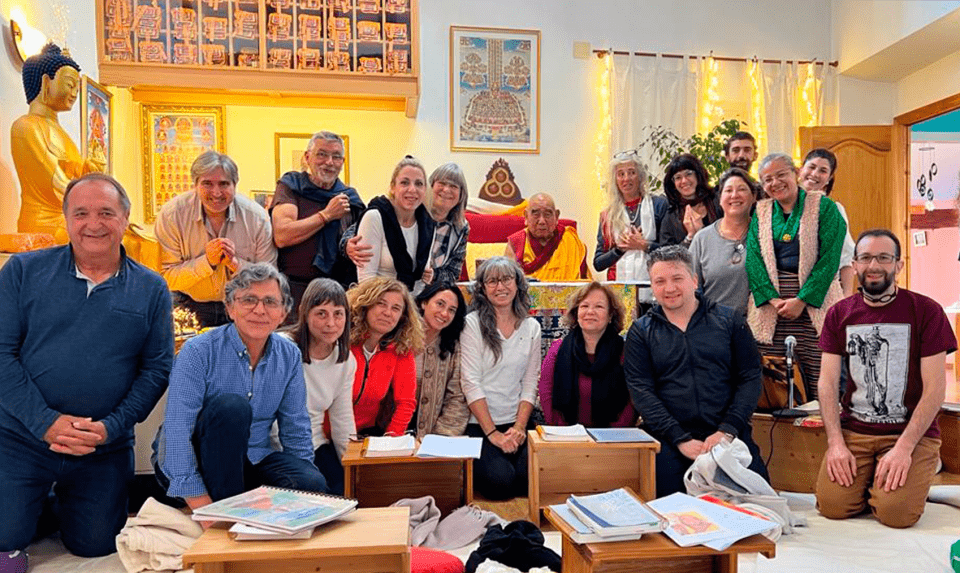
Geshe Lamsang after a teaching in Ontinyent’s old gompa, 2023. Photo courtesy of Tekchen Choeling.
How do you move a Buddhist Center? That is the question that the team at Tekchen Choeling Buddhist Center in Spain had to ask themselves last month, when they had to relocate the center’s holy objects to a new location. Assistant director, Kelsang Bas, tells the story!
How to Move a Dharma Center
By Kelsang Bas
As it turns out, you can’t just pick up the altar, put it in an Ikea box, and drive away.
Tekchen Choeling, aka The Land of the Mahayana Dharma, is a small yet robust FPMT center in Ontinyent, a town located in Eastern Spain between Valencia and Alicante. Like many small centers across the organization, we have been struggling with the challenges of an aging core team, lack of adaptation to the fast-paced digital environment, and difficulties to attract new people. However, there is something unique about Ontinyent’s center.
When Lama Zopa Rinpoche visited Madrid in 2018, Tekchen Choeling chartered a bus with almost fifty people—from a town of little over 30,000. We had rows reserved for them in the venue, and were welcomed with no shortage of hugs, cheers, and applause.
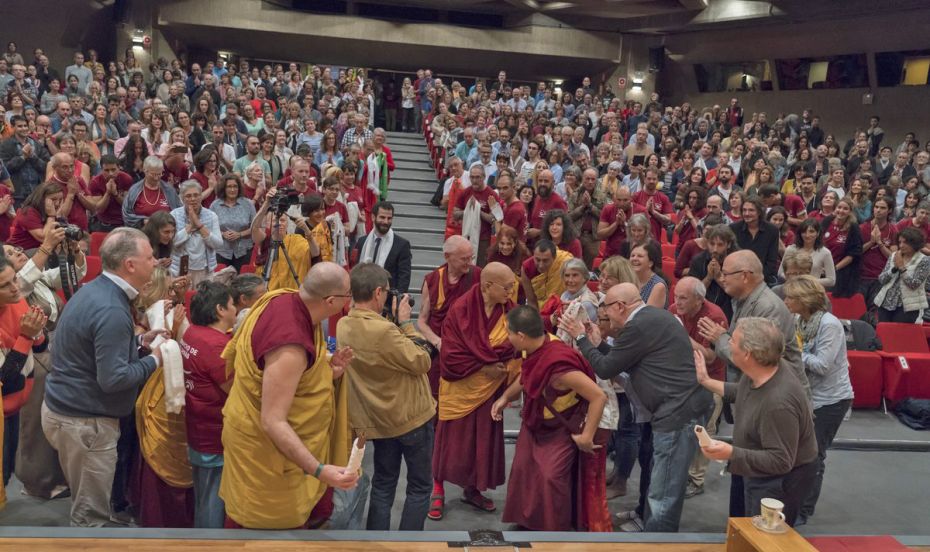
Lama Zopa Rinpoche greeted by students in Auditorio UGT, Madrid, Spain, October 2018. Photo by Ven. Lobsang Sherab.
Ontinyent is famous among Spanish FPMT centers for their devotion, perseverance, and tight-knit community. For example, the three founders who started the center as a study group back in 1986 are still among the most active members, acting now as director, SPC, and secretary. And there is something else that makes us special—we have also secured a generational change, with younger members taking on leadership roles and leading the center’s expansion and growth.
It is precisely that growth and expansion which led Tekchen Choeling to box up our gompa and move. In 2017, after experiencing a surge in attendance—barely fitting in our 70sqm apartment—we asked Lama Zopa Rinpoche for advice. Should we attempt to change locations?
Size wasn’t the only hindrance with our location. The tiny apartment was on a fourth floor with no elevator, and in a hidden and hard-to-access area of town with no easy parking. As the core team and many members grew older, the 4-story climb became a real obstacle. Some of the elder teachers also showed the aspect of having difficulties accessing the remote place. We wanted to move.
But Rinpoche cut our hopes sharp. It wasn’t the right time, he concluded after his investigations. “You must focus on creating a good harmony in the center,” he advised over and over. He also recommended the Sanghata Sutra as a practice for the center—a sutra with over 140 pages. “A thousand recitations,” Rinpoche instructed. By late 2022, we had finished the recitations and offered them to Rinpoche in Bodhgaya in January of 2023 and asked again. “Is it the right time to move?”
A couple of months later, shortly before showing the aspect of passing away, Rinpoche answered. The time couldn’t be better, according to his inquiry. With all of his blessings and words of encouragement, Tekchen Choeling could search for a new place for our center.
Fast-forward to September 2025. A dozen people wait standing in the small gompa—it just doesn’t look like a gompa anymore. The full lot of Kangyur texts are organized in fruit boxes—plastic boxes that can take more weight than cardboard. The walls depict no deities, no thangkas, no merit field, no images of beloved teachers—all of that waits wrapped and protected, to be transported, to the new location. And then Paloma Belda, the director, speaks with her sweet and tender voice, and everyone listens, solemnly. “The rest of the team are in the new venue, already reciting the Sutra of the Accumulation of Auspiciousness, ready to receive the Buddha and his entourage.”
Yes, that’s right. When you move a Buddhist center, you move the Buddha’s energy in it. When you move the holy objects, all buddhas and bodhisattvas come and watch. And if you are moving even the smallest statue, you are part of the buddhas’ entourage to the new location. Shivers. That’s what I felt when we heard the words of our director.
As with any procession, order matters. First, someone carrying incense. Any volunteers? Yes, you. Here, incense sticks and a lighter. Wait by the door. Second, the holy image of His Holiness the Dalai Lama. The privilege was granted to Marisol, an 18-year-old volunteer who had just arrived in Ontinyent to help for a couple of weeks. She was flabbergasted by the honor of her task, His Holiness’s portrait was bigger than her! Third, the images of Lama Yeshe and Lama Zopa Rinpoche. Fourth, the box with the altar objects: the stupa, Buddha Sakyamuni’s statue, and other deities. Fifth… well, you get the point.
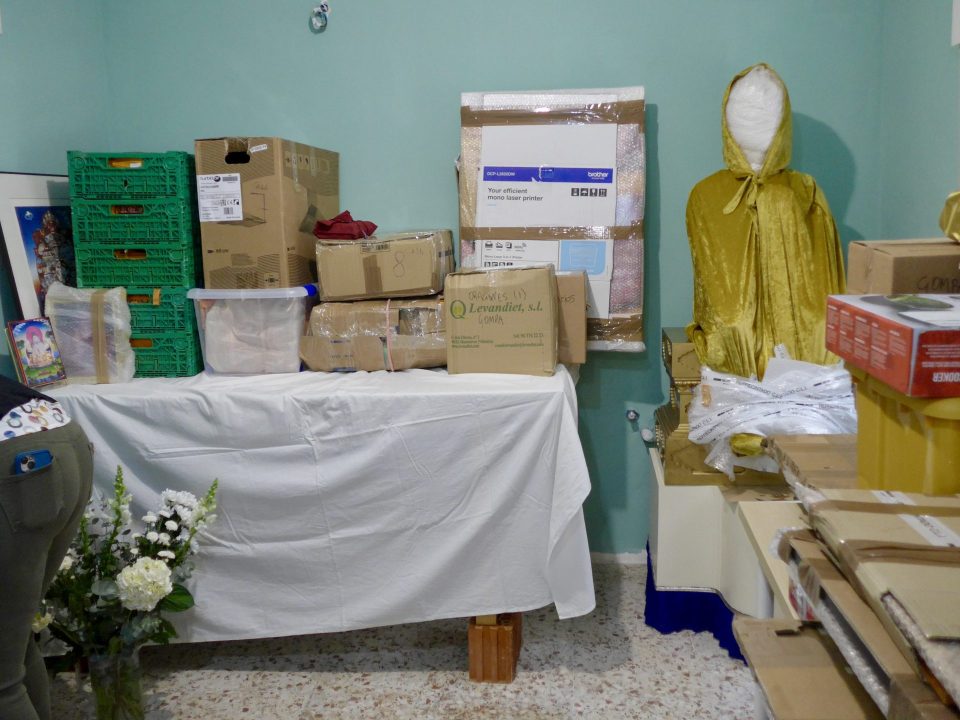
The altar right after the move, 2025. Photo courtesy of Tekchen Choeling.
Geshe Lamsang, resident teacher in Nagarjuna Valencia and one of the most acclaimed geshes of the FPMT organization, gave the precise guidelines and recommendations for the ceremony. We neatly followed suit.
As I was descending down the stairs, these stairs I’ve seen since I was born, carrying the box with the statues, I felt for a moment as if hundreds of people were next to me watching. You know? Like when a row of smiley Tibetans cheer you up by the path when you do a pilgrimage with a lama. But way more intense. Skies filled with deities. Only for a brief moment, but I felt it. It was real.
And with the same order—incense first, His Holiness, Lama Yeshe and Lama Zopa Rinpoche…—they arrived at their new location. They had to traverse 300sqm of a construction site to get there, though.
Tekchen Choeling’s new center is far from finished. When Rinpoche gave us the green light to relocate, we scanned the real estate in Ontinyent for suitable options. It took us until November of that year to find a place that met all of the requirements—a large, light-filled commercial premise in a good area of town, and for a good price. This one came with a big plus: a backyard orchard with fruit trees and an ancient farmhouse—in the middle of town! Surrounded by buildings. It is surreal.
The center bought the property in January of 2024. Permits, paperwork, unexpected structural fixes in the building, and delays with the architects took around a year and a half. Now, the property is ready for renovation, with the gompa as the main priority. However, the garden countryside house is only accessible through the commercial premise, so renovating it in the future would compromise the venue—it had to be renovated before. So rather than waiting, our team renovated the “casita” themselves in an astonishing volunteer effort, with their own hands, skills, and money.
Incense leading the way, His Holiness first, Lama Yeshe and Lama Zopa Rinpoche following…
The ceremonial procession traversed the not-yet-renovated property all the way to the back, down the stairs to the garden, and into the little farmhouse, to find another dozen people—our friends and sangha—reciting the Sutra of the Accumulation of Auspiciousness, with a very auspicious surprise: Ven. Jesús Revert Champa Shempen was there. Venerable Jesús is an Ontinyent-born Geshe—the only Spanish geshe as far as we know—who spends nine months a year in retreat and only occasionally visits centers in Spain.
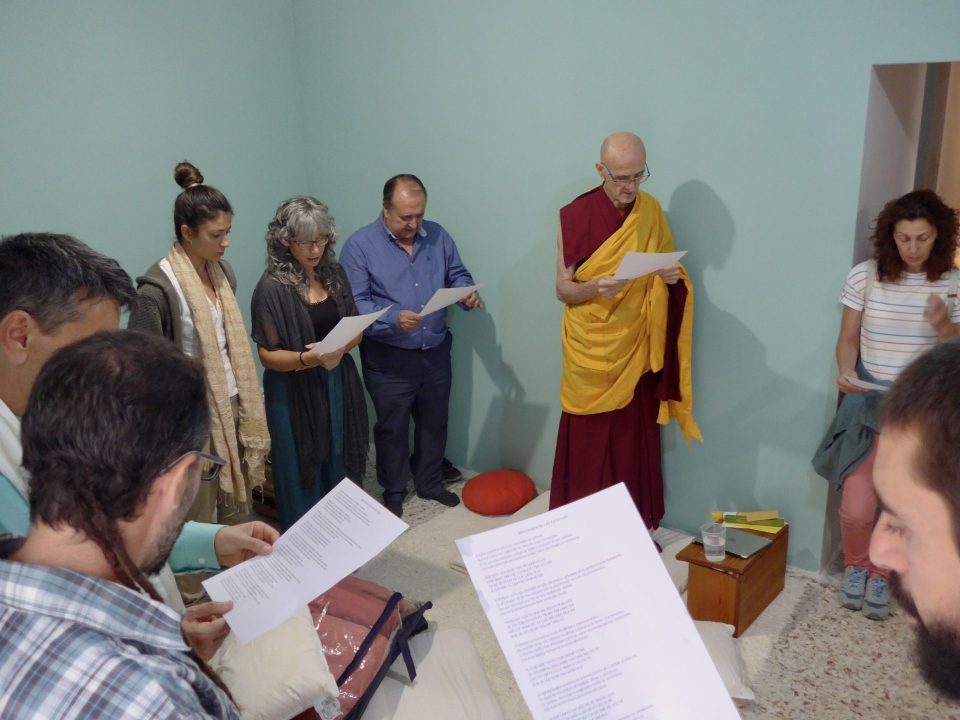
Venerable Jesús and center members recite for the moving ceremony, 2025..Photo courtesy of Tekchen Choeling.
With the revered monk as witness, a dozen people charged into the room with incense, portraits, and box after box of holy objects, including the complete Kangyur texts in fruit boxes, into a room that was already crammed to the limit. This room, it turns out, will only be the kitchenette of the “casita.” For now, though, it has become a temporary gompa stacked with wrapped holy objects until the renovation of the main part of the property is completed.
And why move from a small gompa to an even smaller one? Need. Tekchen Choeling has had to sell the apartment to start payments to the construction firm and begin the renovation. The precipitous relocation is only one of many inconveniences that Tekchen Choeling has faced to move this project forward. A major step for a small center, the renovation is pushing us all to the limits.
Director Paloma Belda confesses having many sleepless nights over worries that they might not finish it. “I would have never chosen this for myself,” she half-jokes. “But it’s my duty. For the center. For the town. For all sentient beings.”
They were left with no alternative. As Chelo, another long-term member of the center, explains, “there was no other way. In two or three years, I won’t be able to climb these stairs. And it’s the same for half the board. And half our teachers. It was either moving or closing down.” (Please watch a short video of video of their Maitreya Buddha statue being transported down the stairs on a wheelchair!)
Despite the major uphill they face financially, the mood is bright as sunlight, and confidence is high as the sky. “Everyone supports us,” says Paloma. “Every teacher, every neighbor, every FPMT center… They all see what we are doing and are left amazed. Especially if they can see the benefit this will bring to the world. We are expanding our guru’s mandala. That’s it. That’s our job.”
Next year, the center will turn 40. For our 40th anniversary, we plan to finish the renovation just in time for an inauguration Mahayana party, complete with teachings, community building, and social impact activities. We will have to move our altar again—but now, at least, we already know how. And so do you.
Kelsang Bas is a writer and social entrepreneur from Spain. Born into an FPMT family—his parents founded the Tekchen Choeling center in Ontinyent—he now helps small centers innovate and grow despite today’s challenges. He is assistant director at Tekchen Choeling.
Please watch an inspiring video Tekchen Choeling has put together on this move and how to get involved:
With grateful thanks to Kelsang for this story. We welcome the submission of news stories from those within the FPMT community. This can be a story about something you have personally completed or accomplished, about someone else who has done so, or about the FPMT center, project, or service of which you are a part. Ideal submissions will give readers reasons to rejoice, share ideas, and create connections between those in the international community. Have something to share? Please let us know!
Foundation for the Preservation of Mahayana Tradition (FPMT), is a Tibetan Buddhist organization dedicated to the transmission of the Mahayana Buddhist tradition and values worldwide through teaching, meditation and community service.
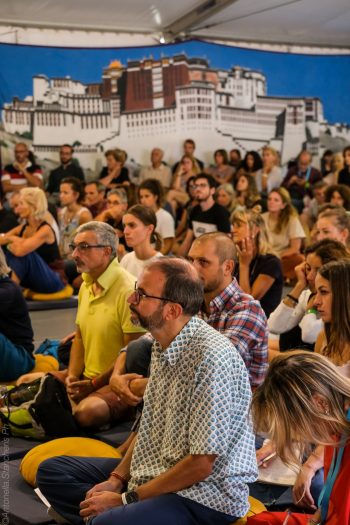
Presentation of books by His Holiness the Dalai Lama and Thich Nhat Hahn at the Festival of Tibet at ILTK.
From September 12-14, 2025, Istituto Lama Tzong Khapa (ILTK), Italy, hosted the fifth edition of Festival of Tibet in Pomaia with thousands of participants benefiting from the event. The Tibetan community in Italy was brought together for a weekend of several Dharma teachings, book presentations, Dharma art activities for children, and Tibetan street food. Carlota Pinheiro and Fabiana Lotito share the story:
Love, Compassion, and Dharma
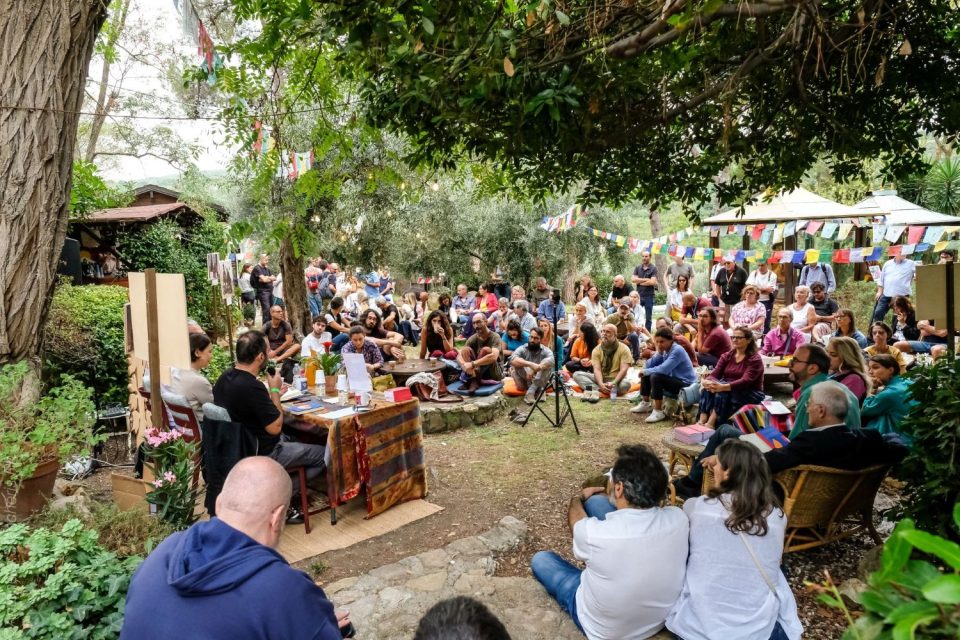
Participants during teachings at the Festival of Tibet at Istituto Lama Tzongkhapa, Pomaia, Italy, September 2025.
We have received nothing but kindness and generosity from the Tibetan people, despite their unimaginable suffering over decades. Though their homes, monasteries, and material heritage have been destroyed, what they strive most to preserve—and what they offer us with open hearts—are the teachings of love and compassion, the precious Dharma itself.
As Dharma practitioners and global citizens, we have much to learn from this resilience. While our world seems to destroy itself more each day, the Tibetan community shows us the way where wisdom and compassion are the true inheritance we pass to future generations.
This festival honored not just Tibetan culture, but the extraordinary capacity of the human heart to transform suffering into wisdom, loss into generosity, and exile into a gift for all humanity.
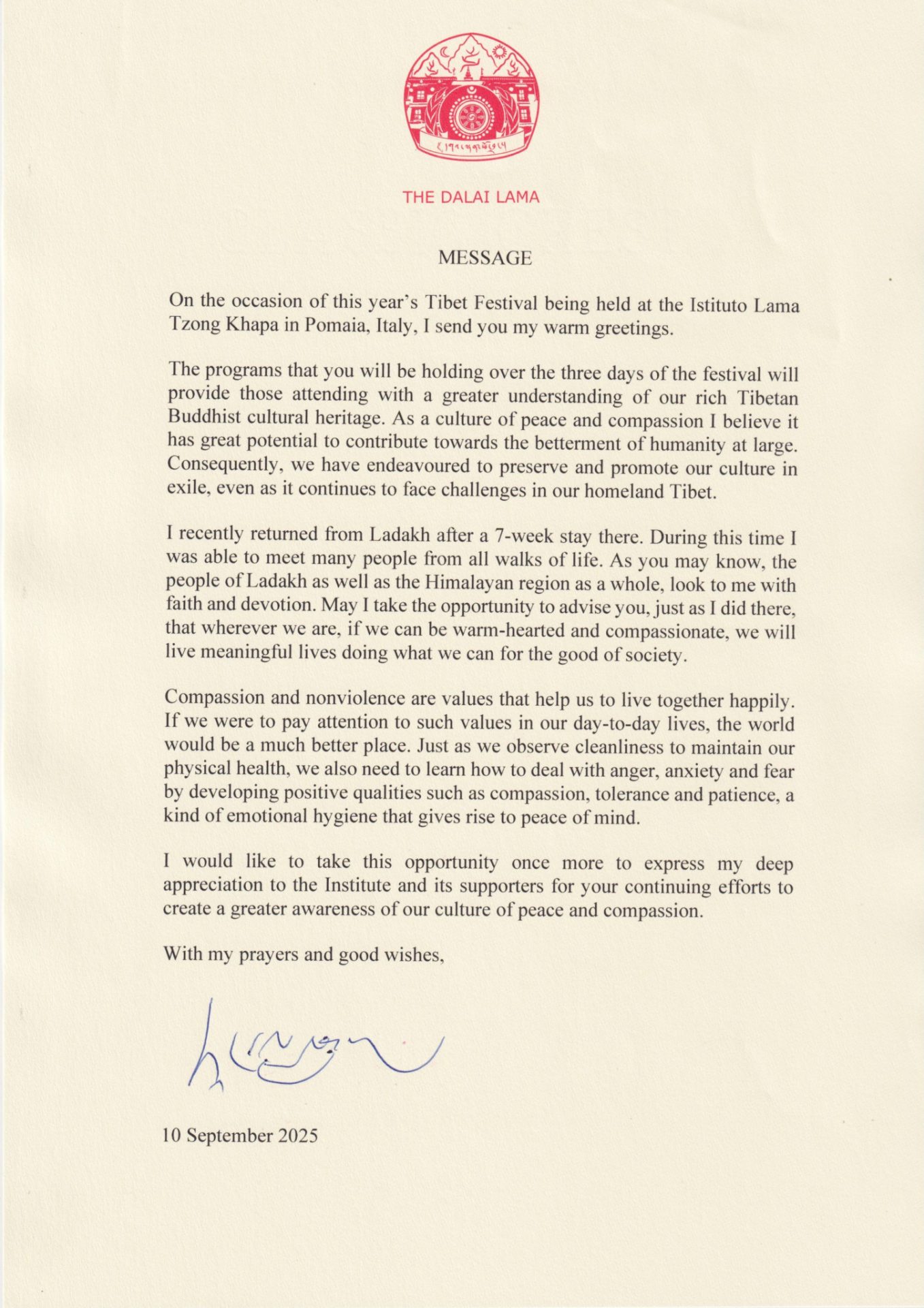
A Letter from His Holiness the Dalai Lama
His Holiness the Dalai Lama kindly wrote a letter addressed to ILTK on the occasion of the festival, noting how our programs would offer participants “a greater understanding of our rich Tibetan Buddhist cultural heritage” and emphasizing that this “culture of peace and compassion” has “great potential to contribute to the betterment of humanity in general.” His words reminded us that wherever we find ourselves, when we can be “cordial and compassionate, we will live meaningful lives doing what we can for the good of society.” We encourage you to read the letter from His Holiness in full.
Celebrating Tibetan Heritage: A Weekend of Dharma, Culture, and Community
The festival was inaugurated with a Lama Chopa puja, followed by the streaming of the wonderful movie “Never Forget Tibet: The Dalai Lama’s Untold Story”, the deeply personal account of the 14th Dalai Lama’s escape from Tibet in 1959. Watching the journey of His Holiness through the most difficult hardships and fears on those mountains, brings us face to face with an extraordinary act of preservation—not just of a single life, but of an entire civilization, a profound spiritual heritage.
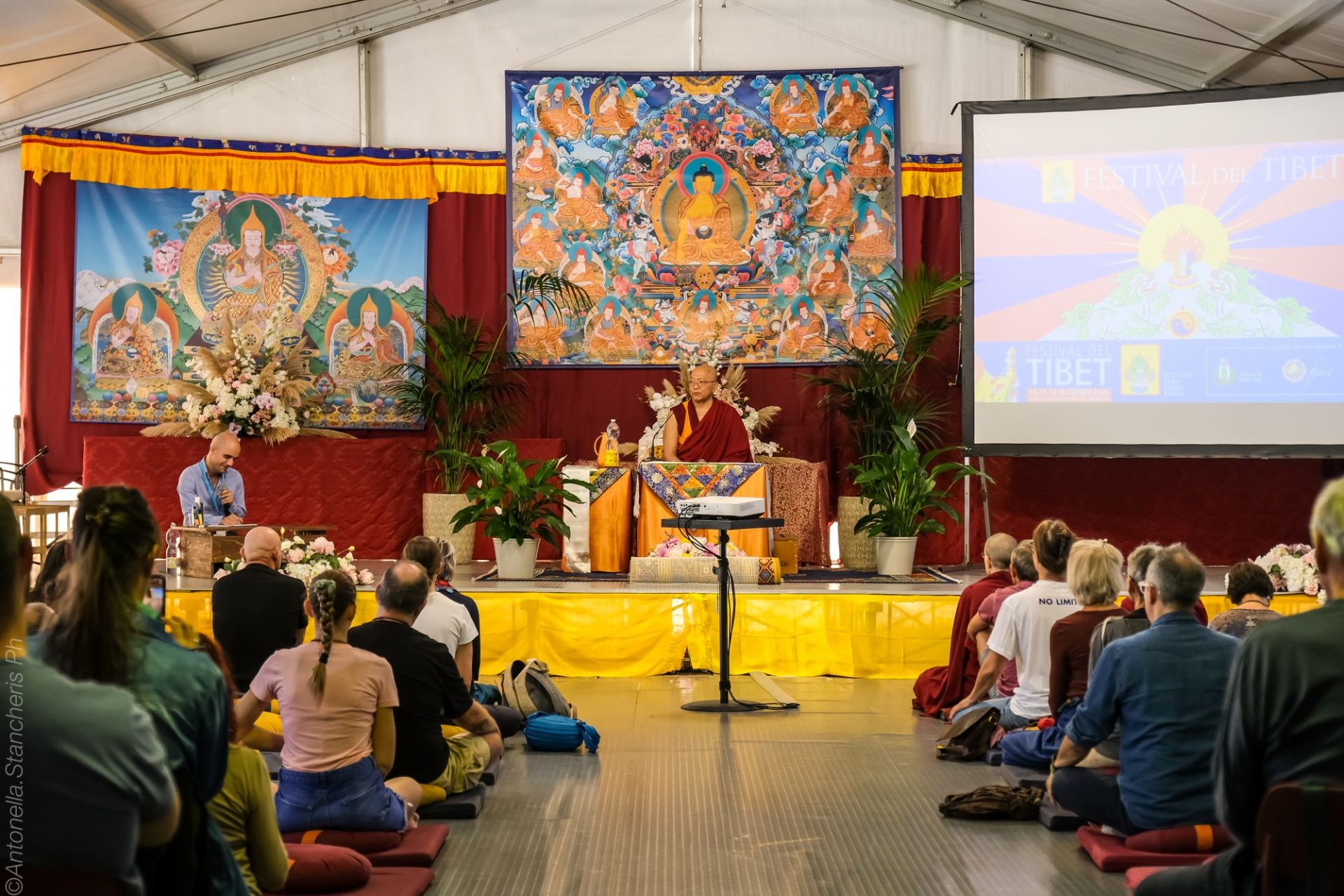
Geshe Tenzin Thenpel, resident teacher of ILTK, offering teachings during the Festival of Tibet at ILTK, Italy, September 2025. Photo by Antonella Stancheris.
Millenia of Wisdom: Teachings and Books
As the sun rose on Saturday, September 13, it was time for the precious teachings of Geshe Jampa Gelek and Geshe Tezin Tenphel, our two resident teachers at ILTK, the teachers of the FPMT Masters Program and FPMT Basic Program, respectively, as well as weekend monthly retreats. The topic, acknowledging the Year of Compassion as a year-long celebration of the life of His Holiness the Dalai Lama, was on compassion and how this practice can help humanity and be our direct path to lasting happiness.
On the morning of Sunday, October 14, we were gifted with more teachings on the same topic for the new visitors, blessing the festival with wisdom and genuine laughs. The afternoons were enriched by the guided meditations of Ven. Sonam Wangchuk.
On both afternoons, we gathered in the Tea Garden for the presentation of two books: Following in the Buddha’s Footsteps: Refuge, Ethical Conduct, Calm‑Abiding, and Insight Meditation, by His Holiness the 14th Dalai Lama and Ven. Thubten Chodron, and Il Nocciolo Della Vacuità by Thich Nhat Hanh, a recent Italian publication based on his teachings on selections from Nagarjuna’s Stanzas on the Middle Way (which has not been published in English).
Both books have been made available in Italian by Nalanda Edizione, publisher of FPMT Italy, and Ubiliber, The Italian Buddhist Union’s (UBI) publisher, respectively.
In the Tea Garden, we hosted “A Space for the Young,” recognizing the importance of connecting younger generations with Tibetan values. A thoughtful 12-year-old girl interviewed Geshe Thenpel about compassion and how to deal with difficult thoughts and challenging friendships.
Wisdom in Dialogue
On a secular approach, the festival was enriched by two deeply meaningful conferences that brought Buddhist wisdom into conversation with our contemporary world—academic and political. We welcomed five professors from the University of Pisa for a conversation on “Compassion and End of Life in the Tibetan Buddhist Tradition.” Ciro Conversano, Angelo Gemignani, Francesco La Rocca, Bruno Neri, and Ilaria Vaglini explored end-of-life in a spiritual, scientific, and philosophical way that fosters awareness and acceptance.
We also had the privilege of hearing from Senator Andrea De Priamo, President of the Italia-Tibet Parliamentary Intergroup, who opened our hearts with a talk entitled: “Dalai Lama: The Politics of Compassion,” which was a reflection on how His Holiness’s approach to leadership and search for peace—choosing compassion over power—offers us a beautiful vision for how we might govern and relate to one another. This conference had the privilege to welcome Claudio Cardelli, President of Italy-Tibet Association, Ven. Massimo Stordi and, via Zoom, Kungo Thinlay Chukky, Representative of the Dalai Lama in Geneva for Southeastern Europe.
These conversations reminded us that the Dharma doesn’t live only in our meditation practice, but can walk with us through our hospitals, our homes, and even our halls of government, gently teaching us how to care for each other.
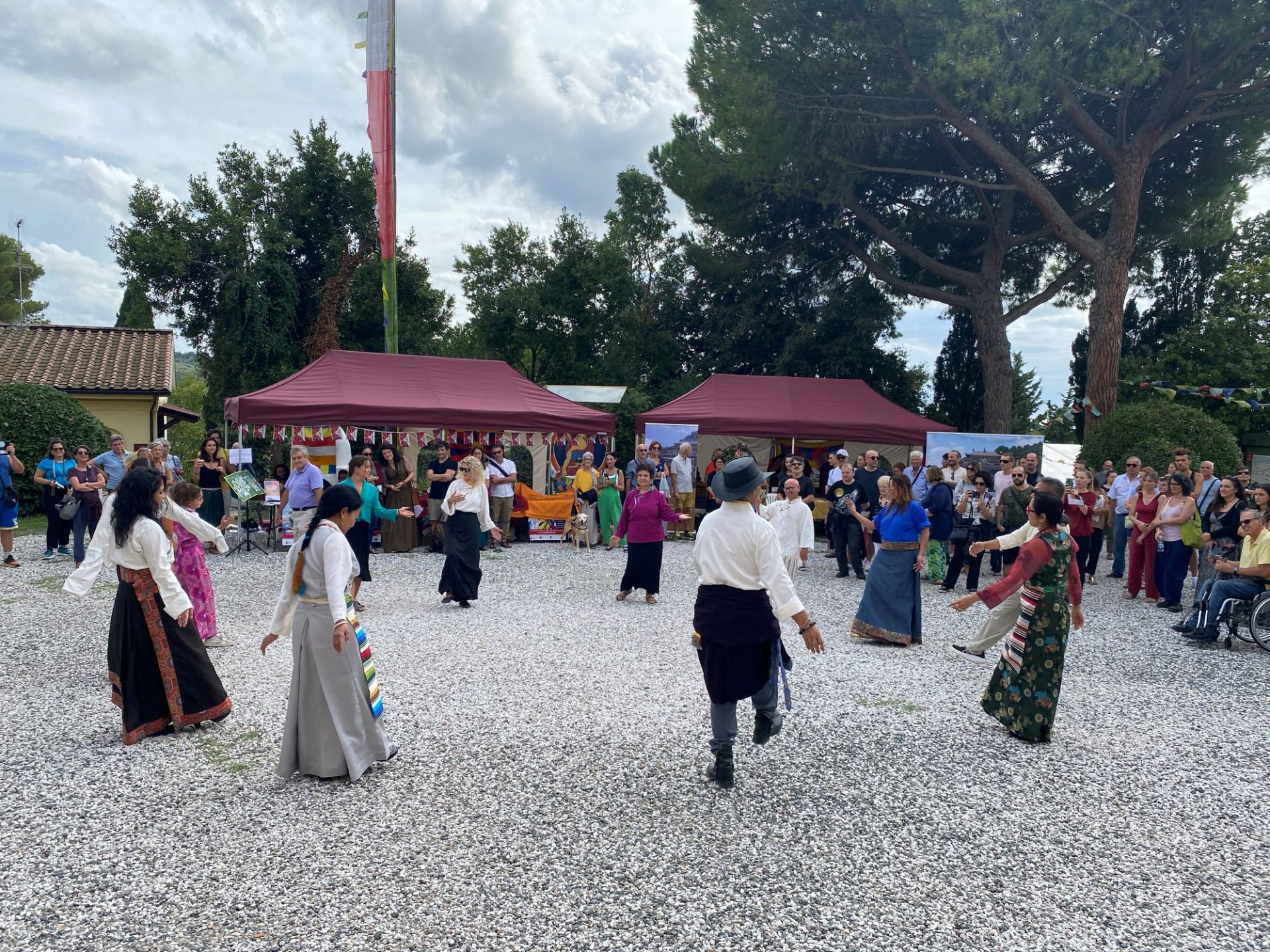
Traditional Tibetan dance being offered at the Festival of Tibet at ILTK. Photo by Antonella Stancheris.
Art as Dharma: Creative Expressions of the Path
The festival came alive with vibrant artistry. Our institute’s dance group, after months of dedicated practice, gathered in a large circle and invited Tibetans to join them in sharing traditional dances, creating a beautiful moment of cultural celebration and community. In the garden, Ani Lucia opened a tsa-tsa workshop, welcoming visitors, parents, and children to learn the sacred art of crafting these small clay offerings—miniature statues that carry prayers and merit. Alongside this, the Dharma Art Academy guided visitors through their first steps in painting a thangka!
Three compelling photo exhibitions enriched the experience: “Ladakh: The Little Tibet of India Monasteries and Buddhist Religious Festivals,” by Antonella Stancheris, “The Life of Siddhartha the Buddha,” by Piero Sirianni, and “Dalai Lama: 90 Years of Compassion,” by the Tibetan Community in Italy, which traced His Holiness’s remarkable journey meeting with great leaders around the world. Together, these activities invited everyone as participants in Tibet’s living traditions.
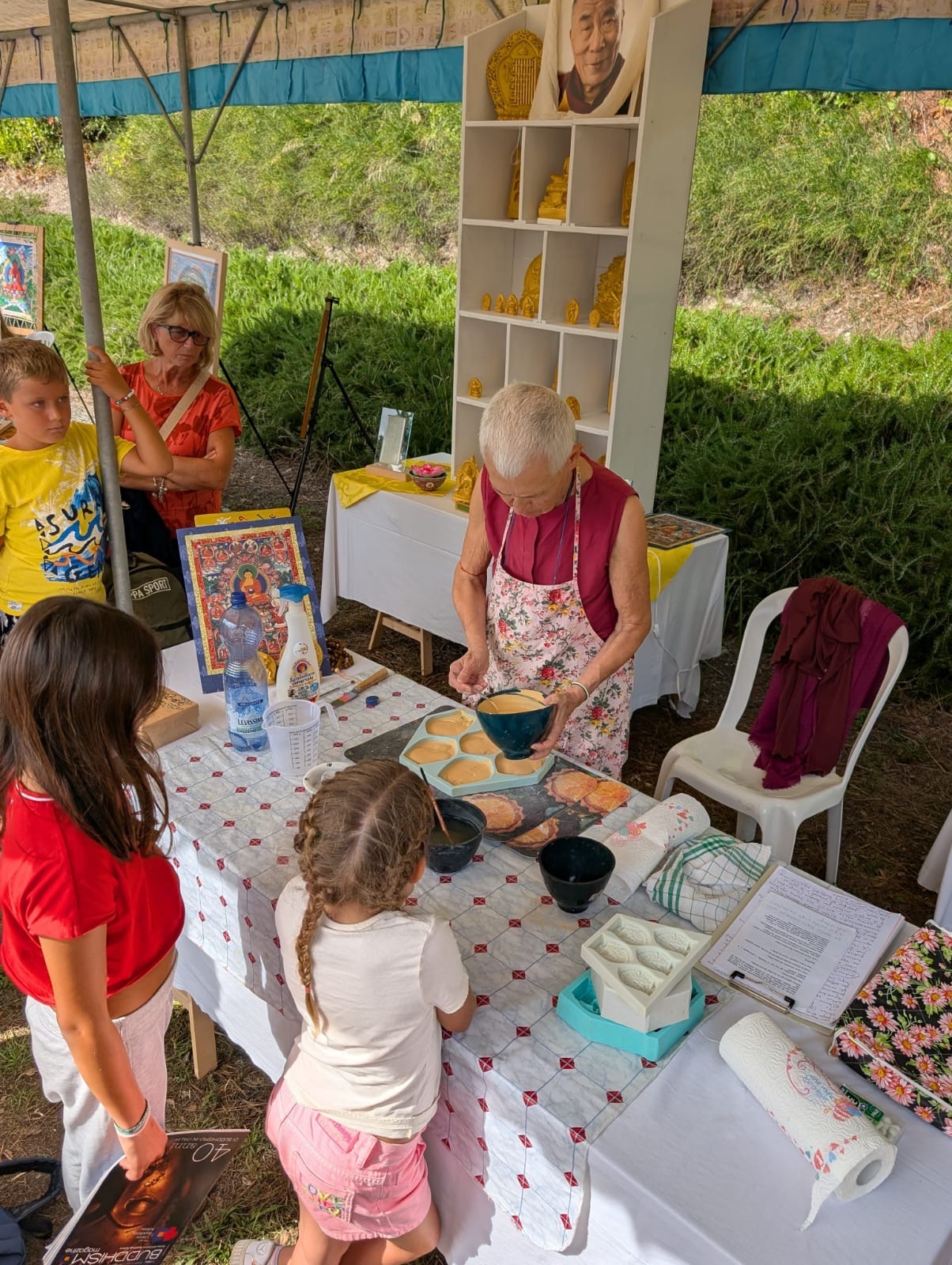
Ani Lucia at the tsa-tsa making booth at ILTK’s Festival of Tibet. Photo by Antonella Stancheris.
Opening Hearts, Opening Doors
One of the most beautiful aspects of our Tibet Festival was witnessing how many people stepped through our doors for the very first time to encounter Dharma and Tibetan culture. The informal atmosphere created perfect conditions for meaningful encounters, with mantra concerts in the tea garden and stands throughout the courtyard offering diverse ways to connect: sessions on Tibetan Medicine and Yoga, members of the Tibetan community in Italy welcoming visitors, and the Italian association “Dare Protezione” (Giving Protection) offering one-on-one dialogues and support about the death process for oneself and loved ones.
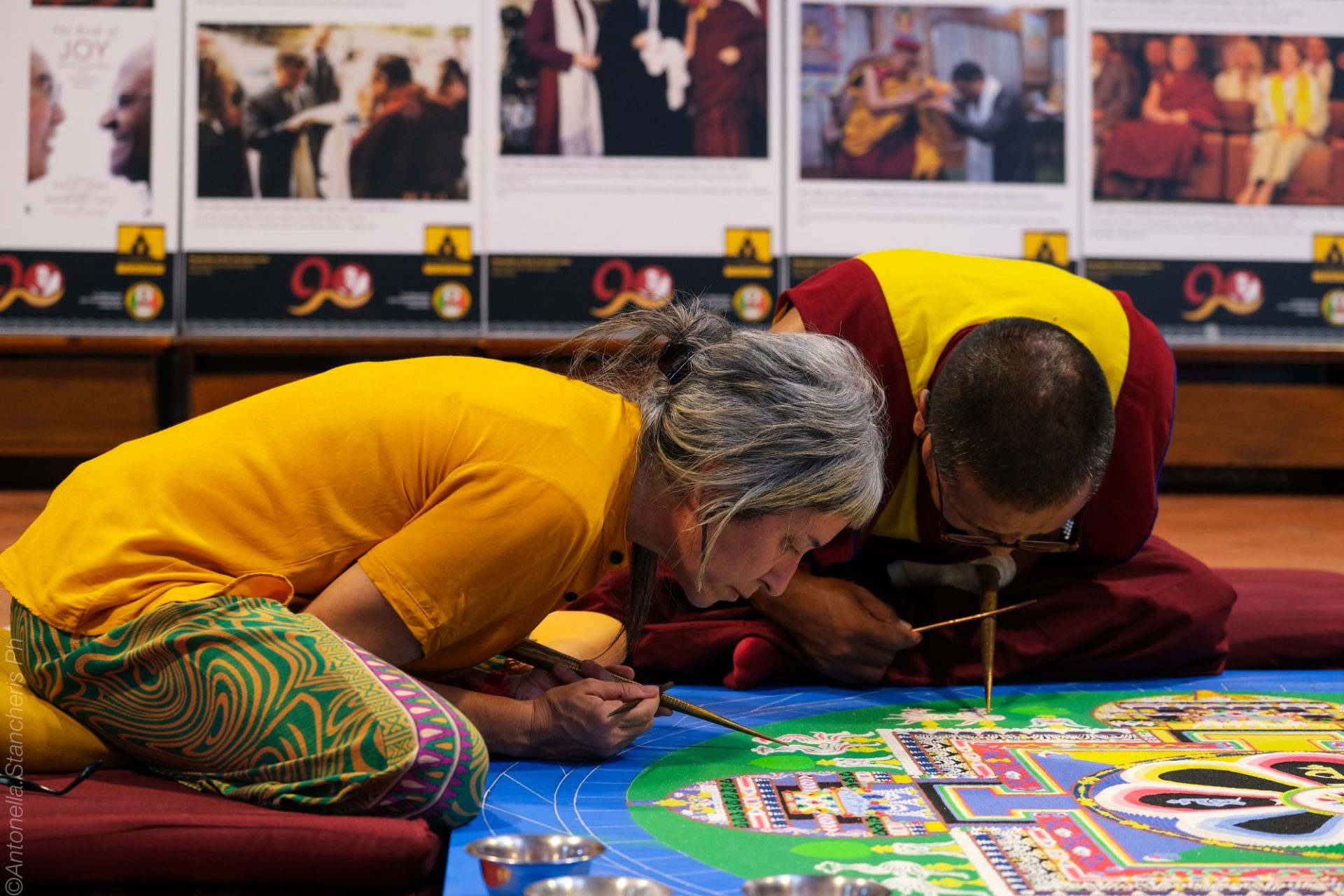
The creation of the sand mandala of Chenrezig for the Festival of Tibet at ILTK. Photo by Antonella Stancheris.
Seeds of Transformation
The festival reached its culmination with the dissolution of the sand mandala of Chenrezig, constructed over a week by Geshe Lhundrup, Elisa Macci, and two geshes from Sera Jey Monastery in India who were invited to help with it’s creation. This extraordinary work—countless hours of meticulous drawing and painting with colored sand while chanting mantras—vanished in mere seconds. Geshe Lhundrup, resident at ILTK, smiled and said “mitagpa!”—impermanence in Tibetan. “So many hours of work and gone in one second!”
Many visitors gathered in the room to witness this powerful moment they will forever carry in their hearts—a living demonstration of the Buddha’s core teaching on impermanence.
As the colored sands were swept away, we dedicated this merit to all those who are not at peace at this moment. We dedicated the merit generated from the whole festival to the end of wars, cultivation of peace, and to the finding of the path to lasting happiness.
With grateful thanks to Carlota Pinheiro & Fabiana Lotito for this story. We welcome the submission of news stories from those within the FPMT community. This can be a story about something you have personally completed or accomplished, about someone else who has done so, or about the FPMT center, project, or service of which you are a part. Ideal submissions will give readers reasons to rejoice, share ideas, and create connections between those in the international community. Have something to share? Please let us know!
Please read another recent story about ILTK’s community events.
Foundation for the Preservation of Mahayana Tradition (FPMT), is a Tibetan Buddhist organization dedicated to the transmission of the Mahayana Buddhist tradition and values worldwide through teaching, meditation and community service.
The early Kopan courses brought together students from many backgrounds who came to Nepal seeking different things. For some, the teachings changed the course of their lives. Others were drawn to Lama Yeshe and Lama Zopa Rinpoche through their unique qualities, wisdom, and compassion.
The recollections gathered here were originally published in Mandala magazine: in the April–June 2009 issue in “Intimate Reflections,” and in the April–June 2004 issue in “The Kopan Experience.” Republished here as part of our celebration of the fiftieth anniversary of the Foundation for the Preservation of the Mahayana Tradition (FPMT), these personal stories offer a glimpse into the formative years at Kopan Monastery and the experiences that would shape the lives of many early students.
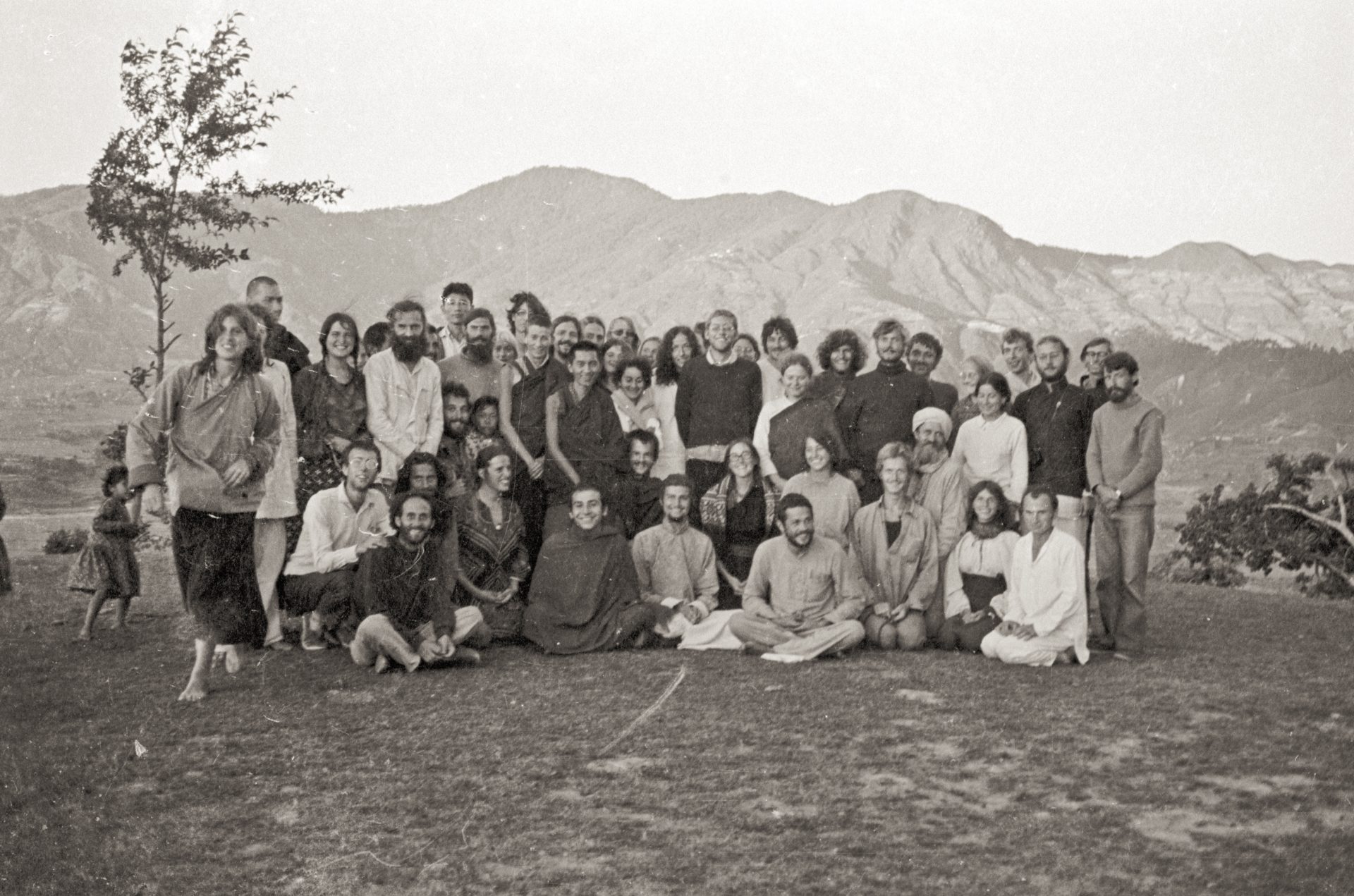
The third Kopan Course group photo, 1972. Photo courtesy of the LYWA.
Suzi Albright, who attended the sixth Kopan course and later became a nun and did a twelve-year retreat, remembers:“ I only went to Kopan to see a friend. I was not interested in Buddhism. In fact, I was completely turned off by the whole scene. Many of the people there seemed unhealthy, both mentally and physically. I thought if this is meditation, who needs it? I was really only an observer and refused to prostrate. However, my first sight of Lama Yeshe changed all that. I immediately sensed he knew things most people don’t. I’d met a lot of highly educated people, but none who were wise. Lama Yeshe was as wise as you could get. His compassion and wisdom were so apparent that one was really struck by his presence. I regarded him as a buddha, because if he wasn’t, I don’t know what he could be. After seeing him, I began doing prostrations.”
Lois Greenwood-Audant, an early student, recalled:” I had the privilege of taking the fourth course in March ’73 with my fiancé, Gabriel Audant. The course deeply resonated with our mutual thirst for understanding the dissatisfied mind and how to achieve happiness. Lama Yeshe and Lama Zopa became our root teachers from that time forward, and they have always served as strong guiding forces for our lives. Throughout our 30-year marriage, whenever the inevitable relationship conflicts would arise, the foundational teachings at Kopan always served as skillful means for finding our ways back to compassion and love for one another. The Dharma in our family was further strengthened when Lama Yeshe kindly agreed to “baptize” our only child, Gabriel (Gabe) Michael, ten years later. When I returned to U.C.-Berkeley to complete a doctorate degree focusing on workforce development issues, I was able to support the early growth of Vajrapani Institute as its second director, and I continue to be an active member of its Dharma community. The lamas have given us thousands of teachings to appeal to the various levels of our minds. For me, Lama Yeshe’s teachings on distilling the universal qualities of Buddhism “without the religious trappings” as an effective way of helping people in the West had the most impact and have guided my Dharma efforts throughout my life. I have successfully experimented with integrating universal wisdom values from Buddhism into business training programs as the director of a business and workforce development training center at University of Hawaii’s Maui Community College for over 15 years. This experience has led me to the writing of a book on Managing Destructive Emotions”
Another early student, Carol Royce-Wilder, recalled: “[I] burst in on Lama Yeshe, sobbing hysterically. His eyes widened and he looked very concerned. I just blubbered, out of control, a real spectacle. “What is it dear?” he asked, taking my hands in his and drawing me close to him. Looking around he found flowers someone had given him and said: “Here dear, these are for you.” I said, “No, no, Lama, it’s me who should be offering them to you!” He handed me some fruit and said to take it, too. “No, Lama, you don’t understand, nothing helps. Not fruit, not flowers, it’s useless! I’m totally isolated and alone. I can’t feel anything. I’m dead. Nothing means anything to me, not even you, Lama!” I shrieked and sobbed. He said: “Not even me? Impossible, impossible!” Then he opened his eyes very wide and drew my eyes to his, and what felt like my whole being went… somewhere. I haven’t the words to describe what happened. I felt like he took me into the deepest recesses of his being, and I saw, I knew, that there was nothing there. Absolutely nothing at all. There was just an empty silence, a black hole. There was simply no person called “Lama” inside. It was awesome. In that moment I realized that the friendly, smiling, personable Lama Yeshe I knew was a figment, a persona he’d created solely for our benefit; that behind the charismatic exterior lay unbounded empty space. Lama had allowed me to catch a glimpse of that for one brief, but eternal, moment.”
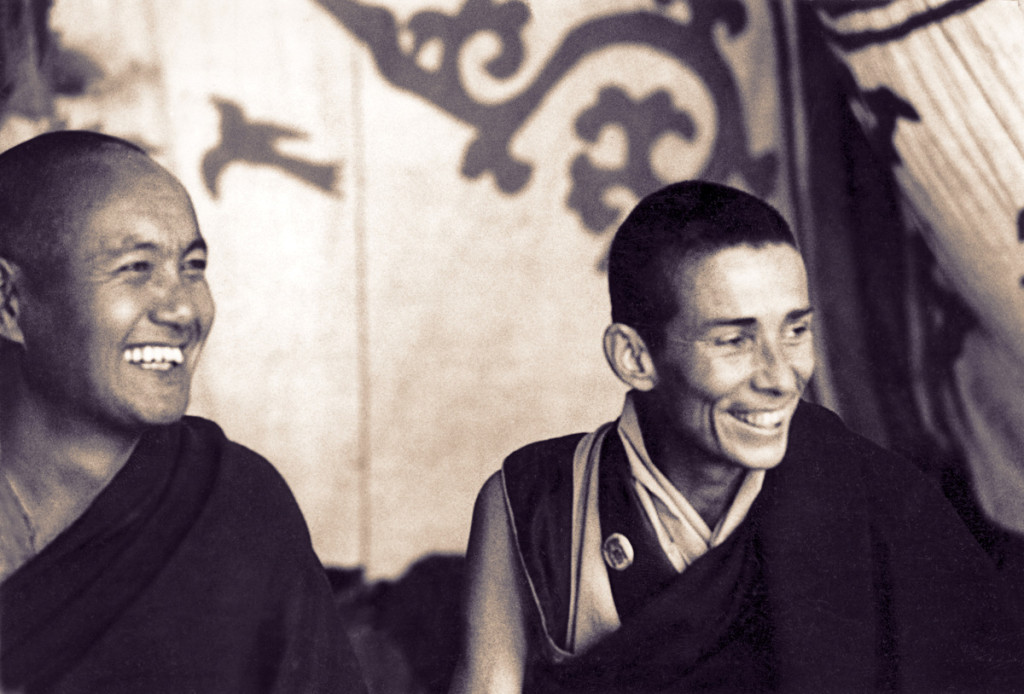
Lama Yeshe with Anila Ann (Ann McNeil), Kopan Monastery, Nepal, 1974. Photo courtesy of the Lama Yeshe Wisdom Archive.
Ven. Ann McNeil, one of the first ordained Westerners and a former director of Chenrezig and Vajrapani Institutes, recalled: “I attended every Kopan Lam-rim Course from the first to the sixth, but I never sat completely through one from beginning to end. I had many duties under strict orders from Lama Zopa Rinpoche and Lama Yeshe. The enrollment seemed to double for every course, so the logistics were a challenge. Lama Zopa Rinpoche worked so hard. Hardly slept. Not only did he attend and give all the teachings of the lam-rim, he also attended all the meditation periods and led them, the early morning ones to the last one at night. He was truly with us all the way. We were so fortunate in those beginning years. He was literally spoon-feeding us the Dharma. In that way we learned how to study and meditate and actualize it. He forced us to internalize our own suffering so we could recognize it in others. But first thing, every morning, he would go on and on about, ‘What Shantideva says, compassion, compassion,’ and then every afternoon for three weeks, ‘Suffering, suffering, suffering.’ Did we get it? To apply compassion to our own suffering? To heal ourselves? And at the crucial moment where our minds were overloaded with everything under the Golden Sun of the Mahayana Thought Training, like a magic genie Lama Yeshe would appear and kiss our minds all better with his delightful joy for the Dharma and us, his golden flower students. Lama could slip right in under our skin and noses and read us like a book, totally disarming us with a line about our “fickle mind” by saying, “I am just a medieval monk. No, I am just a Tibetan anthropologist studying the West.” Now, he had our attention and the mental overload was gone. “What’s our problem, Lama?” Like little birds with our mouths open for wisdom. “You can’t get no satisfaction!” he chanted. A great enlightened howl would go up, and we were in love with this lama.”
Another early student, Steve Pearl, recalled: “I was committed to the Dharma and living and working at the center [Kopan]. I was building my house there, the three-story tower, Dechen Potrang (“Blissful Palace”) and helping in the construction of the first gompa. I was thinking about becoming a monk by then and was interested in doing lots of retreat. The Dharma had hit home, and I was in the process of rising to the challenges and opportunities that would be coming, knowing that this would be my path for the rest of this life and many, many more lives to come. I had been looking for such a path since I could remember and was afraid that they had ceased to be. Lama Yeshe had shown me that there were still saints in the world, and Lama Zopa deftly showed that the path, the way to follow them, still existed as well.”
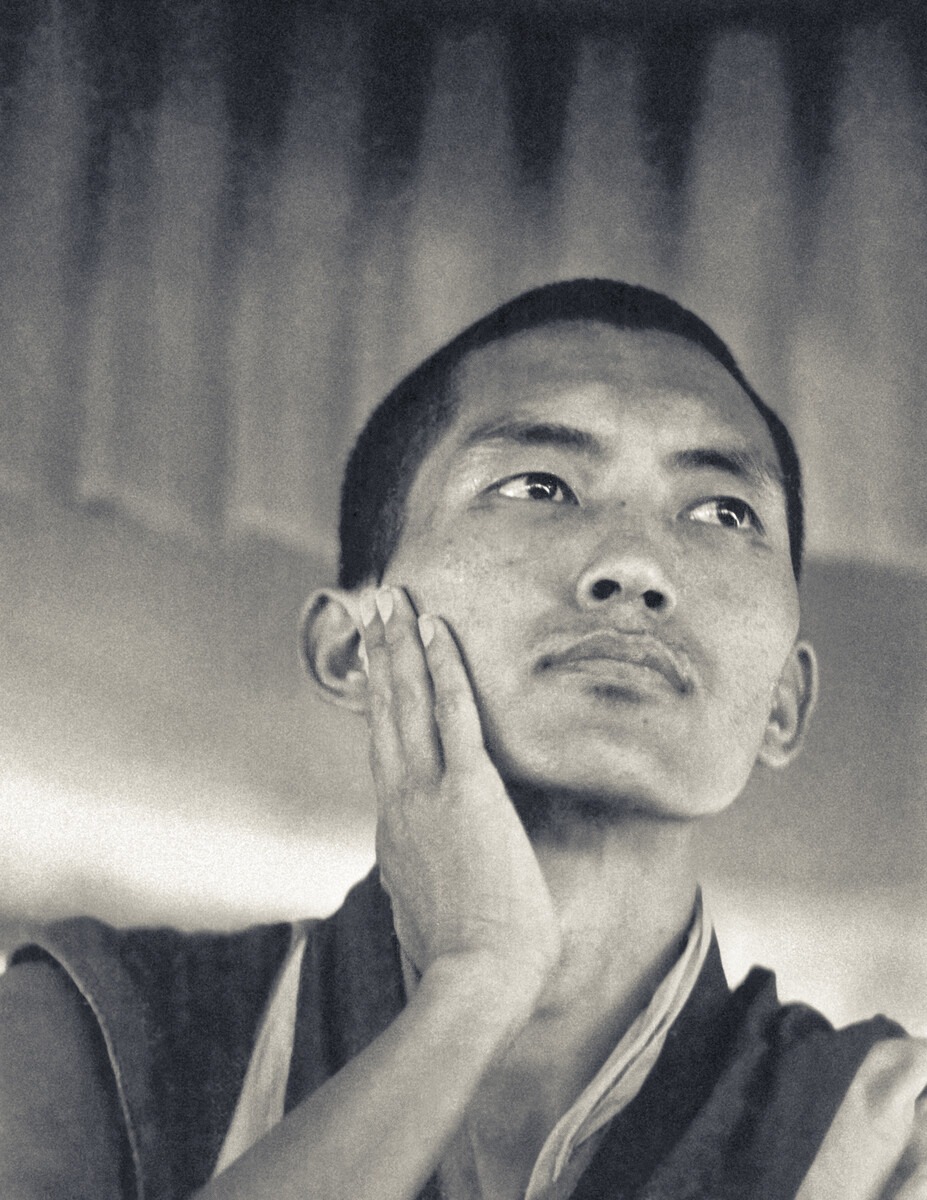
Lama Zopa Rinpoche teaching at the Sixth Meditation Course, Kopan Monastery, Nepal, 1974. Photo by Ursula Bernis. Courtesy of the Lama Yeshe Wisdom Archive (LYWA).
Ven. Connie Miller, writer, editor, early student, and early organizer of Universal Education (now FDCW), recalled: “Lama Yeshe and Lama Zopa Rinpoche were the perfect pair. Extrovert and introvert, outrageous and traditional, heavy and light, relaxed and disciplined, wrathful and gentle (but always compassionate!). And yet that’s altogether too simplistic It is impossible to categorize them concretely as in “Lama was like this and Rinpoche was like that.” Both of them embodied all qualities, all polarities, just in different measures at different times, according to the needs of different people. In their relationship to each other, however, the love and respect and care and deference that each showed the other – and thereby demonstrated to us – was enormous, inexpressible in words”
Ven. Karin recalled: “I attended my first Kopan course in November 1974. It was the first time I’d heard Buddhist teachings. Lama Zopa Rinpoche and Lama Yeshe taught the course. Nick Ribush was leading it, making the course great fun, with his warm sense of humor. My feeling is that although the place itself has changed over the years, the courses have not changed. It has become so much more comfortable and clean at Kopan, but the feeling of the courses is the same. At the beginning we didn’t have even electricity or running water or beds. We slept on straw mats. Pits dug in the ground were toilets, and we used the spring down the hill in the local village. Meals were taken on the hillside. Now we have single and double rooms with bathrooms, as well as dormitories with solar showers, a huge dining room, a cyber café, a restaurant, a shop, a clinic with overnight facilities, and clean water, which is purified at Kopan itself. The most wonderful thing about the course is that the people come and receive the theory and immediately are able to put it into practice; it has an immediate effect on their minds. You see this. When they leave, they are not the same as when they came. This hasn’t changed over all the years. Until Lama Yeshe’s passing away, Lama Zopa Rinpoche would teach the entire course; now Rinpoche comes for the last ten days or so. He appoints a course teacher every year, an incredible variety of course leaders. The leader sets the tone of the course. That is the only thing that makes the courses slightly different. ”
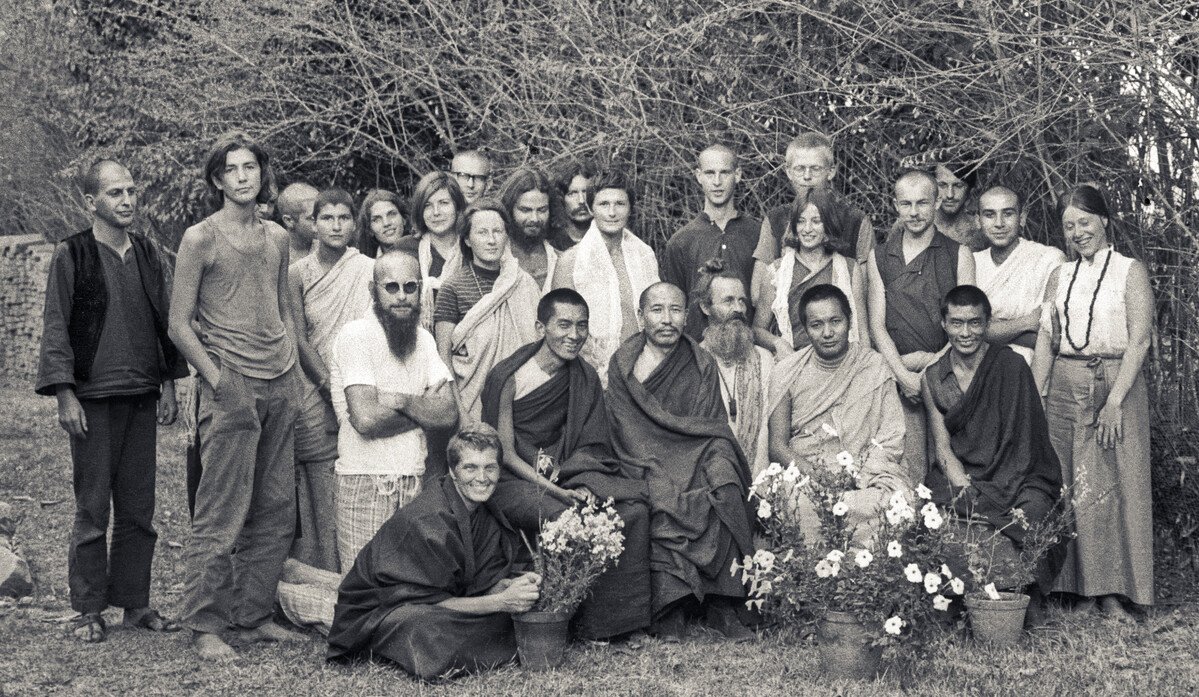
Group photo from the first meditation course held at Kopan Monastery, April, 1971. Photo courtesy Fred von Allmen.
Artist Andy Weber, describing his first commission from Lama Yeshe, a large Manjushri thangka for a new center in England, recalled: “It took three months to complete and changed my life. Lama didn’t want it painted in the traditional style, where you have the lineage holders at the top and bottom of the painting. He wanted just the one single image of Manjushri, which was an unusual request. He wanted it to be huge. He was always telling me, “Think big! Big paintings for big places!” Since then I have continued painting just one deity in thangkas. We Westerners have to learn to communicate with these on a one-to-one basis before we try and deal with many figures at once.”
Sharon Gross, one-time director of FPMT, Inc., recalled:“ In 1974, under the haze of the projected great comet Kahoutec, amidst one hundred thousand or so people shuffling about in the dust as they assembled in Bodhgaya from various parts of the globe, many particularly coming out of Tibet for the first time, I was introduced to His Holiness the Dalai Lama and was present as the Kalachakra initiation was conferred, over a week-long period. My presence there was at the insistence of my teacher, the most kind Lama Thubten Yeshe, whom I had met in the previous months in Nepal. My husband had wanted to go trekking in Nepal, so in September of 1973, we left our usual life in upstate New York as graduates of Syracuse University and headed off with our math professor on an overland trek from Holland to the mountains of Nepal. In looking back I laugh as I mentally picture Lama Yeshe reeling in his students, as if with a nylon fishing line, to re-unite with things much more precious in life than mountain climbing or degrees. At this fifth course in Nepal I met numerous people among the 250 assembled, many of whom are my dear friends to this day. From the moment of hearing the very young precious Lama Zopa Rinpoche say, “The mind is beginningless,” I was hooked by the “velvet glove of Dharma,” as our guide Ven. Ann McNeil described it. I remain a student of awakening, though perhaps the laziest and weakest of the crowd. I am ever grateful for the words of Dharma that were showered upon us as we were immersed in the philosophy of universal responsibility and the good heart over the course of those months. My true north was found, and all that has followed is directed by that guiding star.”
Jon Landaw, early student, writer, editor, and Discovering Buddhism teacher, recalled: “Lama Yeshe had a unique teaching style. Instead of saying, “Do you understand me?” he’d ask, “Are we communicating?” He acted out what he was saying, which was so helpful, because not all of his students spoke English. Even those who did speak English often couldn’t understand him properly until they caught on to his unusual rhythms of speech. Lama communicated way beyond the meaning of the words, using facial expressions and sometimes just silences. When editing his teachings, I could only use the words he said and always felt there was something missing.”
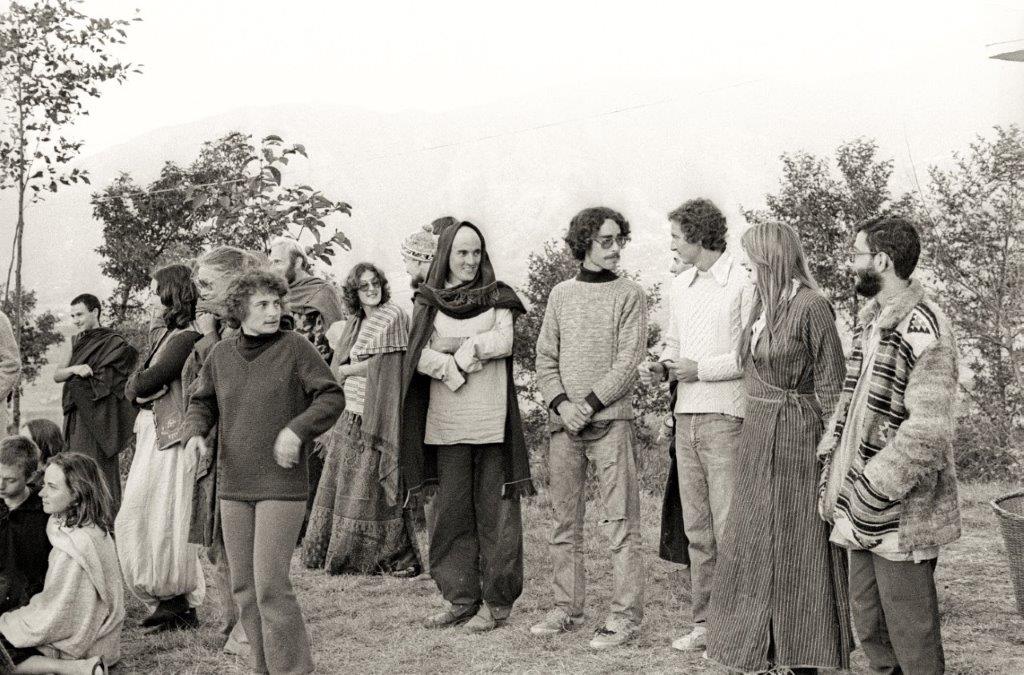
Students celebrating at the end of the 1978 Kopan November Course. Photo courtesy of Michelle Le Dimna. Courtesy of the Lama Yeshe Wisdom Archive (LYWA).
Ven. Fran recalled: “When I came to Kopan for the November course in 1991, it was to get ordained at the suggestion of Lama Zopa Rinpoche. I will never forget the first sentence that Lama Zopa said in his first teaching that time: “The purpose of our life is to work for others!” That was it for me; that made it all clear. Ven. Marcel was leading the course, with Lama Zopa Rinpoche and Kirti Tsenshab Rinpoche teaching every day. It was intense. What I do remember is the kindness of the people I met here at Kopan. How helpful Lama Pasang was when he helped me get my robes straightened out during the ordination. The incredible atmosphere, sitting there in the Chenrezig gompa (just barely finished) with so many monks and lamas receiving initiations from Lama Zopa Rinpoche. At that time there were about 140 monks here and maybe 25 nuns. It was a small village. Now the village is much bigger, a village in the true sense. In another huge difference from earlier years, when most of the students were young people in their twenties, quite a few middle-aged people make the journey to Nepal to meet Buddhism, meet a teacher, and receive teachings. In another very interesting trend, the children of these very early students are coming back to do the November course, just as their parents did twenty or so years ago. From talking to many of the participants, the Kopan experience is still there, still working its magic.”
Marcel Bertels, early student and former director of many early FPMT businesses, shared:” Rinpoche was the most unusual and mystical being, and the fact that Rinpoche was still so young (maybe around 27) made it even more special. Those were the days when Rinpoche was doing almost 24 hours of formal meditation each day, with almost 24 hours of formal meditation each day, with short breaks for meals and occasional teachings. Rinpoche was also available for interviews between 4:00 P.M. and 5:00 P.M., 15 minutes maximum per interview. Many were shorter, and I can’t remember Rinpoche engaging in any small talk with his students. The conditions were spartan; I was staying on the first floor of the school building at the bottom of Kopan Hill. With regularity the floor would give way, and one of the students would crash through and try to hold on for dear life not to fall to the floor below. I made so many enduring friendships during the course. My immediate neighbor in the gompa was Paula de Wijs. Nick Ribush was by far the smartest of the attendees and often engaged in debate with Rinpoche. The course became the most important experience in my life. Within a matter of days I was totally convinced and satisfied that Buddhism was for me, and I couldn’t conceive of ever doing anything else.”
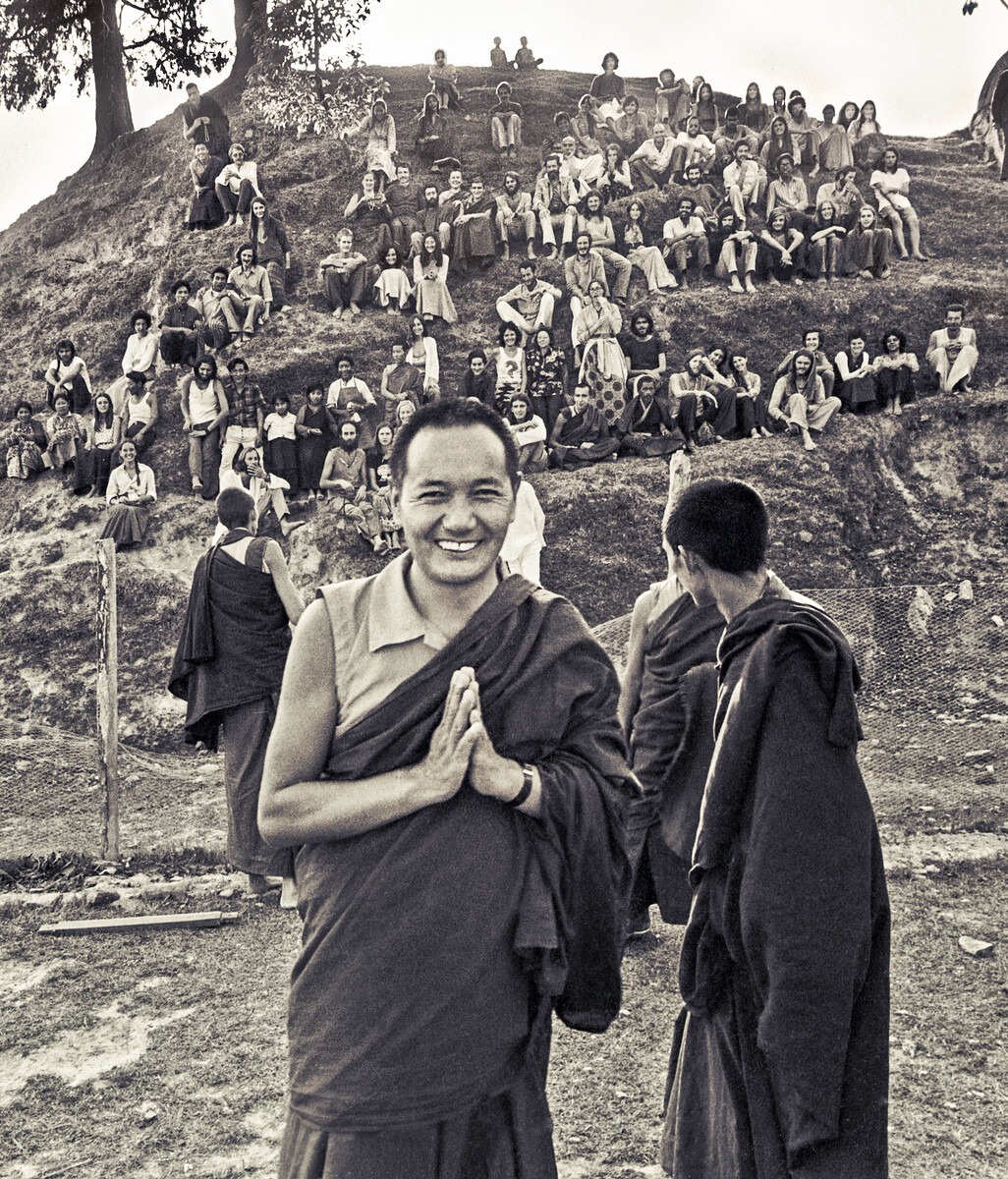
Lama Yeshe in group photos from the Fourth Meditation Course, Kopan Monastery, Nepal 1973, Photo by Brian Beresford. Courtesy of the Lama Yeshe Wisdom Archive (LYWA).
Gareth Sparham, an early student, remembered: “Lama Zopa went on and on about the negative mind. I remember that it was based on misplaced selfishness and that he explained it in the language of the so-called eight worldly dharmas. There was the devil, and you would stay up all night, if necessary, to poke it with its own pitchfork. Fine guru, fine teacher of the guru, fine message, and fine earlier students who worked selflessly to help make those earlier courses a reality.”
Judith Weitzer, an early student, remembered: “Often, at the end of a meeting with Lama Yeshe, he would mention something that he would like you to do. He might ask you to be director of a center, organize a course, or start a school or project. In 1976, one of his requests changed the course of my career and my life. He simply said, “It makes my heart break to see how old people are treated.If you can, do something about it.” Frankly, I didn’t have a clue about how I might work on this problem. After a year in Asia, I returned to my job as a social worker in the Bay Area. I had lost my seniority and had to take whatever position was assigned. When a memo came across my desk, seeking people interested in staffing the newly formed Office on Aging, I remembered Lama’s words and felt I owed it to him to apply for the job even though it was outside of my field of expertise. I remember walking up to the County Offices for my oral examination, thinking: “I don’t know a thing about this, so Lama, if you want me to do this work you had better take care of this interview.” Well, he did! I was surprised how easily answers came to me – it was really as if he was whispering in my ear. I was offered the job. Thus began my long (40-year) career in the field of aging.”
Ngawang Chotak, early student and former director of Wisdom Publications, recalled: “We did a lot of cooking together, Lama teaching me how. For breakfast he liked French toast with lashings of butter and syrup, as well as sausage or bacon and strong coffee with whipped cream. If Anila Ann had seen that she would have gone nuts. She was always on at me about his diet. I agreed with her at the time but Lama claimed nobody knew his body like he did. “I need strong food to keep it going – steak and milk.” He made these big momos but wouldn’t let me buy ground beef for them, it had to be the best steak and he’d chop it up himself. He didn’t like ground beef: “You don’t know what’s in that!” He loved his coffee. He started adding half and half but said it wasn’t strong enough, so moved on to whipping cream.”
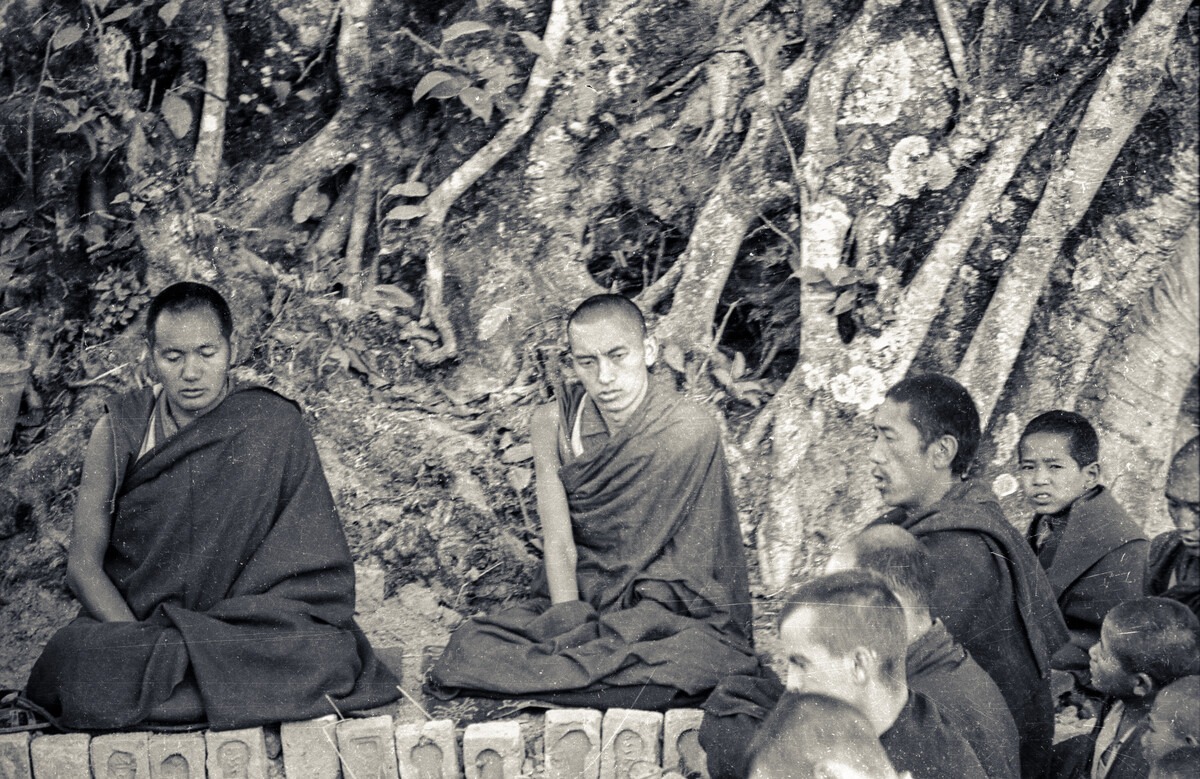
Lama Yeshe and Lama Zopa Rinpoche with students from Mount Everest Centre and Pasang Tsering Lama, 1974, Kopan Monastery. Photo by Ursula Bernis. Courtesy of the Lama Yeshe Wisdom Archive (LYWA).
John Schwartz, Lama Yeshe’s attendant in 1980 and former director of Vajrapani Institute, recalled: “I was always amazed at the amount of food Lama could eat, with all his physical problems. He’d often hold the palm of his open hand on a spot down near his waist and say: “Oh my heart!” I’d say, “Lama, your heart isn’t down there.” But he said it was. I don’t know what he meant by that He always had breakfast and I’d lay out a whole spread for lunch He called it his “California lunch,” with salads and lots of pastrami, salami, cheeses – all the fatty foods. He just loved it. Then he’d have his nap and two hours later he was calling out: “John Shore, where’s my snack!” He loved cold cuts, even with tea, and at night he’d eat a big dinner. We’d just finished one of these “California lunches” one day when he gets a call from this married Mongolian lama who lived nearby. This guy constantly did pujas and Lama always attended them when invited. So this lama rang to say that his wife just made momos. Well, that was the magic word! So he starts putting away these momos, looking up at me with sheepish eyes, like a kid caught with his hand in the cookie jar, as they brought him plate after plate of them. Most of the time Lama ate good food. He was one of the few Tibetan lamas to understand about salads and fresh vegetables. He made a garden out the back of the house as soon as he got there, to maximize the growing time. He really had the touch – you never saw vegetables grow so big in just two months. People would come over and say, “I’ve lived in Berkeley all my life and I’ve never seen anyone grow stuff like this.” He gave it away, a lettuce here, tomatoes there, supplying his students all summer. Lama knew about good food, but he ate junk too.”
Beatrice Ribush, Nick Ribush’s mother, described what awaited her in 1977: “When I returned I noticed this wonderful smell. There was Lama, towel around his waist and laughing loudly, with every saucepan I possessed on the table, under the table, on the stove the mess was indescribable. We sat down to a magnificent vegetarian lunch of many different dishes. Peter [Kedge] had taken him shopping in Chinatown for the ingredients.”
Foundation for the Preservation of the Mahayana Tradition (FPMT) is a Tibetan Buddhist organization dedicated to the transmission of the Mahayana Buddhist tradition and values worldwide through teaching, meditation, and community service.
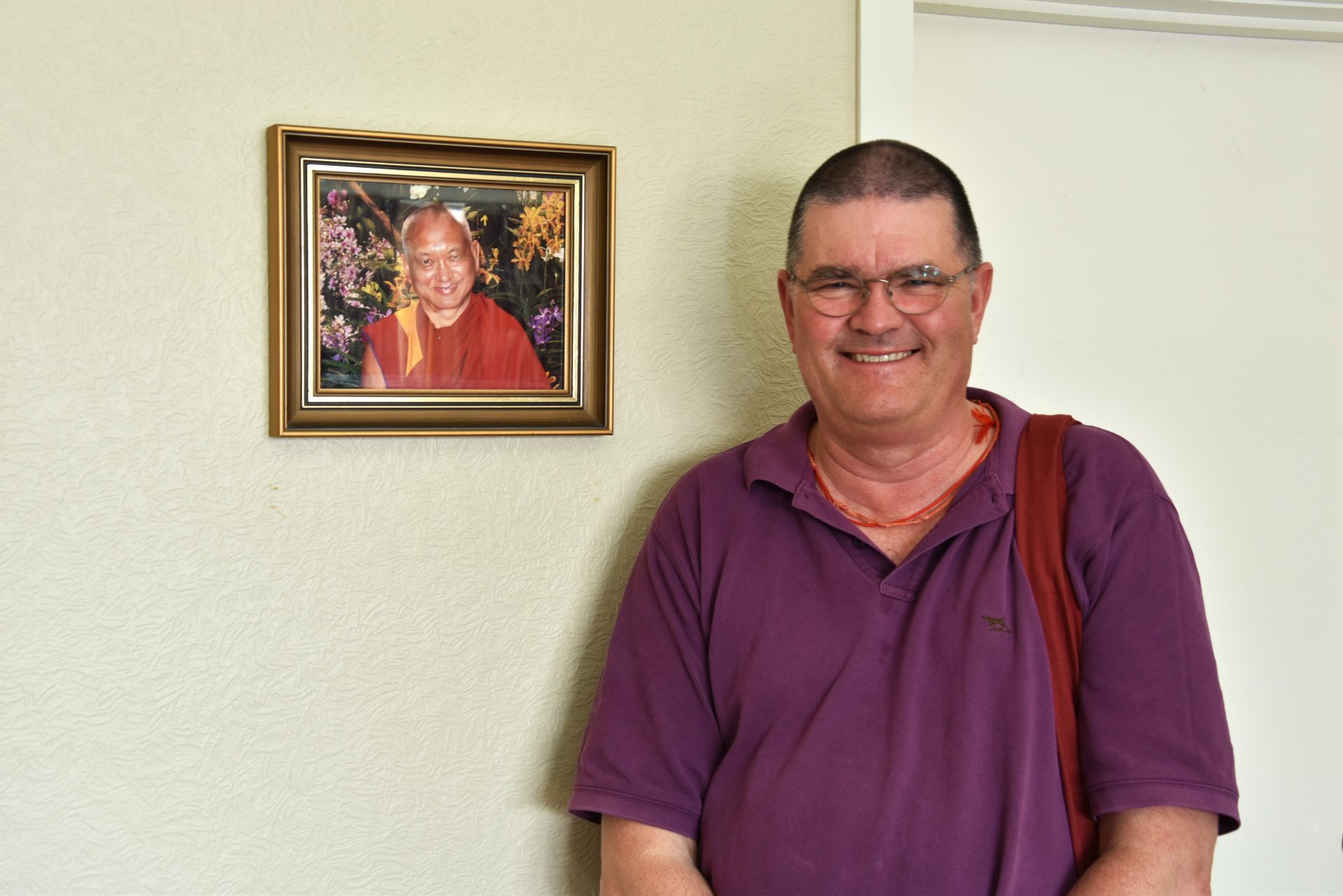
Brian Rae at Dorje Chang Institute, New Zealand, at end of year potluck lunch, December 13, 2020.
Brian Rae passed away suddenly of a heart attack on September 12, 2025 in Taupo, New Zealand.
The following words celebrating Brian’s qualities, interests, and years of service in the FPMT mandala were prepared by Simon Harrison, a FPMT-registered teacher, with input from Brian’s sister Susan, his wife Paula, and Ven. Gyalten Wangmo, the spiritual program coordinator of Dorje Chang Institute.
Brian can be best summed up with 3Hs: hats, hugs, and happiness. He was a big-hearted, big-chested, big-smiling man, for whom nothing was too much trouble. He filled many roles around Dharma centers in New Zealand. He served on the board of Mahamudra Centre and was a trustee of Dorje Chang Institute from 2021 until he passed away on Friday, September 12, 2025, with no warning signs, shortly after completing his morning prayers.
Brian first connected with Dorje Chang Institute (DCI) around 2009, when His Holiness the Dalai Lama visited New Zealand and has been a constant support for both DCI and Mahamudra Centre ever since.
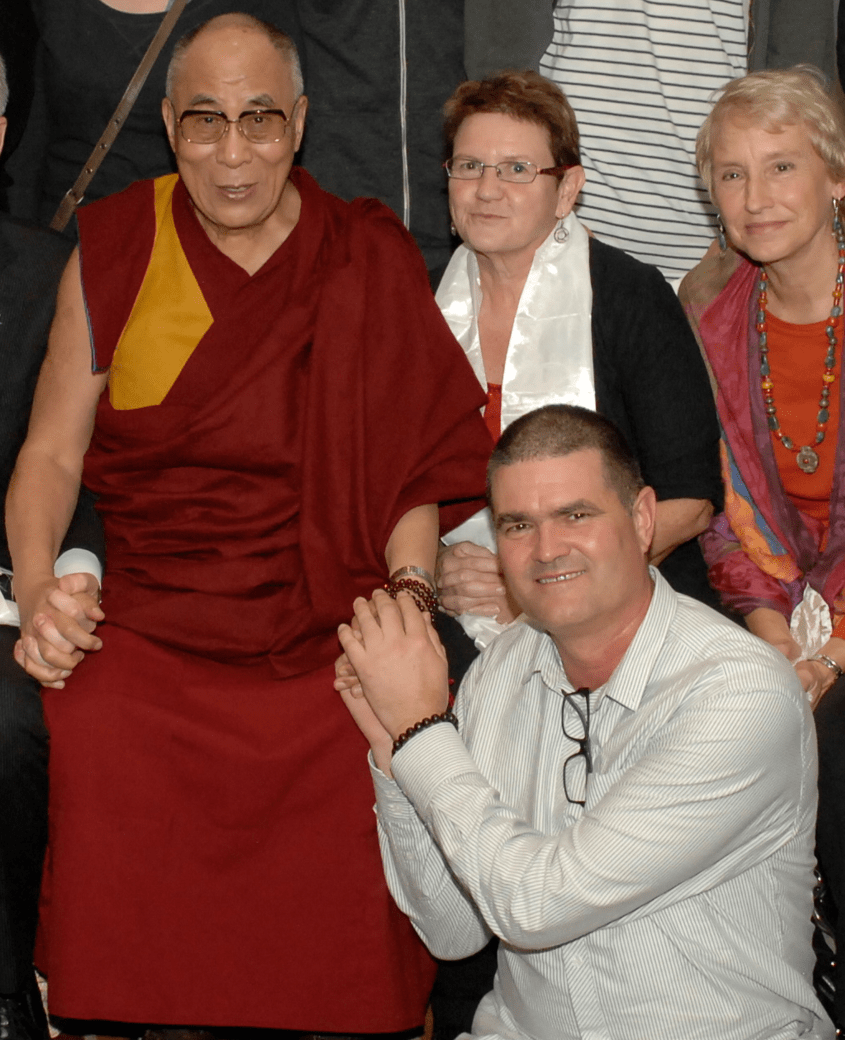
Brian Rae with His Holiness the Dalai Lama, New Zealand, 2013.
He took on the role of national coordinator for FPMT New Zealand in 2014 to coordinate the visit by Kyabje Lama Zopa Rinpoche the following year. He continued in the role until after His Eminence Ling Rinpoche visited in 2020, after which Covid kept us all in our own little bubbles.
Brian loved his family: his wife Paula; three daughters, Ella, Lucy (husband Jake) and Georgia (husband Oliver); and three grandchildren, Luca, Fleur and Leah. There were many times the family would gather with Brian at the heart of it, building Legos with the kids and regaling the rest with extensive stories of the latest “new” thing. He and Paula had just completed building their retirement retreat overlooking Lake Taupo, close to the grandchildren, when he was so suddenly taken from us.
His Dharma journey was infectious. Joined by his sister, Susan, together they would appear for teachings or to offer service at Mahamudra Centre or Dorje Chang Institute. Always humble, his passion for the centers and his devotion to his teacher defined him.
At DCI, he recently oversaw the refurbishment of the stupa. He expressed his love of trees as groundsman supervisor. His memory stays with us in the trees and other greenery around the property, as well as being the star of the training videos for groundskeeping equipment.
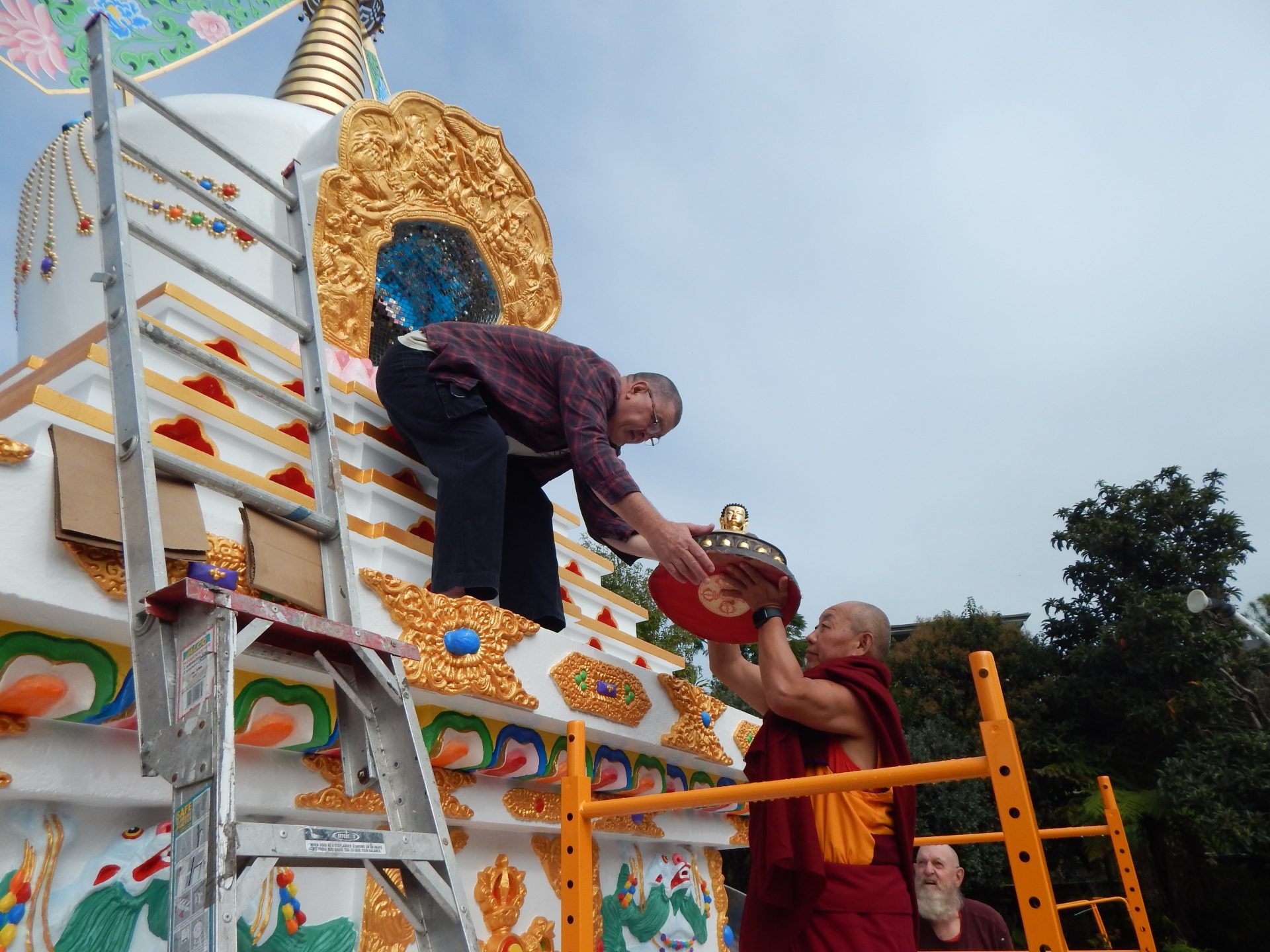
DCI Stupa Refurbishment Project, with Brian Rae assisting Geshe Wangchen, April 6, 2024.
While managing the house build, fulfilling a demanding job with Auckland Airport, sharing his loves for family and trees, and serving on DCI’s board, Brian managed to complete a full round of the FPMT Basic Program with Geshe Thupten Wangchen at DCI.
His final lesson to us all is the fragility and impermanence of this precious rebirth, and the manner of making it happy and useful.
We pray that all of his merit through service, study, practice, and warm-heartedness will serve him well into the future up to his enlightenment.
Please pray that Brian may never ever be reborn in the lower realms, may he be immediately born in a pure land where he can be enlightened or to receive a perfect human body, meet the Mahayana teachings and meet a perfectly qualified guru and by only pleasing the guru’s mind, achieve enlightenment as quickly as possible. More advice from Lama Zopa Rinpoche on death and dying is available, see Death and Dying: Practices and Resources (fpmt.org/death/).
To read more obituaries from the international FPMT mandala, and to find information on submission guidelines, please visit our new Obituaries page (fpmt.org/media/obituaries/).
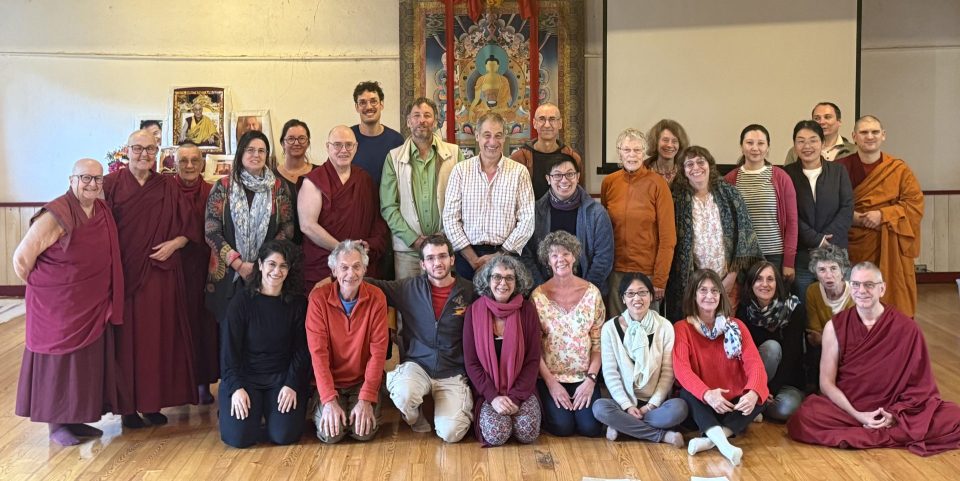
Foundation Service Seminar participants at IVY, France, September. Photo by Capucine Reddon.
FPMT International Office staffer Zarina Osmonalieva attended her fist Foundation Service Seminar at Institut Vajra Yogini in France this September. Here she shares her experience joining this FPMT immersion retreat.
Led by Francois Lecointre and Wendy Ridley, the latest Foundation Service Seminar was held at Institut Vajra Yogini, France (IVY), from September 24-28, 2025. Around 40 participants from different FPMT affiliates from Europe joined. We had the pleasure of sharing the FSS with Sangha members and a new team of volunteers and directors, Venerable Tendar and Christophe Rotiel, of Vajrayogini Institute. What a great start it must be for them, I thought, as FSS with its rich content about the history and values of FPMT, teachings of lamas, Vast Visions for the next thousand years set out by Lama Zopa Rinpoche could be a great boost of energy and motivation!
Many conditions made this FSS a harmonious and safe space to learn about the culture and significance of service within FPMT. Vajrayogini Institute’s team of volunteers offered their best to make everyone feel welcomed and comfortable and nourished by tasty meals. Wendy and Francois, with their many years of service as center directors and FSS trainers, skillfully facilitated the process of internalizing the values and learning the ways of serving at centers and study groups and igniting the “family feeling.”
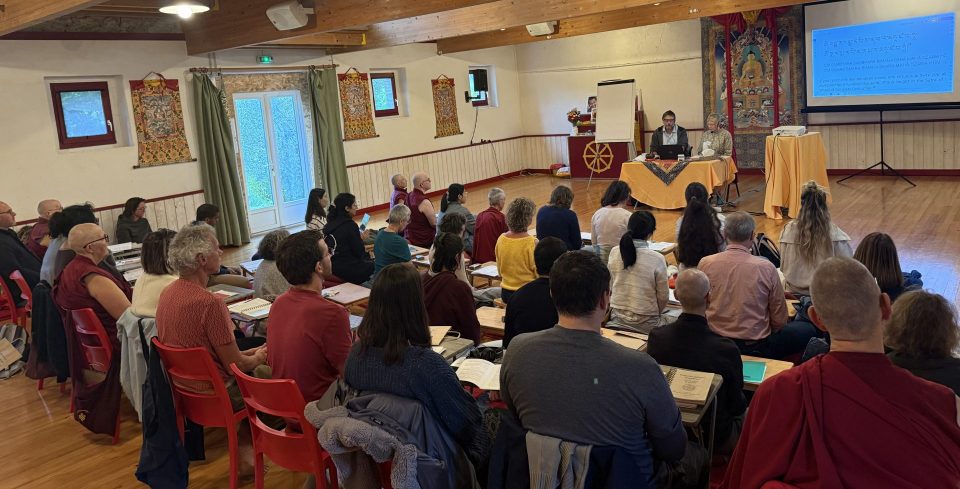
FSS facilitators, Francois Lecointre and Wendy Ridley, leading a session at IVY. Photo by Capucine Reddon.
The format of FSS reminded me of the creative methods used in the 16 Guidelines workshops, where group exercises and playful activities do some magic – they open hearts to new encounters and friendships and allow space for collective wisdom to emerge. I am sure we all made meaningful connections and found new friends!
All participants were gifted a set of Inner Job Description cards, a tool that helps developing mindfulness of our thoughts, speech, and actions. A few participants mentioned they would be happy to use them in their services at centers. One participant shared, “Lots of aspects (of IJD) are practical and I will put them into practice personally.”
One very important message that we were all reminded of was that when offering Dharma service, we do not focus on the outcome only, but on how we do things. We also discussed how understanding our dependence on each other guides us in doing things in a more holistic and sustainable way.
My personal takeaway from FSS this time would be the importance of how we offer service versus getting things done. Very often we may focus on our to-do lists more than creating spaces for spiritual maturation. We may ignore the needs of others because we are busy ticking off completed tasks, or we may ignore our own needs for reflection and rejuvenation and forget that rest and joy are also important ingredients of success.
As Acharya Shantideva says: “The supports when working for the sake of living beings are aspiration, steadfastness, joy and rest.”
We all left IVY feeling immense gratitude and joy. As one of the participants said, “Thank you very much for your tireless preparation and presentation. Thank you also to all those work so hard for FPMT providing resources, archiving teachings, fundraising, but above all, practicing sincerely the Dharma and Wisdom Culture.”
I felt that FSS is not limited to the service within FPMT, it is about cultivating the mindset of offering our best to our family members, friends, and the world at large.
Zarina Osmonalieva worked for Yeshin Norbu Center in Stockholm, Sweden, between 2018 and 2023, first as social media person, then as SPC. Zarina joined the team at FPMT International Office in 2023 and offers service across several departments, including the FPMT Foundation Store, which she manages.
A Foundation Service Seminar is scheduled at Istituto Lama Tsong Khapa, Italy, June 10-14, 2026.
Foundation for the Preservation of Mahayana Tradition (FPMT), is a Tibetan Buddhist organization dedicated to the transmission of the Mahayana Buddhist tradition and values worldwide through teaching, meditation and community service.
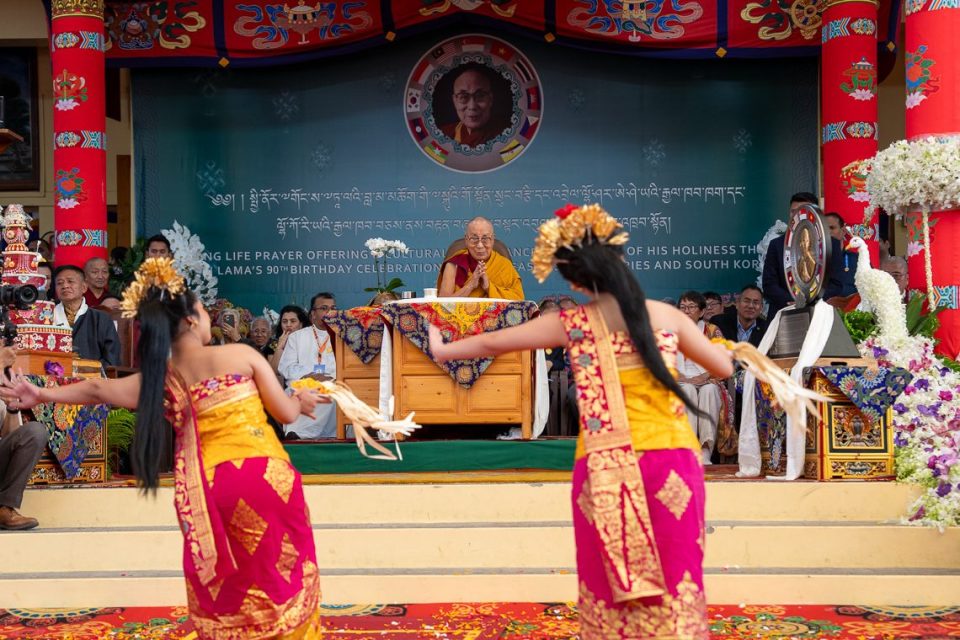
Dancers from Indonesia performing for His Holiness the Dalai Lama at the Main Tibetan Temple courtyard during the long life prayers and cultural performances in Dharamsala, India on September 20, 2025. Photo by Tenzin Choejor
On September 20, more than a thousand people from Korea and several South-east Asian countries gathered in the courtyard of the Main Tibetan Temple, Dharamsala, India, to make prayers and offer praise and cultural performances for His Holiness the Dalai Lama’s long life, in celebration of His Holiness’s ninetieth birthday which occurred July 6. During the ceremony, a joint statement was read on behalf of all the participants by Thich Nhat Tu, Vice Head of the Executive Board of the Vietnam Buddhist Sangha. This joint statement affirmed that His Holiness has devoted his entire life to strengthening Buddhist traditions while at the same time fostering interfaith dialogue. The statement praised his steadfast commitment to nonviolence, environmental stewardship, and the preservation of Tibetan culture has inspired generations and unanimously declared His Holiness the Dalai Lama to be “The Universal Supreme Patriarch of the Buddhist World.”
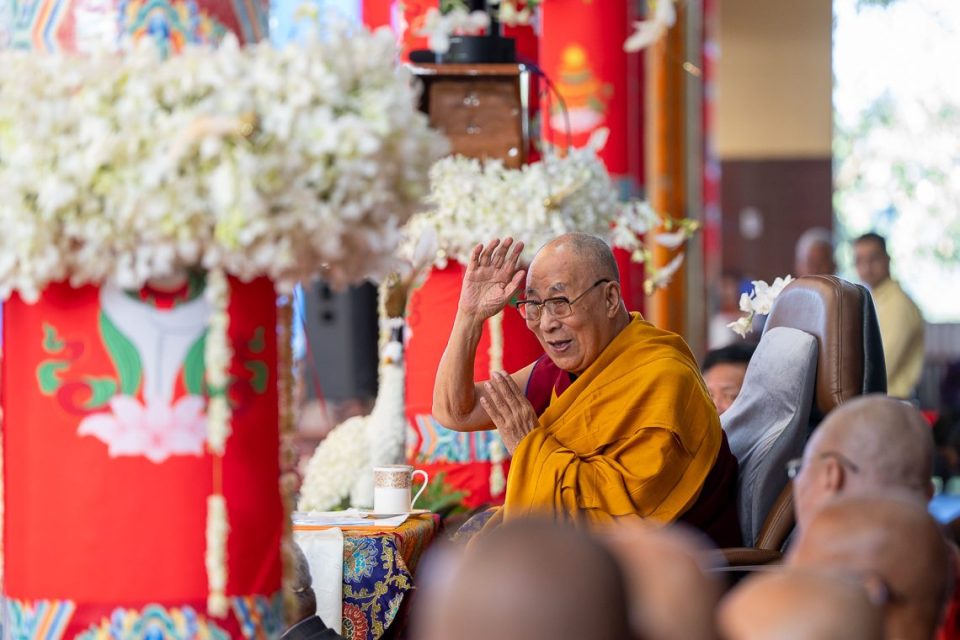
His Holiness the Dalai Lama in the Main Tibetan Temple courtyard during long life prayers and cultural performances in Dharamsala, India on September 20, 2025. Photo by Tenzin Choejor
His Holiness addressed the crowd, offering a detailed history of his studies and arrival in India in 1959. “Anyway, my main practice throughout my life has been cultivating the awakening mind of bodhichitta, the altruistic aspiration for enlightenment, and the view of emptiness,” His Holiness said. “Today, you have all gathered here to offer prayers for my long life. I would like to thank you all, especially the monastics, for coming to make these prayers. We haven’t gathered for the sake of amusement, but for spiritual reasons. As I said before I make it a point to cultivate bodhichitta and the view of emptiness on a daily basis. I also observe and uphold the Vinaya vows of a Buddhist monk. In addition, I reflect on the Perfection of Wisdom and Middle Way philosophy that I studied for so many years.”
Please continue to read a full report on his joyful event and enjoy many photos, and join us in rejoicing in this wonderful declaration from the participants of this celebration.
For more on His Holiness the Dalai Lama and his beneficial activities, please visit DalaiLama.com.
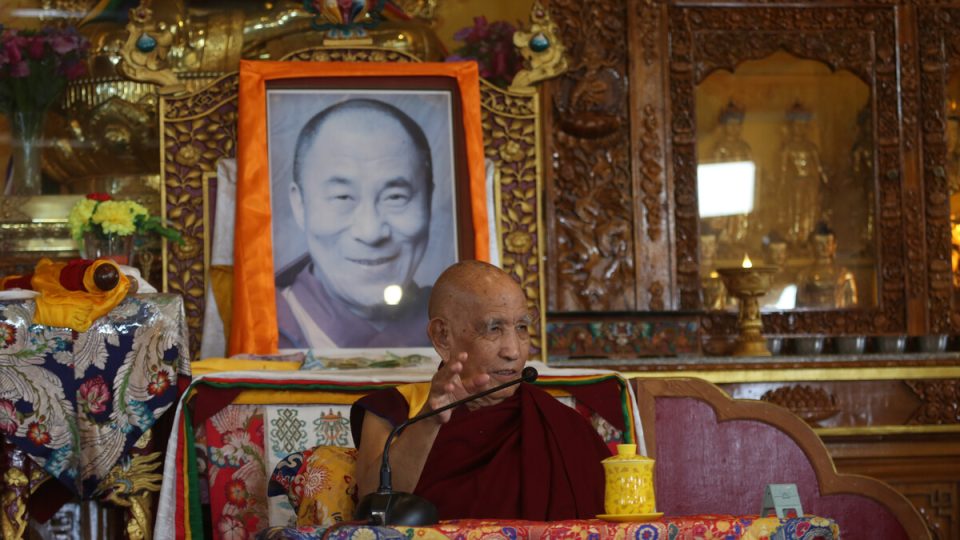
H.E. Ganden Trisur Rinpoche speaking at CPMT 2025, Kopan Monastery, April 11, 2025. Photo by Capucine Reddon.
With deep sadness and reverence we share news of a great loss for Tibetan Buddhism and the world. His Eminence the 104th Ganden Trisur Rinpoche Jetsun Lobsang Tenzin, showed the aspect of passing away on September 26, 2025 at his residence at Sera Je Monastery, Bylakkupe, India.
H.E. Ganden Trisur Rinpoche was teacher to thousands of Sangha and disciples worldwide and many within the FPMT organization, particularly from Kopan Monastery, offering tremendous support to Kopan over the years. Participants of the 2025 CPMT Summit at Kopan were blessed to receive Rinpoche’s wisdom and presence during a very special visit to Kopan during the meeting in April.
His Eminence was appointed the 104th Ganden Tripa by His Holiness the 14th Dalai Lama in 2017, and he successfully served in this seat until November 2024. The position of Ganden Tripa, which can be translated as “holder of the Ganden throne,” is the head of the Gelug school of Tibetan Buddhism. Unlike reincarnation lineages, the Ganden Tripa is an appointed position, held for seven years, and alternately filled by the Jangtse Choje and the Sharpa Choje.
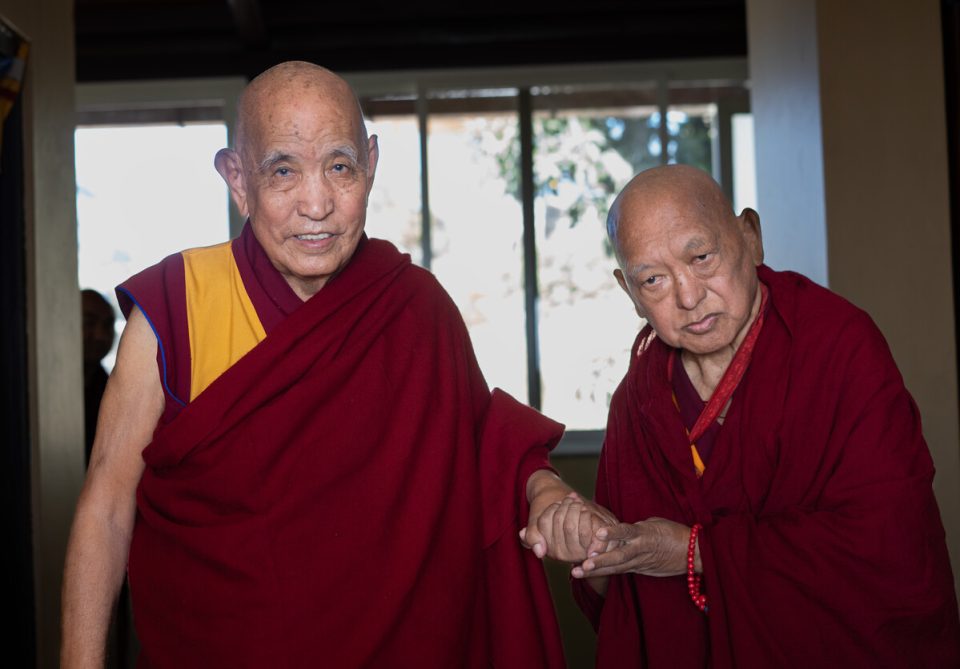
H.E. Ganden Trisur Rinpoche with Lama Zopa Rinpoche at Kopan Monastery, January 14, 2023. Photo by Ven. Lobsang Sherab.
Many FPMT centers have shared information about prayers and pujas offered at this time, please do check with your local center for opportunities to join. Kopan Monastery immediately arranged to offer The Eight Prayers and will be offering Lama Chöpa on September 27 at 8:00 a.m. local time.
In 2017 His Eminence visited Maitripa College and FPMT International Office in Portland, OR, USA, and was interviewed by staff of both, accompanied by Yangsi Rinpoche, who served as translator for the interview. We invite you to read this inspiring conversation where His Holiness discusses his life as a young monk in Tsang, Tibet, the impact of Chinese military activities on his studies, his decision to flee Tibet, and his thoughts regarding the current state of monastic education in India.
His Eminence was always incredibly available, supportive, and kind to the FPMT organization and willing to offer advice and guidance, including at the recent CPMT Summit at Kopan Monastery.
The loss of such a highly regarded teacher with such obvious qualities will be felt deeply by students around the world. We join all students of His Eminence the 104th Ganden Trisur Rinpoche Jetsun Lobsang in praying for his swift return and deep rejoicing in this truly beneficial and inspiring life of kindness, service, and humility.
Foundation for the Preservation of Mahayana Tradition (FPMT), is a Tibetan Buddhist organization dedicated to the transmission of the Mahayana Buddhist tradition and values worldwide through teaching, meditation and community service.
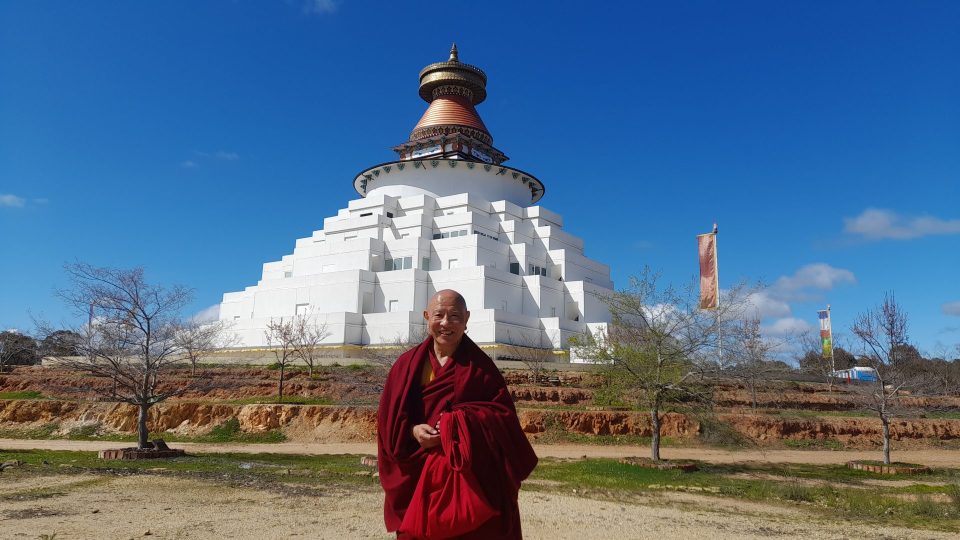
Jhado Rinpoche in front of the Great Stupa of Universal Compassion, Bendigo, Australia, September 2025. Photo courtesy of the Great Stupa of Universal Compassion.
On September 14–15, 550 people received the Kalachakra initiation from His Eminence Jhado Rinpoche at the Great Stupa of Universal Compassion in Bendigo, Australia. Lama Zopa Rinpoche advised Ian Green, Director of the Great Stupa, that this initiation should occur once a giant Kalachakra mandala was completed on the ceiling of the Great Stupa. Following the initiation, a Kalachakra Mind Mandala retreat began with 50 participants on September 16 with Jhado Rinpoche conducting the preliminary rites and leading the first three days of the retreat. This retreat will continue through October 19. On October 17, a public talk and consecration of the Kalachakra Mandala ceiling will occur, followed by a concluding fire puja for the retreat and long life puja for Jhado Rinpoche on October 18.
Please read more on the history of Kalachakra at the Great Stupa along with details on the impressive mandala on the 65.5 ft x 65.5 ft (20 meters x 20 meters) ceiling of the Great Stupa.
“Kyabje Lama Zopa Rinpoche first talked about a Kalachakra mandala on the ceiling of the Great Stupa during his 2014 visit,” Great Stupa of Universal Compassion Director, Ian Green explains. “In 2018 we spoke to Rinpoche about various ways of making the ceiling which included radical ideas such an illuminated LED ceiling or even a stained-glass window. No decision was made at that time, but we continued to explore options until a decision was made in 2021 to create the mandala out of a polycarbonate that offered rigidity, longevity, lightness of weight, precision of colors, affordability, and low maintenance as well as meeting fire regulations. We made Lama Zopa Rinpoche aware that we had started work on the ceiling which made him happy that this project was underway.”
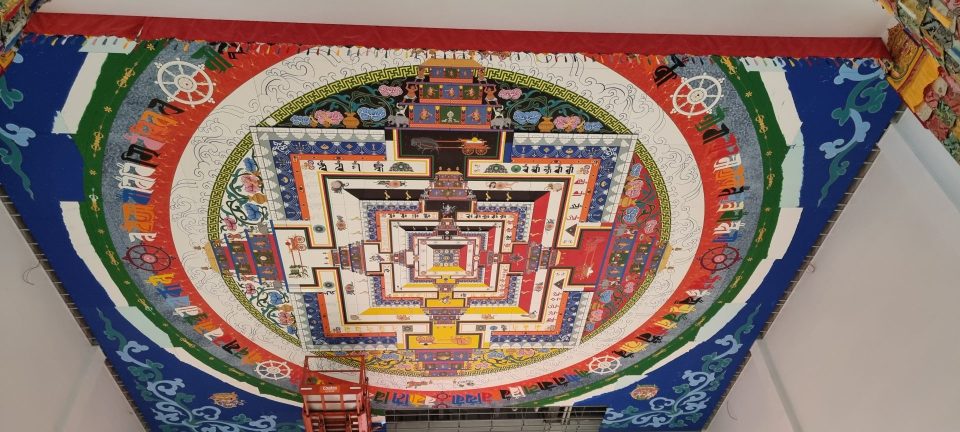
Kalachakra ceiling mandala at the Great Stupa of Universal Compassion. Photo courtesy of the Great Stupa.
Associated with the promotion of world peace, the Kalachakra—or “Wheel of Time”—tantra is one of the most detailed and encompassing systems of theory and practice within Tibetan Buddhism. The Dalai Lamas have had a strong interest in Kalachakra over the centuries and carry on the initiation lineage of the Gelug tradition. All the main traditions of Tibetan Buddhism practice Kalachakra. His Holiness the Dalai Lama has given the Kalachakra initiation 34 times throughout his life, with the first initiation occurring in 1954 in Lhasa, Tibet, and the most recent in 2017 in Bodhgaya, India.
“Lama Zopa said that this [Kalachakra mandala] ceiling would be very important for world peace and that we should have a Kalachakra initiation as soon as the ceiling was complete,” Ian shared. “Rinpoche requested His Holiness the Dalai Lama to lead a Kalachakra retreat on two or three occasions but, on each occasion, His Holiness responded that Australia was too far for him to travel especially as the preparations for a Kalachakra initiation were very involved. Rinpoche then requested Kyabje Jhado Rinpoche to conduct the Kalachakra initiation inside the Great Stupa. Jhado Rinpoche said during the recent initiation that Lama Zopa spoke extensively to him about the Great Stupa and about the Kalachakra initiation. Jhado Rinpoche said that by holding the Kalachakra initiation on September 14–15 inside the Great Stupa he was very happy that he had fulfilled his commitment to Lama Zopa.”
An estimated 25,000 hours of collective work over three years was required to complete the Kalachakra Mandala Ceiling. “The project has been advised by Jhado Rinpoche, Karma Phuntsok, and Andy Weber,” Ian said. “It was led by Artistic Supervisor Garrey Foulkes, Project Manager Guy Lawson, and Works Manager Finn Mathews. Lead artists Garrey Foulkes, Krissie Foulkes, and Guy Lawson were supported by resident artist Lucy Wang and a team of 60 volunteer artists. Panels were the responsibility of Raph Venn, printing by Mike Korsos, and computer art by Michael Gardner.”
What an unbelievable achievement due to the effort of so many! We truly rejoice in this accomplishment which was an expressed wish of Lama Zopa Rinpoche!
The FPMT organization invited His Holiness the Dalai Lama to confer the Kalachakra initiation in Sydney, Australia in 1996. This was Australia’s first elaborate Kalachakra initiation. Please read the story from the 1996 Mandala archives, “Beyond Extraordinary: His Holiness the Dalai Lama in Australia” written by Ven. Robina Courtin.
New Kalachakra Sadhana Available
We are also very happy to share a new sadhana related to the practice of Kalachakra.
The Excellent Vase of All Siddhis: A Mind Mandala Sadhana of Glorious Kalachakra, composed by the Seventh Dalai Lama, Lozang Kalzang Gyatso is a sadhana of the Kalachakra Mind Mandala, complete with the very extensive protection circle and complemented with the ritual texts and prayers that are useful for engaging in the mind mandala retreat.
We also have made updates to The Kalachakra Six-Session Guru Yoga together with An Extensive Review of the Three Vows and An Extensive Prayer and the Six-Session Guru Yoga.
Foundation for the Preservation of Mahayana Tradition (FPMT), is a Tibetan Buddhist organization dedicated to the transmission of the Mahayana Buddhist tradition and values worldwide through teaching, meditation and community service.