
 receive our newsletters
 join Friends of FPMT

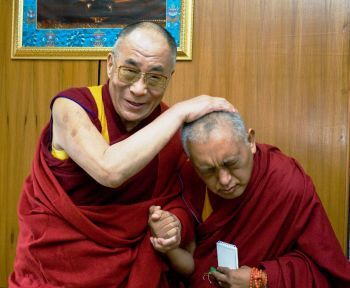
Scott Brusso was among the Western students who met Lama Thubten Yeshe in the early 1970s. He ordained, led the monks at Kopan Monastery, and served as spiritual program coordinator (SPC) at Chenrezig Institute and Tara House in Australia, where he also taught East and West psychology at Lama Yeshe’s request. After Lama Yeshe passed away in 1984, Scott returned to Chicago and built a career in the financial markets. Even in that environment, he never let go of the strength of Lama Yeshe and what he had learned. Scott’s life shows how the Dharma can be brought into the West, into any situation, without relying on Buddhist terminology, just as Lama Yeshe taught.
As part of our fiftieth anniversary celebration, Scott shares his pioneer story. What follows is largely in his own words.

Scott Brusso at Chenrezig Institute, Australia, 1979. Photo courtesy of Scott Brusso.
Something Was Missing
I can’t speak for other people, but I had a very different lifestyle from most of the people I grew up with. I was born in 1951 on the north side of Chicago, into a normal family with no religion.
When I was about five, I remember thinking about reincarnation, though I didn’t know the word. Just that people don’t end at this life but go on from life to life. When somebody finally told me what it was called, I was very happy, because it gave a name to something that was already inside me. I also used to ask myself, “Am I in somebody’s thumb? Is there a whole world inside my thumb?” Years later, when we learned about the body mandala, the tantric practice of seeing the body as a universe in itself, that question came back to me. So when I heard these teachings, it was like going home. It had always been there.
I was a pretty good kid for the most part, with a lot of energy; school didn’t make much sense to me. I didn’t know what I wanted to be. I just knew something was missing, and I always had the energy to find out what it was.
When I was about seven, or a little older, I had a very interesting experience. A lot of kids have this: you’re half-asleep, about to fall asleep, and you think there might be a witch outside the window. I felt that, and then it wasn’t a witch. I entered a timeless state, which I would call great bliss today. I had no sense of time, and I have almost never felt anything like it since. Later I came to think it was a blessing from Vajrayogini, a female Buddha.
In my teens, I took up karate, and alongside it, hatha yoga, and I started combining that with my own kind of meditation. I felt there was much more to life than what the modern world offered.
At about nineteen, I picked up a friend in Tacoma, Washington, and we drove down to San Francisco with my two German Shepherds. Why San Francisco? Honestly, I don’t know. I just had a feeling. I had everything I owned in a Volkswagen van: a bicycle, a little TV, my personal things. One night my friend asked whether we should put the dogs in the van to protect everything. I said no; I wasn’t putting the dogs in the car overnight. In the morning I heard construction outside, looked out, and couldn’t find my van. It had been stolen, with everything inside. And I felt a deep sense of relief—I felt free! There’s always a little worry in your mind when you go to bed and when you get up, and now it was gone. Only later could I connect that feeling to renunciation, when you learn in practice about letting go of attachment.
One evening in San Francisco I went to the beach with some friends. The waves picked up, and we all got soaked. When I got home, I realized I didn’t have my keys, so I went up to the roof to wait until morning. The temperature dropped, and because I was completely wet, I was very cold. Somehow, I sat there meditating and became aware of the heat inside my body. I concentrated on that inner heat. Years later, when I learned inner heat meditation (tummo), I remembered that night on the roof in San Francisco. After learning the practice, I felt that I must have learned it in a previous life.
While I was there, I was fortunate to take teachings from Suzuki Roshi. I was kind of a hippie, but mostly I was training in martial arts for tournaments, and through my Japanese teachers I was involved in Japantown. I didn’t have a real direction other than that. Then one day I was at the apartment of a girl I was dating, who I believe was either an assistant or a manager to the band Santana. Behind where I was sitting was a big shelf of medical books, about thirty of them in a series. I opened one and started reading, and I immediately felt a compassion for the world. A kind of bodhichitta experience. I also thought that studying all those books would take me forever, and that there might be a different way to heal people. That was a strong catalyst. I needed to go off and find something.
I got rent-free lodging at a macramé factory, where I worked in exchange, and put some money together to reach the Seychelles Islands. I had heard about them and thought, “That’s where I should do my retreat.” So I took a boat from Brindisi to Athens, spent some time there, and then went to Ios, where I spent time in a cave. Then it was Turkey, Iran, Afghanistan, and Pakistan, heading for southern India so I could reach the Seychelles.
Around 1972, I got off a bus in Dharamsala.
I had never heard of Tibet, but there was a Tibetan Buddhist there, and he gave me some direction.
That was really the start of that journey.
Meeting the Dharma
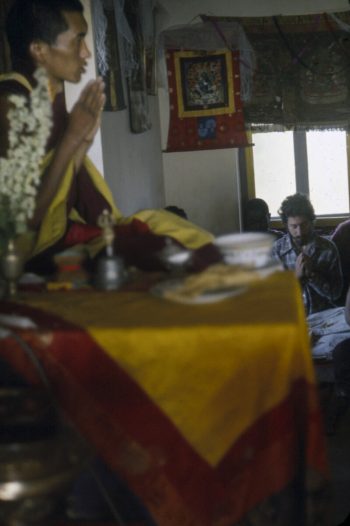
Lama Zopa Rinpoche, and Scott Brusso at Kopan Course, 1974. Photo courtesy of LYWA.
Every morning there were three classes at the Library of Tibetan Works and Archives, at nine, ten, and eleven to twelve, all with Geshe Ngawang Dhargyey. There were about twenty-five or thirty Westerners, such as Jon Landaw, Alex Berzin, and Ven. Sangye Khadro.
I wasn’t interested in the Seychelles anymore after I got to Dharamsala. That was it—my answers were lying right there in those teachings. I was already committed that I had found something!
Yogi, Venerable Jampa Kunchog, came to Dharamsala some time after I did, and from then on we were like Dharma brothers.
We stayed in lower Dharamsala, walked up to the Library every day, took the classes, and went back down for lunch. It was so mystical. The mountains, big horns sounding over the whole valley, and His Holiness the XIV Dalai Lama leading huge pujas outside. It was like being in Tibet. It was so phenomenal! At the end of 1973 the Library went on break for the month, and many people went to Bodhgaya for His Holiness the Dalai Lama’s Kalachakra initiation. Yogi and I went too. Then I heard that Lama Yeshe was giving a talk at a Japanese temple, at night. So we went. It was very mystical, and with Geshe Dhargyey’s blessing we both decided to attend the sixth Kopan course that spring.
After the sixth Kopan course, in May 1974 Yogi and I took Lama Yeshe’s Heruka Vajrasattva initiation and teachings —from which came the book Becoming Vajrasattva. The Tantric Path of Purification.— We then joined the Kopan group retreat. The group retreat was about twenty-five or thirty students. Ven. Sangye Khadro sat across from me and Yogi was next to me. At the conclusion of your 100,000 mantras plus other requirements, you could leave, but I didn’t want to leave. Where was there to go? It was the most fantastic situation I’ve ever had! So, I stayed about five months, almost a double retreat.
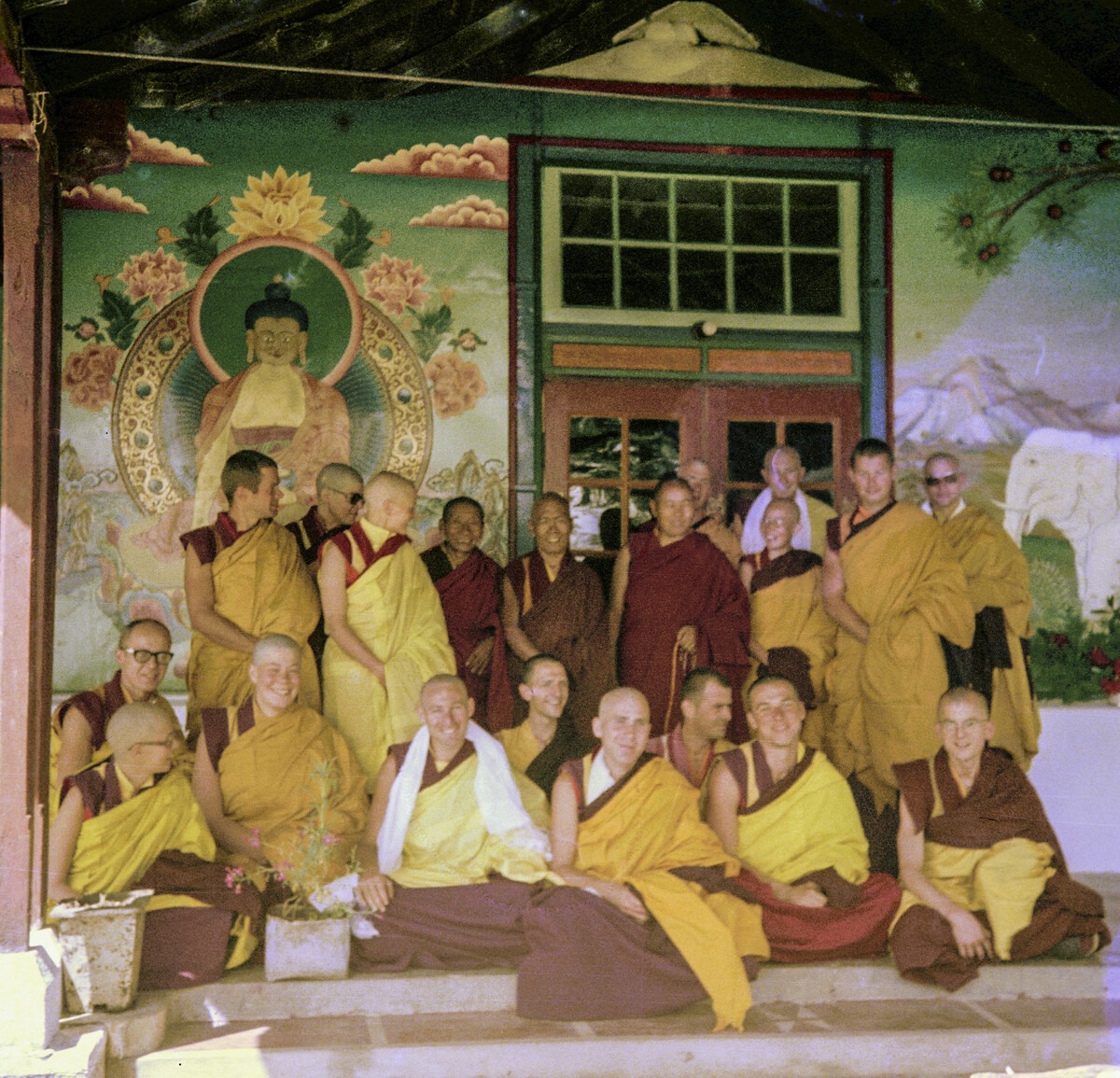
Lama Yeshe with newly ordained monks at Tushita Meditation Centre in 1976. Among them are Scott Brusso, with a khata in the front row. Photo courtesy of LYWA.
After the retreat Yogi and I both asked Lama Yeshe if we could get ordained, and he was fine with that, and sent me to see my parents; he said, “I think I want you to go back and see your parents first, to make sure.” So while the others were ordained, I went back to the U.S. My parents were fine and had no problem with it, but it delayed my ordination.
In July and August of 1974 the Lamas went to the U.S. for their first international tour lectures. They gave a talk in Madison, Wisconsin, and I had sent my parents there, they were completely flabbergasted and enthralled. While I was in the U.S., the Lamas were giving courses in Nashville, Indiana, and I brought my friends and talked them into coming to Kopan with me.
I received novice ordination from H.H. Trijang Rinpoche in 1976, and my full vows were from Kyabje Yongzin Ling Rinpoche. After the ordination Yogi and I lived at Kopan, where Lama Lhundrup was kind enough to teach us debate. Yogi and I were both very stubborn; and we kept arguing and debating all through the years, right up until he passed away. It was no different from those early days at Kopan. Yogi, Venerable Jampa Kunchog, passed away in April 2026.
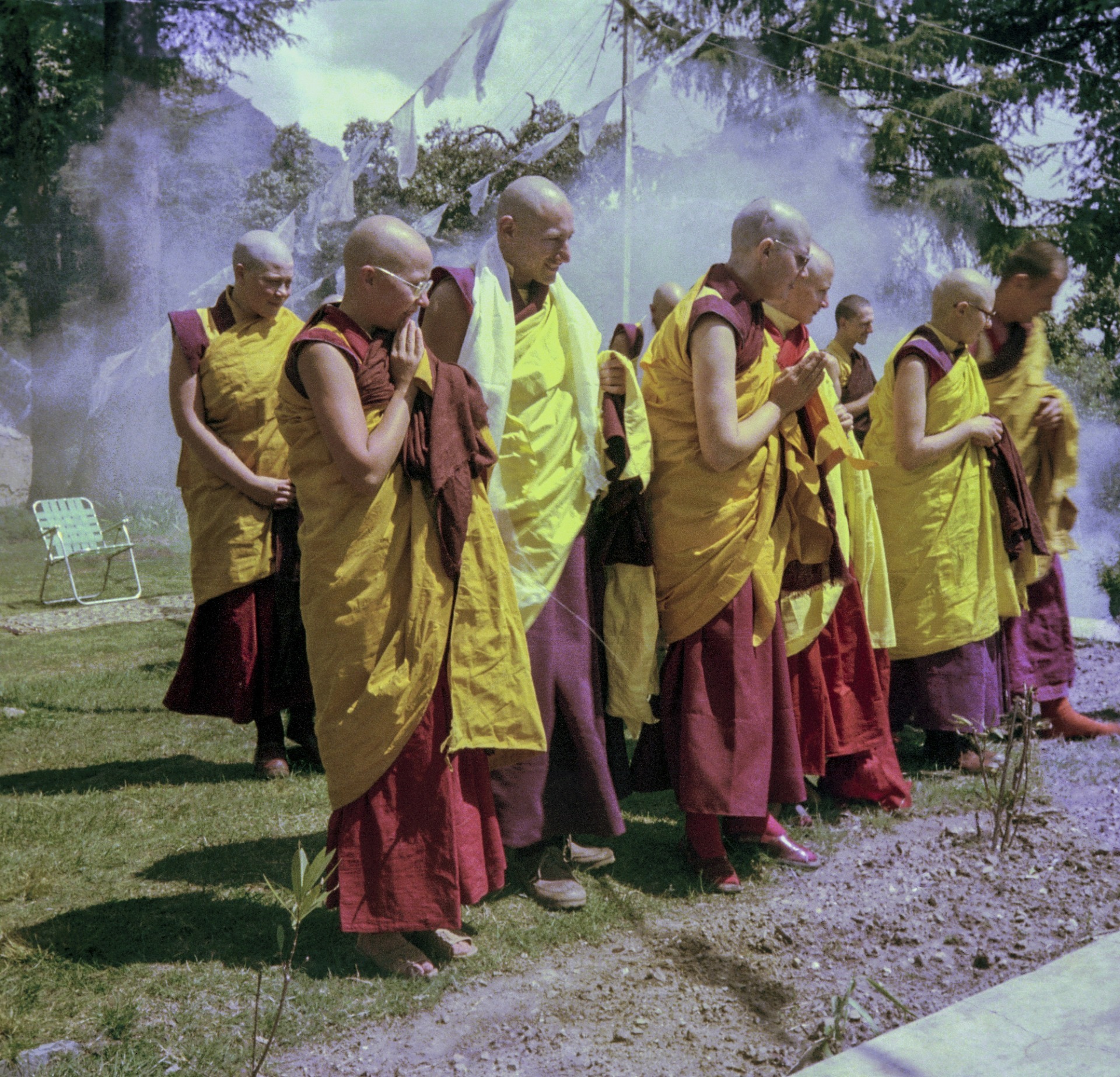
Ordination of Scott Brusso, Tushita Meditation Centre, 1976. Photo courtesy of LYWA.
During this time Lama Yeshe made me the geko, so for a time I was in charge of the monks at Kopan. Here I did a long retreat in a house on the hillside, and when Geshe Sopa came from Madison to teach the Bodhicharyavatara at Kopan, I helped with the preparations. It was very special to just be able to sit with him there for hours and hours. Geshe Sopa was one of the most renowned Buddhist scholars in the world, and he was one of Lama Yeshe’s main teachers.
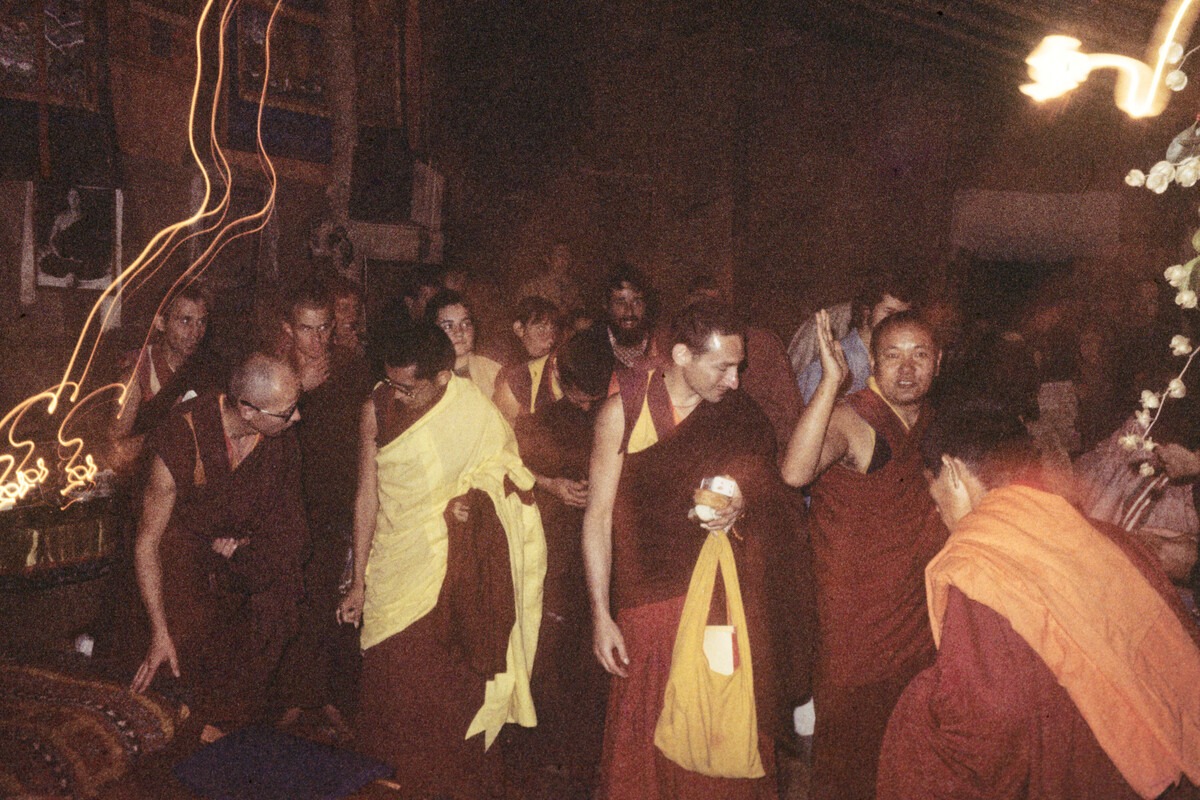
Ninth Meditation Course, Lama Zopa Rinpoche, Lama Yeshe and Scott Brusso, 9th Meditation Course, Kopan, 1976. Photo courtesy LYWA.
Offering Service in Australia
At the end of 1978 Lama Yeshe asked me to go to Australia, to Chenrezig Institute, founded in 1974, as SPC and in charge of the first Western residential sangha.
There were a few different communities on a couple of hundred acres: local people, monks, and nuns. Besides the Dharma teachings, we offered courses in medicine, tai chi, and yoga, things that weren’t being offered there, so that people could find other ways in and other ways to connect with themselves.
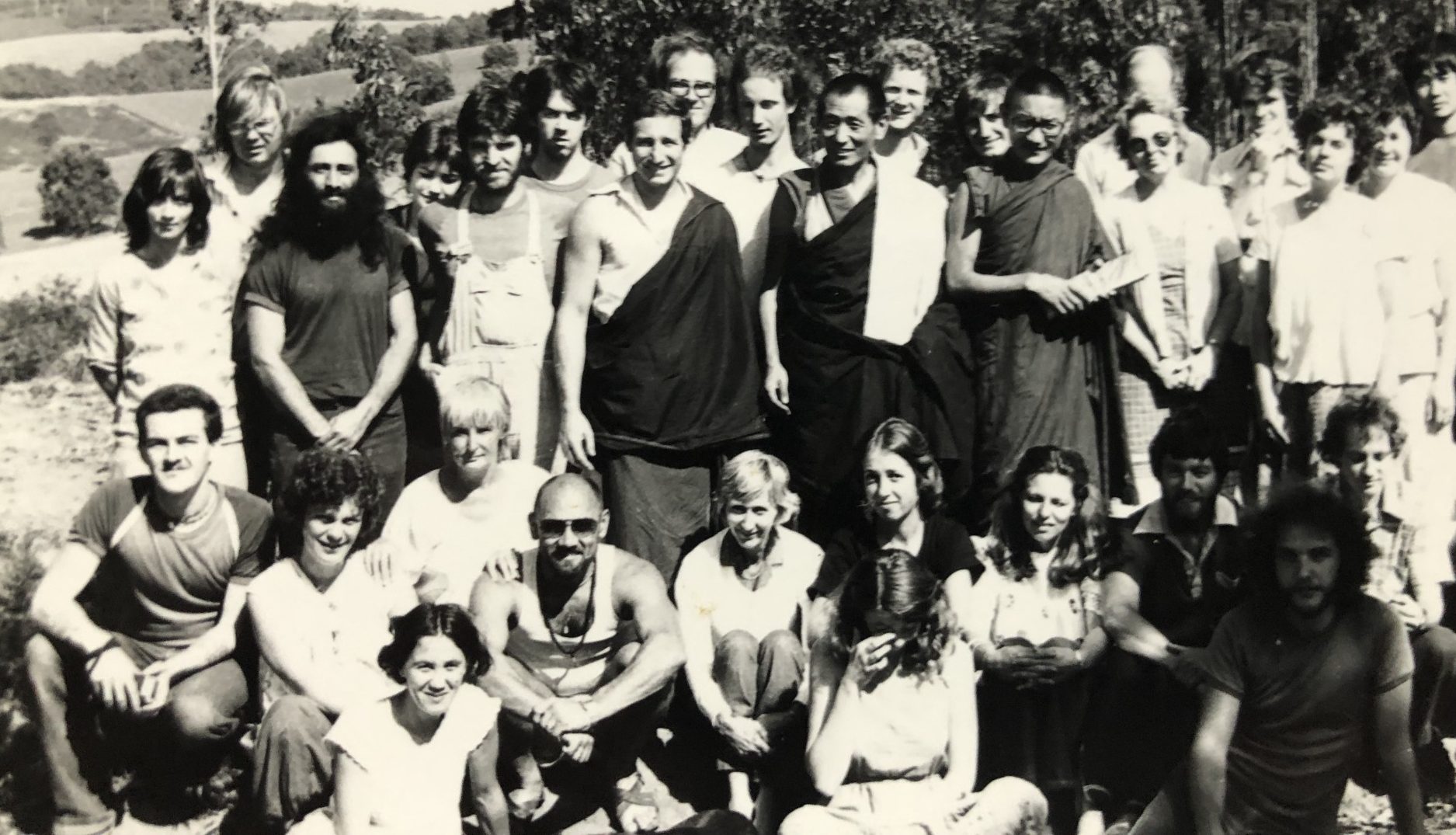
Scott Brusso during a meditation course in Bendigo (Australia). Photo courtesy of Scott Brusso.
In September 1979 Lama Yeshe conferred the Vajrayogini initiation and gave teachings on the tantric practice of Vajrayogini to a group of students preparing for retreat at Chenrezig Institute in Australia, and I led the Vajrayogini retreat for about twenty-five students.
After a couple of years at Chenrezig Institute, Lama Yeshe sent me to Melbourne, to Tara House, which is now Tara Institute. A geshe had been sent out to be the resident teacher, and I was helping give teachings too. Every week I went to Monash University to teach about the psychology of the mind. I also went around Australia and New Zealand giving East and West psychology courses with Patrick Jansen, a Jungian analyst and a student of Dora Kalff. We put together an East and West understanding of the mind, looking at what was close to being the same and what was different. People liked us, and Lama Yeshe was very happy, because he enjoyed working with Dora Kalff.
In 1981, Lama Yeshe bestowed his historic teachings from a two-week Mahamudra retreat in Australia, which were eventually published in Mahamudra, How to Discover Our True Nature. The retreat was held at Sandhurst Town, on land that Ian Green had donated for courses, and I was the retreat leader. There was no Great Stupa there then; the place was just called Sandhurst Town. I would lead the meditations and take Lama Yeshe back and forth.
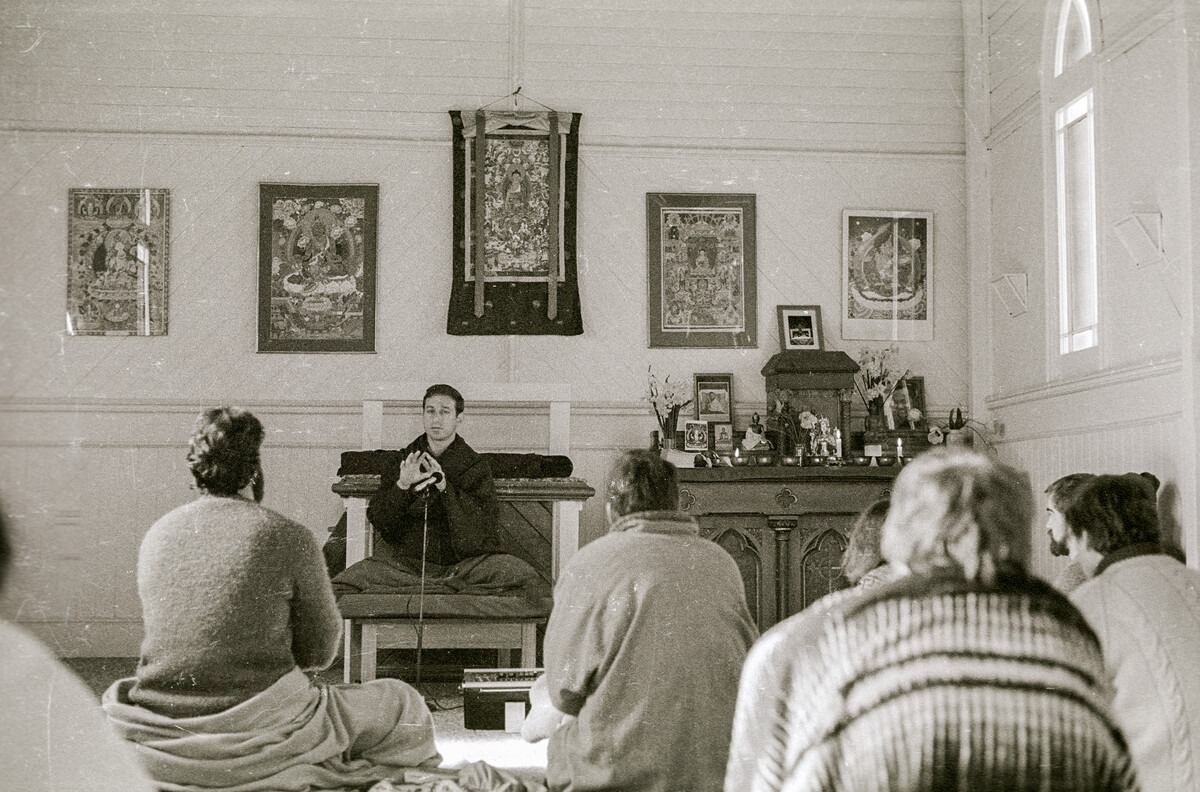
Scott Brusso leading meditation during the Mahamudra retreat in Bendigo, Australia, 1981. Photo courtesy LYWA.
The townspeople were invited for a whole day on a Saturday. At a committee meeting the week before, someone asked Lama Yeshe, “What if it rains?” I expected him to say we’d have umbrellas or big tents. Instead he said, “Don’t worry, it won’t rain.” They asked, “But what if it does?” and he said, “Don’t worry.” I had complete faith in Lama Yeshe and believed anything he said. But in the car going back I said, “Did you have to say ‘I guarantee?’ Couldn’t you just say, ‘We should be okay?'” He turned to me, his eyes went big, and he said, “You doubt me?” I didn’t doubt him. I was worried about what other people would think. This was my Lama, and I wanted everybody else to believe in him too. I believe that created some negative karma for me, and I’m still purifying it! On Saturday morning of the retreat week, the sky was full of thick clouds. I came to get Lama Yeshe ready to go over to Sandhurst Town, and he was on the little front veranda, doing a fire puja. A short while later there was not one cloud in the sky. No rain, nothing. The whole day was clear and beautiful. That was so powerful for me.
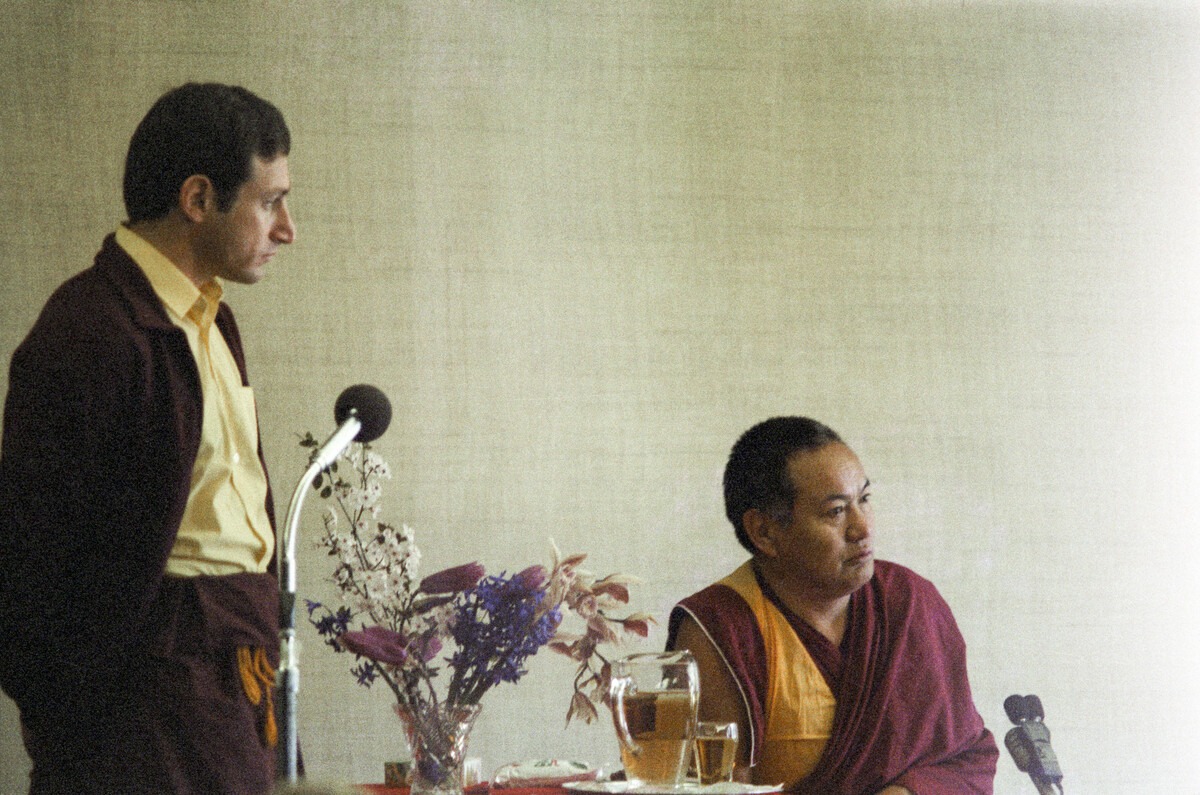
Lama Yeshe, with Scott Brusso, bestowing his teaching “A Letter to a King” in Australia, 1981. Photo courtesy LYWA.
The same year Lama Yeshe led a puja at Tara House, in Melbourne. Two days later he gave a weekend course to eighty people on Nagarjuna’s Letter to a King. During the teaching I was picking random questions from the audience out of a basket. While he was answering one question, I was picking out the next. I read it then decided it wasn’t very good. So I put it back and went to choose another. This was all quite invisible to everyone else and done below the lip of the basket. But Lama stopped in mid-sentence, turned to me and said, “Don’t discriminate! Give it to me now—that one!”
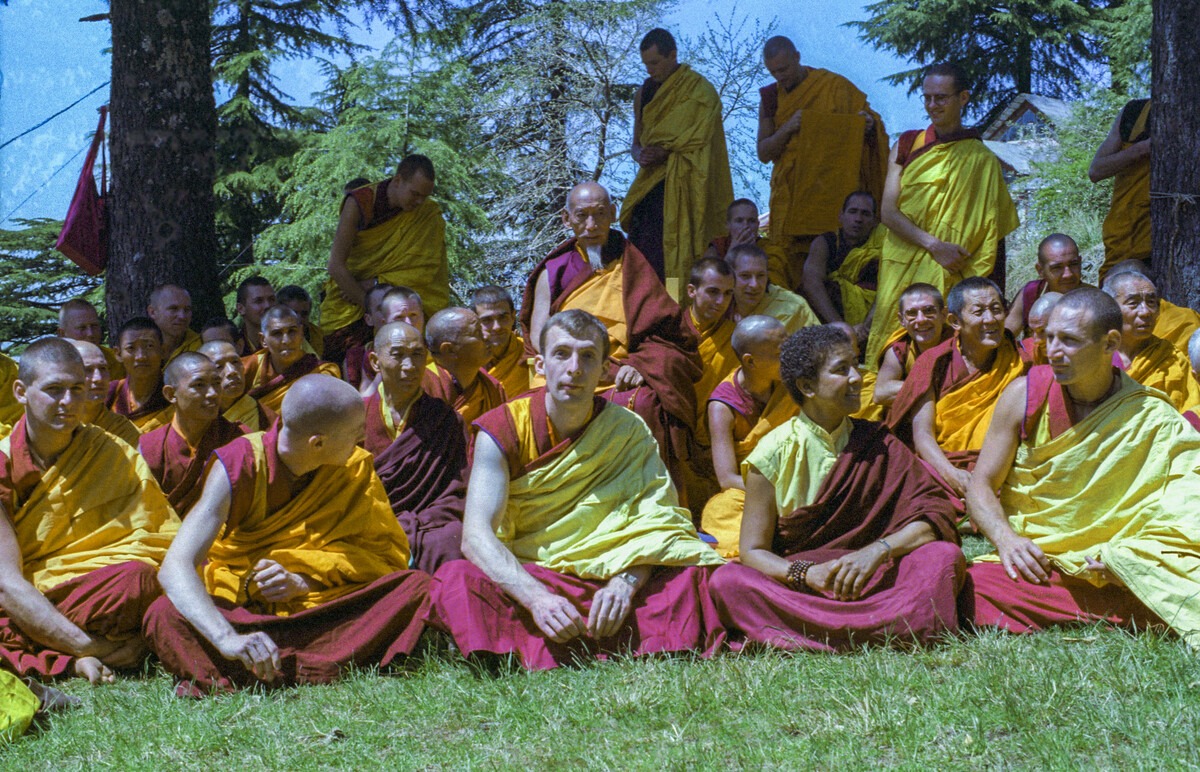
Zong Rinpoche and Lama Yeshe (to his left). In the front row, from right: Scott Brusso, Max Mathews, and Peter Kedge. Tushita Meditation Centre, First Enlightened Experience course, 1982. Photo courtesy of LYWA.
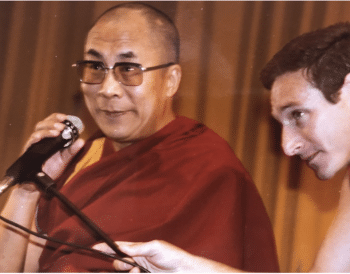
First visit of His Holiness the XIV Dalai Lama in Australia, here with Scott Brusso. Australia, 1982. Photo courtesy of Scott Brusso.
The year after, in June 1982, was the “First Enlightened Experience”, a landmark gathering organized by Lama Yeshe in Bodhgaya to offer special initiations, transmissions, and retreats for Western monks, nuns, and lay practitioners. By then I was also part of the committee that brought His Holiness the XIV Dalai Lama to Australia for the first time in 1982. It was a quiet, low-profile visit, but a lot of people were working on it.
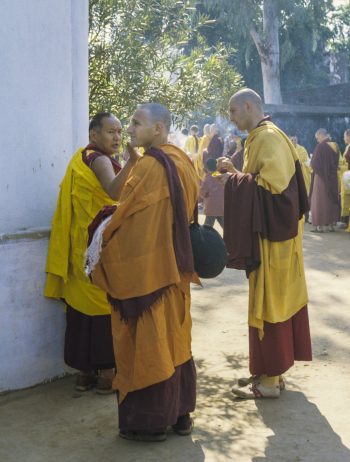
Lama Yeshe with Scott Brusso and Piero Cerri in Bodhgaya, India, during the First Enlightened Experience in 1982. Photo by Ina Van Delden. Courtesy of LYWA.
After almost five years in Australia, Lama Yeshe wanted me to go to Istituto Lama Tzong Khapa in Italy, to be the SPC there. He also wanted to send me to Vajrapani Institute in Santa Cruz, but because I was so attached to Australia I didn’t go and I think this really impacted my karma negatively.
Meanwhile, I was giving a one-month course in Australia, I kept sensing something about my mother. When the retreat ended I called her, and she said everything was great. I went back to Melbourne and it kept coming back to me, so I called again from Tara House. “No, I’m good, everything is good.” It didn’t stop, so I made the decision to fly back to Chicago. Not long after I arrived, she became seriously ill. I spent the next year taking care of her, and she passed away at the end of that year (1983).
In 1984, I was in California, visiting a friend, when Lama Yeshe passed away on March 3. I went to Vajrapani Institute, where Lama Zopa Rinpoche and others were. I sat meditating next to Lama Yeshe’s body all day.
At that point I was still a monk, but I was living pretty much as a Westerner. I was still going places and giving teachings, at friends’ centers and at yoga centers. As time went on, it became apparent to me that maybe I should make a change and become, essentially, a Westerner. If I had listened to Lama Yeshe and gone to Istituto Lama Tzong Khapa or Vajrapani, I don’t know if that would have happened…
Lama Yeshe
Lama Zopa Rinpoche’s teachings were a little hard on Westerners sometimes when they started hearing about death and dying and making use of your human rebirth and so on—not for me. I was enthralled because of Dharamsala too, but then Lama Yeshe came in. He’d pick just the right time to come in and give a talk, and everything would change. He’d be saying something, and then all of a sudden, he’d break into laughter.
I remember a student was saying something about being an actor, and Lama said, “I’m an actor, you know?” and this is what Lama Yeshe could express. He could manifest differently to everybody because of that power, of his strength. Coming from emptiness, coming from the empty nature, he can become anything. Lama Yeshe could change, like an actor, into anything at any time to give teachings. No matter how few words he had, he got the meaning across. Lama would manifest differently to others. He could get through to everybody, no matter who it was.
We’d be inside the meditation tents and there would be 200 people there, many of them were doubtful, but Lama Yeshe had them all in hysterics. He’d get the ideas across. If his words weren’t coming out exactly right, he would start acting it or something. Lama Yeshe had the power of communication. The meaning of the Tibetan words and the Sanskrit words are pretty clear in their language, but Western language is very different. So this is something Lama Yeshe, even with his imperfect English he learned which types of Western terminology and expressions might evoke a proper intellectual understanding. We need to go past our intellectual understanding and have deep realization but these are the steps to that. It’s leading the way. He can’t give us the realizations, but he can lead the way with this. And so he was very powerful; his understanding of the human mind was so complete. I’ve taken teachings from every different Tibetan tradition, as well as from Zen and others in my life. I’ve never been with a lama like Lama Yeshe, my root guru, and I’ve never had things happen to me like they happened with him. And as well, with Lama Zopa Rinpoche.
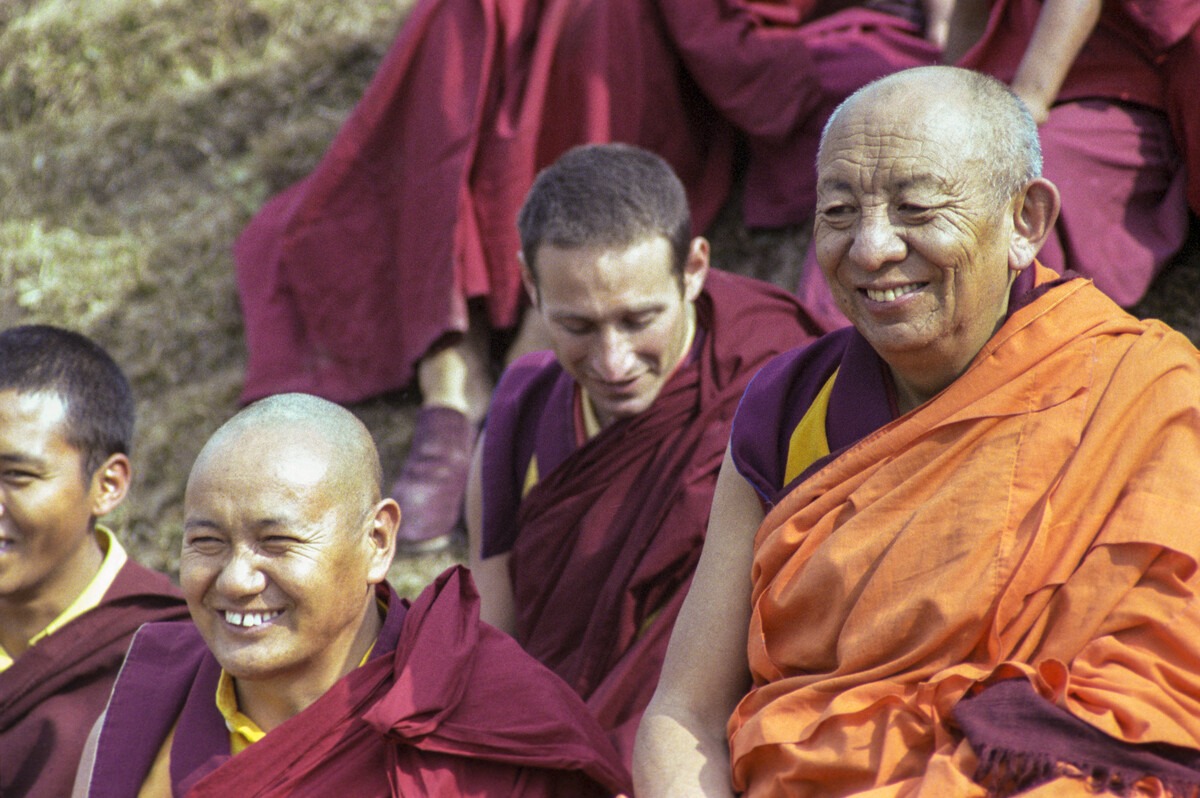
Lama Yeshe, Tsenshab Serkong Rinpoche, and Scott Brusso at the 10th Meditation Course at Kopan Monastery in 1977. Photo by Jan-Paul Kool. Courtesy of LYWA.
Lama Yeshe had no resonant titles, Lama was simply Lama Yeshe. He looked like a simple monk, and yet he was unbelievable. Lama Yeshe was just beyond belief. I’d never been in that kind of energy before. The whole gompa was filled, and Lama Yeshe controlled the entire environment. It was a completely mystical experience for me.
I can say that every single time Lama Yeshe spoke I would have an awakening, taking place inside my mind. It was phenomenal. When he gave teachings, they woke my mind up to a tremendous degree, and I received them live. Even today I use some of the things he said, because he was so clear. He would say your mind is like a mirror. A mirror can reflect, but when there’s dirt on it, the reflection is distorted. The dirt and the mirror are not one, so you can clean it, and then you see clearly. Or your mind is like the ocean. When storms come, the waves are thirty or forty feet high and you can’t see anything. But go down into the depths and it’s calm and clear. That exists within ourselves in every moment of our lives.
One day at Kopan, Lama Yeshe came to give a talk, and somehow I found myself up in his room, talking to him. He held my head like Tibetans do touching foreheads. I never felt our foreheads touch; I only felt something like an electric current. It was very powerful. Years later I asked him and he said: “Psychic energy, darling!”
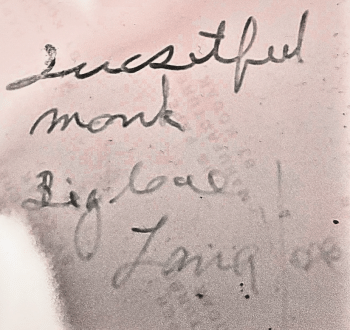
A note from Lama Yeshe to Scott Brusso: “To a successful monk.” Photo courtesy of Scott Brusso.
At one point Lama Yeshe was teaching a course near Santa Cruz, California, and I went and stayed with him. Not as his attendant; I just came and stayed. I believe it was then that he gave me a damaru, which I still have. On another visit he gave me a photograph of himself, which is on my mantel. On the back he signed it, “To a successful monk.” At that stage I was. I didn’t stay one, but at that stage I had done enough retreats and teaching that I hadn’t deteriorated badly.
In 1974 during Lama Yeshe’s Heruka Vajrasattva initiation and teachings I came out of the retreat. I was just trying to stay in the present, right there, and in a small section of the Kopan library there was a sandbox, like the ones used for sandplay therapy, and I saw a drawing of little places set out all over the world. “What is this?” I asked Lama Yeshe. “This is where I’m going to have centers.” He had a vision of what FPMT was to become all over the world. My mind was blown. He was so far beyond.
His name, Yeshe, means wisdom, like primordial wisdom in Tibetan, and Lama Yeshe was the embodiment of the Buddha’s wisdom. Lama Yeshe had the wisdom, the wisdom of Mahamudra, the wisdom of the Vajrayana teachings, the wisdom of Dzogchen. That’s all the same wisdom, the complete wisdom of emptiness and understanding.
Looking back at that little sandbox with these things inside of it, I’m now thinking…everything to do with FPMT today, that it exists, is because of Lama Yeshe.
Lama Zopa Rinpoche
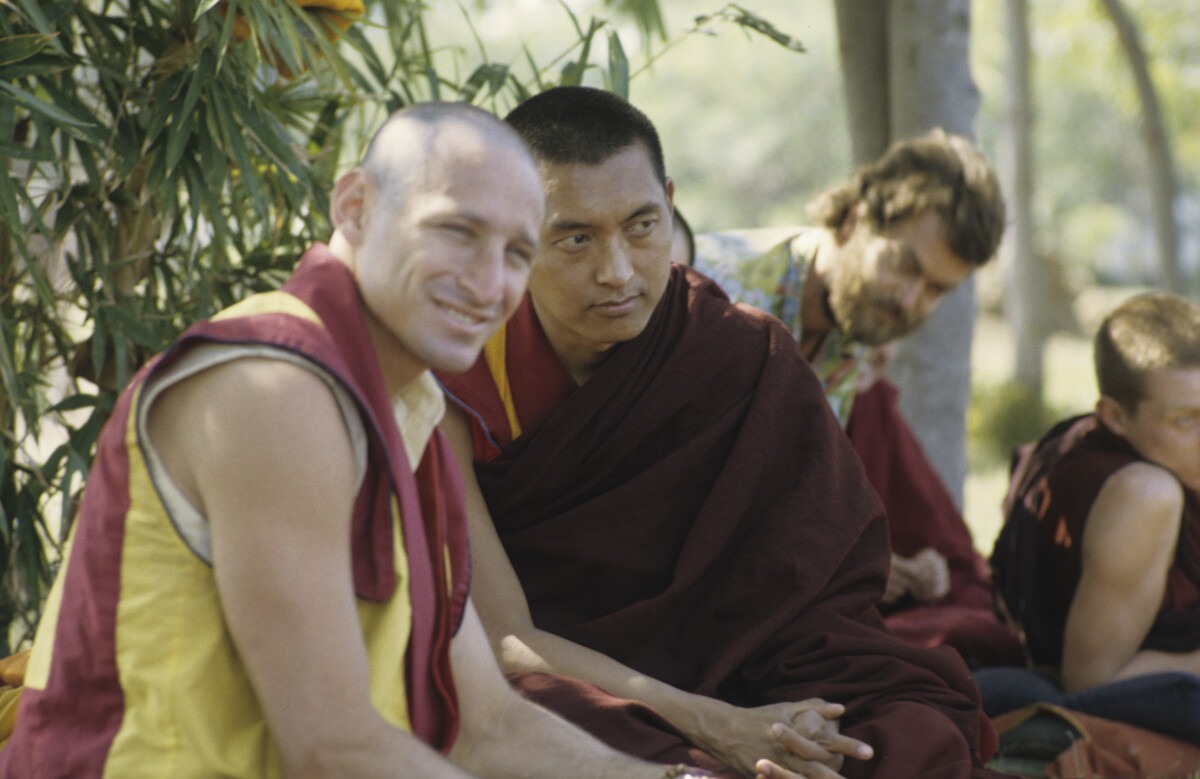
Lama Zopa Rinpoche, and Scott Brusso at the First Enlightened Experience in 1982. Photo by Ina Van Delden. Courtesy of LYWA.
Hearing teachings from Lama Zopa Rinpoche was on a different level. They weren’t on the intellectual level of “this is point one, this is point two, this is point three.” In a one-month course, point one might take him three weeks to finish, at two sessions a day. The sessions were supposed to last a couple of hours, but he wasn’t on the level of conventional time, as many of the older students can tell you.
What it did inside was a transformation of the consciousness. He would take you to levels inside yourself. The teaching was a journey inward. I believe he stayed on a subject for such long periods because in a course of 200 people, some students pick things up very quickly and others take longer and longer. He would try to transform everybody in the room, finding every different angle. That was more than fifty years ago, and the impact has never left me, because it hits on such a deep level. That is the difference when teachings come from someone’s own practice, and his practice was continuous.
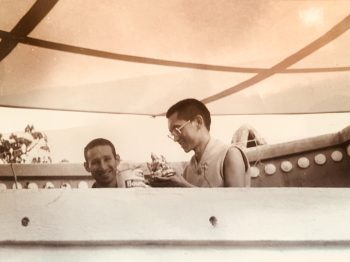
Lama Zopa Rinpoche with Scott Brusso on the roof of the old Gompa, Kopan. Photo courtesy of Scott Brusso.
I was with Lama Zopa Rinpoche many, many times, including walking in the mountains of the Solu Khumbu region, and he was never different. Walking, sitting in meditation, praying, eating, it was always the same. Everybody knew he hardly slept, if at all.
We learned how to act as monks, physically, by watching him. His hand mudras and gestures in pujas were a thing of beauty. He was teaching us through his actions, not only through what he was saying at that moment.
Once, for reasons I don’t know, he gave me a hat. Most lamas wear yellow hats, but the Nyingma and Sakya wear red, and this one was red, because in his previous life, as the Lawudo Lama, he was a Nyingma yogi. The hat had been stored away for a long time, so it was wrinkled and not perfectly straight. My interpretation was that my mind was not straight. My mind was crooked.
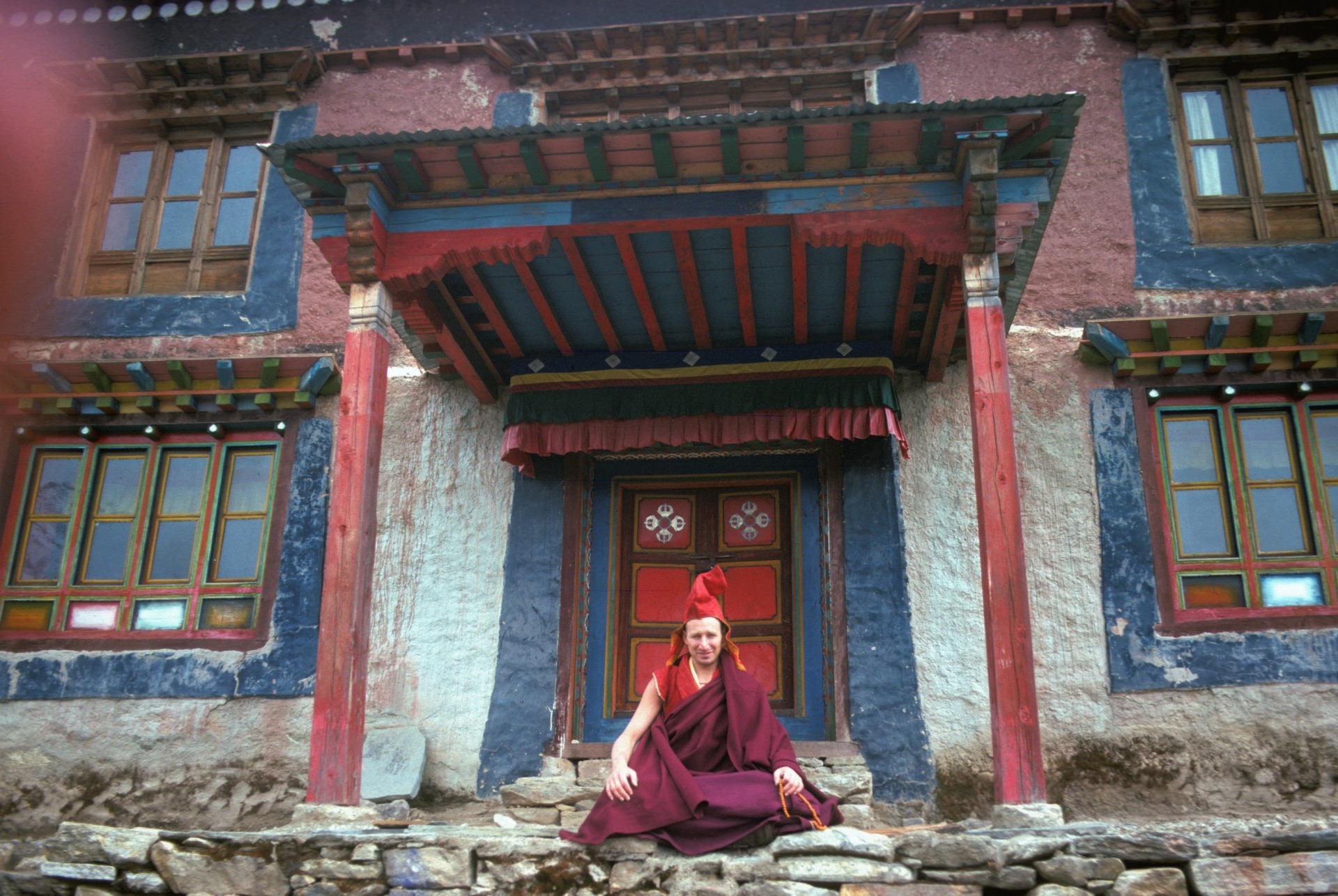
Scott Brusso with the hat donated by Lama Zopa Rinpoche. Photo courtesy of Scott Brusso.
Lama Zopa Rinpoche used to like to recite a prayer on bodhichitta, and I think about it a lot. As I remember it:
The precious bodhichitta, the cause of all happiness and success—may it be born within all living beings’ minds, and within our minds, in an instant. And anything that has been lost before, may it be brought back again.
Coming Home to Chicago
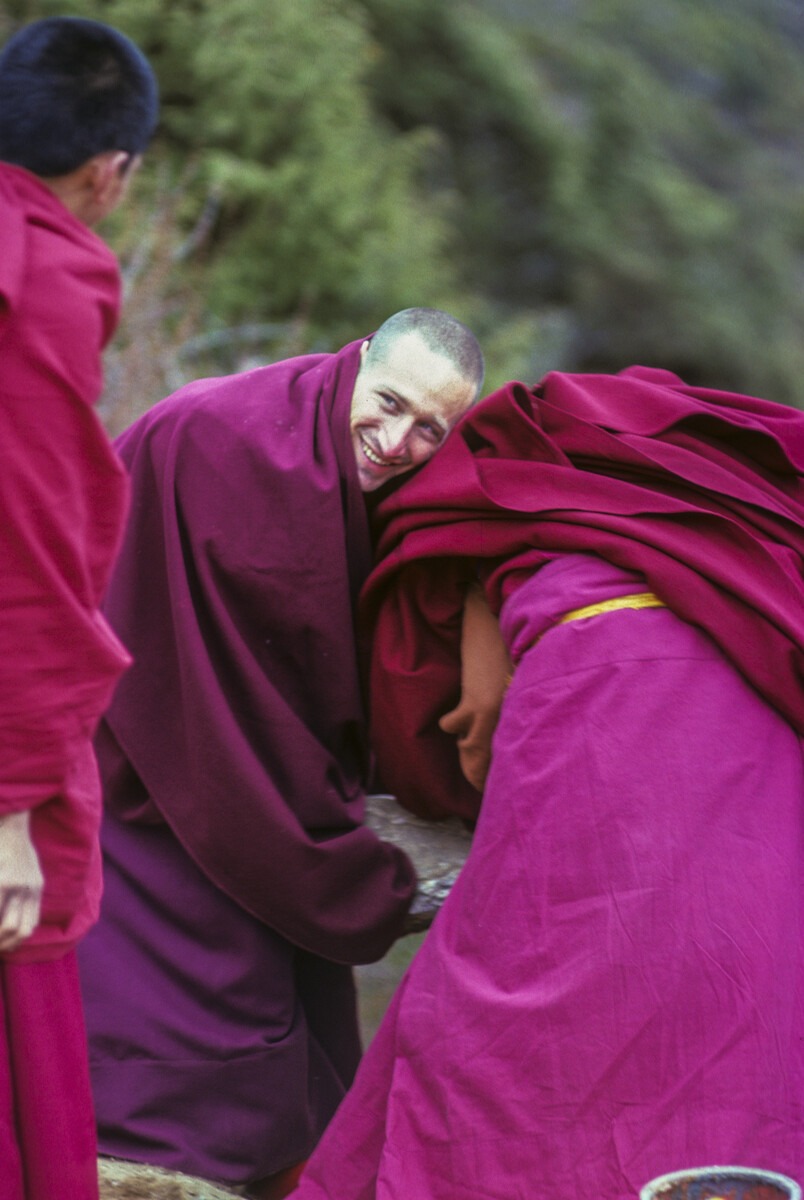
Scott Brusso at Lawudo, 1977. Photo Courtesy of LYWA.
I was back in the U.S. (1984) like somebody who came from another planet, in my mid-thirties. Other people had a big resume, with university and internships and jobs, and I had nothing. Because of Lama Yeshe and the power of the teachings, I was able to move forward.
As a monk, and even when I was living in the city of Melbourne, you’re pretty much protected. Here you have to find your way. I think my years as a monk are why I was able to meet the challenges of Western life. In Buddhism, everything is what we make of it, and when we learn that the Dharma has a way to work with all these situations, every one of them can be worked with. That was Lama Yeshe’s teaching, always: we can learn from the situation.
I married, started a family, and built a career in the financial markets, mostly foreign exchange. I had learned a little about foreign exchange intuitively, from living in different countries.
On my first day on the trading floor at the Chicago Mercantile Exchange, there were different pits for each currency, and a board up on the wall where the prices change. It hit me. It’s very strange, because I’ve spent a lot of my time praying for peace, happiness, and freedom from suffering for all beings. And here many people buy something at five dollars and pray it goes to six, or sell it at six and pray it goes to five. It was strange to see all that mental energy being spent that way. It helped me keep a lot of perspective.
After that my life was like a tornado. When the winds of karma catch up to you, they blow you in certain ways. I traveled all over the world for work and didn’t run into the Lamas much. Chicago has never been a great center for spirituality. For some reason I don’t understand, there hasn’t been much here over the years, and when the Lamas came to the U.S., they went up to Madison, or to California, or to New York. Nobody told me to open a center in Chicago, and I didn’t. I went by what the Lamas do: the Buddha only taught when people asked him, and teachings happen when people ask for them.
Lama Yeshe taught that we can bring the Dharma to the West without leaning on Buddhist terminology. When I think about my own life, in the middle of the financial markets, I’d say that’s right: in a way, that is what has been happening. Lama Yeshe’s teaching was always that we can learn from whatever situation comes our way. He said that poisons can be turned into medicine. That’s what he taught everywhere he went, even when he was walking around.
The very basics of what I had learned, and the strength of Lama Yeshe—those I never let go of.
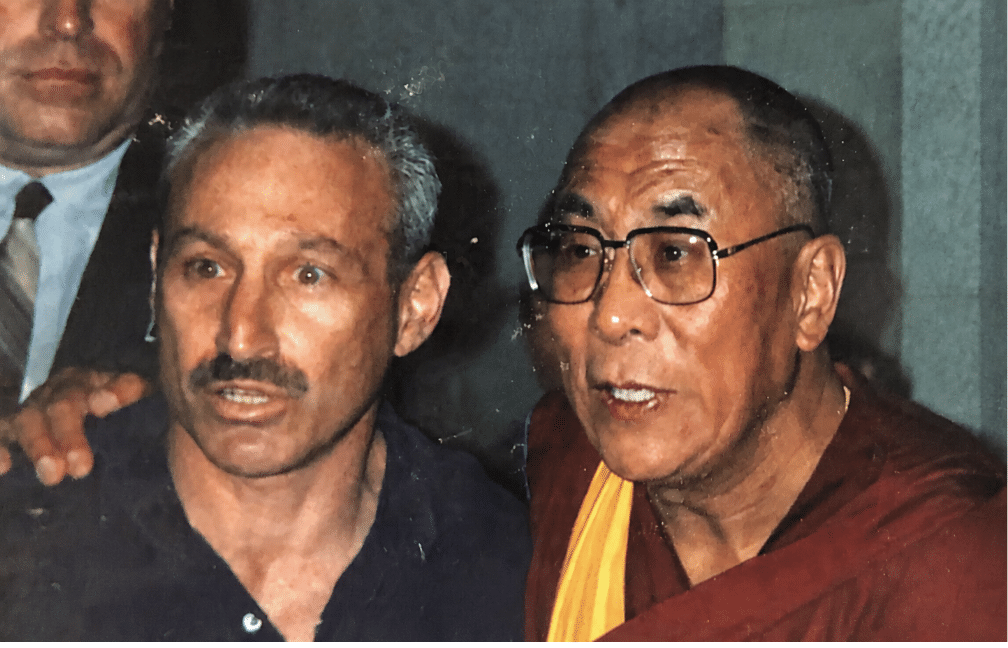
His Holiness the XIV Dalai Lama with Scott Brusso, in Madison Wisconsin 1998. Scott recalls that, as His Holiness was leaving the parliament building, He walked past the waiting crowd and came directly over to greet him. A similar encounter took place in August 1999, when His Holiness visited Chicago’s Field Museum and stopped to bless Scott and his son Zack. Photo courtesy of Scott Brusso.
“An action is considered to be a part of Dharma practice solely on the criterion of its effect on the mind. If delusions are eradicated and sufferings diminished by what we do, then this is Dharma. Thus even if we spend most of our time working inside an office in a crowded city or doing menial labor and the like, we can still be practicing Dharma. The essential thing is that our delusions decrease in strength. Any type of action can be transformed into a Dharma practice if it is done with the proper motivation. If we keep in mind the importance of working to eliminate our ignorance so that we can more effectively help others overcome their suffering, whatever we do is Dharma.” – Lama Yeshe, in Wisdom Energy: Basic Buddhist Teachings, Wisdom Publication, 1976
We are grateful to Scott Brusso for sharing this story as part of FPMT’s fiftieth anniversary celebration, and we would love to hear from other pioneer students with memories of their own to share. Were you there at the beginning? Do you have a story to share about how you met Lama Yeshe or Lama Zopa Rinpoche, or about the impact they have had on your life? We would love to hear from you.
Please explore all of the resources we have compiled related to FPMT history, and use the hashtag #50YearsFPMT in your social media posts so we can all be connected.
Foundation for the Preservation of the Mahayana Tradition (FPMT) is a Tibetan Buddhist organization dedicated to the transmission of the Mahayana Buddhist tradition and values worldwide through teaching, meditation, and community service.