
 receive our newsletters
 join Friends of FPMT
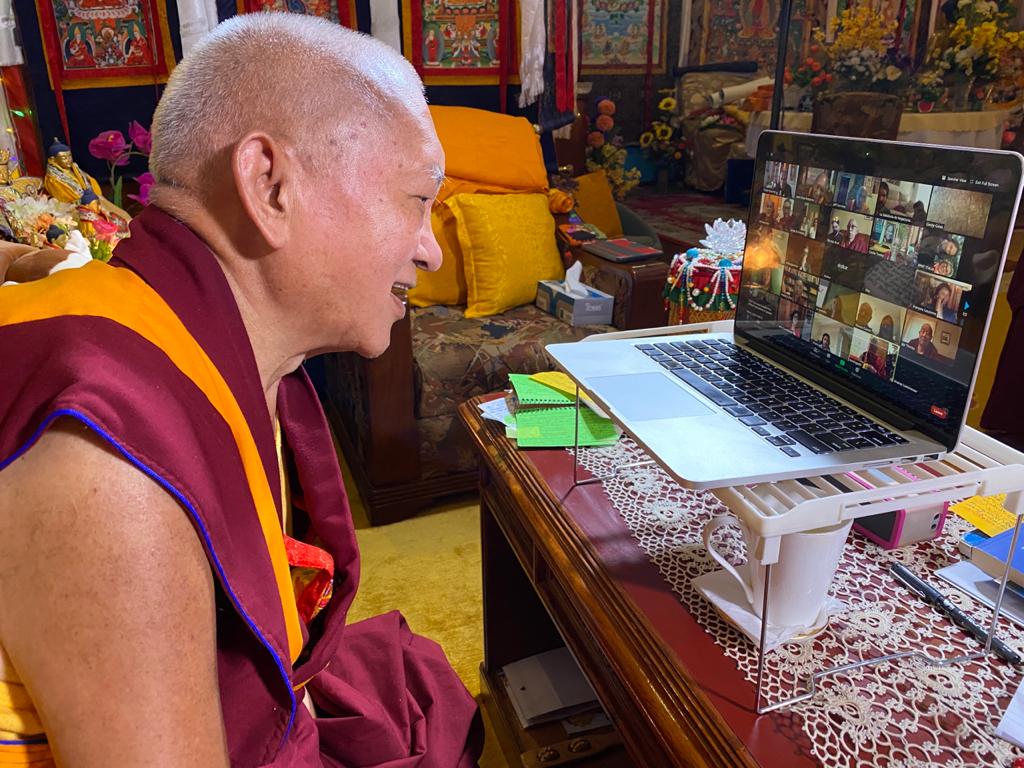


Lama Zopa Rinpoche at 100 Million Mani Retreat, Mongolia, August 2013. Photo by Ven. Roger Kunsang.
Mongolia has a strong history of Buddhist practice in the Tibetan tradition and, in particular, Mani Retreats.
The Mani Retreat started in Mongolia in the mid-15th century under the great Buddhist leader and practitioner, Zanabazar, and continued until the Soviet-backed communist takeover in 1930. During the “Cultural Purges” that followed, more than 1,000 monasteries and temples were destroyed, and thousands of monks were killed, forced into labor camps, or exiled. For 60 years, the active practice of Buddhism in Mongolia disappeared completely from public view. Mongolia gained independence in 1990, following the collapse of the Soviet empire, and while Buddhism remained strong in the hearts of the people, the monasteries, monastic learning, and knowledge of Buddhist teachings had been nearly obliterated. In the Ganden complex, not far from the retreat venue, there was a huge 26-meter (85-foot) Migjed Chenrezig statue. It is an inspiring sight, capable of lifting spirits when the retreat’s challenges become a bit much. The communists destroyed the original statue, which was built by a Mongolian ruler in 1911. But in the 1990s, the holy object was reconstructed as a sign of Mongolian independence and a gesture demonstrating the strength of Mongolia’s Buddhist faith.
Since 2000, FPMT Mongolia, realizing the wish of Lama Zopa Rinpoche, has been helping Mongolians reestablish Buddhism by creating centers, offering teachings, and supporting Sangha in monasteries and nunneries, as well as providing humanitarian support to impoverished Mongolians.
“This is one of my dreams: to have this each year and to continue forever—even after I die, even after the people living now, who are working and offering service, die—to continue as long as Mongolia exists.” — Lama Zopa Rinpoche
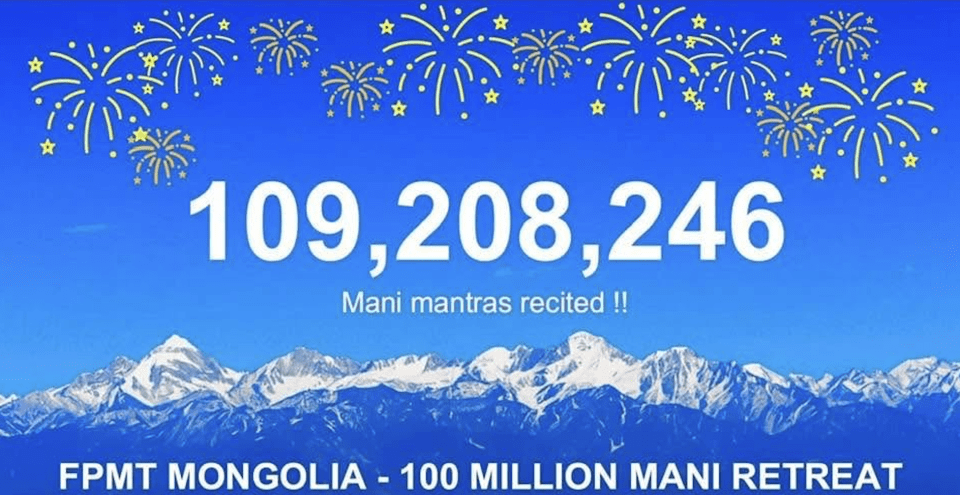
The 100 Million Mani Retreat in Mongolia was a particularly strong wish of Rinpoche, to purify, generate merit, and attain realizations. FPMT Mongolia Center Ganden Do Ngag Shedrup Ling Center just completed its 14th consecutive year of the Mani Retreat with 109, 208, 246 Manis completed. Please rejoice with us in this tremendous achievement.
Here, Ven. Thubten Gyalmo, resident Western teacher at the Mongolian FPMT Ganden Do Ngag Shedrup Ling Center, reflects on the history of the Mani Retreat in Mongolia and how much her life has been impacted by it.
2026 FPMT Global Mani Retreat
FPMT Mongolia has just completed the 14th annual Mani Retreat, from August 20 to September 17, 2026, with an average of 150–250 practitioners daily. It is part of the FPMT Global Mani Retreat program, which has brought together students of Lama Zopa Rinpoche from around the world.
This is all due to Lama Zopa Rinpoche’s skilfull guidance and immeasurable kindness, and without a doubt, this annual event has had a huge impact on my life. I cherish this annual event as a precious opportunity to be together with all the participants, the FPMT Mongolia team, and volunteers as we continue nurturing and growing loving kindness and compassion in our hearts and minds.
How It All Started
For my Getsulma ordination, in 2009 I went to Institut Vajra Yogini in France. My hair-cutting ceremony was done by Lama Zopa Rinpoche in the retreat tent, where Rinpoche was preparing for the Chenrezig initiation. It was the second day, and I was the only one! After some three weeks, Getsulma ordination was granted to a small group, and I attended the whole Mani Retreat, a 100 Million Mani Retreat. That was the very first one for me.
When I returned to Mongolia, I learned that Lama Zopa Rinpoche had given advice in 1999 that Mongolia should do the 100 Million Mani Retreat, because there are so many animals in this country, and so many that are killed for food. Mongolia is a very, very cold country, and the Mongolian people have been eating meat for centuries to survive in the harsh conditions, but these days there are more alternative food options. Rinpoche advised that the Mongolian center should really do something for the people and for the animals.
In 2013, Venerable Tsenla from Kopan Nunnery, who was serving at the Mongolian FPMT Center, launched the first 100 Million Mani Retreat, and apart from during the Covid pandemic, it has been held every year since. We found a way to continue the Chenrezig practice in 2020 by doing a group Chenrezig retreat concluding with a fire puja, and in 2021, FPMT Mongolia nuns, together with a small number of students, in accordance with the guidelines of the pandemic, streamed the retreat from the gompa.
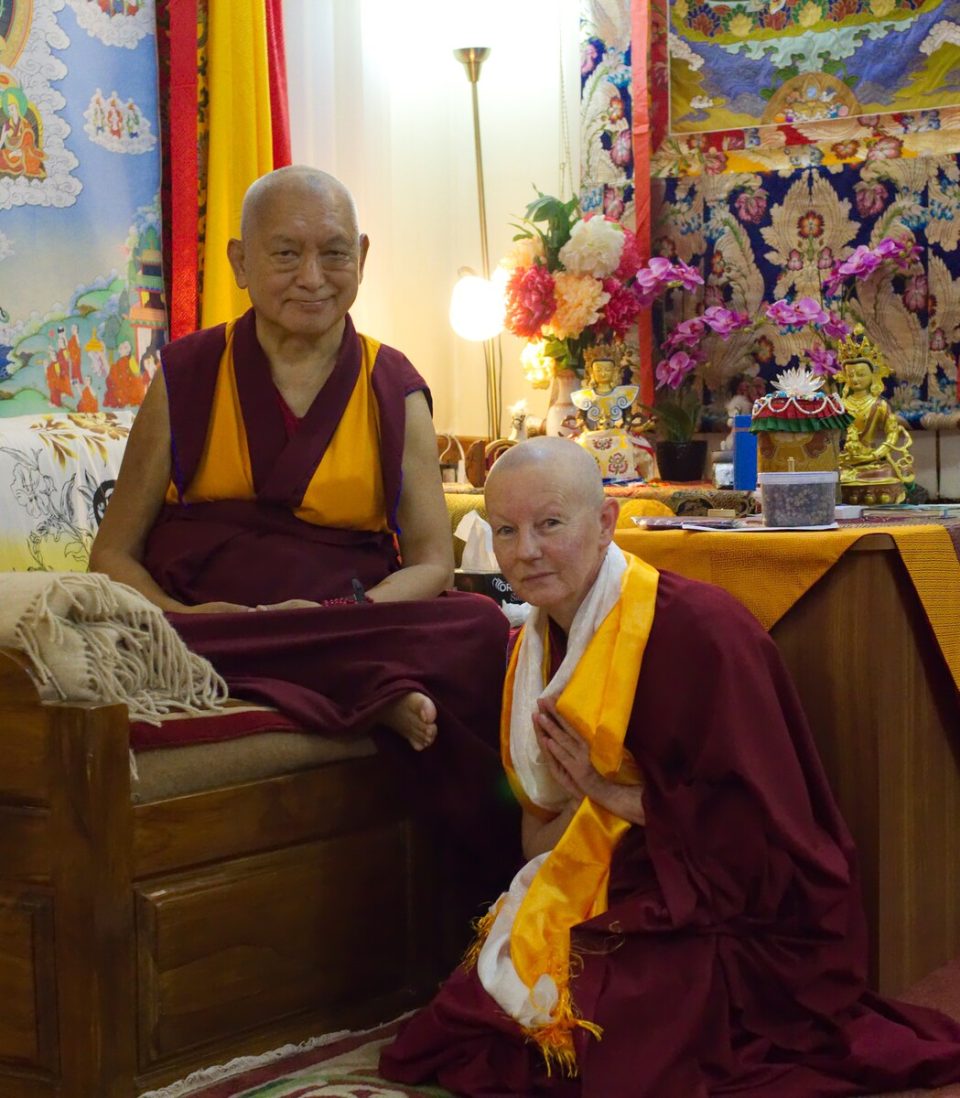
Lama Zopa Rinpoche with Ven. Gyalmo, India, 2017. Photo by Ven. Lobsang Sherab.
In the Global Mani Retreat, the group sessions do what we call the “home practice,” or the short practice. But here, Rinpoche created this long sadhana drawn from the Nyung Nä practice to follow in the traditional 100 Million Mani Retreats. Due to Mongolia having a long history with Mani recitations and an extended Buddhist history, Rinpoche advised that doing the long sadhana was more beneficial. However, people who can’t read, are at home, are sick, or are unable to come to the gompa, they can use the “home practice.”
The Mani Retreat with Lama Zopa Rinpoche in Mongolia
In 2013, Lama Zopa Rinpoche arrived halfway through the retreat and asked that the event be repeated annually, so that “many people can really enjoy the opportunity to purify the negative karmas and obscurations collected from beginningless rebirths and to collect extensive merits.”
Lama Zopa Rinpoche was here with us for the first Mani retreat in 2013. He joined as well at the second one in 2014, and bestowed upon us so much guidance and so many teachings. Since then, Mongolia has been able to continue without missing a year, with an average of 150 to 300 people in the gompa.
In 2017, the Mongolian Center was extremely fortunate to receive the Great Chenrezig initiation bestowed by Lama Zopa Rinpoche just two weeks prior to the commencement of the retreat, bringing so many rich blessings to the retreat and its participants.
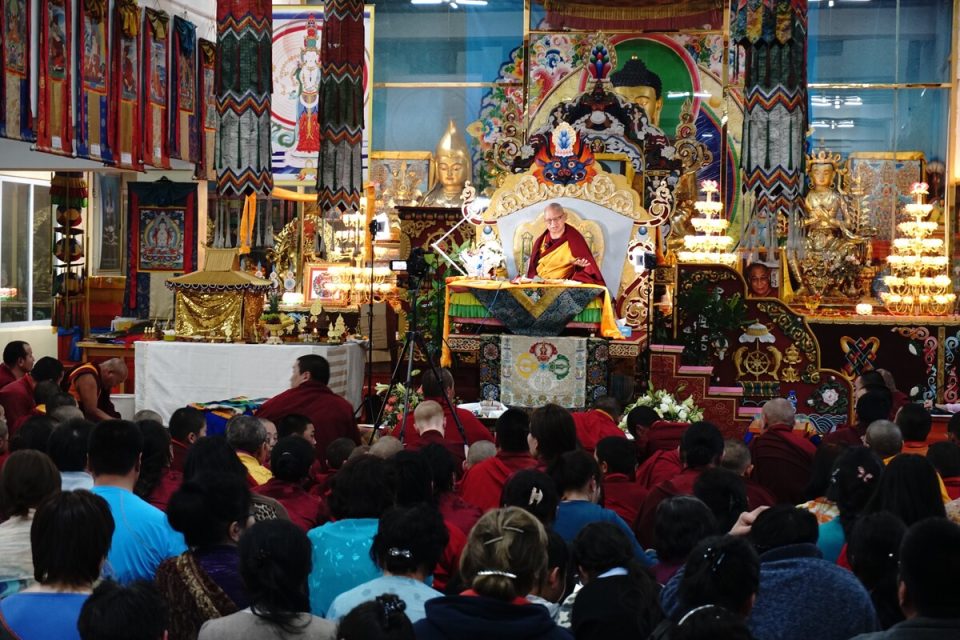
First day of Lama Zopa Rinpoche’s teachings at Idgaa Choizinling Monastery, Mongolia, May 2017. Photo by Ven. Lobsang Sherab.
The Retreat Schedule
This schedule was arranged to accommodate approximately two hundred Mongolian participants, in any one session of a day, who sometimes had to travel very long distances, inspired by the knowledge of the incredible merits of doing the Chenrezig practice. The retreat takes place at the Idgaa Choizinling Dratsang, one of the more modern temples located within the Gandan Tegchenling Monastery complex in central Ulaanbaatar. Lama Zopa Rinpoche, together with FPMT Mongolia, offered financial support for Idgaa Choizinling’s rebuilding, which was completed in 2003, and has continued to support the monks with daily nutritious lunches.
The duration of the retreat is approximately one month, 28 to 30 days. We commence at 8:00 a.m. and conclude at 6:30 p.m. In the first session, we do Lama Chöpa Jorcho, followed by three sessions dedicated to the long Chenrezig sadhana mentioned above.
People are free to come and go according to their time and other life commitments. It is not a residential retreat.
Idgaa Choizinling has a beautiful, spacious gompa, and Rinpoche advised us from the beginning that it’s appropriate to be in the city so that everybody can come. If the retreat is held in the countryside, many people would be excluded because they don’t have transport, and for the elderly, it would be difficult to travel.
Throughout the retreat, we offer a vegetarian breakfast and lunch plus four teas to all participants, FPMT Mongolia staff, and volunteers.
The Food Offering
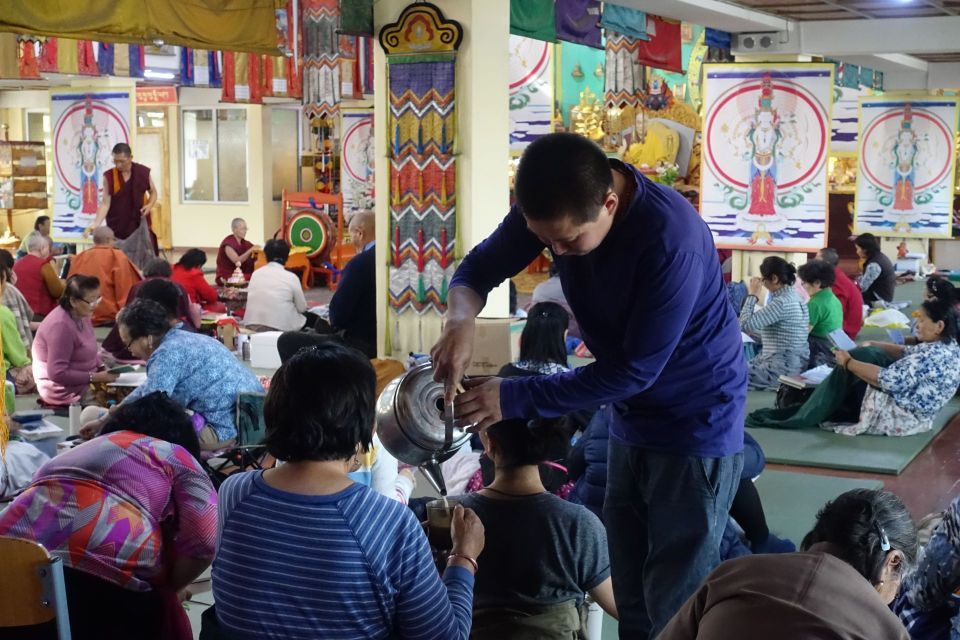
Seventh 100 Million Mani Retreat at Idgaa Choizinling Monastery in Ulaanbaatar, Mongolia, September 2019. Photo by Ianzhina Bartanova.
In Mongolia, people have the tradition of making dedications together with a monetary offering, and during the retreat, our Dedication Desk volunteers are kept fully occupied. Sometimes it can take up to 40-45 minutes to read all the dedications. We also provide the opportunity for people to sponsor the teas and/or food or a whole day if they wish. Somehow, the total donations from this activity miraculously cover the cost of providing nourishment for everyone!
So, it’s a very beautiful way to run the retreat. Like, in the West, I know it’s difficult. You have to pay so much for hiring the venues, and then if you have to feed people, it’s very expensive. But here, in Mongolia, there is no retreat fee, so people can afford to come. It’s a developing country, and the above approach works very well.
It pleased Lama Zopa Rinpoche that we would always offer vegetarian food and drink to the participants, make them comfortable, and have the flexibility that they were welcome to attend for as long as they could.
And the interesting thing is, out of the 13 Mani Retreats we’ve done, there have been only two years that we didn’t reach the goal of 100 million because of the conditions. Every other year, we’ve reached over 100 million Manis. This is amazing!
Mani Retreat: Rinpoche’s Dream
In 2016, for the fourth 100 million Mani Retreat, Lama Zopa Rinpoche shared in a thank-you letter to the center’s director:
“I want to thank from the depths of my heart, from the very inside of my heart bones. Thank you and the others for organizing the mani retreat each year. This is one of my dreams: to have this each year and to continue forever—even after I die, even after the people living now, who are working and offering service, die—to continue as long as Mongolia exists.
“The retreat is like offering infinite skies of help to sentient beings. Each session, even reciting one mala, purifies negative karma, including all the obscurations, created from beginningless rebirths. This is even without doing it with bodhichitta. It collects merit more than the drops of water in the Pacific Ocean, more than the grains of sand in the Pacific Ocean, more than the blades of grass growing in the mountains and on the lands of the earth.
“If one is doing it with bodhichitta—even just reciting OM MANI PADME HUM one time—it collects merit more than the sky. It’s unbelievable, unbelievable, unbelievable. In particular, it causes one to develop compassion for others: for the numberless sentient beings of the six realms—numberless hell beings, numberless hungry ghosts, numberless animals, numberless human beings, numberless suras, numberless asuras—and numberless intermediate state beings.
“Generating compassion is most powerful and is what makes one achieve enlightenment rapidly. Even if you generate compassion for only one sentient being, that is the quickest way to purify all the defilements and accumulate all merits, which are necessary conditions, and to actualize the path to enlightenment.
“The conclusion is that compassion makes it possible to achieve enlightenment—buddhahood, the total cessation of all the obscurations and completion of all the realizations—as quickly as possible. This means being able to free all the six-realm sentient beings from the oceans of samsaric suffering quickly, which means being able to bring the numberless sentient beings to buddhahood quickly. This is the most important achievement, more important than anything else in life. By generating compassion, you are able to achieve this quickly.”
With gratitude to Ven. Thubten Gyalmo for sharing this story, and for her immense effort helping to fulfil this very precious wish from Lama Zopa Rinpoche.
The entire FPMT community has been participating in an unprecedented Global Mani Retreat —an inspiring collective offering of practice, harmony, and dedication to the awakening and benefit of all beings, helping to fulfill Lama Zopa Rinpoche’s Vast Vision of accumulating 100 million Mani mantra recitations worldwide.
The next major teaching of the Global Mani Retreat will be Khandro Tseringma Rinpoche, on Sunday Oct 25, 2026. A truly rare and precious opportunity!
To keep up with all details related to the FPMT Global MANI Retreat, please refer to our webpage, and join the Facebook Group.
Foundation for the Preservation of Mahayana Tradition (FPMT), is a Tibetan Buddhist organization dedicated to the transmission of the Mahayana Buddhist tradition and values worldwide through teaching, meditation and community service.