
 receive our newsletters
 join Friends of FPMT

Retreats and Practices

Participants in the 2025 Nyung Nä retreat at IVY during a prostration session. Photo courtesy of Institut Vajra Yogini.
Across the FPMT mandala, students are creating the causes and conditions for Dharma practice to flourish — from long-term intensive solitary and group retreats to the construction and preservation of retreat centers where students can dedicate themselves to the path.
Lama Zopa Rinpoche gave extensive advice on the practices, retreats, and initiatives that support students’ progress toward realizations. The FPMT Practice and Retreat Fund helps put this advice into action by supporting the opportunities that make such practice possible: maintaining retreat facilities, providing financial assistance to practitioners, and sustaining important lineage traditions. In 2026, the Practice and Retreat Fund offered US$44,138.41 through seven grants supporting retreat centers and practice-related projects across the FPMT mandala. In this roundup, we share some of the practices and projects supported by the Fund — from fifteen years of 108 Nyung Nä retreats at Institut Vajra Yogini and the continuation of the Most Secret Hayagriva retreat commitment at Nalanda Monastery, to new retreat capacity at Land of Joy in the UK and the ongoing development of retreat facilities in Europe and the US. We also rejoice in the many powerful practices taking place throughout the wider FPMT mandala, including the 100 Million Mani Retreats in Mongolia and Nepal, the 2026 Global Mani Retreat, and the Guru Rinpoche Bum Tsog in Australia.
“Among the virtues, rejoicing is the best, because it is the easiest one to practice. It simply involves our mind thinking, and the merit we accumulate is infinite.” — Lama Zopa Rinpoche
Institute Vajra Yogini | Nalanda Monastery | Milarepa Center | Land of Joy | Thakpa Kachoe Retreat Land | Center of White Mahakala Study Group | FPMT Mongolia | Langri Tangpa Centre | Tashi Chime Gatsal Nunnery
Rejoicing in 15 Years of 108 Nyung Nä Retreats in France
One of Lama Zopa Rinpoche’s Vast Visions for FPMT was to support practitioners who make the extraordinary commitment to complete 1,000 Nyung Nä retreats in their lifetime. Nyung Nä is a two-day intensive practice associated with Chenrezig, the Buddha of Compassion. It involves taking the 24-hour Mahayana precepts, with complete fasting and silence on the second day, together with meditation, prostrations, and mantra recitation. Lama Zopa Rinpoche highly praised Nyung Nä as a powerful method for transforming the mind.
Since 2011, Institute Vajra Yogini (IVY) in France has played an important role in helping bring Rinpoche’s vision to life by organizing an annual series of 108 Nyung Nä retreats. From November 2025 through June 2026, IVY completed its fifteenth consecutive series – a remarkable milestone and a cause for great rejoicing. Over these fifteen years, the retreats have provided a sustained opportunity for practitioners to engage in this powerful practice, supported by experienced teachers, resident Sangha, volunteers, and the wider FPMT community. The retreats have been guided for many years by Ven. Charles, who has personally completed thousands of Nyung Nä practices and has inspired generations of students through his compassionate guidance. Lama Zopa Rinpoche himself affectionately referred to him as “Bodhisattva Charles.” After leading the retreats at IVY for fifteen years, Ven. Charles has now begun a year of solitary retreat, and we rejoice in his dedication and wish him every success in his practice.
During the 2025\26 series, 128 people completed at least one full two-day retreat, while others—including local participants and volunteers—joined individual sessions. Although no one completed all 108 retreats this year, IVY continued to make the practice accessible beyond those able to participate full-time. Morning sessions were offered online every day, along with a complete two-day retreat online each month, allowing students around the world to join from home.
The Practice and Retreat Fund offered US$10,638.41 toward the 2025\26 series, continuing the support that Lama Zopa Rinpoche himself provided for many years by sponsoring food and accommodation for practitioners undertaking the retreats. IVY also provided financial assistance to some part-time participants. IVY is now preparing for its sixteenth consecutive series of 108 Nyung Nä retreats, running from November 16, 2026, through June 20, 2027. The new series will be guided by experienced monastic and lay practitioners, including Ven. Amy, Ven. Losang (Rita), and Brigitte Lucas, with the retreats offered in French and English and accessible to participants in other languages. We rejoice in IVY’s extraordinary fifteen-year commitment to this practice, in all the teachers and practitioners who have sustained the retreats, and in the volunteers and sponsors who have helped make them possible.
Rejoicing in the Most Secret Hayagriva Retreat in France
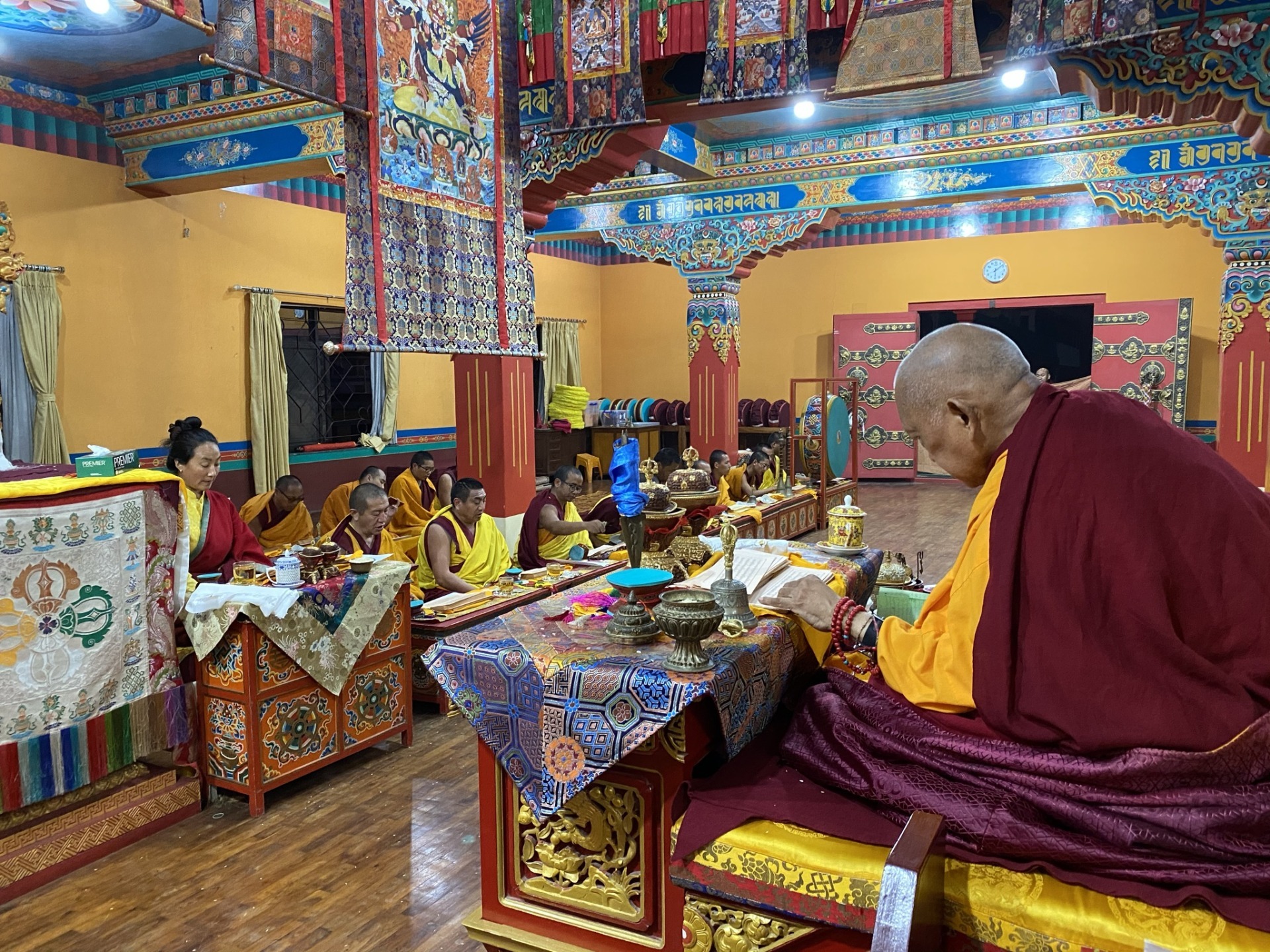
Lama Zopa Rinpoche, Khandro Tsering Kunga Bum-ma (Khadro la) and Kopan senior monks offering all day Most Secret Hayagriva Tsog Kong (extensive tsog offering) in Lama Gyupa Gompa at Kopan Monastery, Nepal, January 2021.
Hayagriva is the wrathful manifestation of Chenrezig, the Buddha of Compassion. The practice of Most Secret Hayagriva is considered extremely powerful for bringing help and support and for swiftly pacifying obstacles. Both Lama Yeshe and Lama Zopa Rinpoche had a special connection with Most Secret Hayagriva. As Ven. Roger Kunsang explained, the retreat was a practice and commitment that Lama Yeshe gave to Lama Zopa Rinpoche to undertake every year for the protection and success of the entire FPMT organization. Today, this commitment has been taken up by FPMT as a whole. The practice belongs to an unbroken lineage extending back to the time of the Buddha and was practiced by realized beings including Nagarjuna, Padmasambhava, the Great 5th Dalai Lama, Lama Yeshe, and Lama Zopa Rinpoche. In 2026, we especially rejoice that two FPMT centers are carrying forward this important practice tradition. Nalanda Monastery in France hosted its annual Most Secret Hayagriva Retreat for the second time, from August 12—29, 2026. Ven. Tritul Jampa Kalden Rinpoche (Gomde Rinpoche) from Sera Je, one of the few specialists in this rare and powerful practice, was invited to lead the retreat, with Ven. Geshe Tsultrim from Kopan Monastery serving as chant leader. Twenty-one retreatants participated with great devotion and dedication. As Ven. Thubten Sherab shared, the retreat offered an important chance for practitioners to engage deeply in this practice for the benefit of FPMT and its activities.
The Practice and Retreat Fund contributed US$5,000 toward the 2026 Most Secret Hayagriva Retreat at Nalanda Monastery. The tradition will continue in 2027 at Chokyi Gyaltsen Center in Penang, Malaysia, where His Eminence Kyabje Jhado Rinpoche will preside over the Most Secret Hayagriva Retreat from March 31—April 14. Registration is now open. We rejoice in Nalanda Monastery and Chokyi Gyaltsen Center for continuing this precious tradition, in the teachers and retreatants who dedicate themselves to the practice, and in all those whose support makes these opportunities possible.
Milarepa Center, USA: Maintaining a Home for Dharma Practice
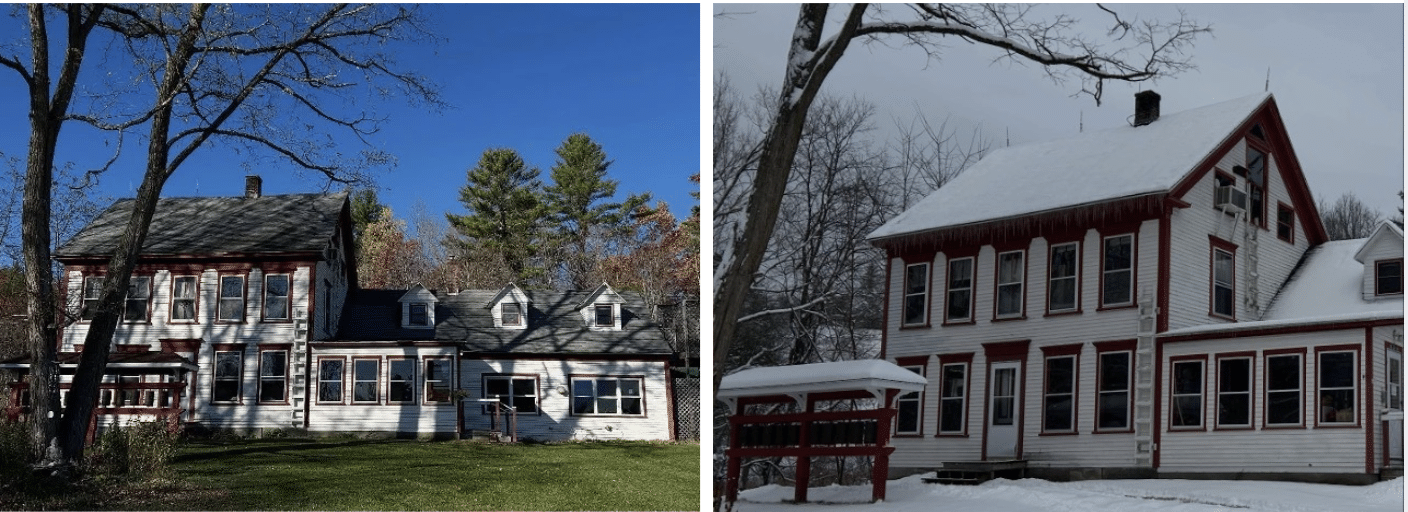
Milarepa Centre through the seasons
Milarepa Center is a Buddhist retreat center situated on 276 acres (112 hectares) of wooded mountainside and rolling fields overlooking the Connecticut River Valley in Barnet, Vermont (US). Founded in 1981 by students of Lama Yeshe and Lama Zopa Rinpoche, the Center is named after the great eleventh-century Tibetan yogi Milarepa, famed for attaining enlightenment in a single lifetime. From its early years – marked by austere conditions but great devotion – Milarepa Center has been blessed by a continuous stream of Tibetan and Western Lamas, beginning with Lama Zopa Rinpoche’s first teaching at the Center in 1981. Over 1,000 people have completed retreats and received teachings here, making it a place deeply imbued with natural beauty and realized presence.
Milarepa Center has received two grants for 2026, both awarded through the Practice and Retreats Fund. The first grant of US$5,000 supports essential 2026 maintenance projects, helping preserve the physical infrastructure that holds retreat and study. The planned maintenance work includes repairing the roofs on the retreat cabins, re‑insulating the main building, replacing rotting siding and roof flashing that has been damaged, and carrying out exterior painting of the buildings. Rising material and labor costs make this support especially meaningful, ensuring a safe and stable environment for future practitioners. The second grant adds US$2,000 to the Milarepa’s Retreat Scholarship Fund, which assists ordained sangha and lay practitioners for whom retreat costs would otherwise be a barrier. Scholarships are awarded based on genuine need through an application process, with recipients contributing what they can so funds may benefit as many practitioners as possible. This past year, scholarship support enabled an ordained sangha member to complete a full three‑month retreat at Milarepa Center. To support Milarepa Center and its ongoing activities, you are welcome to visit its donations page for more details.
Land of Joy, UK: Expanding Opportunities for Solitary Retreat
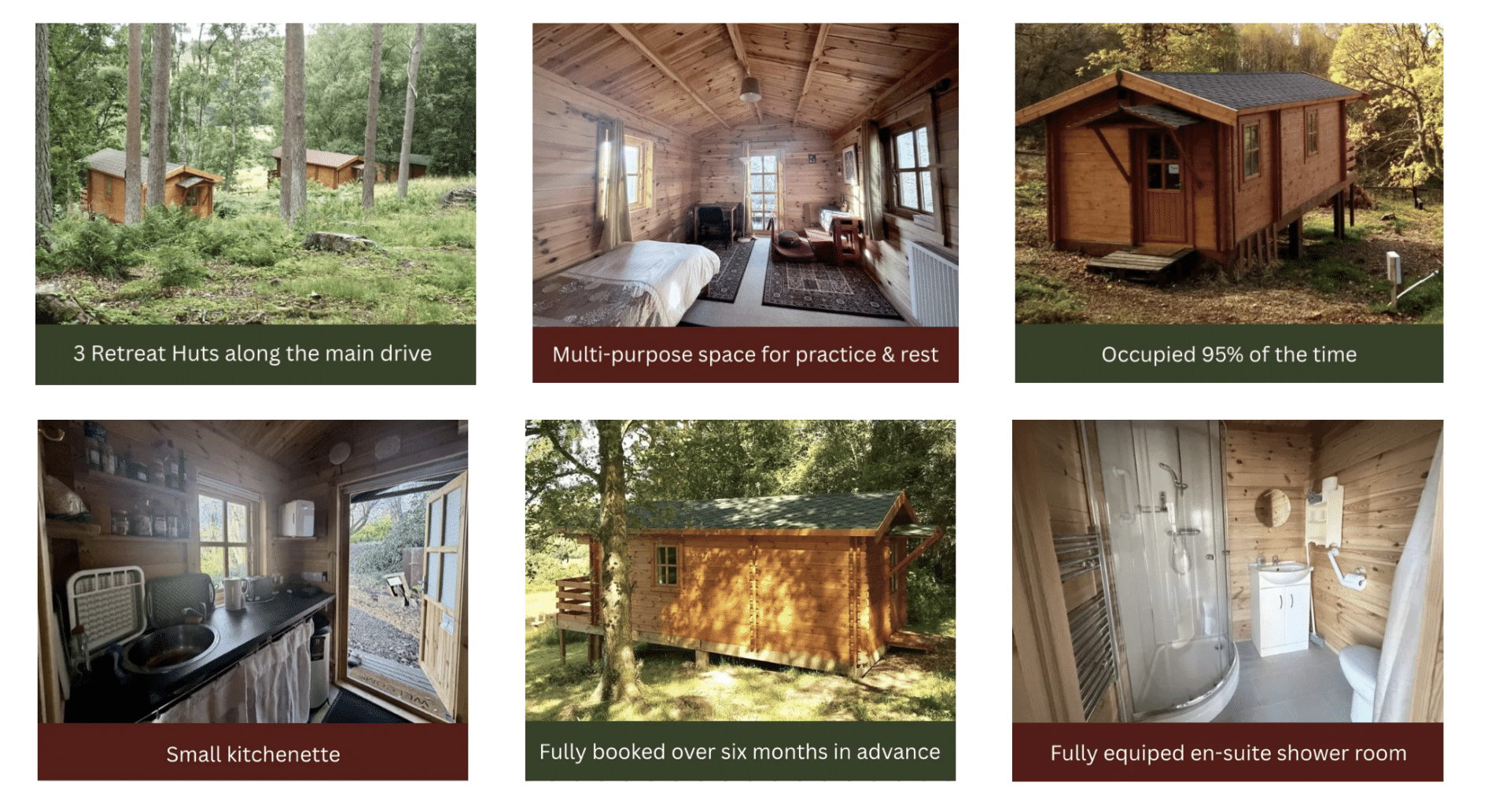
Land of Joy’s retreat huts
Land of Joy is grateful to share that the Practice and Retreat Fund has offered a matching grant of US$16,500 toward the project Building Retreat Huts Together, supporting the construction of two new solitary retreat huts and significantly strengthening long‑term retreat capacity in the UK. Planning consent has been granted by Northumberland County Council, contractors are secured, and utilities and groundwork were scheduled to begin in June 2026. Each hut will be a simple, warm, self‑contained space designed specifically for retreat use, following Land of Joy’s proven and well‑loved model. This expansion responds to growing demand for solitary retreat, increases availability during high‑demand periods, provides additional capacity for sangha, improves scheduling flexibility across existing huts, and aligns closely with FPMT’s long‑term retreat vision for the UK and Europe.
Founded in 2010 under the spiritual guidance of Lama Zopa Rinpoche, with the first retreat held in May 2015, Land of Joy is located in the quiet and spacious setting of Northumberland National Park, offering ideal environment for deep practice. The Land of Joy is a volunteer‑run residential retreat center offering a full program of retreats throughout the year, from introductory courses to longer tantric retreats. The center currently has three solitary retreat huts that are in constant use and often booked many months in advance, highlighting both their life‑changing impact and the urgent need for more such spaces. The two new huts, nestled slightly more seclusively in a birch glade at the edge of the woodland, will quietly support practitioners over many years, creating authentic opportunities for sustained retreat practice and helping ensure that when the wish and conditions for retreat arise, the space can be there to meet it. To support Land of Joy’s fundraising campaign, you are welcome to visit the Building Retreat Huts Together page for more details.
Thakpa Kachoe Retreat Land, France: Preserving a Rare Hermitage for Future Generations
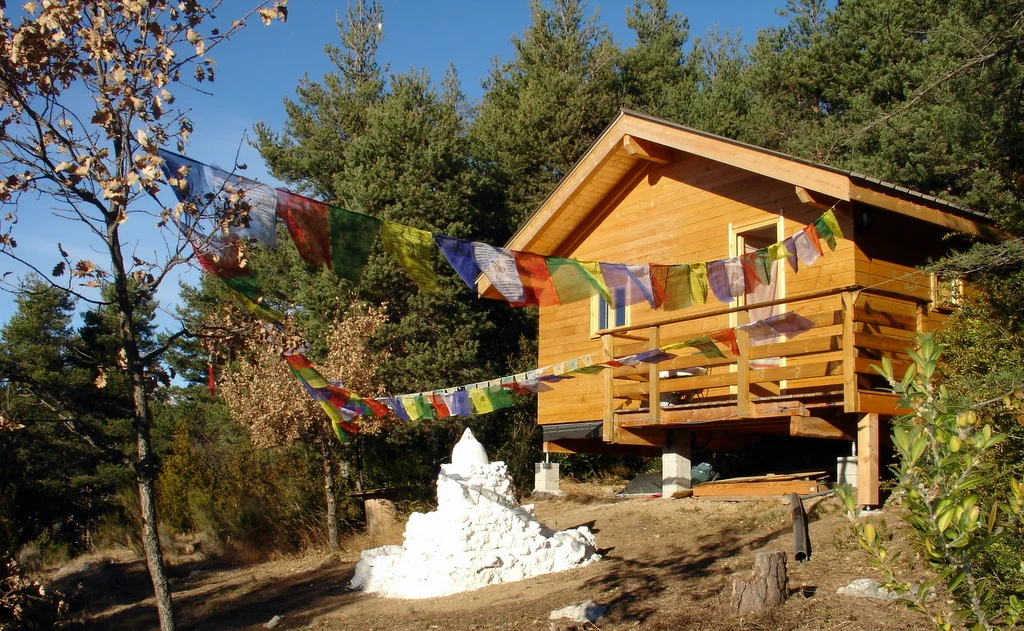
Thakpa Kachoe Retreat Land
We are pleased to share that the Practice and Retreat Fund has offered a grant of US$2,500 in support of the documentary film project An Hermitage in the Southern Alps, created for Thakpa Kachoe Retreat Land in France. The film will form the foundation of a future fundraising campaign aimed at ensuring the long‑term continuity of this rare European hermitage dedicated exclusively to solitary retreat. It will present the land, history, and functioning of the centre, share testimonies from practitioners who have completed long retreats there, and outline future developments envisioned for the site. The documentary will be shared through the centre’s website and, as widely as possible, within FPMT networks. Thakpa Kachoe was born from a deep connection with the lineage of Lama Yeshe and Lama Zopa Rinpoche, whom Sylvaine Litaud and Daniel Mestre first met in 1977 at Kopan Monastery in Nepal. Lama Zopa Rinpoche later advised them to create a retreat centre dedicated to solitary practitioners—a need that remains acute in Europe. Rinpoche personally approved the land and named it Thakpa Kachoe, the name of Vajrayogini’s pure land. Since 2010, Sylvaine and Daniel have lived on the land year‑round, gradually building the hermitage through the generosity of donors while personally supporting retreatants by managing logistics, maintenance, and even cultivating a permaculture garden. More than ten practitioners have already completed retreats at Thakpa Kachoe, including two three‑year retreats. Located on the edge of the Mercantour National Park, overlooking the Gorges de Daluis, Thakpa Kachoe offers spaces of silence, isolation, and natural beauty—an authentic hermitage environment where body and mind can deeply settle. The documentary project responds directly to Lama Zopa Rinpoche’s instruction to “prepare for the future”. Thakpa Kachoe relies entirely on donor support to sustain its mission of offering rare conditions for solitary Dharma retreat, with its current priority focused on creating suitable accommodation for the volunteers who make this work possible. To support Thakpa Kachoe’s activities, you are welcome to visit its donations page for more details.
Center of White Mahakala Study Group, Romania: Building the Foundations for Retreat
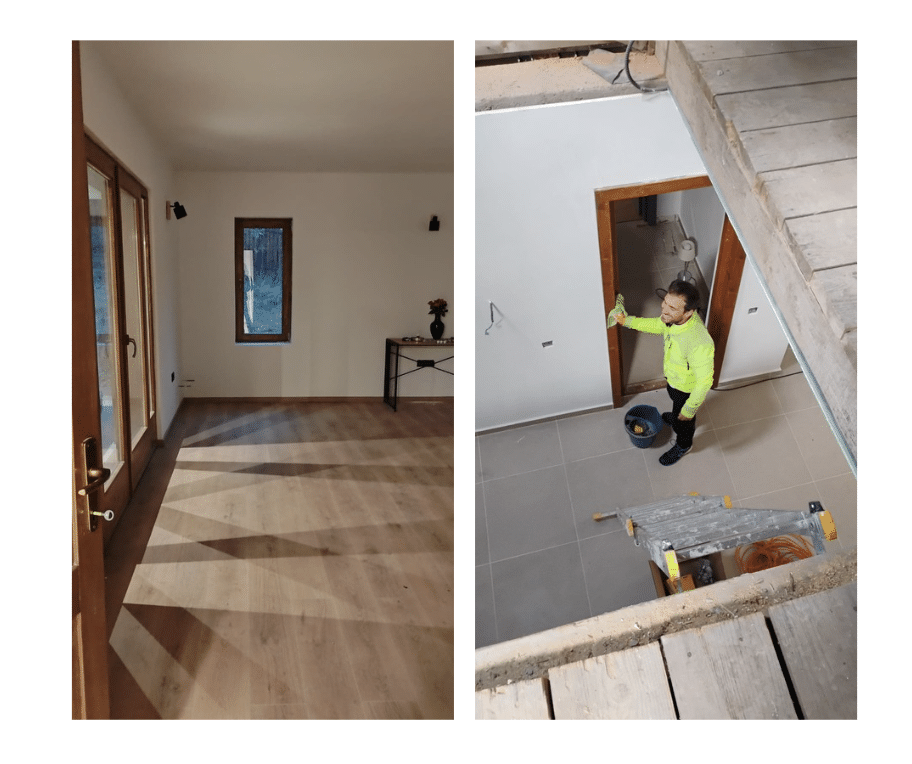
The current state of the Gompa and staircase at the Centre of White Mahakala
We are grateful to share that the Center of White Mahakala in Romania has received a grant of US$2,500 from the Practice and Retreat Fund for 2026 in support of Building the Interior Staircase of the Retreat Cabin at their retreat center in Tranisu. This year’s grant will be used to build a permanent interior staircase connecting the ground floor to the attic floor of the retreat cabin. The Center of White Mahakala is currently in the final phase of constructing its Retreat Cabin. The exterior of the main building and the entire ground floor were completed last year, and during 2026 the focus is on completing the remaining interior infrastructure. This project is part of a long-term vision inspired by Lama Zopa Rinpoche to create holy objects and retreat facilities in places where such circumstances are rare. The overall project includes both a stupa, which was completed last year, and a retreat center located on the outskirts of the Apuseni Mountains in the peaceful village of Tranisu, approximately 50 miles (80 km) from Cluj-Napoca, where the center’s city activities are based. This year’s grant supports a vital step toward making the retreat center fully operational and able to serve practitioners seeking opportunities for Buddhist practice, retreat, and spiritual development. To support the Center of White Mahakala’s retreat cabin project, you are welcome to visit the Building the Interior Staircase of the Retreat Cabin page for more details.
Rejoicing in Powerful Collective Retreats Around the World
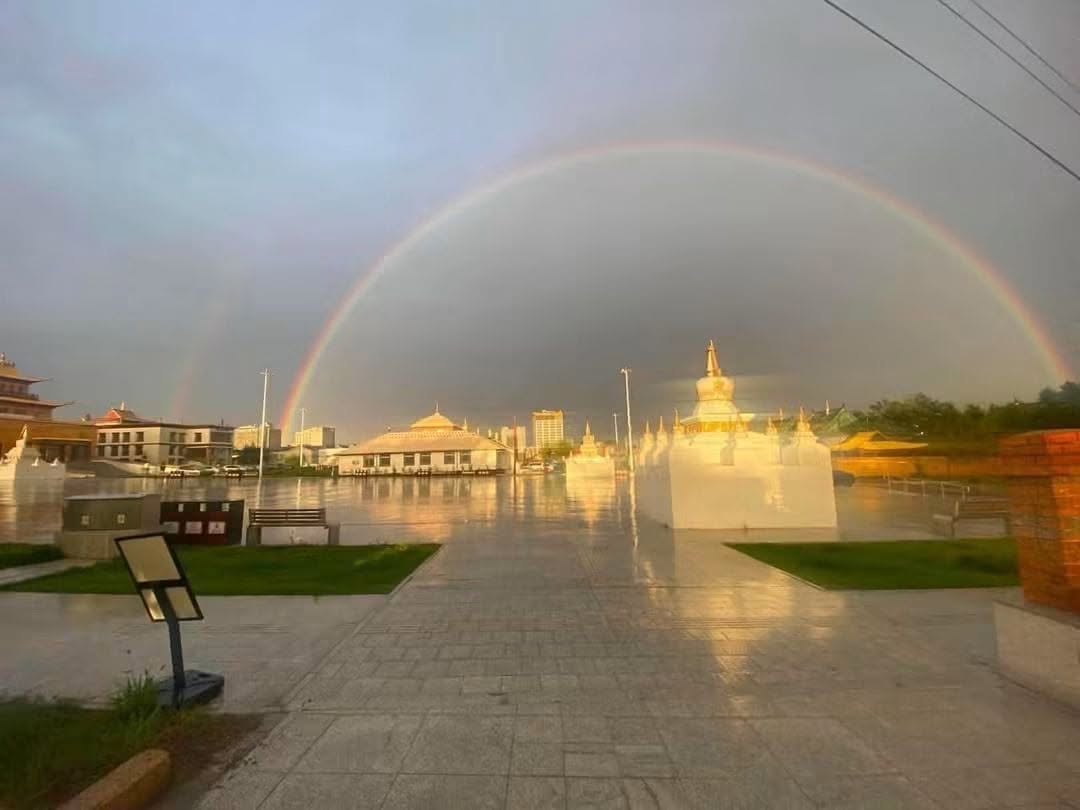
An auspicious double rainbow during the 100 Million Mani Retreat in Mongolia, August 2026.
As we’ve seen throughout this roundup, this year has given us many reasons to rejoice in the many practitioners and communities throughout the wider FPMT mandala who continue to dedicate their lives to study, retreat, purification, accumulation, and the development of compassion and bodhicitta.
Additionally, we rejoice in the successful completion of the 100 Million Mani Retreat in Mongolia, which brought together practitioners in the collective practice of Chenrezig, the Buddha of Compassion, and recitation of the Mani mantra. The retreat has deep roots in Mongolia, where Mani retreats were practiced for centuries before being interrupted during the Soviet-backed suppression of Buddhism. The tradition was revived in its present form in 2013, when FPMT Mongolia held its first 100 Million Mani Retreat following Lama Zopa Rinpoche’s advice.
This year, FPMT Mongolia completed its fourteenth consecutive annual Mani Retreat, held from August 20 to September 17, with an average of 150-250 practitioners participating each day. The retreat fulfills a particularly strong wish of Lama Zopa Rinpoche, who expressed his aspiration that it be held every year and continue for generations.
The extensive Chenrezig practice and collective recitation were dedicated to purifying negative karma, accumulating merit, and developing wisdom and compassion. We rejoice in everyone who participated and in the FPMT Mongolia team and volunteers who continue to make this virtuous annual tradition possible.
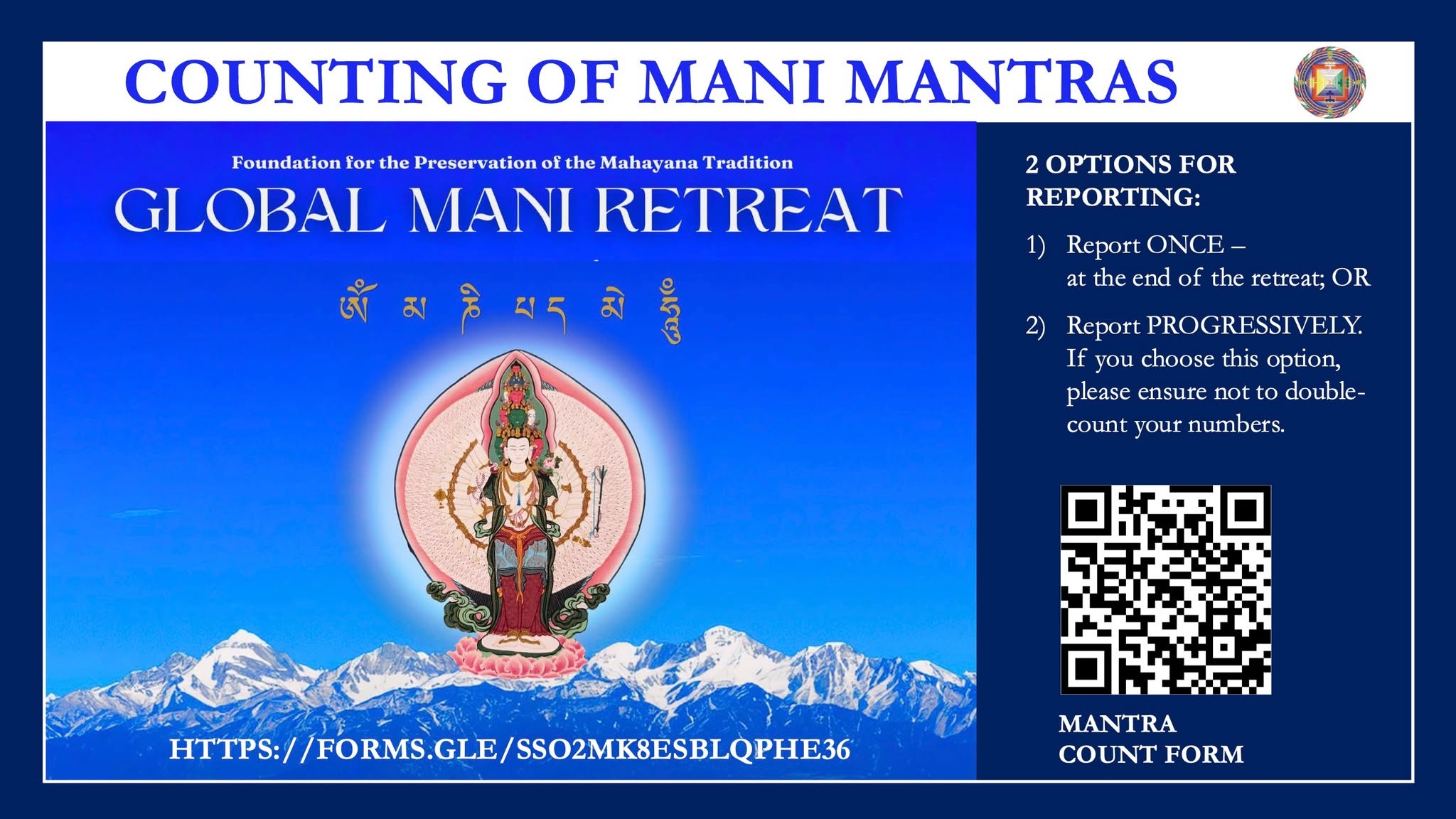
Mani mantra counting online form for participants of the Global Mani Retreat.
We also rejoice that the 2026 FPMT Global Mani Retreat is bringing practitioners together online, extending the opportunity to participate in this practice across countries and continents. Everyone can still participate through November 1, Lhabab Duchen, which commemorates Guru Shakyamuni Buddha’s return to Earth from the God Realm of the Thirty-Three, where he had taught Dharma for several months to the gods, including his mother, Mayadevi, who had died a week after Buddha’s birth and been reborn there. Lhabab Duchen is also one of the four major Buddhist holy days, when the karmic results of actions are said to be multiplied by 100 million, as taught in the Vinaya text Treasure of Quotations and Logic. Check their schedule for the next live session and visit their Facebook page for the latest updates.
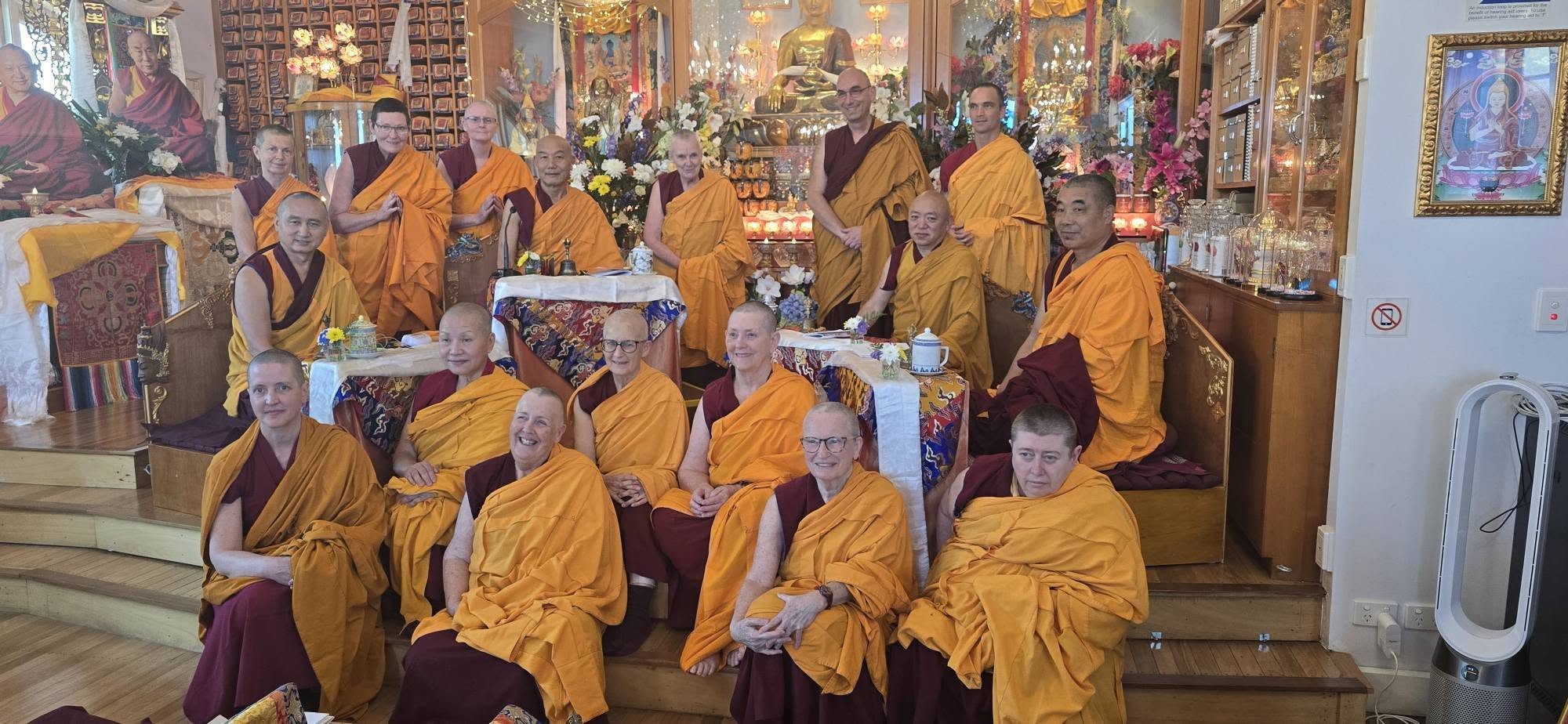
Sangha at the Guru Rinpoche Bum Tsog held at Langri Tangpa Centre in Brisbane.
In Australia, we rejoice in the recent Guru Rinpoche Bum Tsog held at Langri Tangpa Centre in Brisbane. The center was honoured to be chosen by FPMT in Australia to host this year’s national event, with Geshe Tenzin Zopa leading the puja.
On September 5-6, 2026, practitioners from FPMT centers around Australia gathered to engage in the practice. The core of the two-day event was the recitation of 100,000 tsog offering prayers and mantras to Guru Rinpoche, accompanied by many musical instruments. Extensive offerings of lights, flowers, incense, food, drinks, and other tsog items were also made, together with hundreds of tsa-tsas prepared and blessed for the occasion.
The Guru Rinpoche Bum Tsog is an FPMT in Australia national event organized every two years and offered for Australian centers in a spirit of generosity. Accommodation and travel for all Sangha attending were sponsored, while morning and afternoon teas and lunches were freely offered to all participants. With 100,000 flowers, food, incense, drinks, and other offerings, the event created an overflowing abundance of joyful goodness, kindness, and blessings.
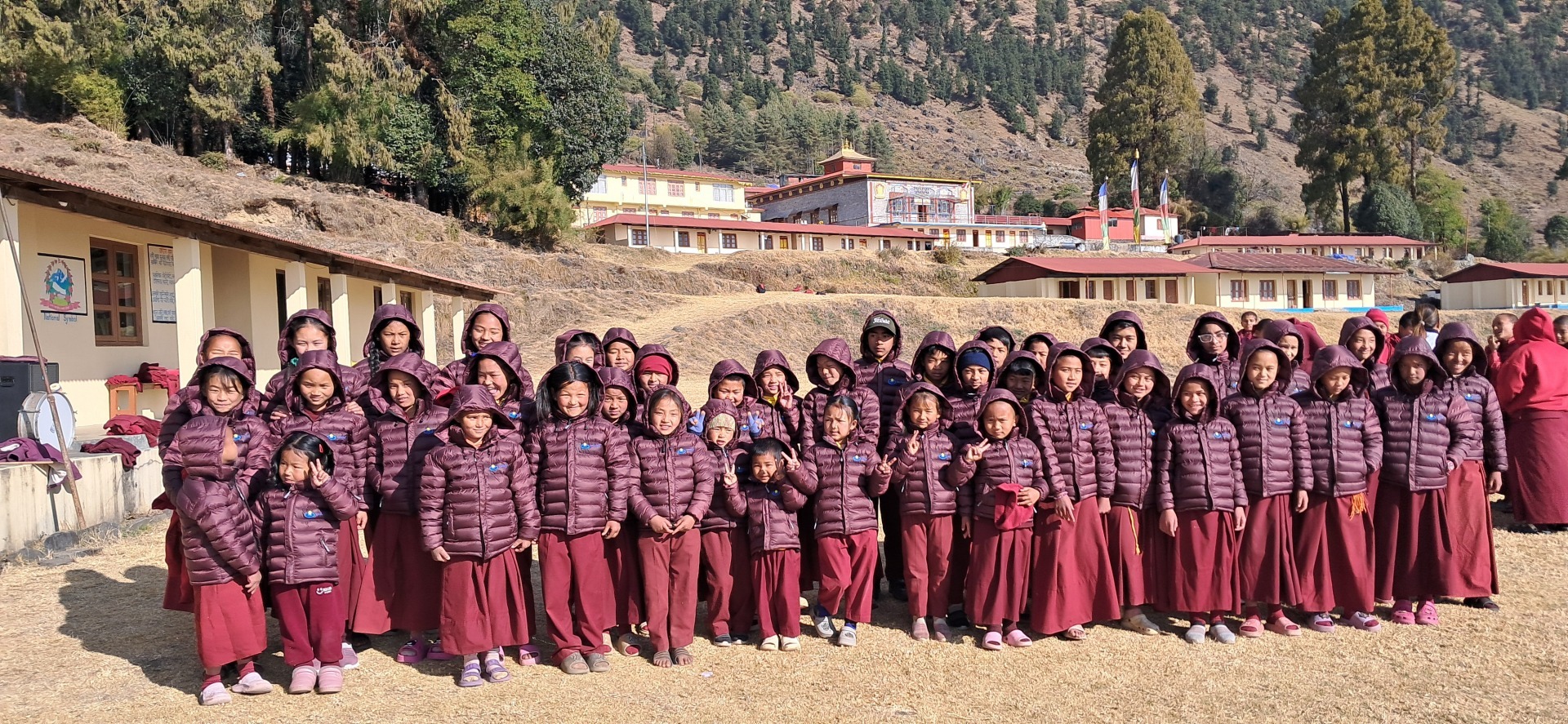
Young nuns of Tashi Chime Gatsal Nunnery (Bigu nuns).
We also rejoice in the wonderful 100 Million Mani Retreat tradition of Tashi Chime Gatsal Nunnery, where the nuns have completed the equivalent of 27.5 100 Million Mani Retreats over the years, accumulating an incredible 2.75 billion recitations of the mantra OM MANI PADME HUM for the benefit of all beings.
Located in the heart of Bigu, a rural municipality in northeastern Nepal, the nunnery has maintained this precious tradition for many years. Since 2010, FPMT, through the Supporting the Ordained Sangha Fund, has supported the Bigu nuns by sponsoring food, gas, firewood, transportation, medical expenses, and offerings to the Sangha upon completion of the retreats.
May the nuns’ incredible dedication and virtuous actions inspire us all on our own paths toward compassion and enlightenment.
The Most Important Thing in the World
If you feel uplifted by any of the initiatives described here, please check the global retreat schedule at FPMT centers worldwide and download Lama Zopa Rinpoche’s Heart Advice for Retreat.
Describing the significance of one of his Vast Visions for the FPMT organization, supporting practice and realizations, Lama Zopa Rinpoche said, “Anybody who dedicates their life to achieving lamrim realizations with the goal to liberate numberless beings from the oceans of samsaric suffering and to bring to enlightenment, this is what I regard as the most important thing in the world.”
We rejoice in every practitioner who engages in these practices, every teacher and Sangha member who guides and supports them, every center and volunteer who creates the conditions for retreat, and every donor whose generosity helps make these opportunities possible.
All are welcome to contribute to the Practice and Retreat Fund, which provides grants and sponsorships to students engaged in retreats such as 108 Nyung Nä retreats, 100 Million Mani Retreats, and other long-term retreats, and helps develop and support retreat centers.
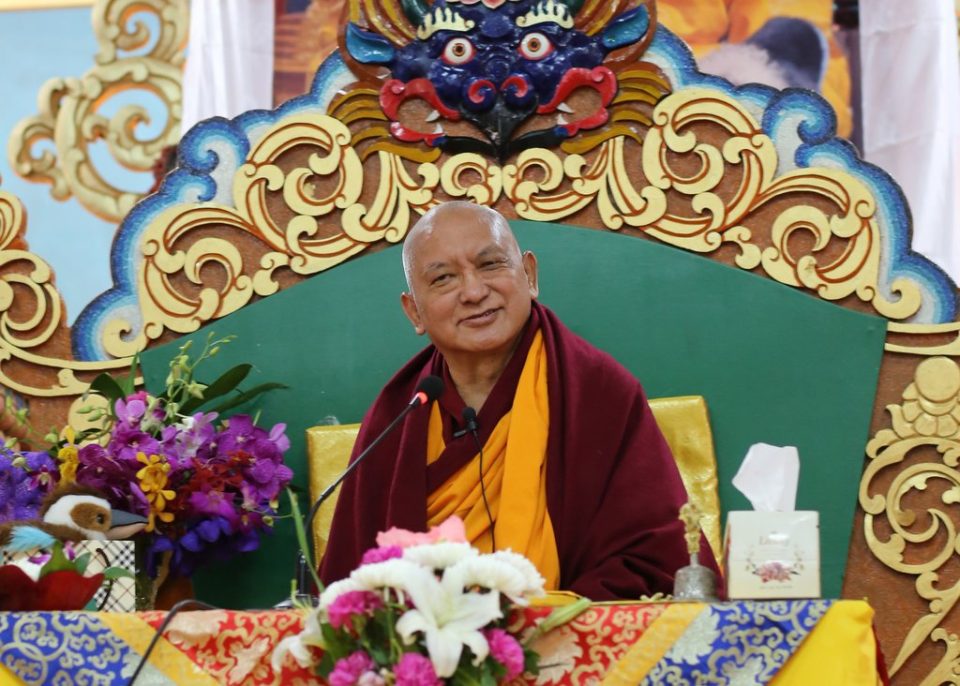
Lama Zopa Rinpoche at 100 Million Mani Retreat, Mongolia, August 2013. Photo by Ven. Roger Kunsang.
Mongolia has a strong history of Buddhist practice in the Tibetan tradition and, in particular, Mani Retreats.
The Mani Retreat started in Mongolia in the mid-15th century under the great Buddhist leader and practitioner, Zanabazar, and continued until the Soviet-backed communist takeover in 1930. During the “Cultural Purges” that followed, more than 1,000 monasteries and temples were destroyed, and thousands of monks were killed, forced into labor camps, or exiled. For 60 years, the active practice of Buddhism in Mongolia disappeared completely from public view. Mongolia gained independence in 1990, following the collapse of the Soviet empire, and while Buddhism remained strong in the hearts of the people, the monasteries, monastic learning, and knowledge of Buddhist teachings had been nearly obliterated. In the Ganden complex, not far from the retreat venue, there was a huge 26-meter (85-foot) Migjed Chenrezig statue. It is an inspiring sight, capable of lifting spirits when the retreat’s challenges become a bit much. The communists destroyed the original statue, which was built by a Mongolian ruler in 1911. But in the 1990s, the holy object was reconstructed as a sign of Mongolian independence and a gesture demonstrating the strength of Mongolia’s Buddhist faith.
Since 2000, FPMT Mongolia, realizing the wish of Lama Zopa Rinpoche, has been helping Mongolians reestablish Buddhism by creating centers, offering teachings, and supporting Sangha in monasteries and nunneries, as well as providing humanitarian support to impoverished Mongolians.
“This is one of my dreams: to have this each year and to continue forever—even after I die, even after the people living now, who are working and offering service, die—to continue as long as Mongolia exists.” — Lama Zopa Rinpoche
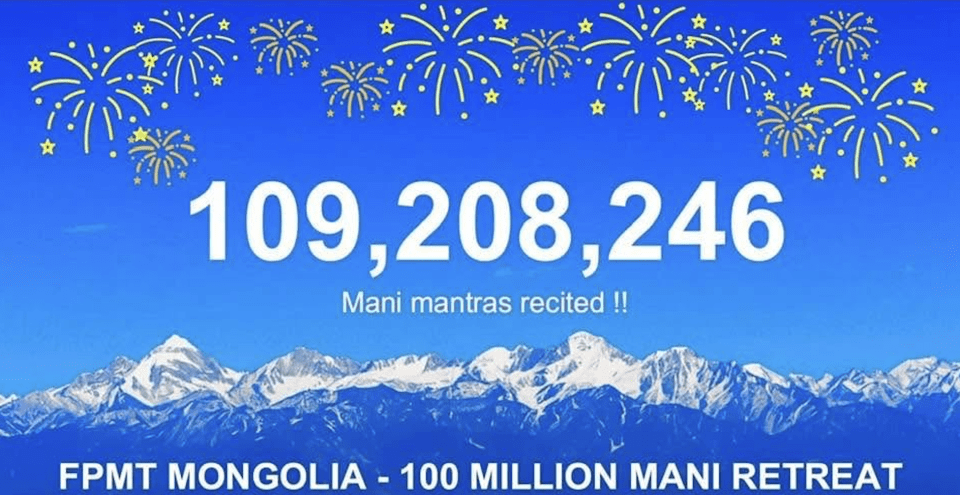
The 100 Million Mani Retreat in Mongolia was a particularly strong wish of Rinpoche, to purify, generate merit, and attain realizations. FPMT Mongolia Center Ganden Do Ngag Shedrup Ling Center just completed its 14th consecutive year of the Mani Retreat with 109, 208, 246 Manis completed. Please rejoice with us in this tremendous achievement.
Here, Ven. Thubten Gyalmo, resident Western teacher at the Mongolian FPMT Ganden Do Ngag Shedrup Ling Center, reflects on the history of the Mani Retreat in Mongolia and how much her life has been impacted by it.
2026 FPMT Global Mani Retreat
FPMT Mongolia has just completed the 14th annual Mani Retreat, from August 20 to September 17, 2026, with an average of 150–250 practitioners daily. It is part of the FPMT Global Mani Retreat program, which has brought together students of Lama Zopa Rinpoche from around the world.
This is all due to Lama Zopa Rinpoche’s skilfull guidance and immeasurable kindness, and without a doubt, this annual event has had a huge impact on my life. I cherish this annual event as a precious opportunity to be together with all the participants, the FPMT Mongolia team, and volunteers as we continue nurturing and growing loving kindness and compassion in our hearts and minds.
How It All Started
For my Getsulma ordination, in 2009 I went to Institut Vajra Yogini in France. My hair-cutting ceremony was done by Lama Zopa Rinpoche in the retreat tent, where Rinpoche was preparing for the Chenrezig initiation. It was the second day, and I was the only one! After some three weeks, Getsulma ordination was granted to a small group, and I attended the whole Mani Retreat, a 100 Million Mani Retreat. That was the very first one for me.
When I returned to Mongolia, I learned that Lama Zopa Rinpoche had given advice in 1999 that Mongolia should do the 100 Million Mani Retreat, because there are so many animals in this country, and so many that are killed for food. Mongolia is a very, very cold country, and the Mongolian people have been eating meat for centuries to survive in the harsh conditions, but these days there are more alternative food options. Rinpoche advised that the Mongolian center should really do something for the people and for the animals.
In 2013, Venerable Tsenla from Kopan Nunnery, who was serving at the Mongolian FPMT Center, launched the first 100 Million Mani Retreat, and apart from during the Covid pandemic, it has been held every year since. We found a way to continue the Chenrezig practice in 2020 by doing a group Chenrezig retreat concluding with a fire puja, and in 2021, FPMT Mongolia nuns, together with a small number of students, in accordance with the guidelines of the pandemic, streamed the retreat from the gompa.
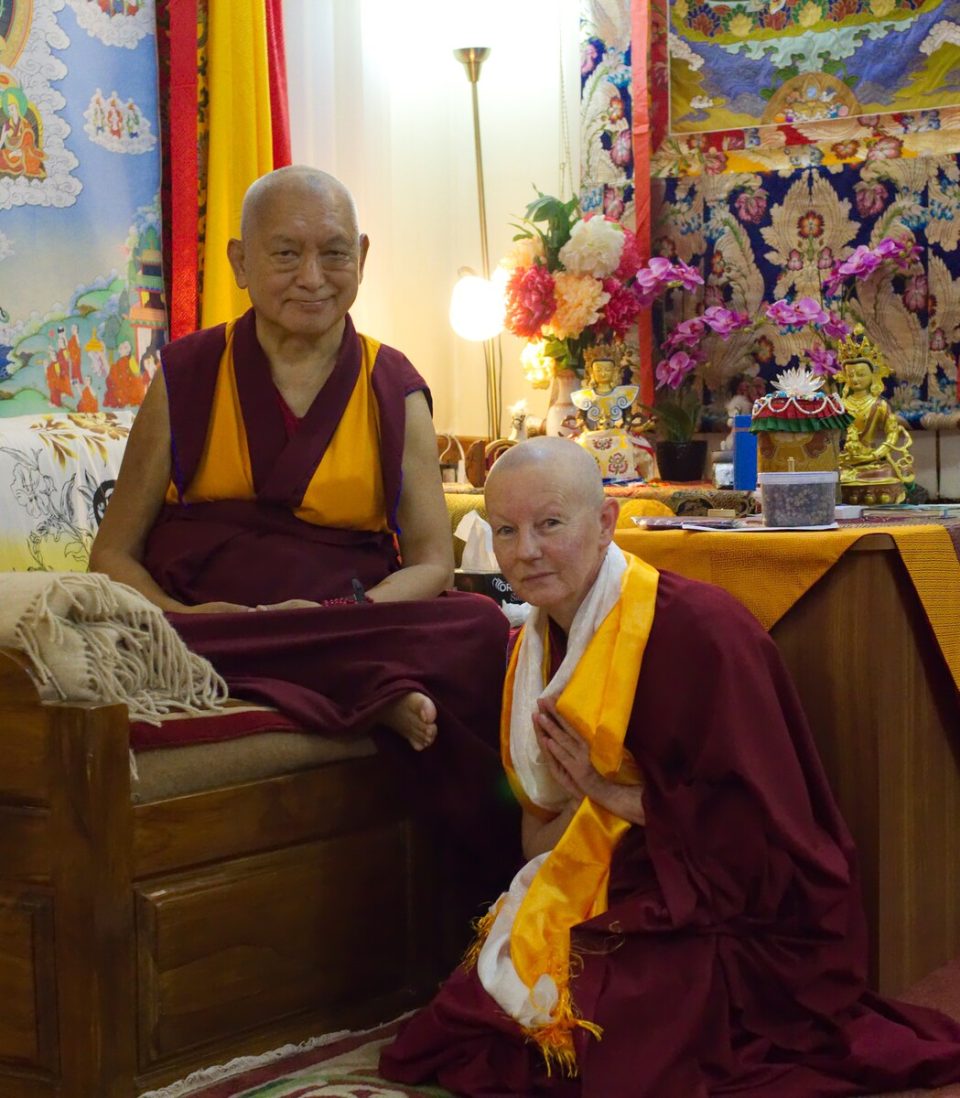
Lama Zopa Rinpoche with Ven. Gyalmo, India, 2017. Photo by Ven. Lobsang Sherab.
In the Global Mani Retreat, the group sessions do what we call the “home practice,” or the short practice. But here, Rinpoche created this long sadhana drawn from the Nyung Nä practice to follow in the traditional 100 Million Mani Retreats. Due to Mongolia having a long history with Mani recitations and an extended Buddhist history, Rinpoche advised that doing the long sadhana was more beneficial. However, people who can’t read, are at home, are sick, or are unable to come to the gompa, they can use the “home practice.”
The Mani Retreat with Lama Zopa Rinpoche in Mongolia
In 2013, Lama Zopa Rinpoche arrived halfway through the retreat and asked that the event be repeated annually, so that “many people can really enjoy the opportunity to purify the negative karmas and obscurations collected from beginningless rebirths and to collect extensive merits.”
Lama Zopa Rinpoche was here with us for the first Mani retreat in 2013. He joined as well at the second one in 2014, and bestowed upon us so much guidance and so many teachings. Since then, Mongolia has been able to continue without missing a year, with an average of 150 to 300 people in the gompa.
In 2017, the Mongolian Center was extremely fortunate to receive the Great Chenrezig initiation bestowed by Lama Zopa Rinpoche just two weeks prior to the commencement of the retreat, bringing so many rich blessings to the retreat and its participants.
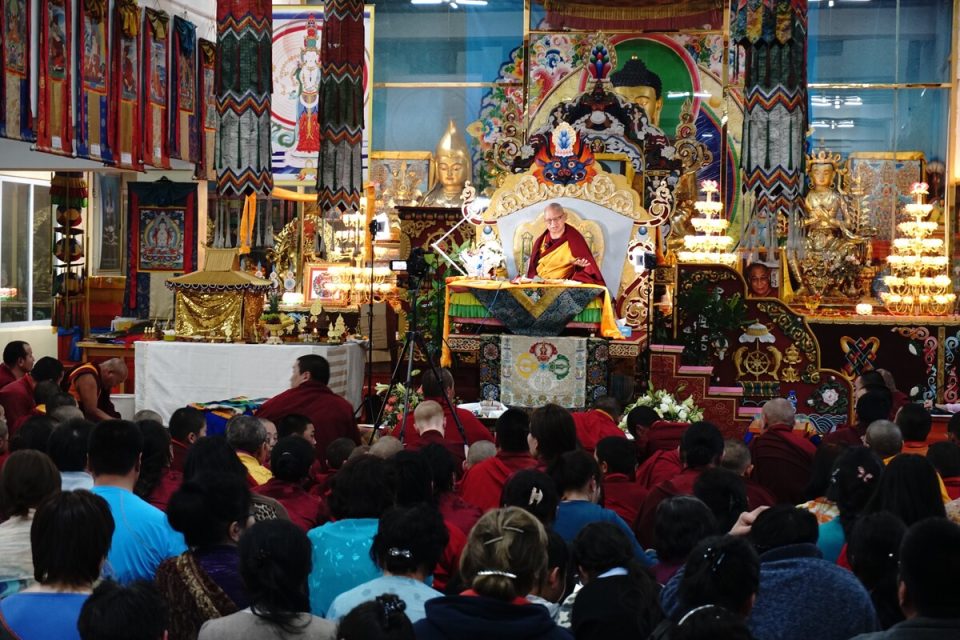
First day of Lama Zopa Rinpoche’s teachings at Idgaa Choizinling Monastery, Mongolia, May 2017. Photo by Ven. Lobsang Sherab.
The Retreat Schedule
This schedule was arranged to accommodate approximately two hundred Mongolian participants, in any one session of a day, who sometimes had to travel very long distances, inspired by the knowledge of the incredible merits of doing the Chenrezig practice. The retreat takes place at the Idgaa Choizinling Dratsang, one of the more modern temples located within the Gandan Tegchenling Monastery complex in central Ulaanbaatar. Lama Zopa Rinpoche, together with FPMT Mongolia, offered financial support for Idgaa Choizinling’s rebuilding, which was completed in 2003, and has continued to support the monks with daily nutritious lunches.
The duration of the retreat is approximately one month, 28 to 30 days. We commence at 8:00 a.m. and conclude at 6:30 p.m. In the first session, we do Lama Chöpa Jorcho, followed by three sessions dedicated to the long Chenrezig sadhana mentioned above.
People are free to come and go according to their time and other life commitments. It is not a residential retreat.
Idgaa Choizinling has a beautiful, spacious gompa, and Rinpoche advised us from the beginning that it’s appropriate to be in the city so that everybody can come. If the retreat is held in the countryside, many people would be excluded because they don’t have transport, and for the elderly, it would be difficult to travel.
Throughout the retreat, we offer a vegetarian breakfast and lunch plus four teas to all participants, FPMT Mongolia staff, and volunteers.
The Food Offering
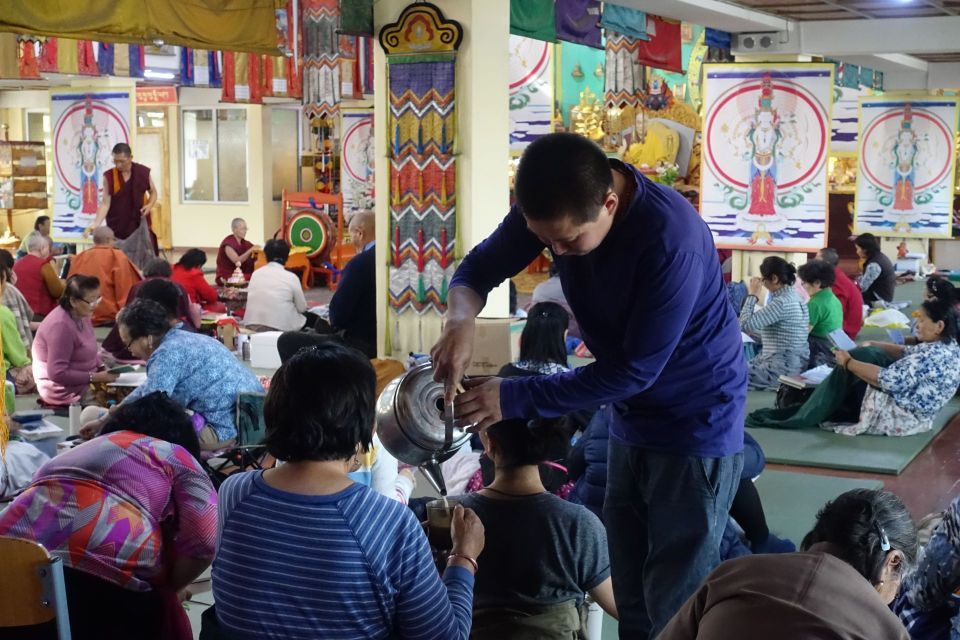
Seventh 100 Million Mani Retreat at Idgaa Choizinling Monastery in Ulaanbaatar, Mongolia, September 2019. Photo by Ianzhina Bartanova.
In Mongolia, people have the tradition of making dedications together with a monetary offering, and during the retreat, our Dedication Desk volunteers are kept fully occupied. Sometimes it can take up to 40-45 minutes to read all the dedications. We also provide the opportunity for people to sponsor the teas and/or food or a whole day if they wish. Somehow, the total donations from this activity miraculously cover the cost of providing nourishment for everyone!
So, it’s a very beautiful way to run the retreat. Like, in the West, I know it’s difficult. You have to pay so much for hiring the venues, and then if you have to feed people, it’s very expensive. But here, in Mongolia, there is no retreat fee, so people can afford to come. It’s a developing country, and the above approach works very well.
It pleased Lama Zopa Rinpoche that we would always offer vegetarian food and drink to the participants, make them comfortable, and have the flexibility that they were welcome to attend for as long as they could.
And the interesting thing is, out of the 13 Mani Retreats we’ve done, there have been only two years that we didn’t reach the goal of 100 million because of the conditions. Every other year, we’ve reached over 100 million Manis. This is amazing!
Mani Retreat: Rinpoche’s Dream
In 2016, for the fourth 100 million Mani Retreat, Lama Zopa Rinpoche shared in a thank-you letter to the center’s director:
“I want to thank from the depths of my heart, from the very inside of my heart bones. Thank you and the others for organizing the mani retreat each year. This is one of my dreams: to have this each year and to continue forever—even after I die, even after the people living now, who are working and offering service, die—to continue as long as Mongolia exists.
“The retreat is like offering infinite skies of help to sentient beings. Each session, even reciting one mala, purifies negative karma, including all the obscurations, created from beginningless rebirths. This is even without doing it with bodhichitta. It collects merit more than the drops of water in the Pacific Ocean, more than the grains of sand in the Pacific Ocean, more than the blades of grass growing in the mountains and on the lands of the earth.
“If one is doing it with bodhichitta—even just reciting OM MANI PADME HUM one time—it collects merit more than the sky. It’s unbelievable, unbelievable, unbelievable. In particular, it causes one to develop compassion for others: for the numberless sentient beings of the six realms—numberless hell beings, numberless hungry ghosts, numberless animals, numberless human beings, numberless suras, numberless asuras—and numberless intermediate state beings.
“Generating compassion is most powerful and is what makes one achieve enlightenment rapidly. Even if you generate compassion for only one sentient being, that is the quickest way to purify all the defilements and accumulate all merits, which are necessary conditions, and to actualize the path to enlightenment.
“The conclusion is that compassion makes it possible to achieve enlightenment—buddhahood, the total cessation of all the obscurations and completion of all the realizations—as quickly as possible. This means being able to free all the six-realm sentient beings from the oceans of samsaric suffering quickly, which means being able to bring the numberless sentient beings to buddhahood quickly. This is the most important achievement, more important than anything else in life. By generating compassion, you are able to achieve this quickly.”
With gratitude to Ven. Thubten Gyalmo for sharing this story, and for her immense effort helping to fulfil this very precious wish from Lama Zopa Rinpoche.
The entire FPMT community has been participating in an unprecedented Global Mani Retreat —an inspiring collective offering of practice, harmony, and dedication to the awakening and benefit of all beings, helping to fulfill Lama Zopa Rinpoche’s Vast Vision of accumulating 100 million Mani mantra recitations worldwide.
The next major teaching of the Global Mani Retreat will be Khandro Tseringma Rinpoche, on Sunday Oct 25, 2026. A truly rare and precious opportunity!
To keep up with all details related to the FPMT Global MANI Retreat, please refer to our webpage, and join the Facebook Group.
Foundation for the Preservation of Mahayana Tradition (FPMT), is a Tibetan Buddhist organization dedicated to the transmission of the Mahayana Buddhist tradition and values worldwide through teaching, meditation and community service.
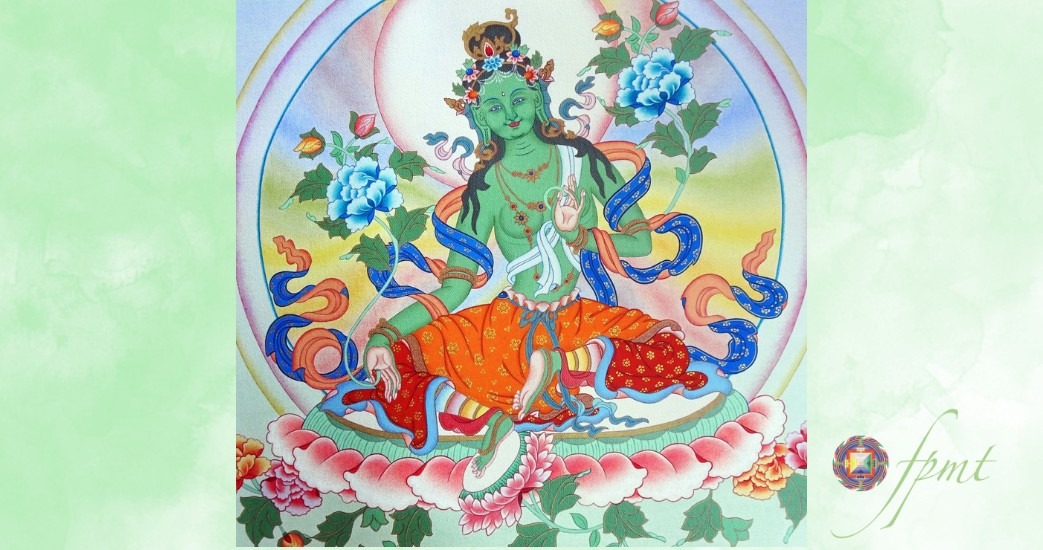
Saka Dawa (May 31, 2026) is one of the most powerful days of the year for creating merit and engaging in practice. The world needs our prayers at this time, and this is a precious opportunity to offer extensive practices and dedicate the merit to all beings.
The actions of all the Buddhas manifest in the aspect of Tara, to grant the wishes of sentient beings, so it is very important for us to pray to Tara — if we pray to her with great sincerity and faith, relying on her completely, she can definitely help eliminate hindrances.
Lama Zopa Rinpoche
With this in our hearts, we have arranged extensive prayers throughout the day on Saka Dawa, including:
- Three recitations of the 100,000 Praises to the Twenty-One Taras – one recitation undertaken by over 4,000 sangha of Sera Je and Sera Mey Monastery
- The recitation of the Guhyasamaja Root Tantra
- 1,000 Offerings to Buddha Namgyalma
- Recitations of Jampal Tshen Jo (Chanting the Names of Manjushri)
- Offerings will be made to all the sangha undertaking these practices and to all of Lama Zopa Rinpoche’s gurus.
- The stupas of Boudhanath and Swayambhunath in Nepal will be freshly painted, and their pinnacle umbrellas replaced and a new set of robes will be offered to the Buddha statue at the Mahabodhi temple in Bodhgaya.
We warmly invite anyone who wishes to share in the merit created by offering any amount toward the pujas:
This is the 31st consecutive year the FPMT Puja Fund has arranged extensive pujas and prayers — offered monthly and on every Buddha Day — on behalf of the entire FPMT organization. Rinpoche expressed his wish that these pujas continue forever, or for as long as the monasteries and nunneries exist.
Rinpoche explained that all the merit created from these pujas is also your merit. While these prayers are taking place on Saka Dawa, you are invited to rejoice, reflect on the practices being done, and dedicate the merits toward your own realizations and the enlightenment of all sentient beings.
This is the “best business,” according to Rinpoche, and the best way to create the most extensive merit.
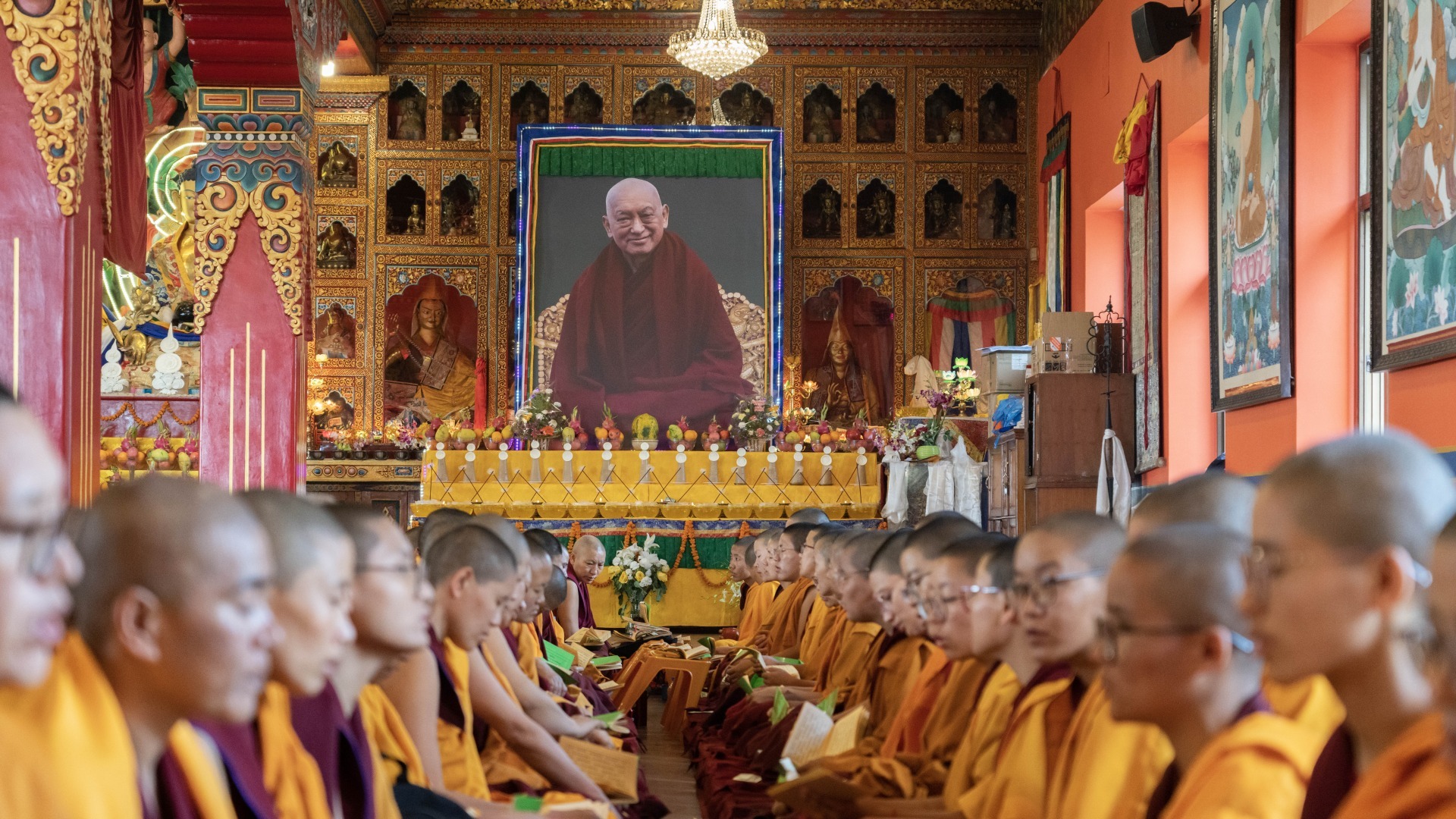
All these prayers are happening on Saka Dawa day and merit created on that day is multiplied 300 million times, as it commemorates Shakyamuni Buddha’s three major life events.
The Puja Fund was established by Lama Zopa Rinpoche to provide resources for continuous pujas dedicated to the long life of His Holiness the Dalai Lama and to the success of all the FPMT centers, projects, services, students, benefactors and those serving the organization in any way. You can learn more about the Puja Fund, or FPMT’s other extensive charitable activity.
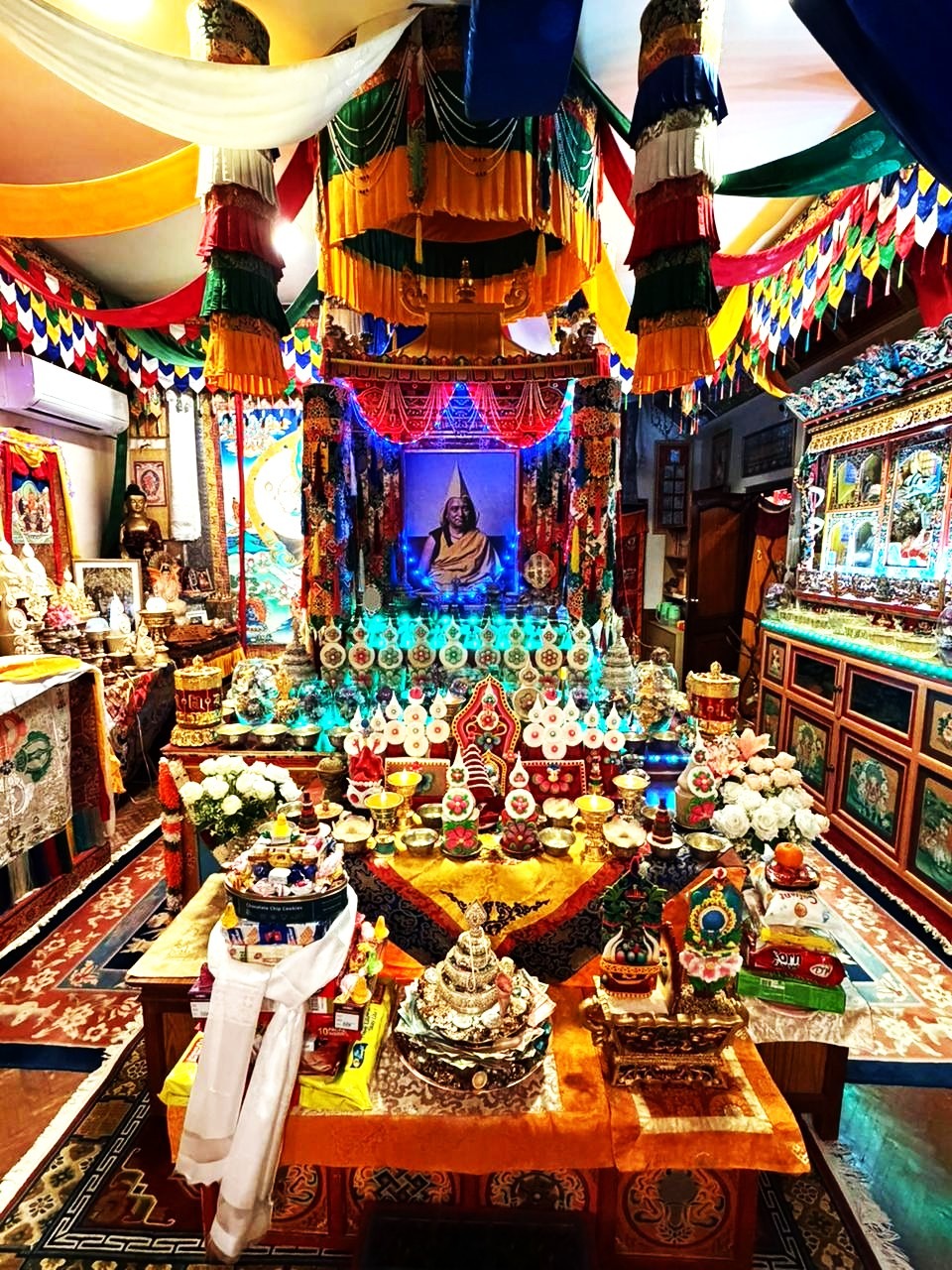
Losar offerings in Lama Zopa Rinpoche’s room, Kopan Monastery. Photo Ven.Sangpo Sherpa
During these Fifteen Days of Miracles (February 18-March 3), any merit created is magnified 100 million times. On behalf of the entire organization, the FPMT Puja Fund has arranged and sponsored a vast number of pujas and prayers, including the recitation of the entire Kangyur, Guhyasamaja Root Tantra, Ksitigharba Sutra, the One Thousand Set of Offerings to Namgyalma practice, Migtrupa puja, and Extensive Medicine Buddha puja.
In addition, a new set of robes will be offered to the Buddha statue in the Mahabodhi temple in Bodhgaya. The stupas of Boudhanath and Swambyunath in Nepal will be freshly painted, and new umbrellas will be offered to the pinnacles.
The 4,000 monks of Sera Lachi will receive an offering of tea and bread and 100 INR on behalf of FPMT, during one of the days of their Monlam.
Each puja is being offered by ordained Sangha, who are all disciples of His Holiness the Dalai Lama, with strong motivation and dedication for the entire FPMT organization and for the swift return of our most precious and kind Lama Zopa Rinpoche.
Recitation of the Kangyur
The nuns of Khachoe Ghakyil Ling Nunnery are kindly reciting the entire Kangyur over two days. The Kangyur is more than one hundred volumes of the direct teachings of Shakyamuni Buddha. Please take a moment to listen to their recitations.
Lama Zopa Rinpoche has explained the unbelievable merits in making it possible to read these holy scriptures by the Sangha members. The benefits, explained in The Condensed Jewel Quality explain that the merit created by reading the Kangyur are infinitely greater than – building a stupa of the sorrowless state, making the stupa from the seven jewels, making as many stupas as to fill many thousands of ten million worlds equaling the number of sand grains in the River Ganges, and infinite sentient being making offerings to these stupas three times a day for eons.
Rinpoche also explained how important it is to have the Kangyur recited at the beginning of every year for the success of the FPMT organization, all the students, volunteers, and benefactors, to create merit for the upcoming year, and so the organization can be of most benefit to all beings.
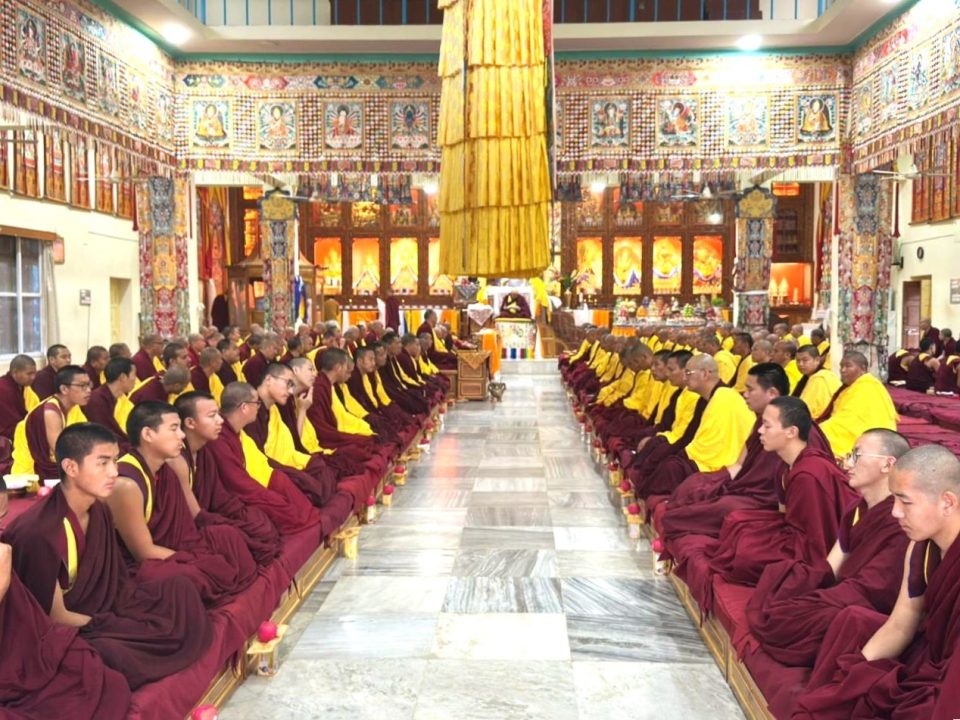
Gyudmed monks reciting Guhyasamaja root text.
Guhyasamaja Root Tantra Recitation
The tantric monks of Gyudmed Tantric Monastery recited the most precious Guhyasamaja Root Tantra.
The Guhyasamaja tantra is praised in Oral Teachings of Manjushri where it says that the presence of the very heart of the doctrine depends upon this tantra being in existence: At the time its meaning enters the ears, at that place the precious doctrine of the Buddha is said to abide there also. When its transmission is cut, the doctrine of the Buddha will cease.
It is so important to have this root tantra recited; we hope you will enjoy hearing a few moments of it:
Extensive Medicine Buddha Puja
At Gaden Jangtse Monastic College, South India, many of the Sangha will offer the Extensive Medicine Buddha puja and Druk Chuma in Lhamo Khang.
Lama Zopa Rinpoche has explained that the Medicine Buddha encompasses all the buddhas. This means that when we practice the seven-limb prayer and make offerings with the seven limbs, we receive the same merit as we would if we had made offerings to all the buddhas. Similarly, when we recite the mantra of Medicine Buddha, we collect unbelievable merit just as when we offer the seven-limb practice to Medicine Buddha. Please take a moment to rejoice in the puja and listen to their prayers.
One Thousand Sets of Offerings to Namgyalma
At Gyuto Monastery, Dharamsala, India, the Sangha are offering One Thousand sets of offerings to Namgyalma and Drugchuma – the Offering of Sixty-Four Parts
Namgyalma is a deity for long life and purification. The mantra has infinite benefits; it is so powerful. It is said that for anyone who hears this mantra, this will be the last time that person is born in the womb. If animals hear it, they will not be reborn in the lower realms.
Please enjoy this video of the puja and the amazing extensive offerings:
Ksitigharba Sutra Recitation
Khachoe Ghakyil Ling Nunnery also recited the Ksitigharba Sutra.
Rinpoche advised that prayers to Ksitigharba are much more powerful than those made to other bodhisattvas, “This dharani mantra is the best one to do for any problems in any situation. Even reciting four or five times, just a few times, is very powerful. [The sutra] talks about so much power, how important the bodhisattva is; even reciting or just thinking of the name of the bodhisattva is very, very powerful.”
This recitation, following the advice of Lama Zopa Rinpoche, is done monthly and is specifically dedicated “to avert harm from the elements (fire, water, wind, and earth) such as tornados, hurricanes, heavy rain, storms, floods, earthquakes, fires; as well as disasters that destroy crops; disasters that destroy entire towns and cities within one hour; disasters that cause so many billions of dollars of damage and so much money has to be spent to rebuild the towns; disasters where so many hundreds and thousands of people die or lose their homes, have no food or clean water; disasters where so many animals and insects are killed and harmed.”
Migtrugpa Puja
Migtrugpa puja will also be offered by some Sangha in Gaden Monastery. Migtrugpa is very powerful in degenerate times in purifying negative karma, particularly the negative karma of having broken vows, such as the eight Mahayana precepts, lay vows, or the vows of nuns and monks.
The Precious Lamp: A Ritual of Making Offerings to and Purifying the Remains of a Special Being
Senior Lama Gyupa monks offer a special puja in front of the holy body relic of Kyabje Lama Zopa Rinpoche. The practice is based on Solitary Hero Yamantaka and The Precious Lamp: A Ritual of Making Offerings to and Purifying the Remains of a Special Being, based on Bhagavän Vajrasattva. This puja has been happening every single morning for nearly three years.
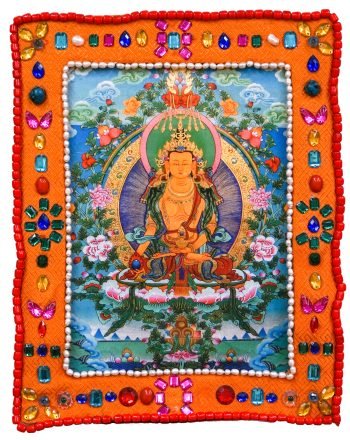
Lama Zopa Rinpoche’s Ksitigarbha image that he carried with him everywhere.
Rejoice and Remember
The merit that is created from all these pujas is also your merit. So, you can dedicate all these merits to having realizations and to achieving enlightenment
During each puja mentioned above, FPMT is making a small money offering to each of the kind Sangha offering the prayers, as well as tea and breakfast. Rinpoche has said that there is nothing compared to making offerings to the Sangha of these monasteries, because they are all disciples of His Holiness the Dalai Lama and other gurus. Offering tea to one disciple is better than making an offering to all the Buddhas.
Rinpoche has said that even just by remembering that these pujas are happening, rejoicing in the activities, and dedicating the merits—This is the best business and the best way to create the most extensive merit, and these pujas are dedicated for anybody who needs these prayers.
All of these prayers are dedicated for the health and long life of His Holiness the Dalai Lama, the swift return of our incomparably kind Lama Zopa Rinpoche; the entire FPMT organization; all those working in FPMT, the kind supporters, all the benefactors, donors of the puja fund, volunteers; anybody who needs these prayers; anyone who is experiencing any kind of obstacles or difficulties; and for peace in the world—for all of the wars, famine, disease, economic problems, torture, the dangers of fire, water, air, earthquakes and tsunamis to be pacified immediately, to pacify all the problems in the world; and for perfect peace and happiness to prevail in our hearts and in the hearts of all sentient beings of this world.
Lama Zopa Rinpoche established the Puja Fund to provide resources for continuous pujas dedicated to the long life of His Holiness the Dalai Lama and to the success of all the FPMT centers, projects, services, students, benefactors and those serving the organization in any way. You can learn more about the Puja Fund, or FPMT’s other extensive charitable activity.
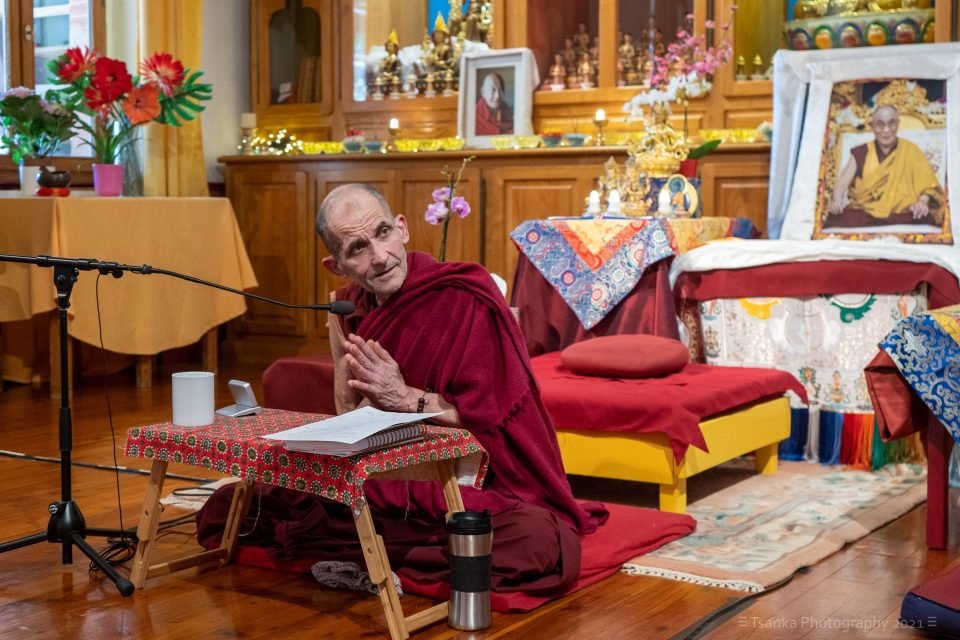
Since 2011, Ven. Charles has led 14 sets of Institut Vajra Yogini’s annual 108 Nyungne retreat. Next set of 108 Nyungne is set to start on November 11.
Institut Vajra Yogini (IVY) in France will soon start a new series of Nyung Na retreats (November 11, 2025 – June 15, 2026). It hosted its fourteenth series of 108 Nyung Na retreats from November 2024 to June 2025!
One of Lama Zopa Rinpoche’s Vast Visions for the FPMT organization was to sponsor people who make a serious commitment in this life to complete 1,000 Nyung Na retreats, and IVY kindly began to host the retreats every year to help fulfil this vision. For the last fourteen years, Lama Zopa Rinpoche has been sponsoring the food and accommodation for a number of people, who undertake the 108 Nyung Na retreats, and in 2025, US$16,347 was offered toward the retreat. In addition, IVY offered financial support to some of the part-time participants. The FPMT Practice and Retreat Fund and IVY are very happy to continue to offer support each year toward the retreats, in alignment with Rinpoche’s wishes and make retreats possible.
The Nyung Na retreat is a two-day intensive practice that includes taking the 24-hour Mahayana precepts every day, with the addition of complete fasting and silence every second day. There are three sessions of about three hours each day, including meditation, prostrations, and mantra recitation. It is a powerful, effective, experiential practice that can be done by anyone with respect and faith for the practice. Lama Zopa Rinpoche has highly praised Nyung Na retreat as a supreme method for transforming the mind.
Three people completed the full round of 108 retreats this year and a lot of other people joined to do one or a few two-day retreats or even do single sessions. Last year, Ven. Charles, the retreat leader, offered the morning sessions online every day, as well as one complete two-day retreat online once a month. In this way more students could participate from home. Please take a moment to rejoice!
The number of participants can vary from only six participants to sometimes twenty people joining the retreat. The long-term participants enjoy doing this practice in a bigger group as these retreats can be more powerful when more people participate. Retreat leader Ven. Charles, who has completed thousands of Nyung Nas, is very inspiring for beginners and advanced students as well. Additionally, resident teacher Geshe Loden is always willing to give advice, and the group benefits from the inspiration and advice from high realized lamas who visit the Institute.
To continue fulfilling Rinpoche’s Vast Visions, Institut Vajra Yogini has already begun planning for the fifteenth series of 108 Nyung Na retreats, which will start on November 11, 2025, and will finish June 15, 2026. The retreats are led most of the time in French and sometimes in English, but can be followed simultaneously in other languages. Ven. Charles will lead the Nyung Nas despite health issues, but a team of experienced practitioners will be assisting and leading sessions if Ven. Charles needs rest.
Please join us in rejoicing in fourteen consecutive years of Nyung Na retreats at Institut Vajra Yogini and feel very welcome to engage residentially or online in the upcoming retreat. You can also reach out to IVY directly for information on upcoming studies, retreats, and volunteer-study programs.
If you would like to support Lama Zopa Rinpoche’s wish to support these important retreats, you are welcome to offer any amount to the Practice and Retreats Fund
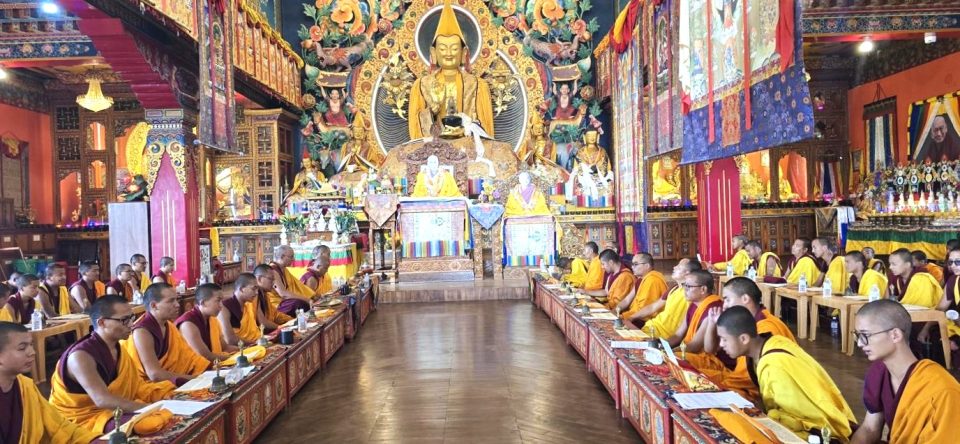
Kopan monks in puja, June 10, 2025. Photo by Kopan Monastery.
Boudhanath Stupa.
During the twenty-four hours of Saka Dawa (June 11, 2025), which commemorates Shakyamuni Buddha’s birth, enlightenment, and parinirvana, and when karmic results are multiplied by 300 million times as it commemorates Shakyamuni Buddha’s three major life events, The FPMT Puja Fund sponsored a number of pujas and prayers on behalf of the entire FPMT organization.
These auspicious activities included: 100,000 recitations of the Praises to the Twenty-one Taras which was recited twice at two nunneries; the recitation of the Guhyasamaja Root Tantra; 1,000 set of offerings to Buddha Namgyalma; and Extensive Medicine Buddha Puja. Additionally, the stupas of Boudhanath and Swambyunath in Nepal were freshly painted and the umbrellas at the pinnacle of each stupa was replaced; and a new set of robes was offered to the Buddha statue in the Mahabodhi temple in Bodhgaya. Animals were liberated, sutras recited and printed; and offerings were made to all of Kyabje Lama Zopa Rinpoche’s gurus and to all the IMI Sangha communities in FPMT.
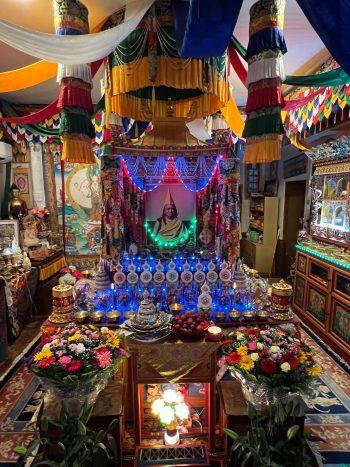
Altar in Lama Zopa Rinpoche’s room at Kopan Monastery in front of the holy body relic on Saka Dawa.
We are so happy to share with you a few videos of the different pujas and the Sangha undertaking these prayers. Each puja was offered by ordained Sangha, who are all disciples of His Holiness the Dalai Lama, with strong motivation and dedications for the entire FPMT family including every center and activity, all the students, volunteers, and kind benefactors; for the swift return of our most precious and kind Lama Zopa Rinpoche; for obstacles to be removed; for the long life and health of His Holiness the Dalai Lama and all the gurus and teachers who are benefiting sentient beings.
Every practice offered starts with bodhichitta motivation and concludes with bodhichitta dedication. When you generate bodhichitta, it is for everyone. There is no partisanship where you do it for some sentient beings, but not others. It is for everyone.
Twenty-Four Hours of Merit
In Kyabje Lama Zopa Rinpoche’s room at Kopan Monastery, in front of Rinpoche’s holy Kudung (holy body relic), the senior monks and Lama Gyupas offered the morning puja. This puja is performed on the basis of Solitary Hero Yamantaka and The Precious Lamp: A Ritual of Making Offerings to and Purifying the Remains of a Special Being [Kyabje Zopa Rinpoche] based on Bhagavän Vajrasattva. This puja has been happening every single morning for over two years. This is a brief video of the practice offered on Saka Dawa:
During the day at Kopan Monastery the monks offered extensive Medicine Buddha Puja, please watch a short video:
Kyabje Lama Zopa Rinpoche chose this puja to be offered every Saka Dawa because Medicine Buddha practice is very powerful to overcome problems and to have success. Rinpoche explained: “If you pray to Guru Medicine Buddha, you will quickly accomplish all that you wish. Just hearing the holy name of Guru Medicine Buddha and the sound of his mantra closes the door to rebirth in the suffering lower realms. It is written in the scriptures that you should not have a two-pointed mind (doubt) with regard to these benefits. …”
The five thousand monks of Sera Je Monastery and Sera Mey Monastery joined together and offered 1,000 sets of offerings to Buddha Namgyalma. Please enjoy the video:
Lama Zopa Rinpoche explained the incredible benefits: “Namgyalma is a deity for long life and purification. The mantra has infinite benefits; it is so powerful. It is said that for anyone who hears this mantra, this will be the last time that person is born in the womb. If animals hear it, they will not be reborn in the lower realms.” You can read more of the benefits and hear Rinpoche reciting this precious mantra.
At Kopan’s nunnery Khachoe Gyakyil Ling Nunnery, the nuns offered 100,000 Praises to the Twenty-One Taras. Please watch this short video:
Rinpoche explained that the benefits of practicing Tara are uncountable. By reciting the Praises to the Twenty-One Taras with devotion, at dawn or dusk, and remembering Tara and reciting her mantra at any time of the day or night, we are protected from fear and danger, and all our wishes are fulfilled. If we pray to Tara, Tara will grant help quickly.
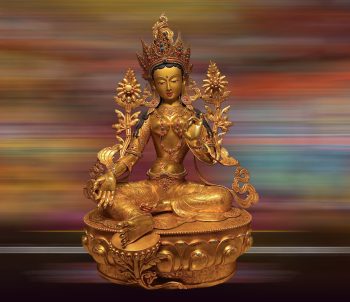
Tara statue offered to Rangjung Neljorma Khandro Tseringma.
She is especially quick in granting us success in obtaining the ultimate happiness of enlightenment, but there are also many temporal benefits of reciting the Tara mantra or the Praises to the Twenty-One Taras prayer. Tara can solve many problems in life: liberating us from untimely death, helping us recover from disease, bringing us success in business. Somebody with a serious problem, such as a life-threatening disease, who relies on Tara will very commonly be freed from that problem.
Rinpoche also has said, “The best way we can become close to Tara, what pleases her the most, is when we fervently try to develop the mind of bodhichitta. The more we are able to practice bodhichitta and cherish others more than ourselves, the closer we will be to Tara, and the easier it will be for her to offer us help quickly.”
The monks who are all students at Gaden Jangtse School offered the whole day of Saka Dawa reciting Migtsema and Jampal Tsenjoe for Lama Zopa Rinpoche’s swift return according to His Holiness Dalai Lamas guidance. FPMT’s Social Service Fund has been supporting this school for the last three years and we were extremely touched by their offering of prayers. Please watch this short video:
Rejoice and Remember
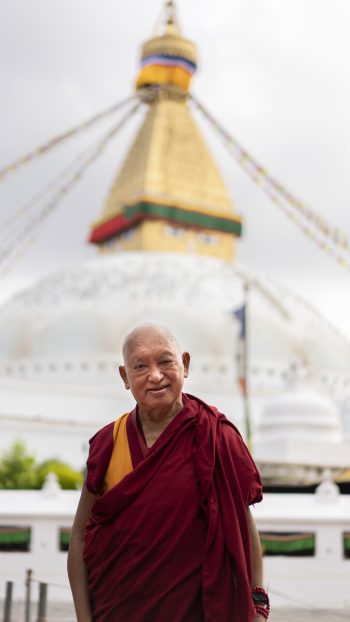
Lama Zopa Rinpoche at Boudhanath Stupa, 2020.
During each puja mentioned above, FPMT is making a small money offering to each of the kind Sangha offering the prayers, as well as tea and bread. Rinpoche has said that there is nothing compared to making offerings to the Sangha of these monasteries, because they are all disciples of His Holiness the Dalai Lama. Offering tea to one disciple is better than making an offering to all the Buddhas.
Rinpoche has said that even just by remembering that these pujas happened, rejoicing in the activities, and dedicating the merits—This is the best business and the best way to create the most extensive merit and these pujas are dedicated for anybody who needs these prayers, and the merit that is created from all these prayers is also your merit, so you can dedicate to having realizations yourself and achieving enlightenment.
This is the thirtieth consecutive year that we have arranged these pujas on each of the four holy Buddha multiplying days, following the advice of our most kind Lama Zopa Rinpoche, who explained how important these continual prayers are for the success of the organization. We sincerely thank all the kind donors who enabled us to arrange these pujas and also everyone who rejoiced in the practices. Thank you.
The whole FPMT mandala, including every center, was engaged in prayers and virtuous practices on Saka Dawa, It was such an incredible day to join in the collective prayers and to rejoice in how much merit was being created.
May all of these powerful prayers be the cause of Lama Zopa Rinpoche’s swift return, for peace and harmony within the FPMT organization; for all obstacles to be removed; for the activities to be successful and of most benefit to all beings; for the long life of His Holiness the Dalai Lama and all of our teachers; and for the success and benefit of all the FPMT Dharma activities around the world.
The Puja Fund was established by Lama Zopa Rinpoche to provide resources for continuous pujas dedicated to the long life of His Holiness the Dalai Lama and to the success of all the FPMT centers, projects, services, students, benefactors and those serving the organization in any way. You can learn more about the Puja Fund, or FPMT’s other extensive charitable activity.
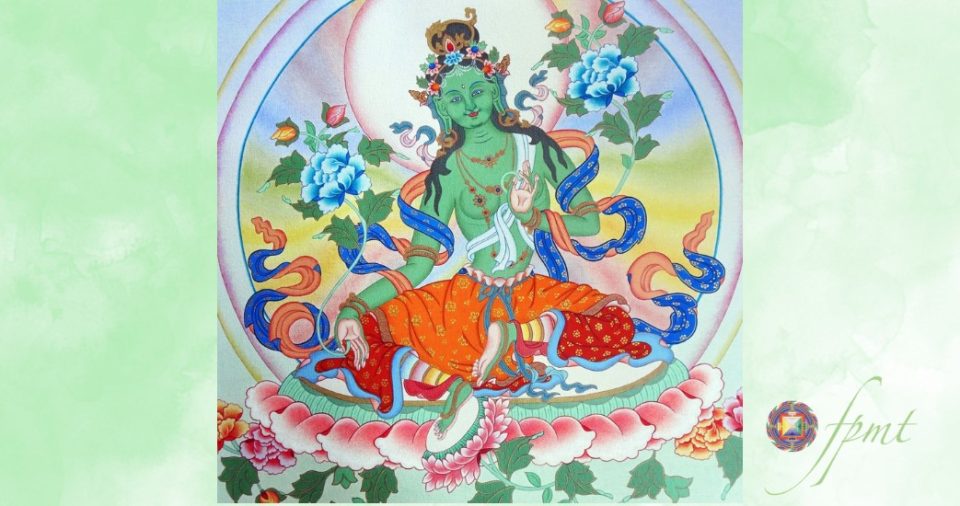
- Two recitations of the 100,000 Praises to the Twenty-One Taras by two nunneries
- The recitation of the Guhyasamaja Root Tantra
- 1000 Offerings to Buddha Namgyalma and Medicine Buddha Puja
- Recitations of Jampal Tshen Jo (Chanting the Names of Manjushri)
- Offerings will be made to all the sangha undertaking these practices and to all of Lama Zopa Rinpoche’s gurus.
- The stupas of Boudhanath and Swambyunath in Nepal will be freshly painted, and the umbrellas at the pinnacle of each stupa will be replaced and a new set of robes will be offered to the Buddha statue in the Mahabodhi temple in Bodhgaya.
We would like to invite anyone who feels inspired, to join in this day of merit and extensive prayers by offering any amount.
This is the thirtieth year that FPMT Puja Fund has been arranging extensive pujas and prayers on behalf of the entire FPMT organization – offered monthly and on every Buddha Day, including Saka Dawa.
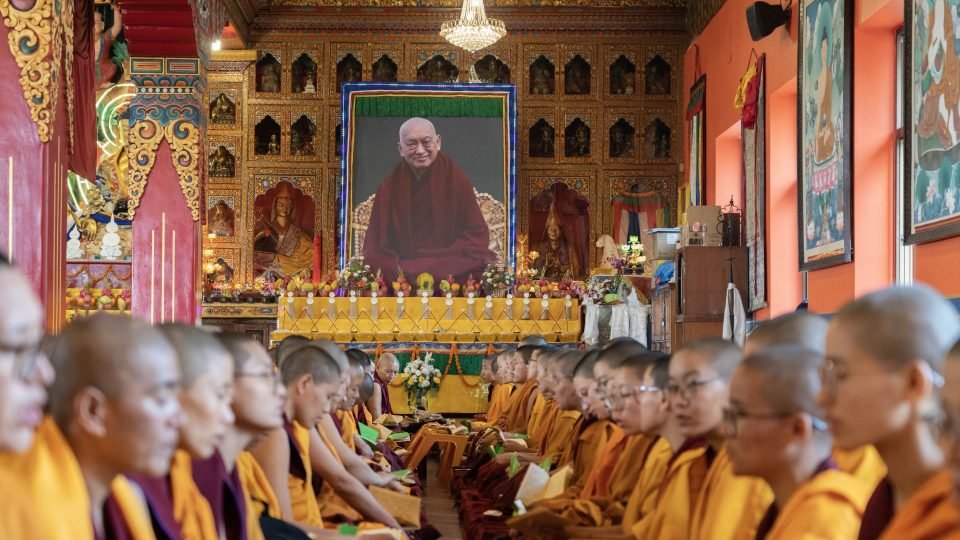
Nuns offering Cittamani Tara Puja, Kopan Monastery, April 2023. Photo by Ven. Lobsang Sherab.
Lama Zopa Rinpoche explained that these offerings and pujas are to continue forever, or for as long as the monasteries exist. By making an offering towards the pujas, you can also consciously rejoice on the actual day, reflect on the practices being done, and dedicate the merits. As Rinpoche said: “This is the best business – the best way to create the most extensive merit.”
All the merit created from all these pujas is also your merit. Everyone can rejoice in the practices undertaken, and dedicate the merits created toward your own realizations and enlightenment for all sentient beings.
All the Sangha undertaking these prayers are dedicating them to the swift return of our most precious guru, Kyabje Lama Zopa Rinpoche; for the overall success of the entire FPMT organization; for all the kind donors, students, and volunteers; and especially for the supporters of the FPMT Puja Fund.
*All of these prayers are happening on Saka Dawa day and merit created on that day is multiplied 300 million times, as it commemorates Shakyamuni Buddha’s three major life events.
The Puja Fund was established by Lama Zopa Rinpoche to provide resources for continuous pujas dedicated to the long life of His Holiness the Dalai Lama and to the success of all the FPMT centers, projects, services, students, benefactors and those serving the organization in any way. You can learn more about the Puja Fund, or FPMT’s other extensive charitable activity.
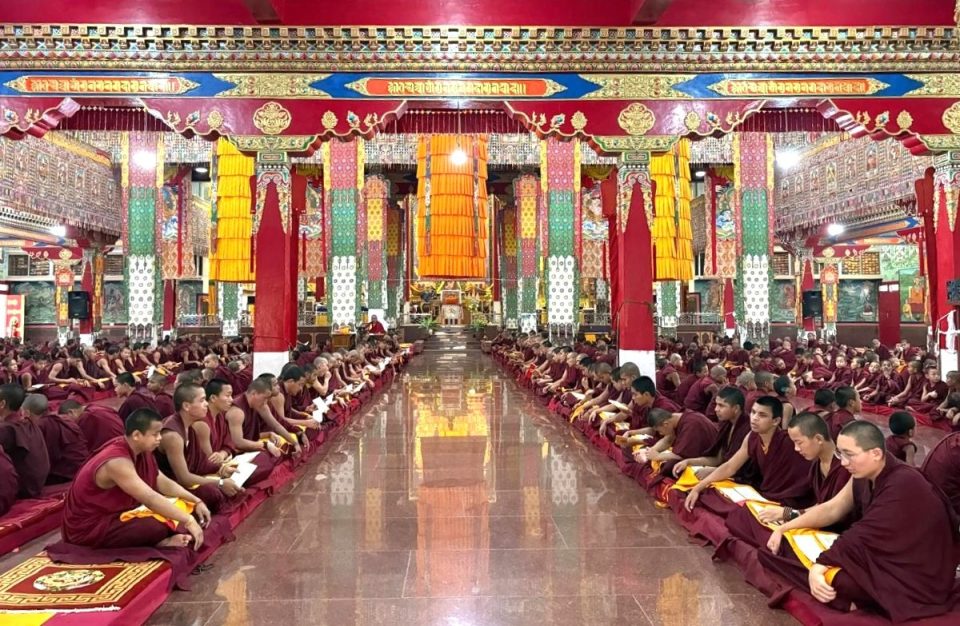
The monks of Sera Mey Monastery offering Extensive Medicine Buddha puja being during Losar on behalf of the FPMT organization.
During the Fifteen Days of Miracles (February 28-March 14), when any merit created is multiplied 100 million times, the FPMT Puja Fund has been sponsoring a number of pujas and prayers, including the recitation of the entire Kangyur, Guhyasamaja Root Tantra, 1,000 set of offerings to Namgyalma, and Extensive Medicine Buddha Puja.
We are so happy to share with you a few videos of the different powerful pujas that have been occurring. Each puja is being offered by ordained Sangha, who are all disciples of His Holiness the Dalai Lama, with strong motivation and dedications for the entire FPMT organization— for the swift return of our most precious and kind Lama Zopa Rinpoche; for harmony among students and for obstacles to be removed; and for the long life and health of all the gurus and teachers who are benefiting sentient beings.
At Gaden Jangtse Monastic College, South India, the Sangha offered Medicine Buddha puja and Druk Chuma. Please watch a short video.
Lama Zopa Rinpoche has explained that, “The Medicine Buddha encompasses all the buddhas. This means that when we practice the seven-limb prayer and make offerings with the seven limbs, we receive the same merit as we would if we had made offerings to all the buddhas. Similarly, when we recite the mantra of Medicine Buddha, we collect unbelievable merit, just as when we offer the seven-limb practice to Medicine Buddha.”
At Gyuto Monastery, Dharamsala, India, the Sangha offered 1,000 sets of offerings to Namgyalma and Druk Chuma. Please enjoy this short video.
Rinpoche offered a beautiful visualization for the Namgyalma practice: “Visualize His Holiness the Dalai Lama and all the gurus. Beneath them are the Sangha, who help to preserve and spread the Dharma. On the moon disc are all sentient beings.” Read the full visualization.
The Sangha at Sera Mey Monastery offered Extensive Medicine Buddha Puja. Please watch this short video.
Lama Zopa Rinpoche explained that, “The seven Medicine Buddhas, attainers of bliss, strongly prayed for the temporal and ultimate happiness of yourself and all sentient beings. They vowed that their prayers would be actualized during these degenerate times when the teachings of Shakyamuni Buddha are in decline. As the buddhas’ holy speech is irrevocable, you can wholly trust in their power to quickly grant blessings to help all sentient beings in these degenerate times.”
Khachoe Ghakyil Ling Nunnery recited the entire Kangyur over two days. Please watch a short video of day one:
Lama Zopa Rinpoche has explained the unbelievable merits in making it possible to read these holy scriptures by the Sangha members. The benefits are explained in The Condensed Jewel Quality:
“The merit created by reading, writing, keeping, making offering to, and paying respect to the Mother Prajnaparamita and Kangyur, taught by Buddha, who possesses the Ten Powers, the benefits are infinitely greater than: building a stupa of the sorrowless state, making the stupa from the seven jewels, making as many stupas as to fill many thousands of ten million worlds equaling the number of sand grains in the River Ganges, and infinite sentient being making offerings to these stupas three times a day for eons.”
Rinpoche also explained how important it is to have the Kangyur recited at the beginning of every year for the success of the FPMT organization and to create merit so the organization can be of most benefit to all beings.
The merit that is created from all these pujas is also your merit. So, you can dedicate all these merits to having realizations and to achieving enlightenment
Khachoe Ghakyil Ling Nunnery also recited the Ksitigharba Sutra. Please watch a short video.
Rinpoche often advised that prayers to Ksitigarbha are much more powerful than those made to other bodhisattvas, “This dharani mantra is the best one to do for any problems in any situation. Even reciting four or five times, just a few times, is very powerful. [The sutra] talks about so much power, how important the bodhisattva is; even reciting or just thinking of the name of the bodhisattva is very, very powerful.”
This recitation, following the advise of Lama Zopa Rinpoche, is specifically dedicated “to avert harm from the elements (fire, water, wind, and earth) such as tornados, hurricanes, heavy rain, storms, floods, earthquakes, fires; as well as disasters that destroy crops; disasters that destroy entire towns and cities within one hour; disasters that cause so many billions of dollars of damage and so much money has to be spent to rebuild the towns; disasters where so many hundreds and thousands of people die or lose their homes, have no food or clean water; disasters where so many animals and insects are killed and harmed.”
Rejoice and Remember
During each puja mentioned above, FPMT is making a small money offering to each of the kind Sangha offering the prayers, as well as tea and breakfast. Rinpoche has said that there is nothing compared to making offerings to the Sangha of these monasteries, because they are all disciples of His Holiness the Dalai Lama and other gurus. Offering tea to one disciple is better than making an offering to all the Buddhas.
Rinpoche has said that even just by remembering that these pujas are happening, rejoicing in the activities, and dedicating the merits—This is the best business and the best way to create the most extensive merit and these pujas are dedicated for anybody who needs these prayers, and the merit that is created from all these prayers is also your merit, so you can dedicate to having realizations yourself and achieving enlightenment.
This is the thirtieth consecutive year that we have arranged these pujas on each of the four holy Buddha multiplying days, following the advice of our most kind Lama Zopa Rinpoche, who explained how important these continual prayers are for the success of the organization.
May all of these powerful prayers be the cause of Lama Zopa Rinpoche’s swift return, for peace and harmony within the FPMT organization and for obstacles to be removed, for the long life of all of our teachers, and for the success and benefit of all the FPMT Dharma activities around the world, long into the future.
The Puja Fund was established by Lama Zopa Rinpoche to provide resources for continuous pujas dedicated to the long life of His Holiness the Dalai Lama and to the success of all the FPMT centers, projects, services, students, benefactors and those serving the organization in any way. You can learn more about the Puja Fund, or FPMT’s other extensive charitable activity.
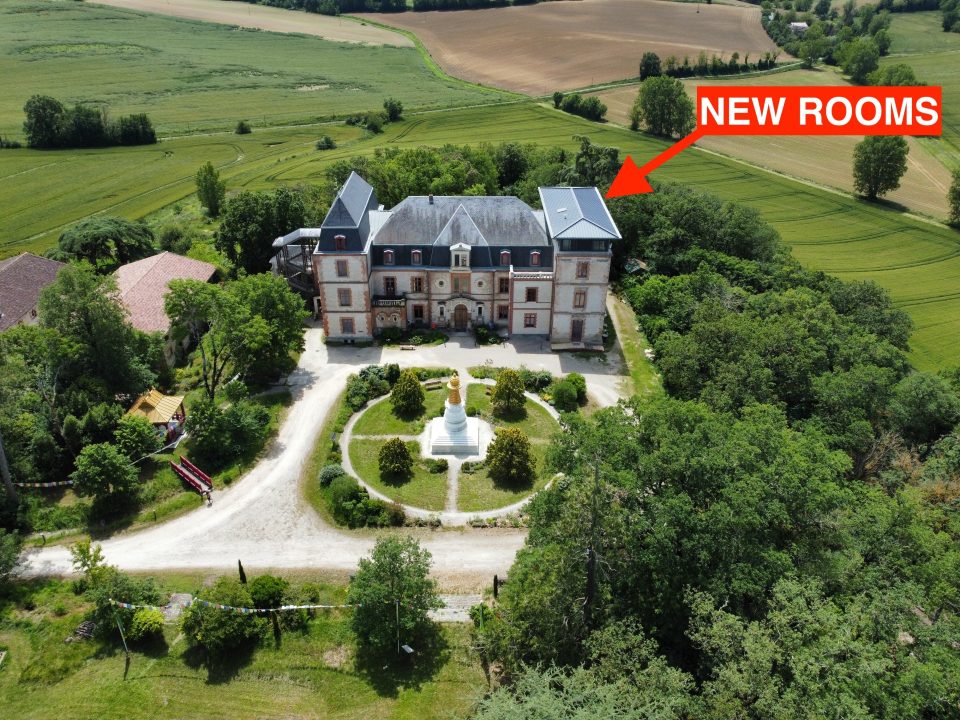
Aerial view of the new long retreat rooms at IVY.
In January 2025, Institut Vajra Yogini (IVY), France, will host its 39th Annual Vajrayogini Retreat, guided this year by Jhampa Shaneman. This retreat, open to all who have received the Vajrayogini initiation, marks a special moment in fulfilling Lama Zopa Rinpoche’s wishes.
in 2019 Lama Zopa Rinpoche expressed his vision for more people to engage in the three-year Vajrayogini retreat. IVY then brought up their wish to create retreat rooms in which people could do this long retreat, up to three years. Rinpoche immediately pledged US$120,000 to help them complete this project. Due to the kindness of a benefactor, half of this was raised in 2020 and Lama Zopa Rinpoche personally offered the rest of the pledge through the Lama Zopa Rinpoche Bodhichitta Fund the following year.
These four individual long-term retreat rooms—each equipped with a private bathroom, individually-controlled air conditioning, and space for study and practice—are designed to provide ideal conditions for practitioners undertaking extended three-year Vajrayogini retreats.
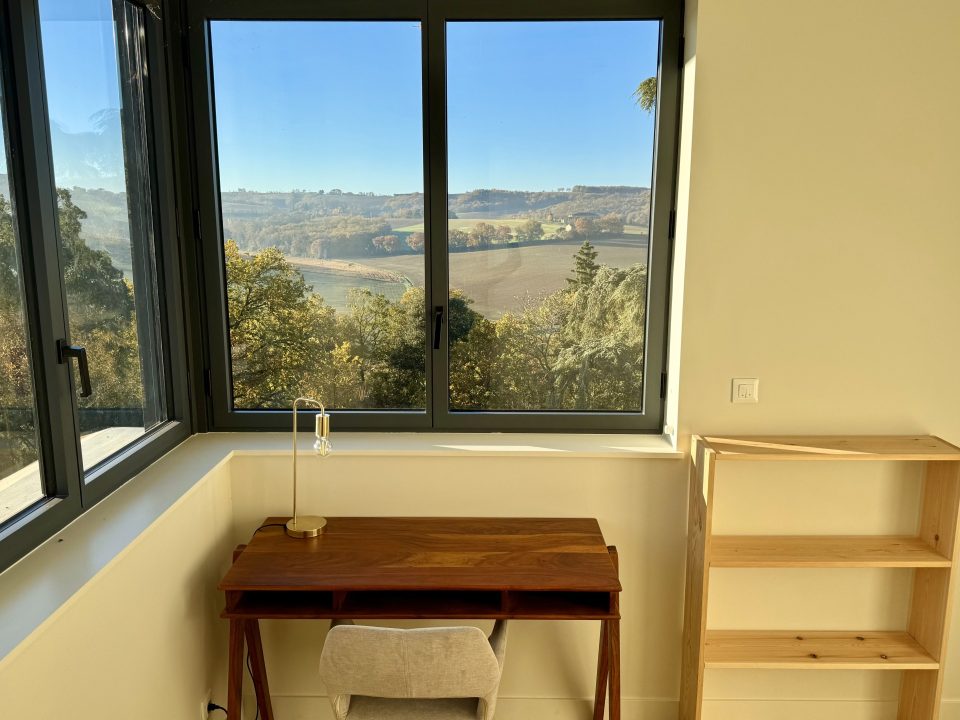
View from one of the new long retreat rooms at IVY.

View of a new long retreat room at IVY.
IVY shares, “As we welcome the energy of retreatants this January, we rejoice in the manifestation of Rinpoche’s wishes and the opportunity to dedicate these rooms to practitioners embarking on deep and transformative retreats.
“We celebrate this milestone as a profound moment for the entire FPMT community! We offer heartfelt gratitude to Lama Zopa Rinpoche for his guidance, generosity, and dedication, which continue to inspire and support practitioners at Institut Vajra Yogini and worldwide.”
To inquire about long-term Vajrayogini retreats at IVY, or to register for the January Vajrayogini Retreat, please visit their website.
With grateful thanks to IVY President Julia Lefebvre for providing details for this report.
Foundation for the Preservation of Mahayana Tradition (FPMT), is a Tibetan Buddhist organization dedicated to the transmission of the Mahayana Buddhist tradition and values worldwide through teaching, meditation and community service.
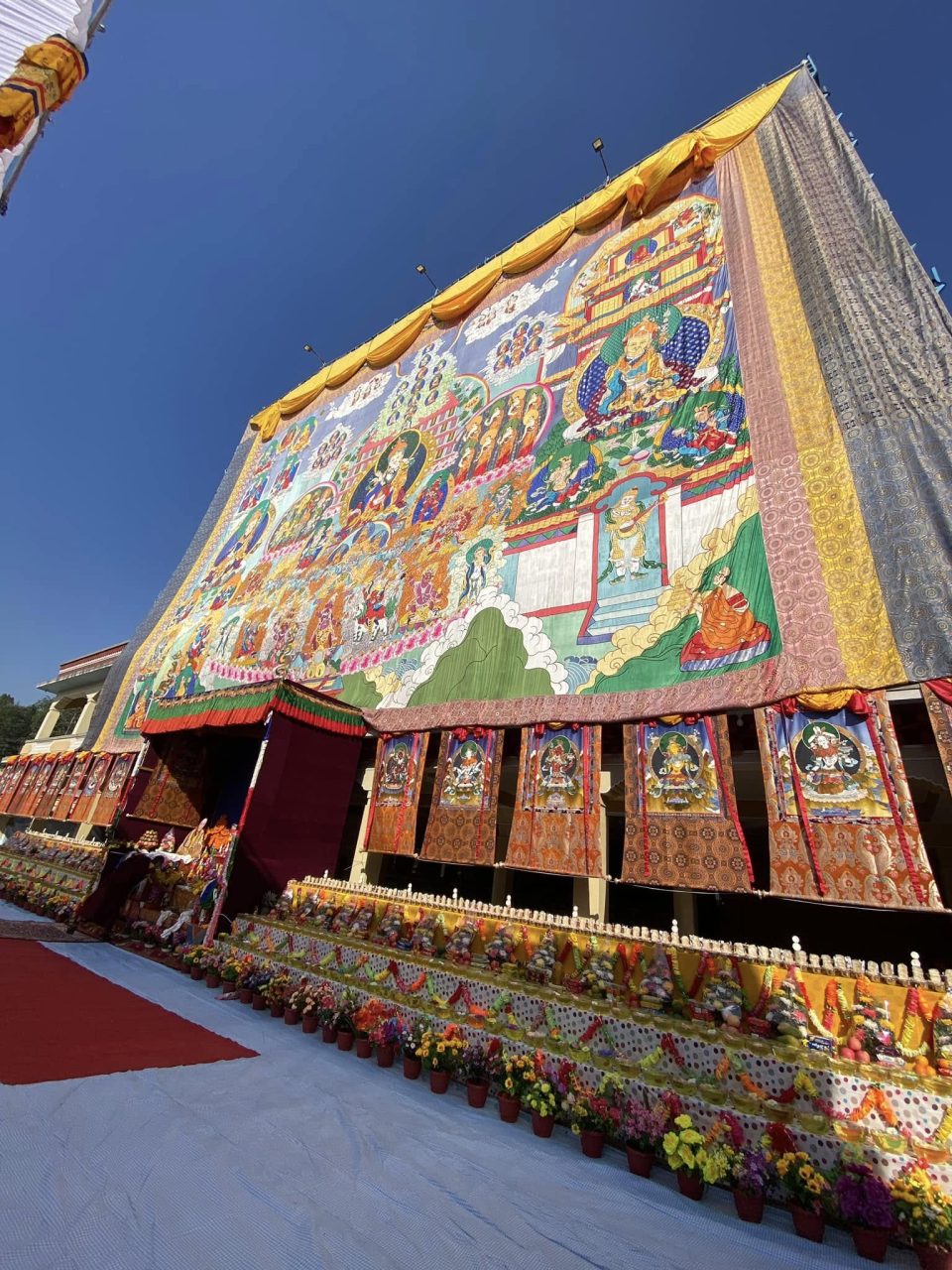
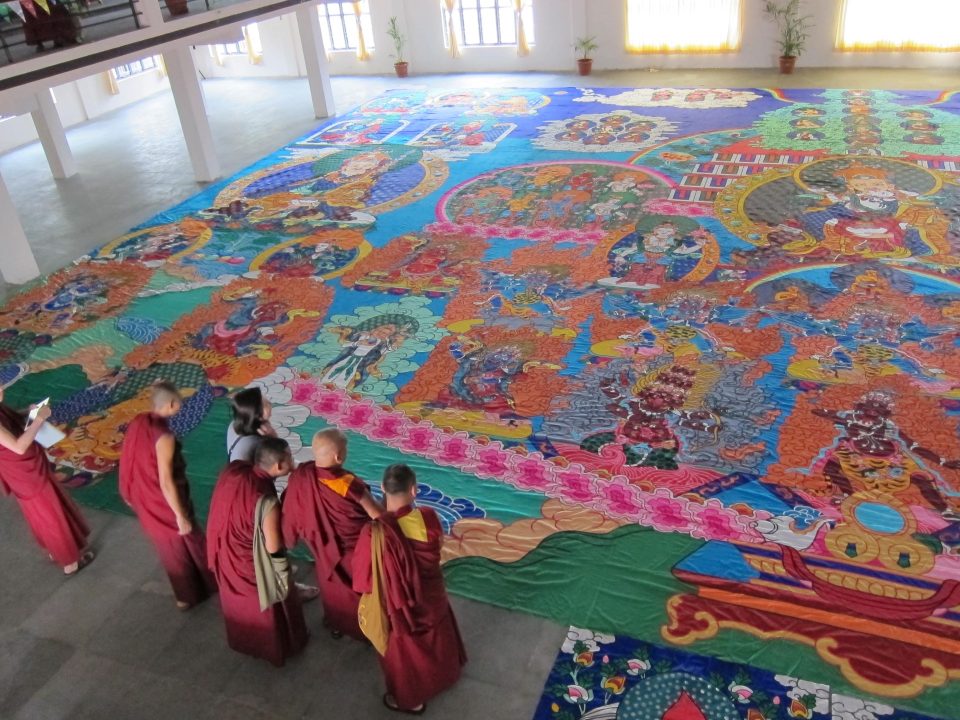
Large Padmasambhava (Guru Rinpoche) thangka with Twenty-one Taras. Photo courtesy of Kopan Nunnery.
For the ninth year in a row, a very large thangka of Padmasambhava (Guru Rinpoche) was displayed and an auspicious 100,000 tsog offering event (Guru Bumtsog) took place at Khachoe Ghakyil Ling (Kopan Nunnery). This giant holy object is 70 feet (21 meters) high and 87 feet (27 meters) wide. This year, in addition to last year and every year going forward, this event occurred on Lama Zopa Rinpoche’s birthday, December 3. Below we share some of the rich history of this magnificent holy object, and we also share a moving report from Ven. Sarah Thresher on this year’s event.
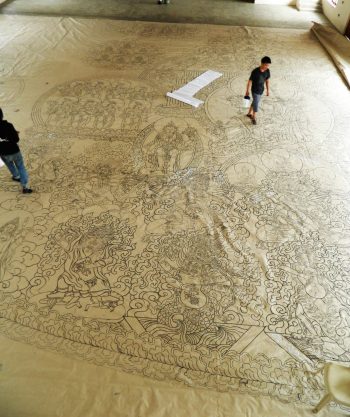
Initial outline of the large Padmasambha thangka, November 2011.
History and Significance of the Large Padmasambhava Thangka
This holy object project and yearly event was initiated by Lama Zopa Rinpoche in early 2011 in order to follow the Tibetan tradition of displaying and honoring monumental thangkas. In this tradition, large thangkas are laid on mountains, monastery courtyards, or large walls once a year with annual prayers, pujas, and extensive offerings. The main purpose of this project was to contribute to the fulfillment of the wishes of His Holiness the Dalai Lama including the preservation of Tibetan culture.
The thangka was completed in October 2013 after 2.5 years of completely handmade work in a school gym in south India near Sera Je Monastery, where 10-12 artists worked at once. Ven. Roger Kunsang commented that there were materials all over the gym during the time it was being made, it seemed difficult to understand how it could all come together in the way it finally did.
Geshe Ngwang Sangye, who oversaw the creation of the thangka shares, “This project is a significant cultural and spiritual endeavor. It not only commemorates the teachings of Buddhism but also acts as a focal point for community gatherings and spiritual reflection, benefiting all beings through its intended use in rituals and teachings.”
Lama Zopa Rinpoche checking the progress on the Padmasambhava thangka, December 2012.
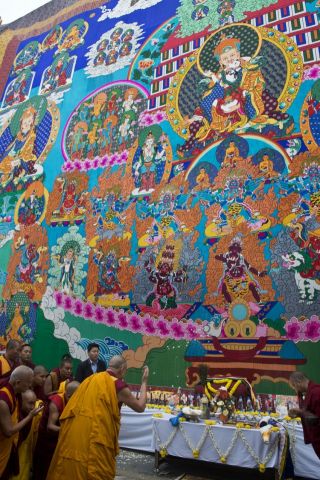
His Holiness the Dalai Lama blessing the Guru Rinpoche thangka, Sera Monastery, India, December 29, 2013. Photo copyright Rio Helmi/Jangchup Lamrim Teaching Organizing Committee.
The thangka was raised for the first time at Sera Je Monastery on the outside of the building when His Holiness the Dalai Lama was teaching in December of 2013. After the teaching His Holiness came to the monastery to bless the holy object. After the blessing, Rinpoche had an appointment with His Holiness and discussed various matters related to the thangka. From this meeting, the plan arose that Rinpoche wanted the thangka raised each year at Lawudo with the pujas and extensive offerings done there. However, at that time it was very difficult to find a way to get the thangka to Lawudo as it was too big and too heavy. Due to this Rinpoche decided to have it raised at Kopan Nunnery each year, which began in 2015 and has continued every year.
Since Rinpoche showed the aspect of passing away, it was decided to hold this event annually on Rinpoche’s birthday, December 3, as a special offering to Rinpoche in order to also fulfill his holy wishes.
The Kopan monks and nuns organize and manage this event with mastery and great care. The puja offered, Guru Bumtsog, is essentially the same as what is offered by His Holiness the Dalai Lama at Namgyal Monastery each year. In addition to helping fulfill the holy wishes of His Holiness the Dalai Lama and Lama Zopa Rinpoche, this project illustrates a deep commitment to preserving and promoting Tibetan Buddhist culture while fostering community engagement through spiritual activities.
With grateful thanks to Geshe Ngawang Sangye for essential information on the history of this most precious object.
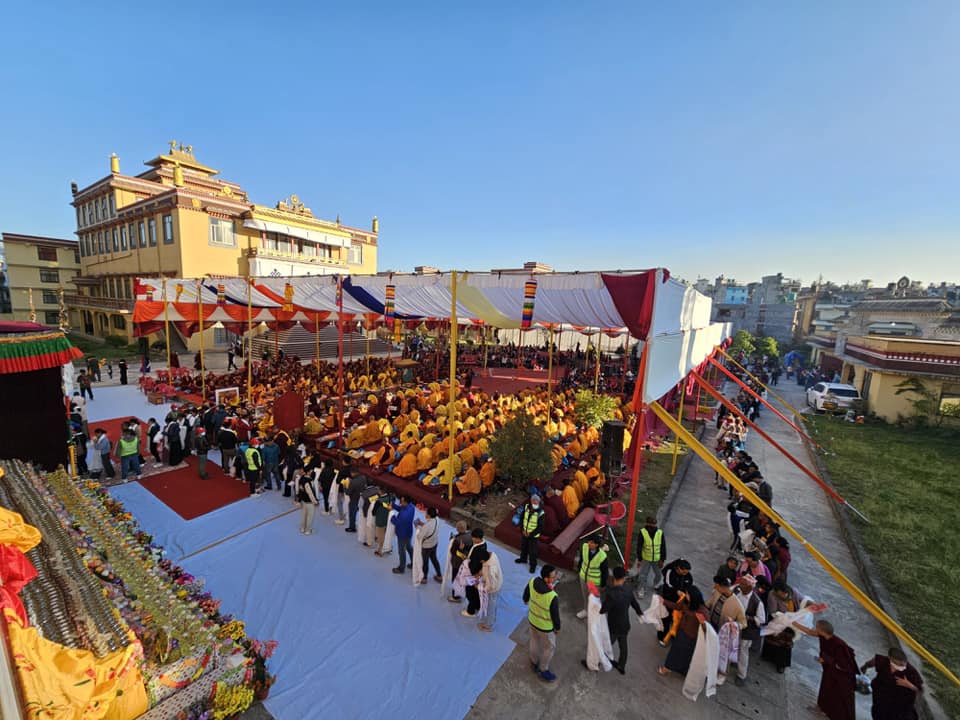
The grounds of Kopan Nunnery during the Guru Bumtsog event on Lama Zopa Rinpoche’s birthday, December 3, 2024. Photo thanks to Kopan Nunnery.
Extraordinary Birthday Celebration for Lama Zopa Rinpoche at Kopan Nunnery
By Ven. Sarah Thresher
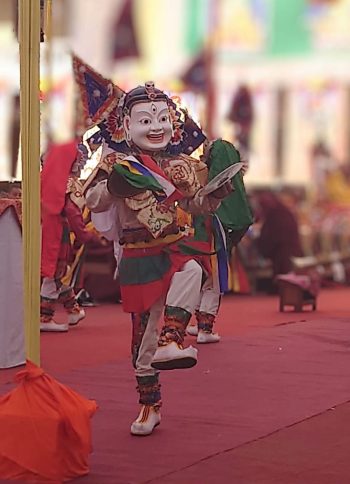
The Cham dance of the ging—messengers of Dorje Drollo performed by Kopan monks during the bumtsog event. Photo by Lesley Abhita
We enjoyed a most extraordinary birthday celebration for Rinpoche yesterday at the Kopan Nunnery with the annual Guru Bumtsog.
Like a seamless fusing of the two manifestations of the Lawudo Lama, the extensive Guru Bumtsog offering, based on a Northern treasures text by Rigdzin Godemchen, was led and inspired by the monks from Thame monastery in Thamichowa, Solukhumbu. Thame is Rinpoche’s “home” monastery so to speak—it is the monastery the first Lawudo Lama was connected to as a ngakpa practitioner and also where Rinpoche entered as a young child to be a monk. The Northern lineage, the gyaling, the dance of the gings and Dorje Drollo—all these are elements from Rinpoche’s past and present life. But the puja was energized by the love and devotion of Rinpoche’s hundreds of monks and nuns at the monastery and nunnery he created in Nepal in this life at Kopan along with the many lay people gathered—some from countries far away where our most cherished lama spread the Dharma throughout this world.
The weather was glorious, the huge applique thangka of Guru Rinpoche (Padmasambhava) merit field and Twenty-one Taras often seemed to dance in rhythm with the chanting. The offerings were beautiful and extensive. Seating and lunch and all details were immaculately arranged. Truly wonderful! And we were joined by such precious lamas as H.E. Jangtse Choeje Kyabje Gosok Rinpoche, Khandro-la [Khandro Kunga Bhuma], Thame Lama, and Dzigar Khenpo of Tsopema.
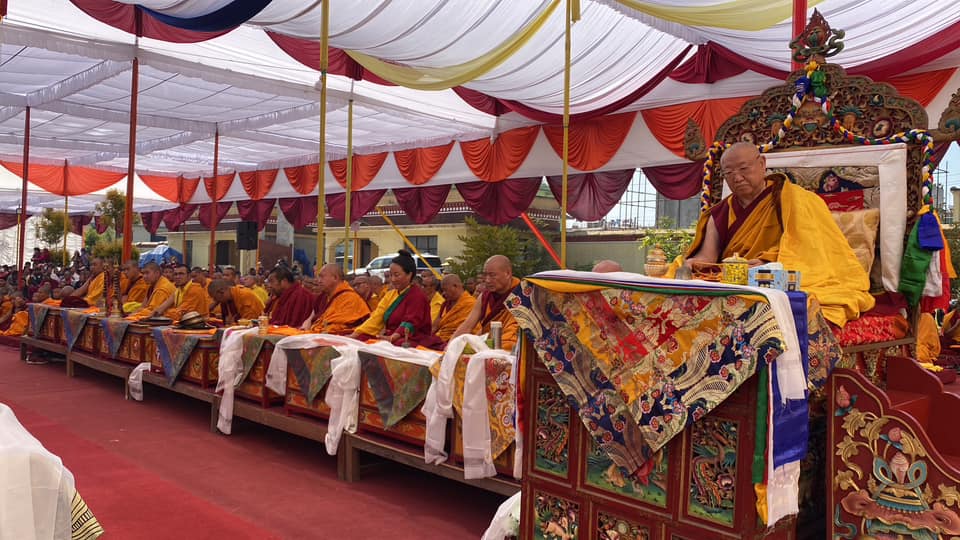
H.E. Jangtse Choeje Kyabje Gosok Rinpoche of Sera Mey Monastery presiding over the puja on December 3, 2024. Photo thanks to Kopan Nunnery.
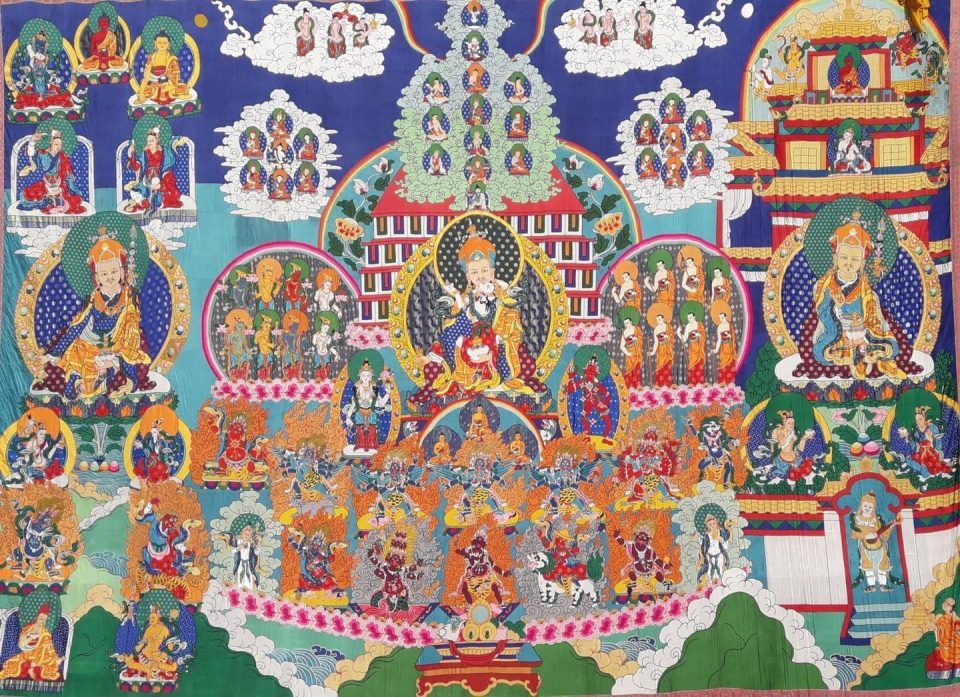
Detail of the large Padmasambhava thangka. Photo courtesy of Tubten Pende.
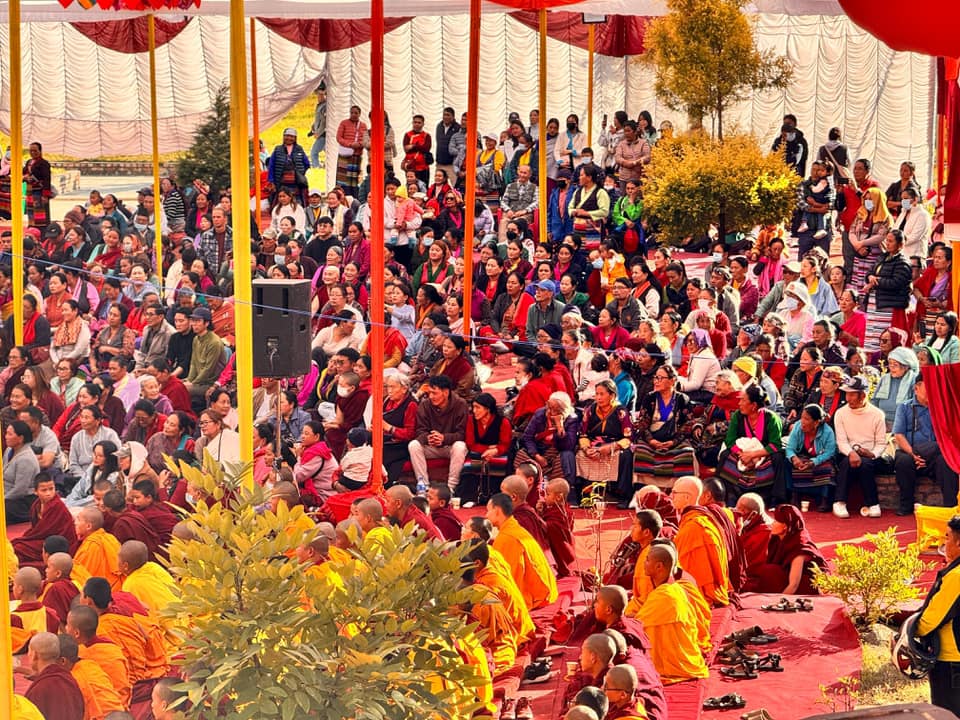
Some of the crowd gathered for the Guru Bumstog event at Kopan Nunnery, December 3, 2024. Photo thanks to Kopan Nunnery.
And so from the depths of our hearts we pray that His Holiness Dalai Lama may live long and all his holy wishes be fulfilled and we request that a new magnificent and unmistaken manifestation of the Lawudo Lama, our most cherished Lama Zopa Rinpoche, swiftly return to continue his enlightened activities for all beings in a precious human form!
With thanks to Ven. Sarah Thresher for this moving brief report of the December 3, 2024 event, and to Geshe Ngawang Sangye for providing details of the history of this incredibly powerful holy object.
Foundation for the Preservation of Mahayana Tradition (FPMT), is a Tibetan Buddhist organization dedicated to the transmission of the Mahayana Buddhist tradition and values worldwide through teaching, meditation and community service.
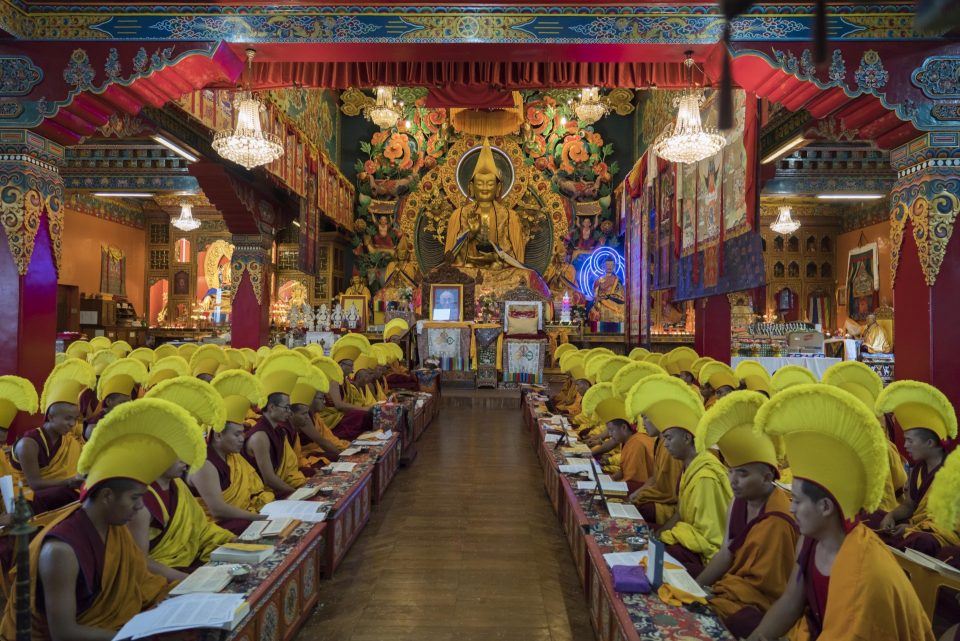
Monks offering puja at Kopan Monastery.
The merit multiplying day of Lhabab Duchen (commemorating Guru Shakyamuni Buddha’s return to Earth from the Realm of the Thirty-Three), occurs on November 22, 2024 this year. On this day, up to ten thousand Sangha will be engaging in powerful prayers and practices for the benefit of all beings and in particular for the swift return of Kyabje Lama Zopa Rinpoche and our FPMT family—all the centers, services, and projects and all the members, volunteers, and kind benefactors.
The Sangha will be reciting the entire Prajnaparamita, offering Medicine Buddha pujas, One Thousand Offerings to Namgyalma, and many other practices. During the pujas, with great respect, a monetary offering will be made to all Sangha engaged in the prayers.
Rinpoche explained during the Four Kadampa Deities Retreat, Institut Vajra Yogini, France, 2003: “The Puja Fund was not revealed for quite a number of years, but then somebody thought that maybe it’s a good idea to let other people know, in case somebody wants to put some donation in the fund. So, then they get this chance to collect all this merit, of having made offerings, even if what the person donated is very little, but it covers all this, offering to the same gurus’ disciples, to all the Sangha in the monasteries. … It’s like putting a drop into the ocean then it gets mixed with the rest of ocean, so until the ocean finishes, the drop that you put in the ocean doesn’t finish. … These pujas will go on forever, for as long as these monasteries last. Even if one is in the hell realm, but the pujas are still going on … even when one is born as ant, crawling on the ground or on the trees, these pujas will still be going on in the human world.”
Rinpoche further explained in 2003: “These pujas happen on the special days, on Buddha days where you collect one hundred million merits. So, if you offer one rupee, you collect the merit of having offered one hundred million rupees. If you offer one cup of tea to the Sangha, you collect the merit of having offered one hundred million cups of tea.”
Regarding the offerings to the stupas and Buddha statue in Bodhgaya, Rinpoche said: “To do all these offerings. It is unimaginable, incredibly fortunate, so fortunate to be able to do that. It’s such unbelievable merit, to offer to these actual manifestations of the Buddhas and these holy objects.”
Monks offering puja at Sera Lachi Monastery.
Rinpoche explains that he set up the pujas in his gurus’ monasteries, “because if you offer to your guru’s disciple, even if it is just a glass of water or one cup of tea, you collect merit far greater than having made offering to all the numberless Buddhas, numberless Dharma, numberless Sangha, numberless statues, numberless stupas, numberless scriptures, all the holy objects. Making offerings to one’s guru’s disciples or the guru’s dog, giving even one biscuit to the guru’s dog, you collect far greater merit than having made offerings to numberless Buddha, Dharma, Sangha, and the statues, stupas, scriptures.
Therefore, these pujas are arranged in Sera, Gaden, Drepung, Gyudmed, Gyuto and Kopan monastery and nunnery, where there are many, many thousands of Sangha and they are all His Holiness the Dalai Lama’s disciples. By remembering the guru, if you offer to each Sangha, you collect far greater merit than having made offerings to all those holy objects.
It is the same at the center. There are so many people there who are also your gurus’ disciples, so if you offer tea (including to lay people), if you offer food at the center, drinks during puja, or any offerings to them at any time, you collect more merit than having made offerings to numberless Buddhas, numberless Dharma, numberless Sangha, numberless statues, stupas, scriptures, all the holy objects. So therefore, there is an unbelievable, incredible opportunity right at the center where one studies Dharma.
You are most welcome to be part of this vast offering to the Sangha, and to be held within their extensive dedications, by contributing any amount.
The prayers, pujas, and offerings sponsored on Lhabab Duchen:

Robes offered to the main Shakyamuni Buddha statue inside the Mahabodhi Temple, Bodhgaya, India.
- The monks of Gyudmed Tantric College will be reciting the Prajnaparamita (three versions).
- The monks of Sera Lachi, Ganden Lachi, Drepung Lachi and Gyuto Tantric College will be offering Medicine Buddha puja, One Thousand Offerings to Namgyalma and Namgyalma Long Life puja, Sixty-four Offerings to Kalarupa, and King of Prayers.
- The Sangha of Kopan Monastery and Khachoe Ghakyil Ling Nunnery will be offering Medicine Buddha pujas.
- All ten thousand Sangha will recite the Names of Manjrushri for the swift return of Kyabje Lama Zopa Rinpoche.
- Offerings will be made to His Holiness the Dalai Lama and all of Lama Zopa Rinpoche’s gurus, such as Jhado Rinpoche, H.E Ling Rinpoche and many others.
- A monetary offering will be made to the ten thousand Sangha, as well as all Sangha residing in the IMI monastic communities around the world.
- New robes will be offered to the Buddha statue in Bodhgaya; and saffron paint, umbrellas, and banners will be offered to Boudhanath and Swayambhunath stupas, with strong prayers.
- Animals will be liberated and there will be the printing of precious sutras such as The Golden Light Sutra, Arya Sanghata Sutra, Vajra Cutter Sutra, Amitayus Long Life Sutra and Sutra of Great Liberation.
Thank you to all who undertake these practices and those who make the offerings possible. You are welcome to join in all these offerings arranged on Lhabab Duchen and on all the future merit multiplying days.
The Puja Fund was established by Lama Zopa Rinpoche to provide resources for continuous pujas dedicated to the long life of His Holiness the Dalai Lama and to the success of all the FPMT centers, projects, services, students, benefactors and those serving the organization in any way. You can learn more about the Puja Fund, or FPMT’s other extensive charitable activity.
Ven. Lobsang Tsering displays a page of the Prajnaparamita he has been writing out.
In the heart of Kopan Monastery, nestled in the beautiful hills of Nepal, a quiet yet monumental task unfolds each day. Ven. Lobsang Tsering has been entrusted with a project that embodies the very essence of continuous joyous effort and guru devotion: writing the Prajnaparamita Sutra in beautiful calligraphy in pure gold ink on archival quality paper. This project for world peace has a huge significance for the entire FPMT community and should continue for as long as FPMT exists.
Ven. Lobsang Tsering’s journey of writing out the Prajnaparamita Sutra in gold began over two decades ago when Lama Zopa Rinpoche, recognizing his potential and devotion, assigned him this important job. Since then, Ven. Tsering has devoted himself wholeheartedly to this practice with unwavering focus, patience, wisdom and compassion. As of now, he is working on the fifth of twelve volumes, a testament to the magnitude of this task.
In a recent interview, conducted by Yanzhina Bartanova at Kopan Monastery, Ven. Lobsang Tsering shared his life story and the deep sense of responsibility he feels towards this assignment. His humility and dedication shine through as he recounts the moment Lama Zopa Rinpoche entrusted him with this work. His words offer a profound insight into the importance of the Prajnaparamita Sutra and the personal transformation he has experienced over the years. This interview provides a rare glimpse into the heart and mind of a practitioner whose life is devoted to the Buddhadharma.
You can read the full interview below and also watch it on video.
The Prajnaparamita Sutra contains the highest teachings of the Buddha and is among the most precious texts available in the world today. Due to the power of this text, writing it out is a way to generate tremendous merit, remove obstacles, and create peace in the world.
Each year, FPMT allocates over US$50,000 for the pure gold and related expenses. This financial commitment highlights the importance of this project within the FPMT community.
While Ven. Tsering’s contribution is unparalleled in its duration and intensity, he is not alone in this virtuous activity. Jane Seidlitz, working from the USA, has also been writing out the Prajnaparamita Sutra in pure gold. Although her involvement has not been for as long or as intense as Ven. Tsering’s, her contribution is equally valued and cherished. Together, their efforts symbolize a huge commitment to preserving the teachings of the Buddha.
Pages of the Prajnaparamita that Ven. Lobsang Tsering has been writing out for over two decades.
This project is a living legacy of Lama Zopa Rinpoche’s vision, a vision that continues to inspire and uplift those who come into contact with it. Rinpoche asked that the sutra is continually being written out as it is a powerful holy object.
Interview with Ven. Lobsang Tsering
Gen la, can you please, introduce yourself?
Ven. Lobsang Tsering writing out the Prajnaparamita from Kopan Monastery.
My name is Lobsang Tsering. Actually, my hometown name is Lobsang Tsering, but my gelong name is Thubten Dawa. I’m from Manang Village. It’s a very remote area here in Nepal.
At age of eight, my parents brought me here at Kopan. I grew up here with many children. It was good. I finished my study in 1990. Then I started to serve monastery, working in the office, as a lama gyupa, making sand mandalas. I also got a chance to do some translation work. Then Rinpoche invited me to the United States, I had an opportunity to go there. Rinpoche advised me to write out Prajnaparamita Sutra.
So then I studied again, Rinpoche was showing me caligraphy and the way how to write, how to set up the motivation and the dedication. I was so fortunate. At the beginning of 2002 I started writing out the first volume. It took me 5 years. The second volume took me 5 years. This is the 5th volume I’m working on right now.
So I’m all all the way, 70% of the fifth volume. I was so fortunate that I got this opportunity and I got to carry it on. Still now, my mind is so blessed. I feel like this. I’ve decided I will do it as long as my body supports me, my eyes support me. As long as the gold is supported. I decided I will carry on. Rinpoche has mentioned to me even after His passing away I have to keep writing. Rinpoche mentioned this on a few occasions.
Can you please explain for those who are very new to Buddhism, what is Prajnaparamita Sutra?
Prajnaparamita Sutra is the the wisdom of perfection. The wisdom of perfection was taught by Buddha in Rajgir. It has many different versions, like short, medium, and long versions. Shortest one is very common, well known, is the Heart Sutra, which consists of 25 stanzas, and then when we talk about the short version of the Prajnaparamita Sutra is 8,000 verses. Rinpoche was doing that one, writing in gold letters. And then the middle one is 20,000 verses, which has 3 volumes.
And then the long one is a 100,000 verses, which has 12 volumes. So that’s what I’m working on here right now. I’m on the 5th volume out of 12 volumes. It’s slowly but steadily is going on.
When we’re talking about the Heart Sutra is mainly we’re talking about the interdependent origination and emptiness, and it’s a very crucial teaching of the Buddha. That’s why it’s so important text of the Buddha. It is very important to write with the gold so to collect merit. So all the projects of Rinpoche and the FPMT will come true. As Buddhists we believe in order to fulfill or to accomplish the wishes, we need to have merits. So that’s the main reason why we are writing out Prajnaparamita Sutra to accumulate merit so all projects can be done without any obstacles. That was the main purpose.
Can you please explain what is merits and why we need to accumulate it for those who don’t know?
Merit is some kind of the positive energy. So the more negative energy around, the atmosphere becomes negative and then everything actually becomes negative. So all we need is positive energy around. So then positive energy in, out, everywhere. So more positive energy around, the wish come true. That’s what I understand. Something like a virtue as we say, it’s virtues actions. Also, positive energy.
Can you please advise people who would like to do the same as you do, to collect merits by writing out Prajnaparamita Sutra? What they can do, how they can start, if they want to do the same as you?
To write Prajnaparamita Sutra – anybody can do it, but what I understand for us, we need to have a wish to do. That’s so important. So if we have an eager to do it or wish to do it. To have a wish, we need to understand the benefit of that. If you understand the benefit of writing Prajnaparamita Sutra, then because of that the wish will come true. You have a wish, and then you make an effort, then you need to be trained, you can train, anything can be trained. So as we say once it’s habituated, there’s nothing that cannot be done. So that’s all, we need to make an effort on that.
So to make an effort, we need to have a wish first. Then we can do anything – writing out Prajnaparamita Sutra, writing or reading, with the gold or with the ink. It doesn’t matter. While you are writing, make sure that you set up a bodhichitta motivation, it’s very important. Or fulfilling the guru’s wishes or for the sake of the Buddhadharma or Buddha’s teaching or for the sake of all mother sentient beings.
These are very important motivation that we need to set up at the beginning. And then once we done that and then whatever you do or whatever skill you have, you offer your time. So we can do it for years, keep carrying it on as your own practice. Once you carry on as your practice, gradually, maybe a year after year, after year, you keep doing that. I believe by doing that, we will create a lot of positive karma as well and same time with a lot of purification. The more we purify our negative karma, the more positive karma will raise. It felt to me like that.
So with less negative karma, more positive karma will be naturally there. With more positive karma there, your willingness will increase. Then you will be doing more and more and more. More purification is happening, more and more you turn towards the Dharma. More and more compassion is coming. More and more positive thoughts are coming.
More and more you feel devoted to your guru. You feel more kindness.
So this all automatically comes. So that’s very important. To make an effort with it. And by the way, we were saying that short term effort will make a short result, but we have to carry on.
So seriously, keep carrying on, and the rest will be okay. Since we are beginners we need to make effort without losing a hope. No matter what obstacles you may encounter or the challenge you may encounter, but thing is – it’s Dharma practice for the sake of all mother sentient beings. It’s for all Buddhadharma. So if you’re thinking this way, if you keep it in your mind, recollecting it in your mind, then the energy will come. And then you can carry on year after year, after year, after year. And then finally, after 10 years, 20 years, you will see the benefit, and then you’ll find the peace of your mind. And once you have peace of mind you will see how important Buddhadharma is.
All these are coming to you. But definitely we need to make it long. We have to plan for long term.
You discussed a lot about benefits of writing, reading, seeing Prajnaparamita. What would be the top three benefits if we narrow them down?
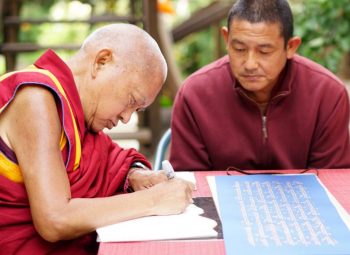
Lama Zopa Rinpoche working on writing out the Prajnaparamita Sutra with Ven. Tsering at his side, Aptos, California, United States, June 2017. Photo by Ven. Lobsang Sherab.
First, I think is the imprint. The imprint is so important. Sometimes what I do is I play His Holiness Dalai Lama’s teachings. Because I cannot play a song here [laughing], I like playing lamas’ teachings.
So this all comes together. That gives me a lot of knowledge as well. I believe when I first began my writing I can say that I didn’t understand Dharma. I was a monk. I was happy in the monastery. So I carried on like that because of kindness of Rinpoche. But when I look back now, I didn’t understand Dharma at that time.
But luckily, while I’m writing it, I listen to His Holiness’ teachings or Rinpoche’s teachings. Then in between, there are some questions coming up and also negative questions are coming. I’m still a normal human being, so they’re all these nonsense questions are coming. But luckily, because of writing out Prajnaparamita Sutra I got all the answers, which really keeps me strong! So this is how I’m able to carry on still now, after almost 23 years. My mind is still going on maybe because of this. I will say this is the benefit of writing out Prajnaparamita Sutra and listening to teachings. So that’s the first benefit.
The second benefit, definitely, because of doing this, I feel myself very peaceful. Very satisfied with myself. Because of that I can sleep peacefully. Because of that, I can feel my body. So that’s a benefit too. Because as long as we keep our mind in peace our health will be good. Because of that, we could sleep. You can happily live with anybody around. So that’s the second benefit.
The third benefit, of course, it will guide us to the enlightenment. Rinpoche told me one time, “Tsering, because you’re writing out Prajnaparamita, this will guide you to the enlightenment!”. This is so important to me. Wow! There are so many benefits of doing this!
[Please watch a two-part video of Lama Zopa Rinpoche explaining some of the profound benefits of writing out the Prajnaparamita Sutra and why he started this project]Can you please describe briefly your day at work?
Here at Kopan, I get up around 6 o’clock in the morning, and then I make my water bowl offering. I set up my motivation in the morning. And then do a half part of my prayers, and then go for breakfast around 7:30am. Come back and finish all my prayers.
I finish by 9 or 9:30am. Then I come here and get prepared for my day for the writing out Prajnaparamita Sutra. I prepare everything, like mixing gold with glue, paper. Make a cup of tea. Then again, I set up the motivation here. I’m writing till 11:30am, and then I have a lunch break till 1 o’clock in the afternoon, and then I’m writing from 1 o’clock till 4 o’clock. That is my period of writing Prajnaparamita Sutra. Then after 4pm, I dedicate. That’s so important practice of Dharma. When we’re setting the motivation and at the end we do dedication. If we don’t dedicate at the end, what happens is because we have a lot of delusions inside, such as anger or attachment or something like that. We don’t know when it will arise. So at the moment of anger, they say, that countless, many years of merits will be destroyed. That’s why dedication is so important. I set up dedication, that’s the end of my day. Then I make a cup of tea in my room, get rest. Then I go for a walk. I need to walk because I need to move my body, doing exercise so I will be able to carry on. We need a good health. Without a good health, it’s not possible. That’s very important for the Prajnaparamita project, for the practice of Dharma, whatever activities you are doing the health is so important. So that’s why I go for a walk maybe an hour or so. While I’m walking, I recite the mantras that I need to recite. Then around 6:30pm is dinner, then at the end, again, I have evening prayers to do. Maybe half an hour. And then rest. That is my 5 days a week, 2 days I take days off.
Another question is, you are doing this virtuous activity for more than 20 years. What encouraged you to start this activity?
At that time it was Rinpoche’s power. Rinpoche invited me to America. Rinpoche trusted me. My mind would feel bad, if I didn’t obey Rinpoche. That mind kept me there. Secondly, it’s because Rinpoche is so pure! More we serve him, we want to serve even more.
Maybe Rinpoche’s power. A lot of my friends are saying that I’m the only one who got the renunciation after going to America. Mostly people go to America and they finish their monks life. They want to live a normal life. I think most are like that. Just a few came back still as monks. I am the one of them. So that’s why I feel very blessed.
I would definitely say because of Rinpoche’s power. One reason is I’m in the mandala of Rinpoche. So I need to do well. I’m also a Kopan boy. I need to respect Kopan as well. So this kind of mind helps me to carrying on. Maybe at the beginning I didn’t understand, but because of this kind of mind it helped me. After I’ve been writing for 6-7 years I started to understand. Started to understand maybe 6-7 years after. At the beginning for many of us, we don’t pay attention because we’re young. We just go around or something like that. But once we start to understand, all answers come. Like I said I listened to His Holiness’ teachings and Rinpoche’s teachings. Then I found all the answers to my questions. Then my mind became stronger. I feel very joyous! Now I feel like if I don’t do, if I don’t write one day, I feel like I’m wasting my day.
So important to make sure your day is meaningful. As we say, we have a precious human rebirth, it is so important. If we miss this time, then next life, we don’t know where we will be reborn. As we understand all these things, it’s so important to make sure, while you have this precious human rebirth, you use it in a meaningful way. By thinking that, I’m using it as maximum as possible. So here I am.
You talked about meaningful life, happy life, not wasting your life. So what would be your one advice for people to live happy, meaningful life?
I would say don’t engage in any kind of “happy” negativities. Don’t do that. Live the life positive as much as you can. I think in that way you will definitely find a happy life. Carry on year after year, year after year. You’ll find deep satisfaction, because of your positive actions, positive deeds that you have done in your entire life. If you do some negative action somehow, somewhere you have a regret in your mind. That leading you to the problems, unhappiness, depression. Make sure your day, your month, years are meaningful in the positive way. That’s so important. Then to live in the positive, living with the bodhicitta is the most important. That’s the essence of the Dharma as we say. You live the best way with compassion, with bodhicitta. If not, then at least, restrain from the negative actions as much as you can. Even the small negative action, we have to restrain from it. You have to avoid it.
If you do that, maybe at the end of your life, you will be able to find a deep satisfaction. Then you will definitely be happy. That’s what I believe.
We offer grateful thanks to Yanzhina Bartanova for conducting this extremely moving interview.
As we reflect on Ven. Tsering’s journey and the ongoing efforts of individuals like Jane Seidlitz, we may be inspired to support this incredible work. Whether through financial contributions or rejoicing in this achievement, we can all be part of this extraordinary endeavor. In doing so, we create an incredible amount of merit and help ensure that the Prajnaparamita Sutra continues to shine brightly, guiding countless beings toward the path of enlightenment.
You can learn more about the Prajnaparamita Project as well as the other Charitable Projects of FPMT.