 receive our newsletters
 join Friends of FPMT
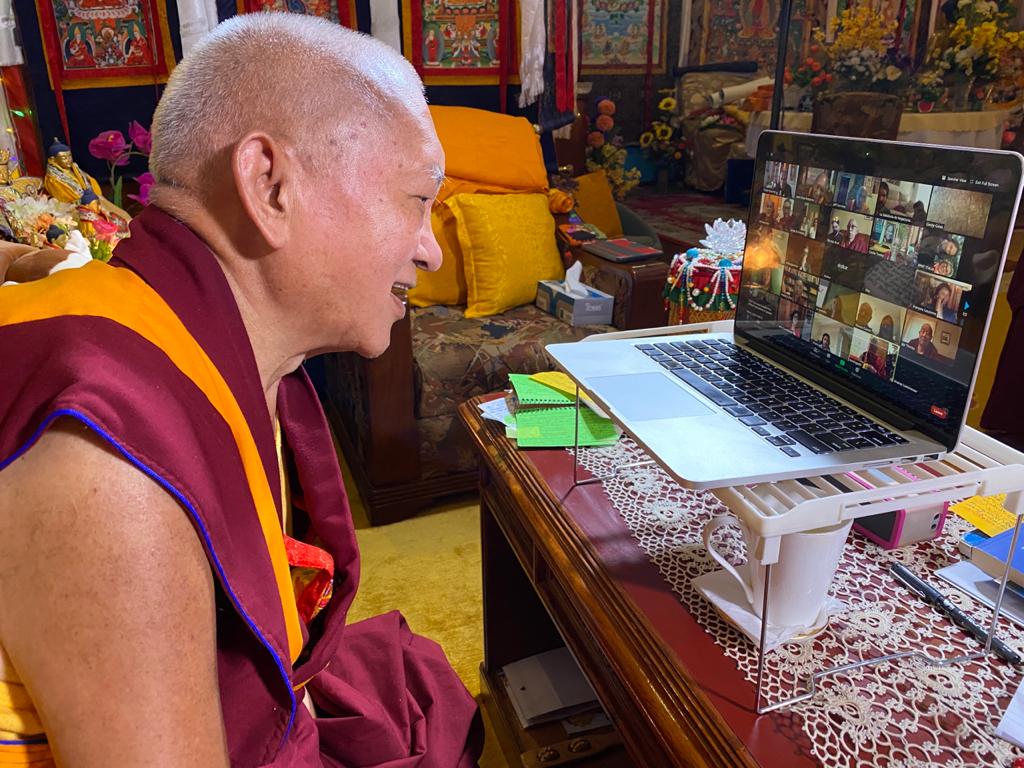
Jamyang Buddhist Centre (JBC) sits in the heart of bustling London, with around 10 residential volunteers at any time and a network of about 100 more, local and remote, who serve in roles from hospitality to tech to blog writing. Hundreds of students join its teachings in person and online, and new volunteers are constantly onboarding. To serve this community well, JBC created a new role in 2025 dedicated to the center’s volunteers and community life, and welcomed its first People & Community Manager, Jasmine Mohtashami.
Here she shares what she has learned in the role so far, and what it might offer centers across the FPMT mandala.

Ven. Thubten Drolma, JBC executive director, with Miguel Espinosa, JBC carpenter and artist, and Robin Bath, JBC trustee. JBC, 2026. Photo by JBC London.
What Prompted JBC to Create this Role?
Maintaining relationships with volunteers and community members takes sustained investment. Other volunteers often did this work, but people move on, roles go vacant, and communication styles differ. Investing in community is investing in the Dharma, and a center’s long-term success depends on healthy, responsible, and transparent relationships with its volunteers and community members.
What Turns a Visitor into a Community Member?
A visitor becomes a community member at two key stages: first, when they’re new, before they’ve started courses or formed a relationship with the Dharma; and later, when they begin offering service, a time when interpersonal challenges can cut their time at the center short.
The answer often lies hidden – how many parts of someone’s identity are we speaking to? Are we making space for communal vulnerability, for productive tension, for random joy? Are we able to hold the business of tight deadlines amidst Lama visits, while also sitting with community members in crisis (and take care of ourselves at the same time, knowing when to say no and take a day off)?
Investing in community work is fundamentally investing in the Dharma, ensuring that centers continue to benefit beings for many more years.
When I first discovered the Dharma, it struck me how different Buddhist organisations that I visited had different kinds of communities: in some of them, people practiced together daily, taking on much responsibility amidst busy lives, travelling great distances to see each other, helping each other move and taking care of one another during hospital visits.
In others, people met once a year, and communication was fragmented. There was a lot of movement in service positions, groups that folded, and people who left the dharma entirely was normalized.
The Dharma was wonderful everywhere – but the quality of community was different.
And the more I started becoming engaged at Jamyang London Buddhist Centre (JBC), studying the Exploring Buddhism course and volunteering for Lama visits, the more I asked myself: How can I safeguard this incredible community I have found?
And when the new position of People & Community Manager was advertised at JBC I knew that my spiritual home too understood that community doesn’t sustain itself – it needs tending.
I was thrilled to join the team at JBC. Having worked in campaigning and volunteer management before, I took note of what made Dharma community engagement seamless and sustainable:
- Transparency and support in offering service. A way in to the center was accessibly advertised and meaningful in shaping the center and held throughout the experience. Resources were designed bottom-up and frequently updated in collaboration with the people they were for.
- Professional and kind communication, time-sensitive and personal, suiting individuals accessibility needs.
- Spaces to be other than “student”, but together – affinity groups such as LGBTQ+ and BIPOC spaces which are easy ways in; or informal, creative spaces in the Kindness Cafe, easy ways to make friends and ask questions on how others engage with the Dharma.
- An openness to name tensions. People are people, and each obstacle can be used on the path, individually and as a community. Fair and clear pathways for listening and resolution help people find a way forward. This is the thinking behind our new Wellbeing Framework, which sets out how we raise concerns, resolve disagreements, and repair harm with care — and which other centers are welcome to draw on for their own communities.
But I want to be honest about something here too – naming tension well is harder than it sounds. People are, understandably, wary of anything that resembles a process, because being asked to “attend” something can feel like an accusation before a word is even spoken. So in practice, we might not name the wellbeing framework or walk through formal steps, which still let people know their voice is fairly valued. Instead, we make space for listening, and where it feels right, gently probe into mind training: whether the situation is really as fixed as it appears, what our own part in it might have been, where compassion for a flawed and struggling person might open something up.
Not everyone wants to talk. Not every conversation resolves. Sometimes people aren’t in a place where continuing to engage is safe or right for them. But being genuinely available, and not shying away from difficult conversations, has made a real difference. The aim was never to keep everyone in the room, or to keep every relationship comfortable – it’s to engage compassionately, safely, and in a way that means the center responded responsibly when it mattered.
What Are the Main Responsibilities of the People & Community Manager?
-
HR for staff
- Holding the relationship with our Kindness Café facilitators, who offer free secular activities
- Volunteer infrastructure: keeping records up to date, ensuring everyone completes training, and ensuring equal opportunities, treatment and feedback channels across every department
- The Wellbeing Framework, which lets people raise concerns or questions transparently and know what follow-up to expect
- Supporting the team to onboard volunteers responsibly and sustainably
- The residential Karma Yogi programme, making it sustainable and enjoyable
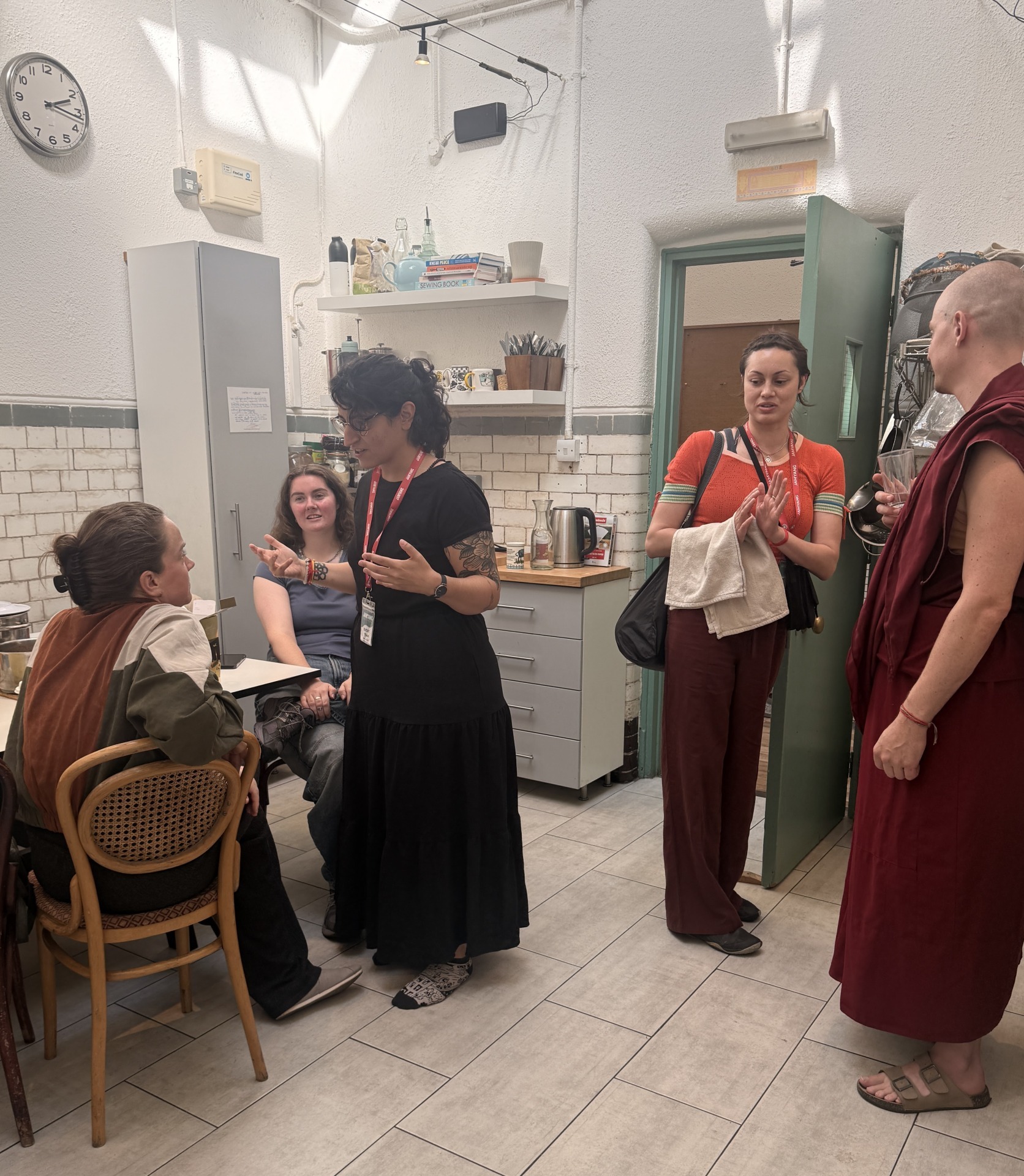
Iris, a translator, Kate on the Cafe team, Zola from hospitality and Ven Jampa on the ritual attendant team, chatting with Jasmine Photo Courtesy of JBC’s newsletter
How Does the People & Community Role Add Value to Day-to-Day Operations?
The power of community comes from repetition. It’s from these strengths being demonstrated again and again. Being a familiar face. A gradual accumulation of small moments of trust and recognition.
Volunteering creates the conditions for exactly that. When someone commits to turning up regularly, something opens up – relationships deepen, the center starts to feel genuinely familiar, and the teachings begin to find expression not just in meditation but in how we show up for one another. That’s a kind of practice in itself.
On any given week I might be coaching our different coordinators on the various needs of volunteers, training up new facilitation leaders for self-held affinity groups, discussing communication styles with our residential volunteers, writing up HR policies for the team or organizing a day to celebrate our volunteers. I’m also building out our onboarding and resource training systems so that people – whether they’re joining as volunteers or staff – have a real sense of what they’re stepping into and how they belong. A year in, the volunteer infrastructure feels grounded and built-out, and we’re turning our attention to mentoring long-term students into leadership positions, incorporating mind training into the very ethos of our residential program, and so much more – the community speaks, and we listen.
What Concrete Changes have Happened During the First Year?
Much of the first year was systematising: building structures that don’t depend on one person.
- Volunteer infrastructure that was ad hoc is now sustainable and tangible. Volunteers in every department, remote or on-site, receive the same opportunities and follow-up.
- All community members can raise concerns, such as accessibility needs and special requests.
- We’ve built relationships with long-standing community members and listened to their feedback.
-
We’re engaging the local community, for example giving building tours to the Lambeth heritage community.
Two examples show the impact.
Shared structures for volunteers
We replaced ad hoc arrangements with structures that are clear and open to everyone:
- An updated Volunteer Agreement that sets out what is expected and what protections volunteers have, so nothing is left to assumption
- A transparent Wellbeing Framework, available to all, with a clear route for raising concerns and knowing what follow-up to expect
- One digital hub holding every form, resource and way to get involved, so remote volunteers get updates and can take part just as on-site volunteers can
Looking after our people at the front line
Front-facing volunteers and facilitators have taken part in group reflective practice sessions hosted by our Inclusivity Ambassador, Matt, where they can share what it’s like to serve the public. We also held one-to-one conversations with team members and created an incident log where people can flag difficult encounters. Together these give people a space to feel heard.
What Does JBC Hope to Develop Next?
- Bringing back our Inclusivity Ambassadors, championing and mentoring people from minority backgrounds to hold some of our activities.
- Revamping the residential Karma Yogi program around lojong and mind training, so participants leave having achieved something and deeply engaged with the Dharma.
A Thought for the Wider FPMT Community
I’ve been reflecting on what it means for a center to consciously invest in this kind of role, and I think it’s worth sharing with the broader network.
Every center has people at its edges – those who attend regularly but haven’t yet found their way into a deeper sense of belonging, or volunteers who give generously without always feeling fully seen into community, or those who have co-created spaces for years, sometimes decades, but burn out or face immersion aversion. Tending to those people isn’t peripheral work. It’s some of the most important work a center can do.
That doesn’t have to mean a dedicated staff role – it might look very different depending on the size and context of your center. But it does mean asking the question: who is actively looking after the human experience of our community members? Who ensures that volunteers feel valued, that newcomers are genuinely welcomed, and that long-term members are able to take time off?
These questions aren’t secondary to educational programs, they are what keep them alive for many more years to come.
Some lessons from our first year that other centers could adapt:
- Invest in volunteer management. Onboarding more people than you can support means people fall through the cracks. Long-term members get overlooked, treatment becomes uneven and resentment grows.
-
Build more than a work relationship. A relationship with volunteers differs from one with employees. If we only turn to volunteers when we need work done, and don’t create safe, transparent ways to communicate, it can damage both the centre and individuals. Social spaces help.
- Build infrastructure that outlives volunteer coordinators. Keep the database current and know who has signed the ethical policies. It’s basic, but it makes a big difference, and it doesn’t require a dedicated post.
- Look after the core team. People who offer service risk giving too much. Ask who is looking after them.
- Create feedback loops. Centers rely on volunteers and community members but rarely have capacity to learn from them. Even small, gradual efforts to hear and act on people’s experiences, including those of people with different abilities, make an impact.
After all, our community spans beyond our center walls and remote students, and includes the entire FPMT family. Building a warm, sustainable and courageous home for the Dharma takes all of our initiative – what a privilege and joy it is to be of service to the Dharma together!
Written by Jasmine Mohtashami, People & Community Manager for JBC. Jamyang is very happy to offer more information about the development of their People & Community Manager role, should any FPMT center wish to pursue creating a position like this to suit their own community’s needs.
We welcome the submission of news stories from those within the FPMT community. This can be a story about something you have personally completed or accomplished, about someone else who has done so, or about the FPMT center, project, or service of which you are a part. Ideal submissions will give readers reasons to rejoice, share ideas, and create connections between those in the international community. Have something to share? Please let us know!
Foundation for the Preservation of Mahayana Tradition (FPMT), is a Tibetan Buddhist organization dedicated to the transmission of the Mahayana Buddhist tradition and values worldwide through teaching, meditation and community service