
 receive our newsletters
 join Friends of FPMT

Michelle Le Dimna at Boudha Stupa, 1978. Photo courtesy of Michelle Le Dimna.
Michelle Le Dimna arrived in Kopan for the 1978 November Course and stayed in Nepal and India, following teachings and doing retreat, until February 1985. Michelle has spent about 40 years translating Dharma books into French and is an FPMT registered teacher. She was instrumental in organizing relic tours in France and Belgium and helped with fundraising for the Maitreya Project.
As a continuation of our yearlong celebration of the FPMT organization turning 50 in December 2025, we are delighted to share Michelle’s story as one of the early students of FPMT!
My Kopan Story (1977-1984)
By Michelle Le Dimna
Circumstances: I left France in September 1977 for two weeks on a Trans-Siberian journey and a three-day sea crossing before arriving in Yokohama, where my brother and his girlfriend (fervent practitioners of karate, as I was, somehow, of aikido) were waiting for me—we had not seen each other for three years and had only spoken on the phone a few times. My husband and I had separated a few months before, and when I left for Japan, he left for Darjeeling and Nepal, following his recent discovery of Tibetan Buddhism at the famous Dashang Kagyu Ling, “Temple of a Thousand Buddhas” in France.
A year later, he came to Japan to convince me to come to Nepal for two reasons: he thought we could come together again, and he wanted me to meet the Lamas and attend the November Kopan Course. My gratitude toward him remains very strong. I promised to leave Japan and this life that I was truly enjoying; he then returned to France for a few months of work.
We met in Kathmandu a few days before the start of the November course. But my husband had fallen in love with someone else; she arrived in Kopan a few days later. That is how it began. In a way, these were the best possible conditions for encountering the lamrim.
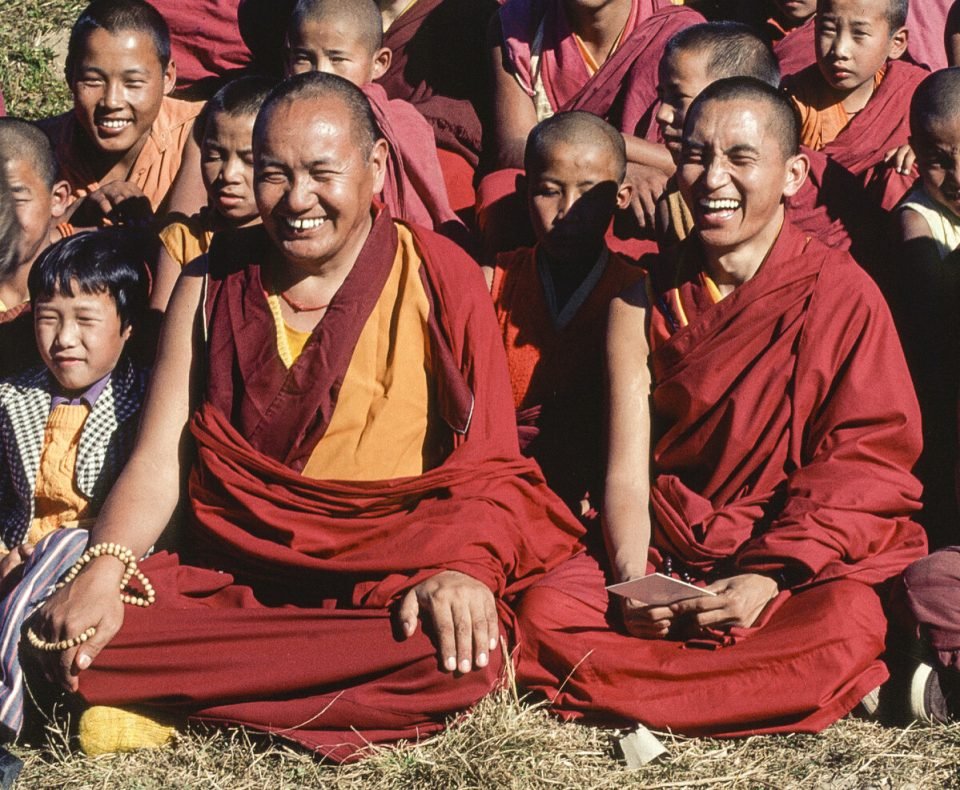
Lama Yeshe and Rinpoche at the 11th Kopan Meditation Course, Kopan Monastery, Nepal, 1978. Photo by Murray Wright, courtesy of the Lama Yeshe Wisdom Archive.
The culture shock was quite strong, but not overwhelming. I had traveled by hitchhiking for years and was used to precarious conditions. At the same time, I felt a deep fascination with discovering a new world.
I found myself in Norbulingka, in a dormitory on the ground floor of a high brick building, sleeping on a string mat with only a sleeping bag, in a dusty room. I especially remember the open toilets: six holes in the ground, separated by simple curtains, with a vast view over the northwest valley (the side where the stupas are now), and dozens of colorful budgies flying around. I was completely under their spell. We had some water for daily washing, but about once a week we would go to the spring to bathe. The Nepali women did not appreciate Western habits, and sometimes tensions arose.
The teachings occurred in a long tent leaning against the hillside, facing the Kathmandu Valley. In the early morning, we would drink soy tea while looking out over a sea of clouds, from which the tops of the hills and bamboo trees emerged. The beauty was so intense it brought tears. It remains with me to this day. We sat in silence, simply contemplating. That made all the difference.
What I remember most from my first days in Kopan is a group of Italian monks chatting noisily, wearing sunglasses—they looked like friendly mafiosi. I thought, “If monks can behave like this here, then I will feel at ease in this monastery.”
My English was limited, so I stayed mostly with French speakers. At that time, many Europeans—Dutch, German, Italian—spoke French fluently. I improved my English mainly by listening to the teachings. My Dharma vocabulary became quite rich, but everyday language remained more difficult.
I do not clearly remember my first impressions of the Lamas. I might not have connected easily with Lama Zopa Rinpoche at first, yet I was deeply touched by some of his teachings—so precise and so compassionate toward both animals and people. At times, I felt impatient or even irritated, and I was not alone in that. Then, when it became too much, Lama Yeshe would appear, almost like a circus figure. Suddenly there was joy, lightness, creativity, great love, and an overwhelming sense of compassion.
When Lama Yeshe spoke about “not killing,” I felt devastated because I had had abortions. It remains one of the most painful experiences of my life. I asked to see him and told him everything, crying continuously. He said, “Look, you know Milarepa. He killed many people out of anger, but he became enlightened in one life. He purified. You can purify. Everyone can purify any karma.” He was practical and grounded, always encouraging. For him, nothing was impossible. At the same time, he did not support self-pity; he encouraged us to take responsibility for our actions.
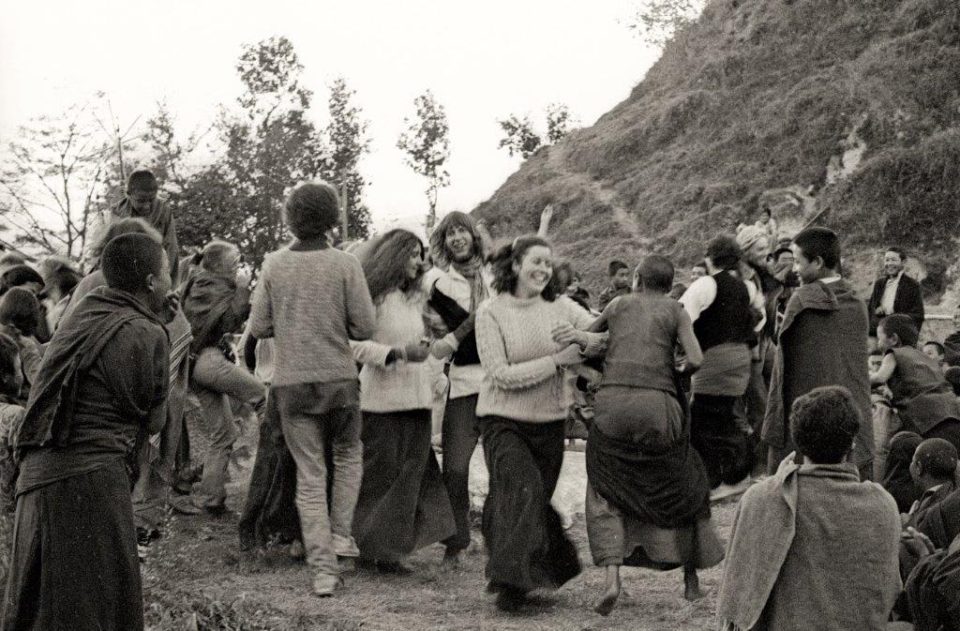
Students celebrating at the end of the 1978 Kopan November Course. Photo courtesy of Michelle Le Dimna.
This was a period of rethinking my whole life. I had followed the spirit of the seventies—“liberation,” “sex, drugs, and rock and roll,” as Ven. Robina Courtin used to say—and I began to see how much suffering I had created for myself and for others. This was not easy to face. At the same time, the teachings offered a way forward, and I could begin again.
Lama Yeshe would appear unexpectedly and often asked about my husband. After some time, I felt irritated and wondered why. Later, I understood that he always knew what he was doing.
After the course, I stayed in Bodhgaya. In May 1979, I did a two-week Chenrezig retreat in Lawudo with Lama Zopa Rinpoche, followed by a three-month Dorje Sempa retreat in Tushita Center, Dharamsala, that Summer. Later, I traveled to Afghanistan to obtain a new visa for India. It was just before the Russian invasion. Many Indian residents—mostly Sikhs—were leaving, and most shops were already closed. The atmosphere felt very unusual. After that, I returned to Bodhgaya, where I spent winters doing prostrations.
In spring 1980, a one-month Cittamani Tara retreat was held in Kopan under Lama Yeshe’s guidance. He had already given the initiation and commentary. The retreat took place in a long, simple building with a tin roof on the northeast side of the hill. There were about twenty participants.
Everyone took great care arranging their altar, seat, and texts, with a sense of quiet joy. When everything was ready, Lama Yeshe entered to give a short introduction. He looked at us very directly and said, “Remember, the best protection is emptiness,” and then he left.
About ten minutes later, a sudden storm came directly over the building. The tin roof began to lift, and everything inside was thrown into chaos. It was frightening, as the metal sheets could have caused serious injury. At the same time, Lama Yeshe’s words stayed in my mind. I did not know how to apply them, yet something shifted, and I found myself laughing. The situation was simply too much.
I attended two more November courses, in 1980 and 1982, and my memories of them are now intertwined.
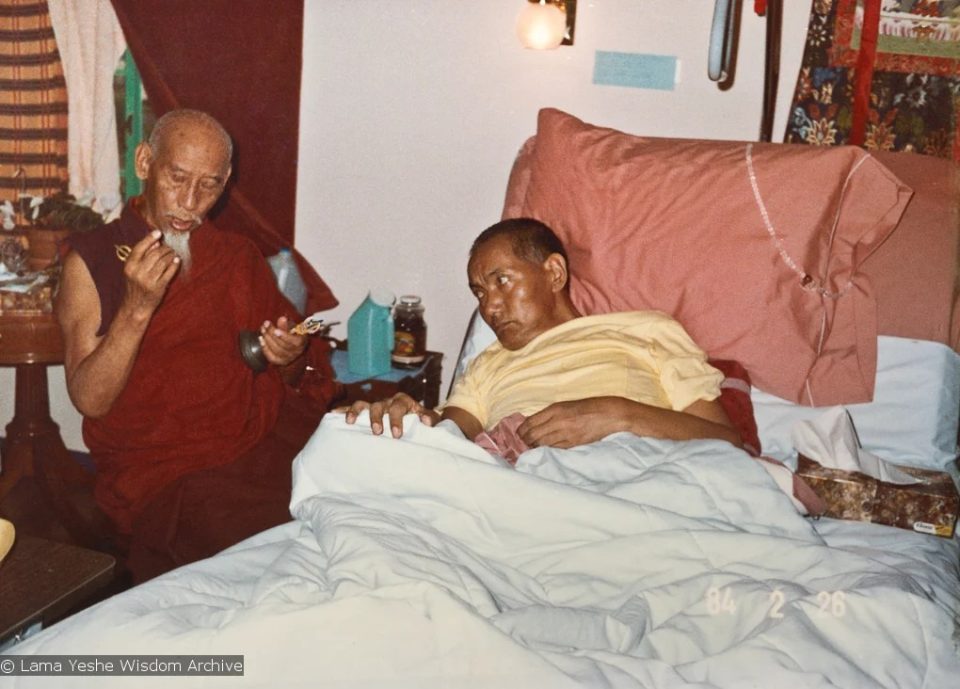
Zong Rinpoche and Lama Yeshe shortly before Lama’s death, California, 1984. Photo by Lama Zopa Rinpoche, courtesy of LYWA.
In winter 1983, I was in Bodhgaya. Ling Rinpoche had just passed away, and Lama Yeshe was seriously ill in California. Each evening, we gathered at the stupa with Piero Cerri to recite the Lama Chopa. When news came of Lama Yeshe’s passing, I was away renewing my visa. When I returned, Piero had left me a telegram with the news.
My mother arrived soon after for a one-month visit, and we went to Dharamsala for the forty-nine days following his passing. On our way to Tushita for a puja, I badly twisted my ankle. Fortunately, Dr. Drolma in McLeod Ganj treated it effectively, though it was quite painful. We missed the puja.
I returned to Kopan around mid-April. A continuous, twenty-four-hour Dorje Sempa practice was taking place in several locations worldwide. I rented a small house from farmers below the hill. Very few people were in Kopan at that time. We took turns each hour. I especially valued the night sessions, when everything was quiet. It felt like maintaining a presence, a continuity. Lama Yeshe’s presence felt very close.
When the monsoon began, frogs leapt at every step. The paths were slippery, and I often fell, returning home covered in mud. Yet there was joy in this. I could almost hear Lama Yeshe laughing.
When Lama Zopa Rinpoche returned, I met with him at length. For the first time, I felt completely open to whatever he might suggest. He advised me to do a one-month retreat in Namo Buddha, Kathmandu, followed by a three-month retreat in Lawudo. I prepared with trust, even though there were no clear arrangements and no way to communicate in advance.
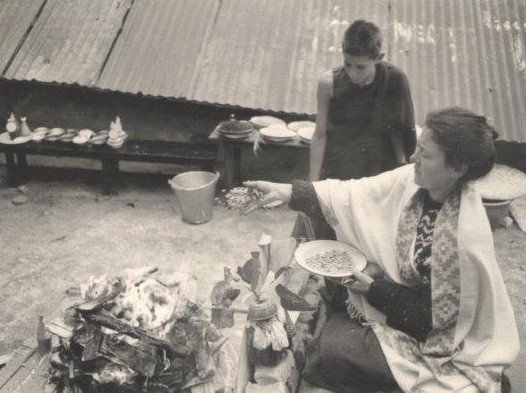
Michelle Le Dimna fire puja at Kopan Monastery at the end of her three month retreat at Lawudo. Helped by young Daja Wangchuk. Photo courtesy of Michelle Le Drimna.
I traveled to Dhulikhel and walked up to Namo Buddha. The site is a major pilgrimage place, with large brick buildings surrounding an ancient stupa. It commemorates the offering of a previous life of Buddha Shakyamuni to a starving tigress and her cubs. I found a simple room and stayed there. After that, I went to Lawudo, as mentioned earlier. When I returned to Kopan at the end of December, 1984, Lama Zopa Rinpoche was there. He invited me for a meal and asked in detail about life in Lawudo.
You can read about Michelle’s visit to Solu Khumbu in 1984-1985 and her three-month winter retreat in Lawudo.
With grateful thanks to Michelle Le Dimna for sharing this story of how she found her way to Kopan, and for her forty-year contribution to translating Dharma texts into French, teaching Dharma, and many other projects!
Are you an early student of FPMT who was there at the beginning? Do you have a story to share about how you met Lama Yeshe or Lama Zopa Rinpoche or the impact they have had on your life? Have you personally achieved or actualized a request, advice, practice accomplishment, or project given to you by Lama Yeshe or Lama Zopa Rinpoche? We want to hear from you!
Please explore all of the resources we have compiled related to FPMT history. We look forward to all of your creative ideas on how to bring this year-long celebration to your own local activities and personal practices! Please use the hashtag #50YearsFPMT in your social media posts so we can all be connected in this way.
Foundation for the Preservation of Mahayana Tradition (FPMT), is a Tibetan Buddhist organization dedicated to the transmission of the Mahayana Buddhist tradition and values worldwide through teaching, meditation and community service.