- Home
- FPMT Homepage
Foundation for the Preservation of the Mahayana Tradition
The FPMT is an organization devoted to preserving and spreading Mahayana Buddhism worldwide by creating opportunities to listen, reflect, meditate, practice and actualize the unmistaken teachings of the Buddha and based on that experience spreading the Dharma to sentient beings. We provide integrated education through which people’s minds and hearts can be transformed into their highest potential for the benefit of others, inspired by an attitude of universal responsibility and service. We are committed to creating harmonious environments and helping all beings develop their full potential of infinite wisdom and compassion. Our organization is based on the Buddhist tradition of Lama Tsongkhapa of Tibet as taught to us by our founders Lama Thubten Yeshe and Lama Thubten Zopa Rinpoche.
- Willkommen
Die Stiftung zur Erhaltung der Mahayana Tradition (FPMT) ist eine Organisation, die sich weltweit für die Erhaltung und Verbreitung des Mahayana-Buddhismus einsetzt, indem sie Möglichkeiten schafft, den makellosen Lehren des Buddha zuzuhören, über sie zur reflektieren und zu meditieren und auf der Grundlage dieser Erfahrung das Dharma unter den Lebewesen zu verbreiten.
Wir bieten integrierte Schulungswege an, durch denen der Geist und das Herz der Menschen in ihr höchstes Potential verwandelt werden zum Wohl der anderen – inspiriert durch eine Haltung der universellen Verantwortung und dem Wunsch zu dienen. Wir haben uns verpflichtet, harmonische Umgebungen zu schaffen und allen Wesen zu helfen, ihr volles Potenzial unendlicher Weisheit und grenzenlosen Mitgefühls zu verwirklichen.
Unsere Organisation basiert auf der buddhistischen Tradition von Lama Tsongkhapa von Tibet, so wie sie uns von unseren Gründern Lama Thubten Yeshe und Lama Thubten Zopa Rinpoche gelehrt wird.
- Bienvenidos
La Fundación para la preservación de la tradición Mahayana (FPMT) es una organización que se dedica a preservar y difundir el budismo Mahayana en todo el mundo, creando oportunidades para escuchar, reflexionar, meditar, practicar y actualizar las enseñanzas inconfundibles de Buda y en base a esa experiencia difundir el Dharma a los seres.
Proporcionamos una educación integrada a través de la cual las mentes y los corazones de las personas se pueden transformar en su mayor potencial para el beneficio de los demás, inspirados por una actitud de responsabilidad y servicio universales. Estamos comprometidos a crear ambientes armoniosos y ayudar a todos los seres a desarrollar todo su potencial de infinita sabiduría y compasión.
Nuestra organización se basa en la tradición budista de Lama Tsongkhapa del Tíbet como nos lo enseñaron nuestros fundadores Lama Thubten Yeshe y Lama Zopa Rinpoche.
A continuación puede ver una lista de los centros y sus páginas web en su lengua preferida.
- Bienvenue
L’organisation de la FPMT a pour vocation la préservation et la diffusion du bouddhisme du mahayana dans le monde entier. Elle offre l’opportunité d’écouter, de réfléchir, de méditer, de pratiquer et de réaliser les enseignements excellents du Bouddha, pour ensuite transmettre le Dharma à tous les êtres. Nous proposons une formation intégrée grâce à laquelle le cœur et l’esprit de chacun peuvent accomplir leur potentiel le plus élevé pour le bien d’autrui, inspirés par le sens du service et une responsabilité universelle. Nous nous engageons à créer un environnement harmonieux et à aider tous les êtres à épanouir leur potentiel illimité de compassion et de sagesse. Notre organisation s’appuie sur la tradition guéloukpa de Lama Tsongkhapa du Tibet, telle qu’elle a été enseignée par nos fondateurs Lama Thoubtèn Yéshé et Lama Zopa Rinpoché.
Visitez le site de notre Editions Mahayana pour les traductions, conseils et nouvelles du Bureau international en français.
Voici une liste de centres et de leurs sites dans votre langue préférée
- Benvenuto
L’FPMT è un organizzazione il cui scopo è preservare e diffondere il Buddhismo Mahayana nel mondo, creando occasioni di ascolto, riflessione, meditazione e pratica dei perfetti insegnamenti del Buddha, al fine di attualizzare e diffondere il Dharma fra tutti gli esseri senzienti.
Offriamo un’educazione integrata, che può trasformare la mente e i cuori delle persone nel loro massimo potenziale, per il beneficio di tutti gli esseri, ispirati da un’attitudine di responsabilità universale e di servizio.
Il nostro obiettivo è quello di creare contesti armoniosi e aiutare tutti gli esseri a sviluppare in modo completo le proprie potenzialità di infinita saggezza e compassione.
La nostra organizzazione si basa sulla tradizione buddhista di Lama Tsongkhapa del Tibet, così come ci è stata insegnata dai nostri fondatori Lama Thubten Yeshe e Lama Zopa Rinpoche.
Di seguito potete trovare un elenco dei centri e dei loro siti nella lingua da voi prescelta.
- 欢迎 / 歡迎
简体中文
“护持大乘法脉基金会”( 英文简称:FPMT。全名:Foundation for the Preservation of the Mahayana Tradition) 是一个致力于护持和弘扬大乘佛法的国际佛教组织。我们提供听闻,思维,禅修,修行和实证佛陀无误教法的机会,以便让一切众生都能够享受佛法的指引和滋润。
我们全力创造和谐融洽的环境, 为人们提供解行并重的完整佛法教育,以便启发内在的环宇悲心及责任心,并开发内心所蕴藏的巨大潜能 — 无限的智慧与悲心 — 以便利益和服务一切有情。
FPMT的创办人是图腾耶喜喇嘛和喇嘛梭巴仁波切。我们所修习的是由两位上师所教导的,西藏喀巴大师的佛法传承。
繁體中文
護持大乘法脈基金會”( 英文簡稱:FPMT。全名:Found
ation for the Preservation of the Mahayana Tradition ) 是一個致力於護持和弘揚大乘佛法的國際佛教組織。我們提供聽聞, 思維,禪修,修行和實證佛陀無誤教法的機會,以便讓一切眾生都能 夠享受佛法的指引和滋潤。 我們全力創造和諧融洽的環境,
為人們提供解行並重的完整佛法教育,以便啟發內在的環宇悲心及責 任心,並開發內心所蘊藏的巨大潛能 — 無限的智慧與悲心 – – 以便利益和服務一切有情。 FPMT的創辦人是圖騰耶喜喇嘛和喇嘛梭巴仁波切。
我們所修習的是由兩位上師所教導的,西藏喀巴大師的佛法傳承。 察看道场信息:
- FPMT Homepage
- News/Media
-
- Study & Practice
-
-
- About FPMT Education Services
- Latest News
- Programs
- New to Buddhism?
- Buddhist Mind Science: Activating Your Potential
- Heart Advice for Death and Dying
- Discovering Buddhism
- Living in the Path
- Exploring Buddhism
- FPMT Basic Program
- FPMT Masters Program
- FPMT In-Depth Meditation Training
- Maitripa College
- Lotsawa Rinchen Zangpo Translator Program
- Universal Education for Compassion & Wisdom
- Online Learning Center
-
- Prayers & Practice Materials
- Overview of Prayers & Practices
- Full Catalogue of Prayers & Practice Materials
- Explore Popular Topics
- Benefiting Animals
- Chenrezig Resources
- Death & Dying Resources
- Lama Chopa (Guru Puja)
- Lama Zopa Rinpoche: Compendium of Precious Instructions
- Lama Zopa Rinpoche: Life Practice Advice
- Lama Zopa Rinpoche Practice Series
- Lamrim Resources
- Mantras
- Prayer Book Updates
- Purification Practices
- Sutras
- Thought Transformation (Lojong)
- Audio Materials
- Dharma Dates - Tibetan Calendar
- Translation Services
- Publishing Services
- Ways to Offer Support
- Prayers & Practice Materials
-
- Teachings and Advice
- Find Teachings and Advice
- Lama Zopa Rinpoche Advice Page
- Lama Zopa Rinpoche: Compendium of Precious Instructions
- Lama Zopa Rinpoche Video Teachings
- ༧སྐྱབས་རྗེ་བཟོད་པ་རིན་པོ་ཆེ་མཆོག་ནས་སྩལ་བའི་བཀའ་སློབ་བརྙན་འཕྲིན།
- Podcasts
- Lama Yeshe Wisdom Archive
- Buddhism FAQ
- Dharma for Young People
- Resources on Holy Objects
- Teachings and Advice
-
-
*If a menu item has a submenu clicking once will expand the menu clicking twice will open the page.
-
-
- Centers
-
- Teachers
-
- Projects
-
-
-
-
*If a menu item has a submenu clicking once will expand the menu clicking twice will open the page.
-
-
- FPMT
-
- Shop
-
-
-
The Foundation Store is FPMT’s online shop and features a vast selection of Buddhist study and practice materials written or recommended by our lineage gurus. These items include homestudy programs, prayers and practices in PDF or eBook format, materials for children, and other resources to support practitioners.
Items displayed in the shop are made available for Dharma practice and educational purposes, and never for the purpose of profiting from their sale. Please read FPMT Foundation Store Policy Regarding Dharma Items for more information.
-
-
17
Advice from Our Lamas: Death Education

Cover of Big Love: The Live and Teachings of Lama Yeshe
How to deal with and prepare for the death of a loved one, and how to take care of a dying person—including oneself—are topics both Lama Yeshe and Lama Zopa Rinpoche gave several teachings on over the years, and they both stressed that death education is essential learning and practice for all of us.
Adele Hulse, the author of Big Love: The Life and Teachings of Lama Yeshe, and a popular journalist, recounted how the news of her father’s death brought her to a clear awareness of impermanence. Today we share this profound excerpt from Big Love (Volume 1, pp. 333-334), which gives insight into Lama Yeshe’s unique style of reaching students around the topic of death:
In early March [1974] the lamas returned to Nepal and met the Australian journalist Adele Hulse. She had been in Boudha, the area around the monumental stupa located a forty-minute walk from Kopan hill, since before Christmas. “Having spent eleven years in Catholic boarding schools in Australia,” Adele explained, “religion was the last thing on my mind. I wasn’t keen on Californian ‘Boodhists’ jangling their beads and mumbling about their ‘gooroo.’ Then a telegram arrived with the news of my father’s death. Standing outside the Kathmandu post office I suddenly realized I too was going to die one day. The words exploded in my brain: ‘He’s dead. You’re next.’ I looked around me at the people in the street and saw that they too would die.
“I returned to the house full of the ‘sophisticated’ hippies I hung around with, but now they seemed childish—they just wanted me to smoke opium and forget about it. I didn’t want to forget about it. I yearned to talk to someone sensible and knew the ‘gooroo’ on Kopan hill spoke English. On my way up there I ran into the English girl everyone said was crazy. I had met her before in a tea shop and she seemed fine to me. She asked me why I was crying and when I explained she clapped her hands and said, ‘Perfect! The lamas can do puja for him and transfer his mind into a pure realm.’ What?
“When I arrived at Kopan, Yeshe Khadro took me to Lama Yeshe’s room. ‘Tell me about your father,’ he said. I explained he was a truly wretched war-damaged alcoholic who had singled me out for consistently vicious treatment all my life. ‘You want to help him?’ he asked. I said I did, and the girl everyone called crazy had said something about pujas and mind transfers but I didn’t believe in such stuff. ‘Doesn’t matter you believe or you don’t believe,’ he said. ‘Fact is, you are his daughter and you want to help. That’s all we need. But it should happen on a special day, an auspicious day, so we should do later. Now you tell me—can you visualize your father?’ He said ‘bisualize.’ I certainly could—that huge red and purple head, the stink of alcohol, the ever-present threat of abuse and violence.
“So, you should try to see him in the worst suffering aspect, most drunk, most angry, that one. Put that picture in your heart. Then think that through a hole in the crown of your head comes white radiating light from Lord Buddha; it comes down through your heart and washes your father, purifying him of all negativities and sufferings. You think you can do that? Good. So you practice that now as much as possible and come back in four days and we’ll do puja. You will need to pay for small offerings. Yeshe Khadro, she will tell you. OK, dear, goodbye for now,’ he said.
“Considerably cheered, I went to see Yeshe Khadro again. She said that when she told Lama my father had died and I wanted to see him, he had said, ‘Yes, dear, everything that is born must die.’ That was exactly what I had realized when I had read the telegram. I had met my guru and I wasn’t even looking for one.
“Four days later I came back with some money in white envelopes for the officiating lamas and more to pay for tea and ‘gompa buns,’ as they were called. It all cost very little. The gompa was full of boys and Injis. Lama Lhundrup was umdze and Lama Zopa Rinpoche sat on the throne. Lama Yeshe had a big bundle of burning incense in his hand and walked around throughout the ceremony. I thought it was what he always did, because it was my very first puja. I later learned it was most unusual. While cymbals crashed and the incomprehensible rhythmic chanting went on and on, I just sat and did the ‘bisualization’ thing Lama Yeshe had taught me. I didn’t understand anything but felt so comfortable there—and afterward so happy and, somehow, useful. I decided to do the course that was coming up, not because I thought Lama Yeshe was nice, not because I wanted to be a Buddhist—I was busy enough trying not to be a Catholic—but because I knew it required mental discipline and would help me decide if there really was anything more exciting in life than acid and black Nepalese temple ball hashish.
“Over the next two weeks I continued to visualize my father as instructed and noted that he seemed to appear younger, healthier. He was back to looking as he had in his wedding photos. Was I imagining all this? By this time I’d been at the course for a while and discovered I had almost no powers of concentration. Then one day I couldn’t conjure him up. No matter how hard I ‘bisualized,’ he didn’t come back.
“I never had to seek out Lama Yeshe as he always just appeared in front of me whenever I felt like talking to him. When I told him my powers of concentration had completely deserted me, he looked deeply into my eyes, bumped his forehead against mine and said, ‘Gone now. Reborn.’ So I stopped trying. I didn’t know what to make of it all but felt good about my father for the first time in my life.”
Excerpted from Big Love: The Life and Teachings of Lama Yeshe by Adele Hulse. Lama Yeshe Wisdom Archive, 2020, pp. 333-334.
Big Love: The Life and Teachings of Lama Yeshe is published as a set of two 700-page hardcover volumes in a slipcase with over 1,550 photographs, maps and other illustrations, full color throughout. This is essential reading for FPMT history!
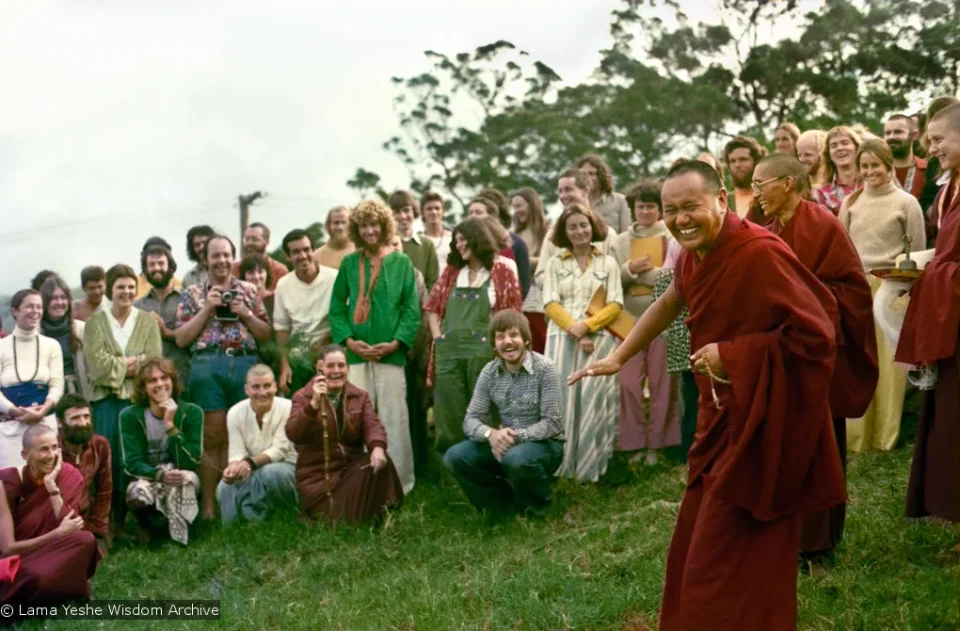
Lama Yeshe and Lama Zopa Rinpoche with Yeshe Khadro (Marie Obst) as their attendant blessing the prayer-flag pole, Chenrezig Institute, Australia, 1976. Adele Hulse is pictured directly to the left of Lama Yeshe. Photo courtesy of the Lama Yeshe Wisdom Archive.
Lama Yeshe and Lama Zopa Rinpoche on the Importance of Death Education
In 1983, Lama Yeshe gave one of his most direct teachings on impermanence, shortly before he passed away the following year. During the seminar in Geneva called Life, Death and After Death, from which a free e-book has been published by the Lama Yeshe Wisdom Archive, Lama highlights how important it is to understand how the mind works, including during the process of dying:
“It’s essential that you educate yourself in this. If you do, you’ll have no fear that dying is horrible, like falling into a black hole; that death’s a black hole that’s going to suck you in and eat you up. From the moment we were born we’ve been destined for death. We think that dying is a big deal, worse than losing a job, a boyfriend, a girlfriend, husband or wife. That’s the wrong attitude. We think that dying is negative, but that’s just our projection Death is better than a flower, for example. A flower cannot give you tremendous peace and bliss. It can give you something, but not that. Death, however, can give you both: tremendous peace and tremendous bliss. Death is better than your boyfriend, girlfriend, husband or wife because they give you very little bliss. They cannot truly solve your problems. They can alleviate emotional anxiety momentarily, perhaps, but not for long. At the moment of death, however, all anxiety and other emotional problems are totally cut off for a long period of time.”
Lama Zopa Rinpoche also emphasized: “that a complete education about death is the most important education we can have. What death is, how we die, what minds we need at death, and what happens after death—only by knowing about death and rebirth can we actually fully understand what life is and so learn how to live fully. In the West, such questions are generally not studied. What happens at the very beginning of this life and at the end are like two big black holes; there is no clarity. Even if there are some scientific explanations, these are based on hypotheses, not on personal experience. It seems that if scientists cannot verify something with their instruments, it doesn’t exist for them. They can explain how, at death, the cells break down and the brain stops functioning, but they cannot go beyond that, and they can never address the real question of what happens to us at death.” From How to Live and Die: The Transformative Power of Meditating on Impermanence by Lama Zopa Rinpoche, Wisdom Publications, 2025.
Please explore more resources about death available to you: https://fpmt.org/death/
Foundation for the Preservation of Mahayana Tradition (FPMT), is a Tibetan Buddhist organization dedicated to the transmission of the Mahayana Buddhist tradition and values worldwide through teaching, meditation and community service.
- Tagged: advice for death and dying, big love, lama yeshe
- Home
- News/Media
- Study & Practice
- About FPMT Education Services
- Latest News
- Programs
- New to Buddhism?
- Buddhist Mind Science: Activating Your Potential
- Heart Advice for Death and Dying
- Discovering Buddhism
- Living in the Path
- Exploring Buddhism
- FPMT Basic Program
- FPMT Masters Program
- FPMT In-Depth Meditation Training
- Maitripa College
- Lotsawa Rinchen Zangpo Translator Program
- Universal Education for Compassion & Wisdom
- Online Learning Center
- Prayers & Practice Materials
- Overview of Prayers & Practices
- Full Catalogue of Prayers & Practice Materials
- Explore Popular Topics
- Benefiting Animals
- Chenrezig Resources
- Death & Dying Resources
- Lama Chopa (Guru Puja)
- Lama Zopa Rinpoche: Compendium of Precious Instructions
- Lama Zopa Rinpoche: Life Practice Advice
- Lama Zopa Rinpoche Practice Series
- Lamrim Resources
- Mantras
- Prayer Book Updates
- Purification Practices
- Sutras
- Thought Transformation (Lojong)
- Audio Materials
- Dharma Dates – Tibetan Calendar
- Translation Services
- Publishing Services
- Teachings and Advice
- Find Teachings and Advice
- Lama Zopa Rinpoche Advice Page
- Lama Zopa Rinpoche: Compendium of Precious Instructions
- Lama Zopa Rinpoche Video Teachings
- ༧སྐྱབས་རྗེ་བཟོད་པ་རིན་པོ་ཆེ་མཆོག་ནས་སྩལ་བའི་བཀའ་སློབ་བརྙན་འཕྲིན།
- Podcasts
- Lama Yeshe Wisdom Archive
- Buddhism FAQ
- Dharma for Young People
- Resources on Holy Objects
- Ways to Offer Support
- Centers
- Affiliates Area
- Teachers
- Projects
- Charitable Projects
- Make a Donation
- Applying for Grants
- News about Projects
- Other Projects within FPMT
- Support International Office
- Projects Photo Galleries
- Give Where Most Needed
- FPMT
- Shop
Translate*
*powered by Google TranslateTranslation of pages on fpmt.org is performed by Google Translate, a third party service which FPMT has no control over. The service provides automated computer translations that are only an approximation of the websites' original content. The translations should not be considered exact and only used as a rough guide.When I talk of being detached, what I mean is to be simpler, more easy-going. Detachment doesn’t mean totally renouncing everything. It means that you loosen your grip and be more relaxed.