 receive our newsletters
 join Friends of FPMT


Harvey Horrocks and Peter Kedge with Lama Yeshe at the Pisa airport, Italy, 1983.
We recently received the news that long-time student and FPMT pioneer, Harvey Horrocks, has suffered a stroke and is recovering. As inspiration and with prayers for Harvey’s full recovery, we thought to highlight his extraordinary contribution to FPMT including his Road to Kopan story and details of his fifty years of service.
Harvey Horrocks, an English engineer whose life became an unlikely thread connecting Rolls-Royce aircraft workshops and the founding of one of Britain’s first Tibetan Buddhist centers, has dedicated his life to spreading the Dharma and serving the wishes of our Lamas. It was Lama Yeshe himself who called him “an English bodhisattva” — a description that captures, in three words, the spirit of an extraordinary life of service.
Born in Mansfield, Nottinghamshire, into a prosperous Midlands family — his father, a senior engineer, and later, Director, at Rolls-Royce Aero Engine Division, his mother a steadfast and loving presence throughout his life — Harvey grew up in a spacious house and grounds including tennis court, in Radcliffe-on-Trent, near Nottingham, with his parents and sister.
From an early age he was drawn to making things. Sent away at age seven to board at Oundle, one of the UK’s elite Public Schools. Alongside his success in squash, where he played for the First Team, Harvey found his greatest satisfaction in the workshop. That instinct followed him home and into a lifelong love of cars, which he would modify and tune for performance including his beloved Lotus 7. It was the disposition of an engineer: precise, practical, and quietly exhilarated by the physical world.
He read engineering at the University of Sheffield and trained under the Rolls-Royce University Apprenticeship scheme — a year in industry, three years at university, a final year back on the shop floor. But seated at his desk in Rolls-Royce’s vast engineering offices, watching the tea trolley make its rounds and tracing the trajectory his career was expected to follow, Harvey understood, with unusual clarity for a young man, that this was not a ladder he had any interest in climbing.
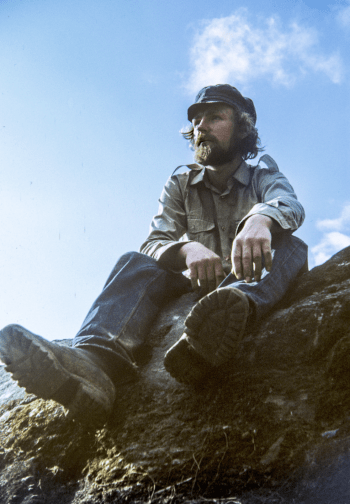
Harvey Horrocks, Nepal, nr. Everest Base Camp, 1972 Photo: Peter Kedge
In his mid-twenties, Harvey and three fellow apprentices — among them his dear friend Peter Kedge — drove a Land Rover from England to Nepal taking six months and covering many miles and adventures. Originally intending to make it to Australia, the four spent six months with the United Mission to Nepal helping build a boarding school north of Pokhara. The Land Rover itself never made it to Australia but by that time, the team had made a connection with Kopan – a connection which has endured to the present day. What began as an adventure, quietly became the opening of a spiritual journey.
Harvey eventually reached Australia via Singapore, crossed the Nullarbor Desert to Sydney, and stayed two years working as an engineer. During this time, he also gained his pilot’s licence.
It was through Peter that Harvey really encountered the Dharma. Peter was by then helping Lama Yeshe establish Tushita Retreat Center in McLeodganj, India, and urged Harvey to come to Nepal.
In 1974, Harvey attended the sixth course at Kopan Monastery, outside Kathmandu, and was moved in ways he had not anticipated by the teachings of Lama Yeshe and Lama Zopa Rinpoche. At the course’s end, hearing there was to be a high-altitude retreat, he volunteered to serve as attendant to those who would go — certain he could not endure four months alone in the mountains. Then Lama Yeshe asked him, simply and in passing, whether he was going to do the retreat. The question was sufficient. Harvey knew he had to go.
He completed four and a half months of Vajrasattva practice — enduring a broken tooth managed only with oil of cloves — without a single moment of boredom, and with a deepened understanding of the mind’s stubborn, circling power, even when one can see exactly what it is doing.
Harvey returned to England in December 1974. Before leaving, Harvey with Peter asked Lama Yeshe for his blessing to establish a Dharma center there, and Lama Yeshe arranged for the pair to meet and take advice from His Holiness the Dalai Lama.
In London working from a flat, then lodging with two British Tibetan Buddhist nuns in Bromley, Harvey organized Geshe Rabten’s first teaching visit to England — a ten-day residential course attended by over a hundred people, with Gonsar Rinpoche translating and Alan Wallace leading discussion groups.
In 1975, Harvey searched with Peter for a suitable property all over the UK. On their list of possible properties was Conishead Priory in Cumbria, vacant for four and a half years. They sent photographs to Lama Yeshe. Lama sent back a postcard: “Proceed immediately to buy.” Three or four weeks before Lama Yeshe was due to arrive in England to give a course, negotiations were underway when the owner of Conishead Priory called Harvey on a Friday and said: “Take it now, or not at all.” By Monday it was purchased for £70,000 (seventy thousand pounds): seventy acres, a mile of beach, mature woodlands, and a large 200 room Victorian building that had stood silent since 1971. Harvey and his colleagues had ten days to make it habitable before the Lamas arrived. Twelve people stayed on through the winter. Manjushri Institute was open, and Harvey was to serve as its director.
Harvey managed the practical and administrative life of the community, establishing a daily rhythm of teachings, pujas, and work practice, and ensuring that every resident — however long the working day — had access to the Dharma. A journalist from the Daily Express visited the Priory and was so struck by what he found that the story ran on the front page.
In 1978, Lama Yeshe unveiled the revolutionary Geshe Studies Program at Manjushri Institute with the help of Geshe Jampa Gyatso. As FPMT activity began to spread around the world and the demand for quality teachers became apparent, Lama Yeshe hoped to ensure that his own students could obtain an excellent education, qualifying them as legitimate sources for Buddhist teachings.
In 1979, Geshe Tegchock gave his first talk at Manjushri Institute, with Lama Zopa Rinpoche conferring a Chenrezig empowerment, followed by Lama Yeshe’s Tara Cittamani empowerment and six days of commentary reviewed by Jon Landaw. Of 120 people attending, 105 stayed on for the retreat. Students who had completed the first Geshe Studies Program examinations received congratulations and gifts from the Lamas in recognition of their hard work and dedication.
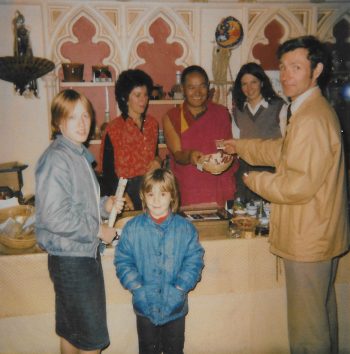
Lama Yeshe with Ondy Willson, Brenda, Harvey Horrocks and kids, at the Chapel Cafè of Manjushri Institute, 1980. Photo courtesy Lama Yeshe Wisdom Archive. Big Love p. 845
After another demanding year at Manjushri Institute, Harvey returned to Kopan for the Tara Cittamani initiation. He later recalled that the intensity of activity at Manjushri Institute had left him completely exhausted. Lama Yeshe called him in and asked for a full account of what had been happening, listening as Harvey described the situation in detail. As the conversation went on, Harvey found himself overwhelmed and began to cry. At that point, Lama responded with great kindness, reaching out, taking his hand, and gently explaining that it was not possible to support so many people without a proper financial structure in place. He later addressed this issue directly with the residents at the Institute. Over time, Lama continued to speak with Harvey on several occasions, including during his stay in the Lake District, helping him to understand the full responsibility of leading such a vast undertaking and how to grow into his role as director. Lama recognized how busy the Institute had become and how difficult it was for Harvey to come to terms with the scale of what he had taken on.
Some of Manjushri’s students had become increasingly frustrated with the way the center was being run under Harvey’s direction, and a brainstorming weekend was organized, bringing together many of the stakeholders. During that time, Lama Yeshe was teaching in the chapel. At one point, his tone grew unexpectedly firm as he addressed the situation directly. He challenged the group’s reliance on collective decision-making, pointing out the difficulties it had led to, and urged them to reflect on its consequences. He then made it clear that, if they truly wished to support Manjushri Institute, they should go to Harvey and ask how they could be of help. Lama reminded everyone that he had appointed Harvey as director, and that this decision should be respected, with the community offering him their full support in that role.
Harvey was then appointed to lead the Istituto Lama Tzong Khapa in Pomaia, Italy, at a moment of urgent need. Pulled out of retreat by a telegram from Lama Yeshe — “Urgent. Harvey Horrocks: Emergency stop please come immediately ILTK to be director stop…” — he arrived in 1981. Lama assured the community: “I send you an English bodhisattva”, Massimo Andreazzo, who was at ILTK at the time, simply remembered Harvey as “the perfect person.”
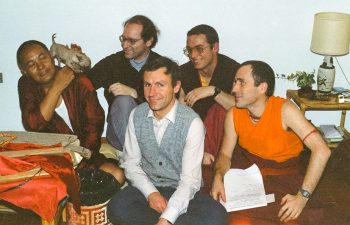
Lama Yeshe with Jon, Harvey, Pende, George at the Lama Tzong Khapa Institute, 1982. Photo courtesy Lama Yeshe Wisdom Archive. Big Love p.1092
At ILTK, Harvey hosted the European Regional meeting, for which Lama Yeshe sent a detailed letter crystallizing the respective responsibilities of the CPMT and of individual centers. High on the agenda was organizing His Holiness the Dalai Lama’s European tour. In 1982, while Harvey was director, His Holiness made his first visit to ILTK — a landmark occasion that also included the historic first meeting between the Dalai Lama and Pope John Paul II. In 1983, Lama Yeshe appointed Harvey to serve on the first FPMT Board of Directors.
Later Harvey settled in San Jose, California. His father, facing financial difficulty, illness, and the loss of medications he had relied on for decades, took his own life on Harvey’s birthday in 1984— a few weeks before Lama Yeshe also passed. Harvey believed the choice of date was not made in anger, but to ensure that he would be with his mother when it happened. His father had, in his final months, told Harvey’s mother that he thought Harvey had become a nice young man. Harvey always considered this significant praise, given the rather austere man his father was.
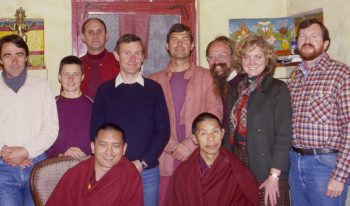
Lama Zopa Rinpoche, Lama Lhundrup, Paul Bourke, Yeshe Khadro, Nick Ribush, Harvey Horrocks, Marcel Bertels, Jeff Nye, Jacie Keeley, Doren Harper. First FPMT board created by Lama Yeshe (including not in the photo Massimo Corona, Trisha Donnelly, Shan Tate). Kopan 1984 . Photo courtesy Lama Yeshe Wisdom Archive. Big Love p.1121
In 1987, Harvey was appointed director of the FPMT International Office, and in that same year, he launched the newsletter The Blissful Rays of the Mandala, precursor to Mandala magazine (established in 1995 by Ven. Robina Courtin). He served the International Office in an exemplary way. Through his extraordinary merit, Harvey was also able to raise substantial funds for the International Office: a single benefactor offered $100,000 a year for five years, enabling the office to expand, offer healthcare benefits to staff, and establish an education fund providing scholarships to students of the Master’s Program in Italy.
Ven. Robina shares: “I’ll never forget when we got a big donation at International Office when it was at Land of Medicine Buddha in the mid-1990s, when I worked for Mandala, and Harvey Horrocks was the CEO: Rinpoche told us that ‘this is the result of Harvey’s mandala offerings.’ Wow.”
In his editorial in the first issue of Mandala, October 1987, Harvey set out a vision whose clarity and scope remain remarkable:
The work of the Foundation is to preserve the Mahayana tradition. It is all the people, in the different centers, who do this work. The method is to take the living seed, the inspiration of the pure lineage received from our teachers, and to give these seeds the right conditions for germination and growth. So, this in turn creates the need for the city centers where people can come to have personal contact with the teachings.
We need publishing activities to reach those other people who are unable to come to the centers as well as to produce support material for study. Then we need the residential centers where there is the chance for serious study to be undertaken over a long period of time in a suitable environment.
We need monasteries for both monks and nuns to enable even deeper studies to be made, supported by the monastic discipline. (The measure of when the Dharma has been established in a country is dependent upon the presence of the Sangha community.)
We need retreat centers to provide perfect conditions for making serious meditational retreats, which allows the real flowering.
Finally, we need universal education as the product of all our study, contemplation and meditation. In this way, our teachers begin to present the Dharma to the people of all ages, from our own, contemporary cultures, in a manner which is “psychologically feasible.” Schools for Buddhist children, as well as for those looking for improved education, are obviously an essential element. School education ready for reincarnate lamas is something we can no longer see as just a theoretical aspect of the responsibility of the Foundation… . In the future, with the aim of representing all the different aspects of the work of the Foundation, we clearly and definitely need news and participation from you in order to have a balanced representation of the FPMT. If you think about it, it is easy to see how the goal of the Foundation cannot be met by just operating one center alone. The different parts of our mandala are all vital for us to have success.
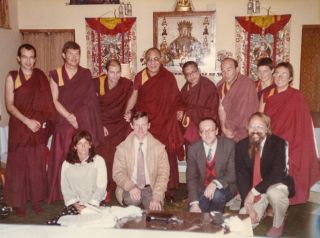
Trisha Donnelly (seated left) with His Holiness the Dalai Lama, Lama Zopa Rinpoche , Pierro Cerri, Heil Huston, Marcel Bertels, Claudio Cipullo, Yeshe Khadro, Robina Courtin, Harvey Horrocks, Massimo Corona and Jeff Nye, at His Holiness’ residence India, 1984 or 85. Photo courtesy of Lama Yeshe Wisdom Archive.
Harvey stands for his sincerity, professionalism, and a life completely devoted to the Dharma and offered in service to benefit all sentient beings. He has dedicated himself to helping realize the vast vision of Lama Yeshe and Lama Zopa Rinpoche. His life continues to be a source of inspiration and gratitude for those whose lives he touched—the communities he helped bring into being, and the present and future generations of students who benefit from what he helped to create.
Details compiled by Fabiana Lotito from an excellent two-part interview Judy Weitzner conducted in 2017, as well as from Big Love: The Life and Teachings of Lama Yeshe, and from archived articles from Mandala magazine and Blissful Rays of the Mandala. Input and details on the history were also shared by Peter Kedge and Nicholas Ribush.
Read more about Harvey’s mandala offerings and his philosophy of service, in his own words, in the article “Patience Rewarded” (p. 30), Mandala, August–September 2006.
Are you an early student of FPMT who was there at the beginning? Do you have a story to share about how you met Lama Yeshe or Lama Zopa Rinpoche or the impact they have had on your life? Have you personally achieved or actualized a request, advice, practice accomplishment, or project given to you by Lama Yeshe or Lama Zopa Rinpoche? We want to hear from you!
Please explore all of the resources we have compiled related to FPMT history. We look forward to all of your creative ideas on how to bring this year-long celebration to your own local activities and personal practices! Please use the hashtag #50YearsFPMT in your social media posts so we can all be connected in this way.
Foundation for the Preservation of Mahayana Tradition (FPMT), is a Tibetan Buddhist organization dedicated to the transmission of the Mahayana Buddhist tradition and values worldwide through teaching, meditation and community service.