 receive our newsletters
 join Friends of FPMT
Obituaries
Arvind Kumar Singh, 55, died in Gaya District, Bihar, India, on April 25, 2021, of COVID-related complications
By Ven. Tenzin Paldron, Root Institute for Wisdom Culture former director, and former volunteer Ven. Tashi Choedup
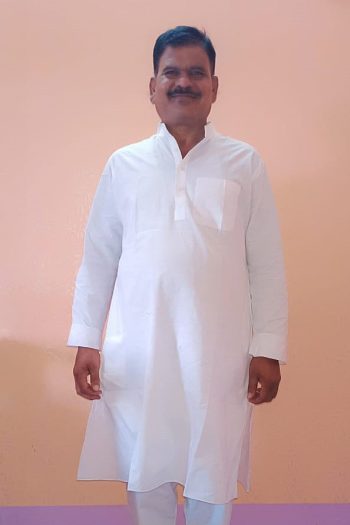
Mr. Arvind Kumar Singh; photo courtesy of the family
Mr. Arvind Kumar Singh, affectionately known as Singh ji, worked at Root Institute for Wisdom Culture, the FPMT center in Bodhgaya, Gaya District, Bihar, India, as an entrance gate guard for more than twenty years. He was a valuable senior member of the Root Institute family.
Singh ji was well liked and respected by his peers and the many volunteers and directors who served Root throughout his years of service. He cheerfully welcomed each and every guest and visitor who passed through our entrance gate.
He is survived by his wife, two sons, and daughter Pooja, who also have deep connections to Root. The children studied at Maitreya School, a project of Root. Pooja worked at Shakyamuni Buddha Clinic, another social service project of Root, for seven years as a female health educator.
Singh ji’s death is a deep loss to the community. He will be dearly missed, and his memory will be fondly cherished by many in the years to come.
Lama Zopa Rinpoche requests that students who read obituaries pray that the person mentioned finds a perfect human body, meets a Mahayana guru, and becomes enlightened quickly, or be born in a pure land where the teachings exist and they can become enlightened.” While reading obituaries we can also reflect on our own death and impermanence prompting us to live our lives in the most meaningful way. More advice from Lama Zopa Ripoche on death and dying is available on Lama Zopa Rinpoche’s advice page.
From Mandala 2006: Margaret (Ellen) Castles, 54, passed away on July 28, 2006, in Port Kembla, NSW, Australia.
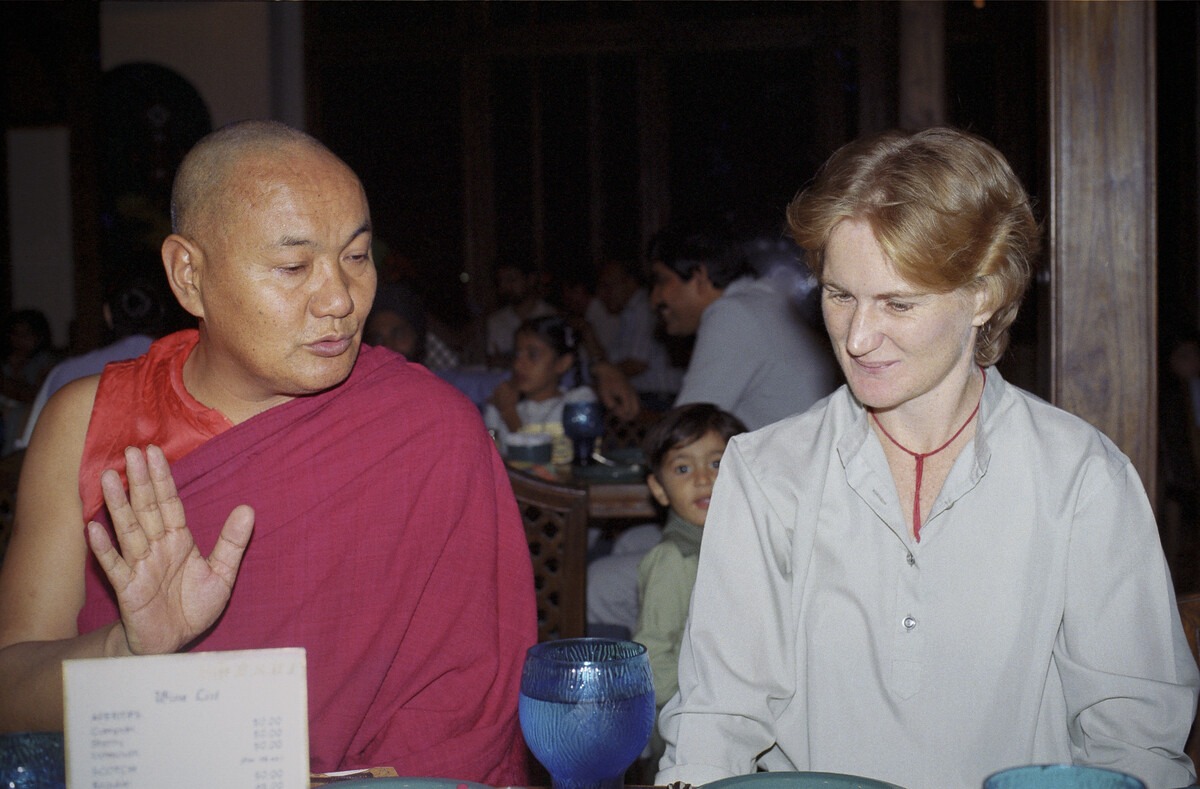
Lama Yeshe and Margaret Castles, Hotel Oberoi, India, 1983. Photo By LYWA Collection.
Margaret, who attended the third Kopan course in the 1970s, lived in India for five years. At Lama Yeshe’s request, she worked for Anila Yeshe Dolma (Sister Max Matthews known affectionately as “Mommy” Max) in the clothing business. She undertook several retreats and took teachings from many lamas including His Holiness the Dalai Lama and His Holiness Ling Rinpoche. Gehlek
Rimpoche, Lama Yeshe, and Lama Zopa Rinpoche were her main teachers.
Back in Sydney, she became involved with Vajrayana Institute where she served as director from 1988 to 1990. She led retreats, taught, advised, listened, and organized events, among them tours for His Holiness the Dalai Lama in 1992 and the Panchen Lama.
Margaret did her practices – got angry (she’d be the first to admit it) – thought, helped others – got angry – listened to teachings, didn’t give up, and always inspired others. Sometimes she made others angry – but she had such practical faith: She listened to her teachers
and would not give up. She later became an FPMT regional coordinator – and got angry! But she kept going.
Thirteen years ago, she developed a life-threatening illness and under instruction began a weekly self-initiation practice which she kept up until her death.
Read the complete article as a PDF.
Please pray that Margaret (Ellen) Castles, may never ever be reborn in the lower realms, may she be immediately born in a pure land where he can be enlightened or to receive a perfect human body, meet the Mahayana teachings and meet a perfectly qualified guru and by only pleasing the guru’s mind, achieve enlightenment as quickly as possible. More advice from Lama Zopa Rinpoche on death and dying is available, see Death and Dying: Practices and Resources (fpmt.org/death/).
To read more obituaries from the international FPMT mandala, and to find information on submission guidelines, please visit our new Obituaries page (fpmt.org/media/obituaries/).
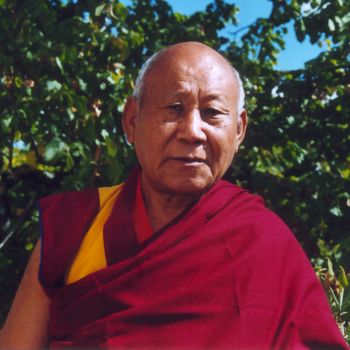
Geshe Losang Tengye. Photo courtesy of Institut Vajra Yogini.
Geshe Losang Tengye, who played an important role in helping establish Tibetan Buddhism in the West, stopped breathing in his room at Institut Vajra Yogini in France on Friday, October 19. Geshe Tengye stayed in clear light meditation for five days. He was 92.
Geshe Tengye was born in Lhatse, Tibet, in 1927. He went to the local monastery at the age of six. He followed a traditional path of in-depth monastic Buddhist study until the 1959 Chinese takeover of Tibet. He went into exile in India and continued his geshe studies at Buxa Chogar, the camp for refugee monks in Buxa Duar, West Bengal, India. Despite illness and hardship, Geshe Tengye received the lharampa geshe degree in 1969.
In 1980, at the request of FPMT co-founder Lama Thubten Yeshe, Geshe Tengye became the resident teacher at Institut Vajra Yogini (IVY), the newly established FPMT center located in the south of France near Toulouse. Due to Geshe Tengye’s infinite patience, wisdom, and compassion, IVY has grown into a large and flourishing Dharma center. He was much loved by his students and will be deeply missed.
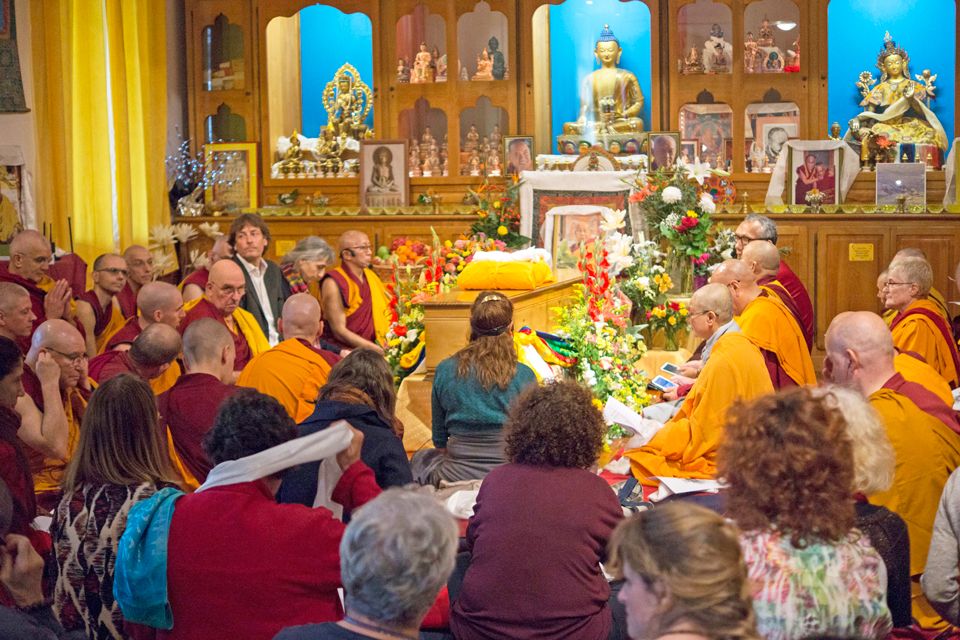
Sangha and lay students doing prayers and practices for Geshe Tengye, Institut Vajra Yogini, France, October 2019. Photo courtesy of Institut Vajra Yogini.
Yangsi Rinpoche, who was a close student of Geshe Tengye, arrived at IVY from the United States on Saturday, October 21. He joined with Geshe Tenzin Loden, the current resident geshe at IVY, and Geshe Losang Jamphel and Geshe Jamphel Gyaltsen, the resident geshes at the nearby Nalanda Monastery, doing daily pujas as advised by Ganden Tripa Lobsang Tenzin Rinpoche, who was a close friend of Geshe Tengye. Western Sangha and lay students also did daily prayers and practices for Geshe Tengye. On Monday, October 28, the body of Geshe Tengye was taken to a local crematorium for cremation. IVY students will continue to do prayers and practices for Geshe Tengye through the forty-nine days, which ends on December 5.
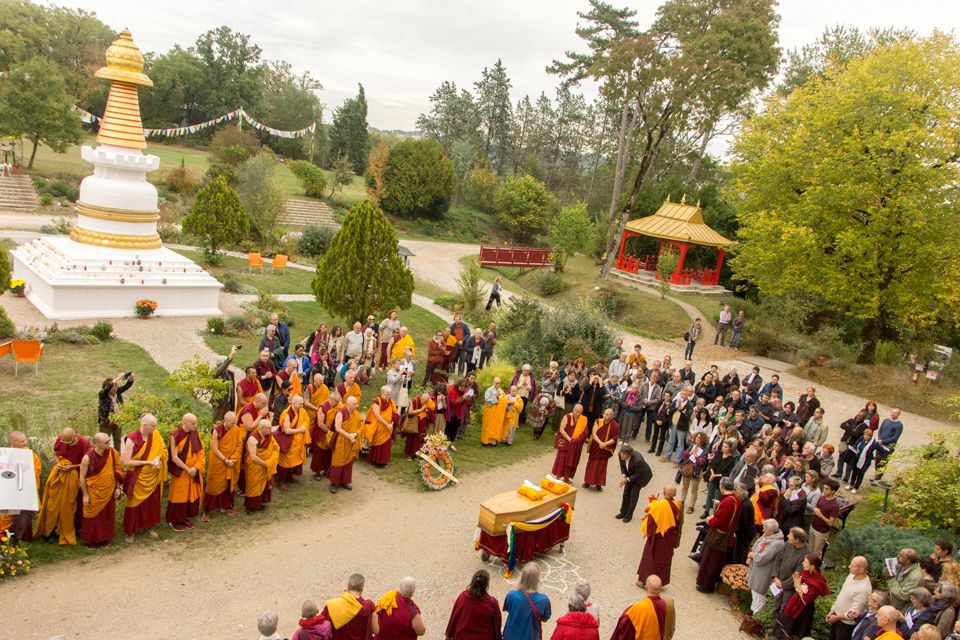
Sangha and lay students gathered for Geshe Tengye at Institut Vajra Yogini, France, October 2019. Photo courtesy of Institut Vajra Yogini.
Read the obituary for Geshe Losang Tengye published in Mandala Issue One 2020.
Learn more about Institut Vajra Yogini, on their website:
https://www.institutvajrayogini.fr/indexA.html
FPMT.org and Mandala Publications brings you news of Lama Zopa Rinpoche and of activities, teachings, and events from over 160 FPMT centers, projects, and services around the globe. If you like what you read, consider becoming a Friend of FPMT, which supports our work.
Chris Vautier 84, died in Watsonville, California, US, July 2, 2018, of Alzheimer’s disease.
Obituary by Barbara Vautier

Barbara and Chris Vautier, Kopan, 1972. Photo credit Lama Yeshe Wisdom Archive
Chris Vautier was born in Barcelona, Spain, on February 4, 1934. He grew up in Switzerland, where he studied architecture as a young man. Chris had a bright and inquisitive mind. He traveled widely in Europe, North Africa, Russia, India, Nepal, Afghanistan, and northern Pakistan, and lived for some time in Spain.
In the fall of 1971, Chris set off on a long overland trek to India. He spent a year living in Afghanistan and the Swat Valley before arriving in India in 1972. He immediately traveled to Dharamsala to study at the Library of Tibetan Works and Archives. One day he noticed a flyer about a month-long meditation course given by Lama Yeshe and Lama Zopa Rinpoche at Kopan Monastery. He was immediately intrigued and decided to travel to Nepal for the course. The course at Kopan changed his life, and he became very devoted to the Lamas, as Lama Yeshe and Lama Zopa Rinpoche were called, and to their work.
At the end of the Kopan course Lama Yeshe asked Chris to come to Dharamsala to design and help build meditation cabins at Tushita Retreat Centre, which became Tushita Meditation Centre. At Losar Chris returned to Dharamsala to meet Lama and began building the A-frame retreat huts at Lama’s request. In 1974 Chris returned to Switzerland from Asia and immediately set about organizing the Lama’s first teaching trip to Europe, which took place in Les Bayards, Switzerland. He was also active in helping organize Geshe Rabten’s first visit to Switzerland in 1975. In 1977, Chris traveled to the United States and attended the course given by Lama Yeshe and Lama Zopa Rinpoche in Yucca Valley, California. The Yucca Valley course planted the seeds for Vajrapani Institute to be created. Later Chris and his family moved to Boulder Creek, California, and Chris became one of the early directors of Vajrapani. During Chris’s tenure as director, Vajrapani invited His Holiness the Dalai Lama to the University of California at Santa Cruz, where he gave two talks. Chris passed away peacefully in Watsonville, California, with his loving family at his side. He had been living with dementia for
about eight years prior to his death. Chris was a very kind, compassionate, and generous person. He was devoted to the
Dharma and played a significant role in helping bring the Dharma to the West. He leaves three daughters, Tai, Alaya, and Olivia, six grandchildren, and three great-grandchildren, his brother, Ben, and his partner, Arin Duggins, who was devoted to looking after him during the long years of his illness.
Read the complete article as a PDF.
Please pray that Chris Vautier may never ever be reborn in the lower realms, may he be immediately born in a pure land where he can be enlightened or to receive a perfect human body, meet the Mahayana teachings and meet a perfectly qualified guru and by only pleasing the guru’s mind, achieve enlightenment as quickly as possible. More advice from Lama Zopa Rinpoche on death and dying is available, see Death and Dying: Practices and Resources (fpmt.org/death/).
To read more obituaries from the international FPMT mandala, and to find information on submission guidelines, please visit our new Obituaries page (fpmt.org/media/obituaries/).
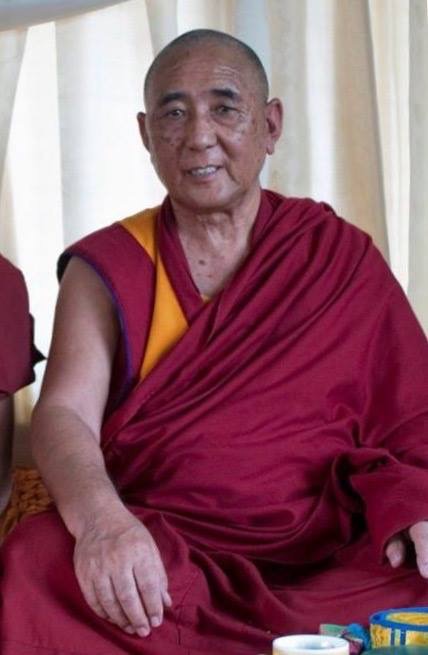
Geshe Pema Tsering
On February 11, 2017, Geshe Pema Tsering, who served as resident teacher at Buddha House in Adelaide, Australia, for nine years entered into clear light meditation after passing away. Mandala received this tribute to Geshe-la from Buddha House director Gabe Edwards on February 16, while Geshe-la was in his fifth day of clear light meditation:
It is with great sadness that we heard of the passing of most precious Geshe Pema Tsering, who was our resident teacher here at Buddha House from September 2001 to December 2010. He returned to Sera Je Monastery in December 2013 and remained there until his passing.
Geshe-la was born in 1939 in Dhargye Village in Kham province, Tibet, the only child of farming parents. He became ordained as a monk in Dhargye Monastery at the age of seven and at seventeen went to Sera Monastery in Lhasa where he met his spiritual teacher, Kyabje Khensur Kangyur Lobsang Thubten Rinpoche, who was also Buddha House’s former resident teacher, and continued his studies with the aim of getting his Geshe degree. He escaped to India at twenty years old following His Holiness the Dalai Lama’s departure from Tibet. Despite the hardships of traversing the snow covered mountains of the Himalayas, Geshe-la said his mind remained happy and buoyed by the positive spirit of his companions.
After ten years in a refugee camp in Buxa Duar, India, Geshe-la traveled to Karnataka in South India and for three years cleared the jungle and assisted in the re-establishment of Sera Je Monastery. He was thirty-three years old when he resumed his geshe studies under Khensur Rinpoche and Geshe Torche. In 1980 he achieve the highest level Geshe Lharampa degree.
Geshe-la had many students in Adelaide and India, and despite his high qualifications, he was widely known for his exceptional humility, kindness, and compassion.

Geshe Pema Tsering with friend and colleague the late Geshe Tsulga
As expressed by student Wendy Cook: “Geshe Pema Tsering passed away four days ago. Although he is considered clinically dead, he is, however, still in meditation, as his most subtle consciousness continues to reside in his body at his heart. The great yogis of Tibet who have committed their lives to deep practice and inquiry manifest this at the time of death. It is considered a very powerful time as one resides in the clear light with great wisdom and motivated by compassion for all beings. Geshe-la is in his final meditation at Sera Je Monastery in South India where the monks are engaged in practice, meditation, and chanting around the clock to support him in his transition. When his consciousness leaves the body, there will be signs, and then the monks will cremate Geshe-la’s body. This is how a great master of Tibet passes. Extraordinary. Without these precious lineage holders, the treasure of Tibetan Buddhism would not have been reestablished in India and then brought to the West.”
Ruth Gamble, scholar and translator for Geshe Pema Tsering while at Buddha House, so eloquently and poignantly expressed: “Gen-la always talked about impermanence. His mother died when he was young. In 1959 an artillery shell hit the room next to him killing his friend. Minutes later, he walked out of his home, and weeks later, he walked out of his country. He lost teachers and friends in refugee camps, and almost lost his thumb clearing the jungle in South India building a new monastery.
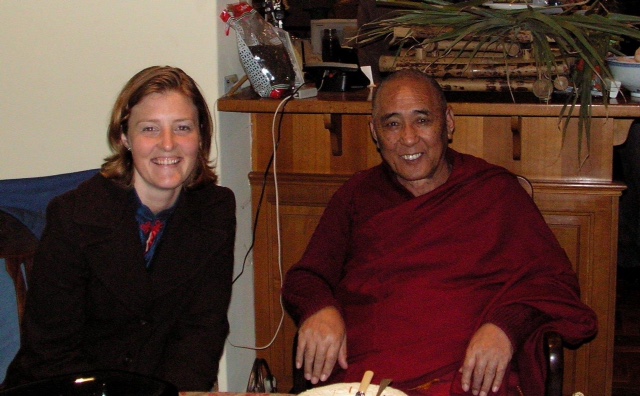
Geshe Pema Tsering with Ruth Gamble
“But even in the midst of all this, he maintained a startlingly sharp sense of humor, fun, and wonder. His hero was a senior monk who told him that ‘the only things a monk needs are a sack and a rope, so it’s easy to get rid of his body when he dies.’ He thought this was a hilarious line. I guess his dark humor explains why he also found former prime minister John Howard and former president George W. Bush amusing: he seemed to think they were personally responsible for keeping the streets clean and the toilets flushing, so they can’t be all bad. He was fascinated by garbage trucks, sewerage works, and construction sites. They seemed to him, a farmer’s son who helped carve a monastery out of a jungle, as an ingenious magic show. He also loved soccer, but rather than barracking for a team, he barracked for a particular score: 3-3. That way, he said, no one felt sad about losing, but there were lots of goals.
“None of this (especially finding John Howard funny) is why he is my hero, though. He’s my hero because I saw him change his state of mind again and again. Rather than let anger, frustration, and jealousy—or even physical pain—shape his mind, he could transform his thoughts in an instant (or sometimes two). His anger would evaporate, his frustration would turn to patience, and his habitual compassion would reassert itself. The good thing about impermanence, he would say, is that it allows change.”
A complete obituary for Geshe Pema Tsering will be included as part of the July-December 2017 issue of Mandala.
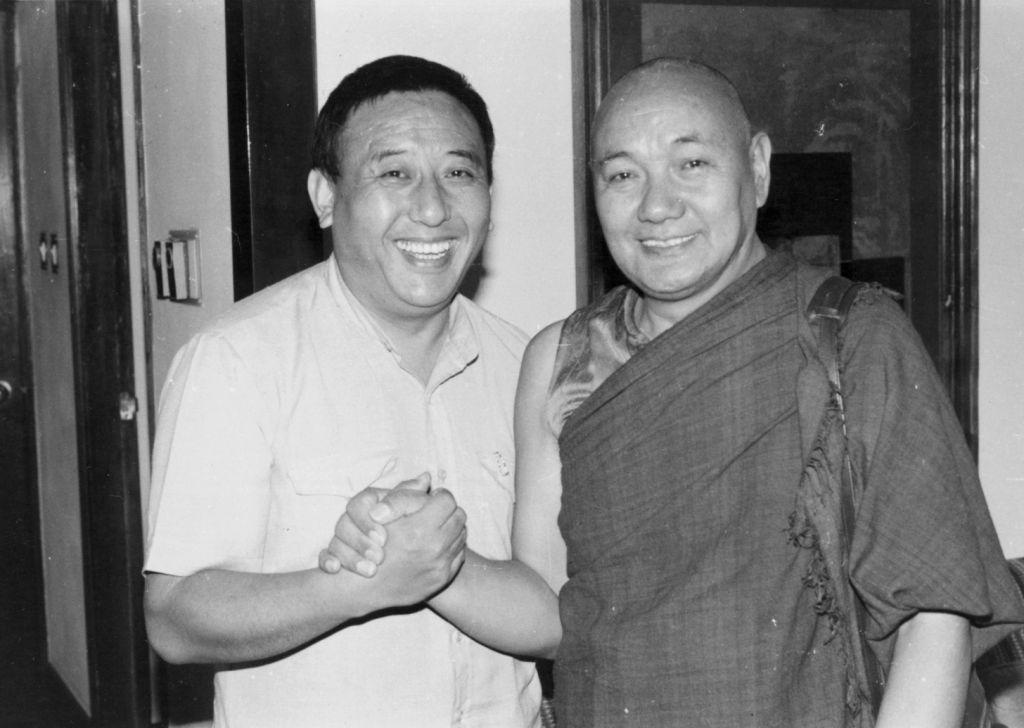
Gelek Rinpoche with Lama Yeshe at Rinpoche’s house. Lama Yeshe would go there to buy texts. Photo courtesy of Lama Yeshe Wisdom Archive.
It was with great sadness that we at FPMT International Office learned of the passing of Gelek Rinpoche (often spelled Gelek Rimpoche), founder of the Jewel Heart centers, on February 15, 2017. Rinpoche was a close friend of FPMT founder Lama Yeshe and spiritual director Lama Zopa Rinpoche.
Long-time student and director of Lama Yeshe Wisdom Archive Nicholas Ribush shares a personal reflection and some historical photos of Rinpoche from the Archive:
In January 1977, Lama Yeshe sent me to Delhi to start Tushita Mahayana Meditation Centre “in order to help repay the kindness of the Indian people to the Tibetans.” Lama explained that the Buddhadharma had come to Tibet from India, had largely been lost in India, had been preserved and developed in Tibet, and now was the time to reintroduce it to its land of origin.
It took a couple of years to find the right place but I eventually found a great house to rent in the lovely New Delhi suburb of Shantiniketan. During this period, in 1978, I first met Gelek Rinpoche at his home in Defence Colony, which was the base for his publishing many important Gelug texts and was where Lama Yeshe went to buy sets of these for his developing Western centers.
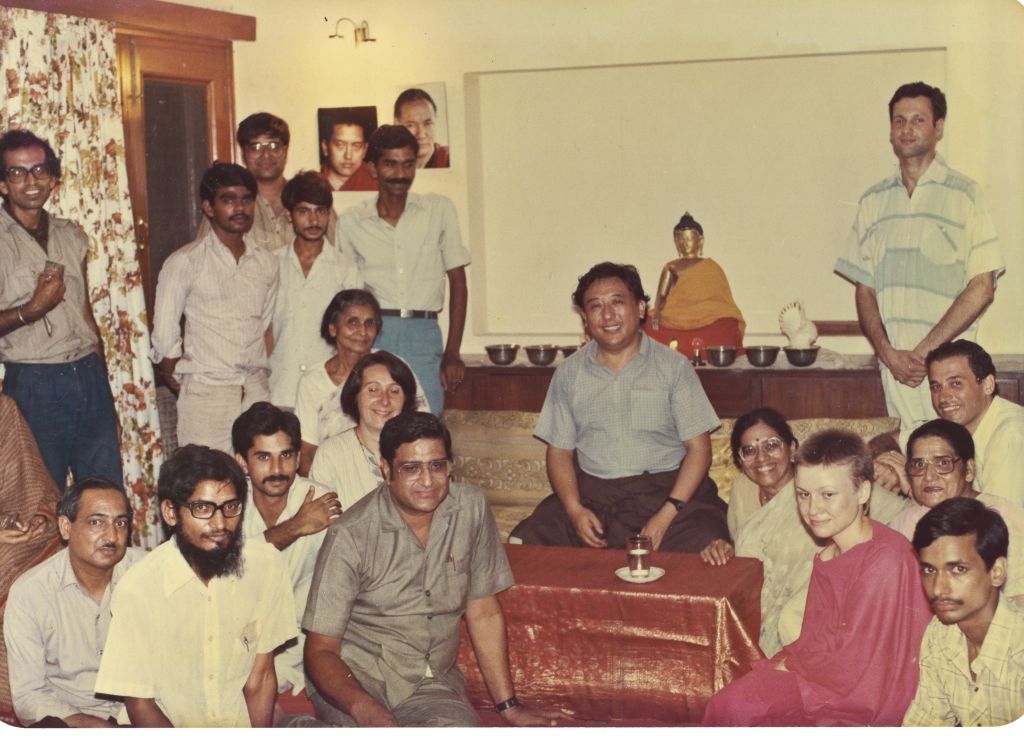
Gelek Rinpoche with students at Tushita. Photo courtesy of Lama Yeshe Wisdom Archive.
After we found the house for Tushita in 1979, Lama suggested I ask Gelek Rinpoche to teach, and he kindly accepted. That was the beginning of a seven-year collaboration between Rinpoche and Tushita. He was a wonderful teacher and connected with both Indian and Western students. I think it was as a result of the connections that Rinpoche made with some American students staying at Tushita (one of our functions was as a guest house for Westerners passing through Delhi) that led to Rinpoche being invited to the USA to teach and later to the establishment of his own organization, the Jewel Heart centers, starting in the late 1980s.
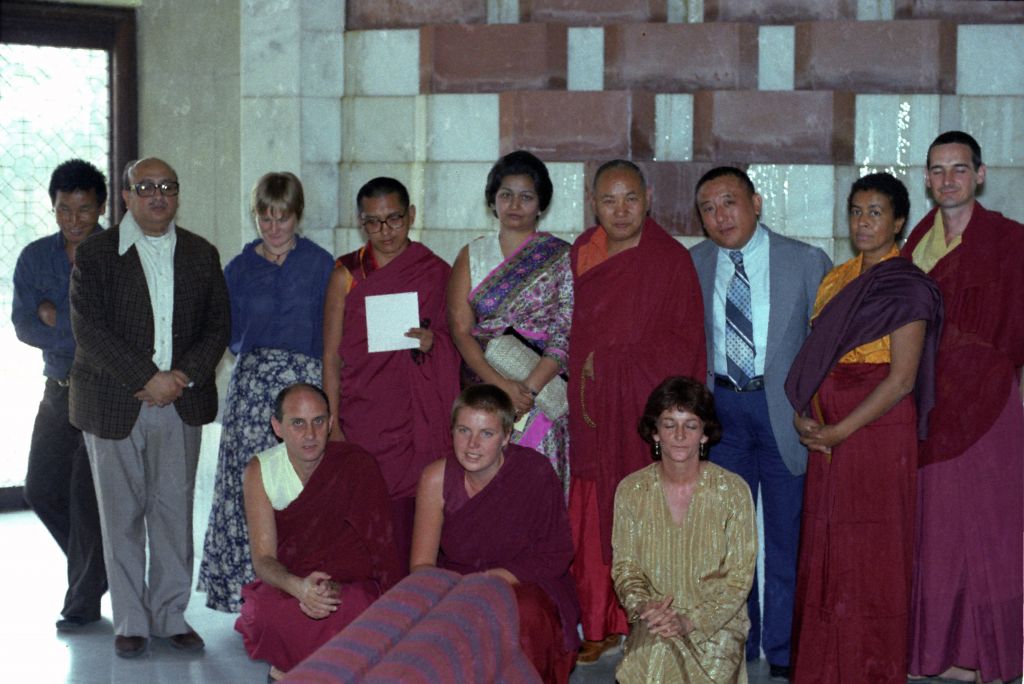
Tushita’s First Dharma Celebration. Photo courtesy of Lama Yeshe Wisdom Archive.
Rinpoche also actively participated in Tushita’s Dharma Celebrations. The first was held at the Oberoi Hotel and Rinpoche was one of the featured panelists. The guest of honor was supposed to be His Holiness the Dalai Lama but he couldn’t make it, so we got the home minister Giani Zail Singh, who later became president of India. Rinpoche was also a prominent guest at our Second Dharma Celebration, held at the Hotel Ashok.

Tushita’s Second Dharma Celebration. Photo courtesy of Lama Yeshe Wisdom Archive.
Lama Yeshe and Lama Zopa Rinpoche used to pass through Delhi at least twice a year and would stay at Tushita. Most times Gelek Rinpoche would visit them on at least one of those visits and they would enjoy meals with him at the center or take him to one of Lama’s sister’s restaurants or to one of the five-star hotels around town.
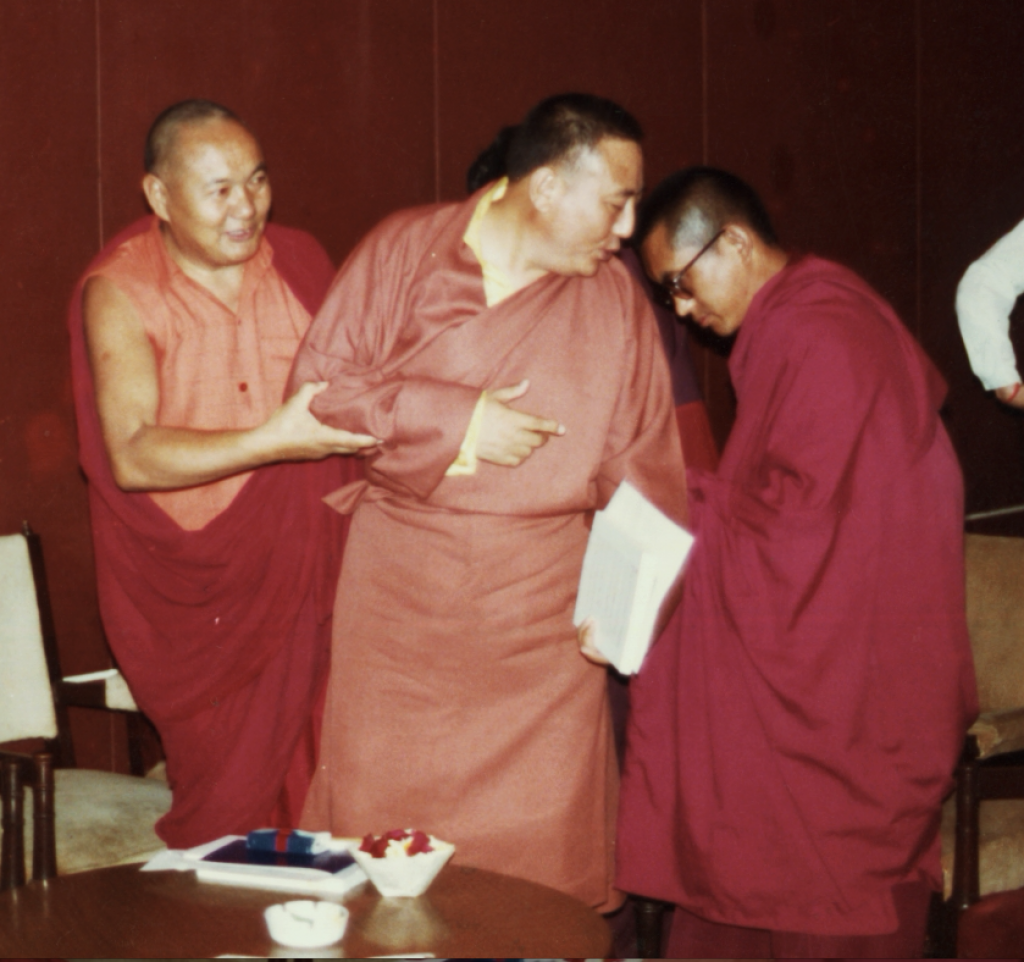
Lama Yeshe and Lama Zopa Rinpoche pushing Gelek Rinpoche into the top seat. Photo courtesy of Lama Yeshe Wisdom Archive.
After Rinpoche moved to the USA and I arrived soon after, I would meet him only occasionally and sometimes speak by phone, but I always felt a strong connection with him and rejoiced at the success of his Dharma work. Gelek Rinpoche’s passing is a great loss to his students, the Dharma, and the world.
Rinpoche’s official biography may be found on the Jewel Heart website.
An interview with Rinpoche appeared in Mandala in 1999:
https://fpmt.org/mandala/archives/older/mandala-issues-for-1999/may/gelek-rinpoche/
Rinpoche also talks about his early life in his book Good Life, Good Death. If you “look inside” the book on Amazon, you can read Robert Thurman’s very interesting introduction online.
A complete obituary for Gelek Rinpoche will be included as part of the July-December 2017 issue of Mandala.
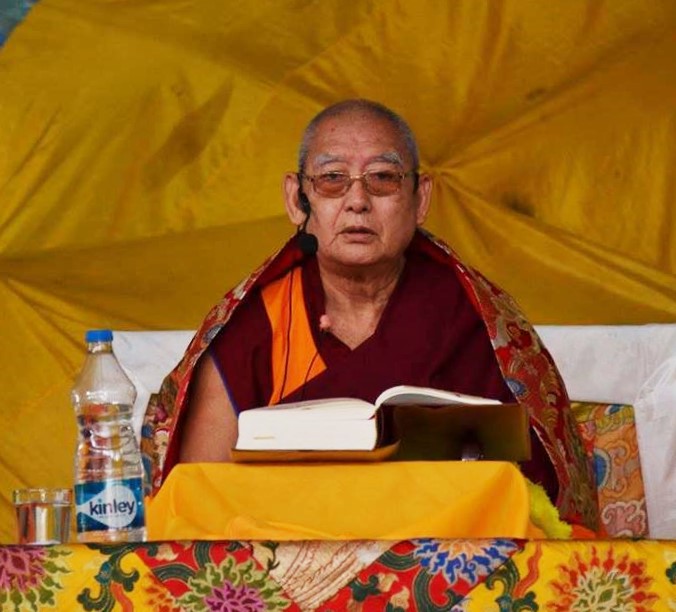
Khen Rinpoche Geshe Gendun Choephel. Photo via Facebook (Osel Hita).
We are sad to announce that on July 31, 2016, Sera Je abbot Khen Rinpoche Geshe Gendun Choephel suddenly passed away. Among Khen Rinpoche’s many students is Tenzin Ösel Hita, the recognized reincarnation of FPMT founder Lama Yeshe.
Khen Rinpoche Geshe Gendun Choephel was born in 1941 in Karze in eastern Tibet. He later joined Sera Je Monastery in 1955 and went into exile in India in 1959, joining the Buxa Duar community to study and practice. He was among the foremost group who re-established Sera Je in Bylakuppe, South India. After earning his Lharampa Geshe degree, Khen Rinpoche began teaching at the monastery and did so for the rest of his life. He was enthroned as the 75th abbot of Sera Je Monastery on July 18, 2016.

Enthronement ceremony of Khen Rinpoche Geshe Gendun Choephel, Sera Je Monastery, Bylakuppe, South India, July 2016. Photo via http://www.serajeymonastery.org
“My dearest and most precious Teacher, Friend, Mother, Father and Khen Rinpoche, Geshe Gendun Choephel, just passed away in a very sudden way,” Ösel wrote on his Facebook page on July 31. “He was the closest person in my life, he raised me and gave me everything, taught me and loved me like no one else. It is devastating and so hard to accept, but I feel joy for having known him and it has been such an honor to grow up under his guidance. Thank you so much Gen-la, you are always in my heart.”
Mandala will have a complete obituary for Khen Rinpoche Geshe Gendun Choephel in the January-June 2017 issue.
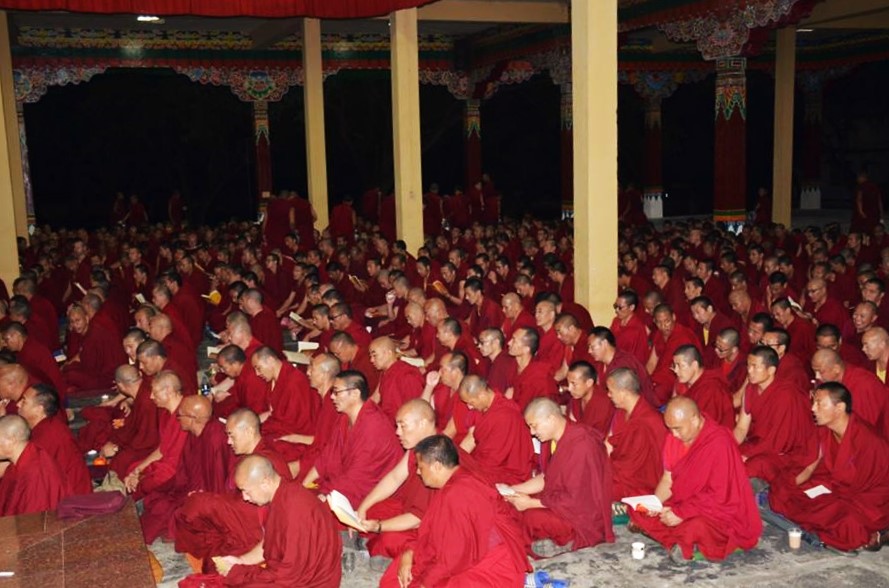
Sera Je monks reciting texts for Khen Rinpoche Geshe Gendun Choephel, Sera Je Monastery, South India, July 2016. Photo via Facebook (Sera Jey Monastery).
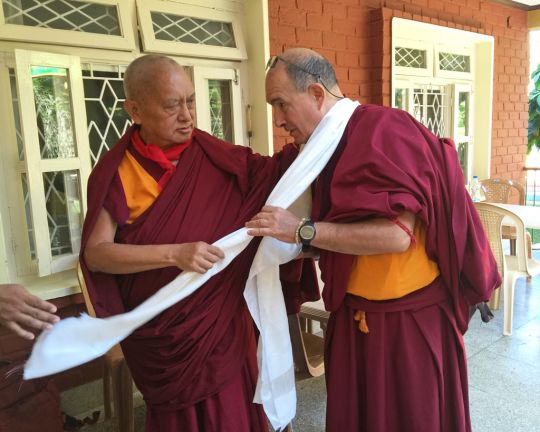
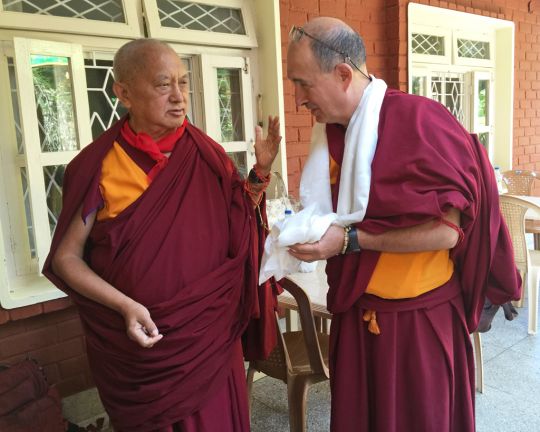
Lama Zopa Rinpoche offering Ven. Thubten Kunsang a khata blessed by His Holiness the Dalai Lama for Ven. Kunsang, Sera Monastery, India, January 2016. Photo by Ven. Roger Kunsang.
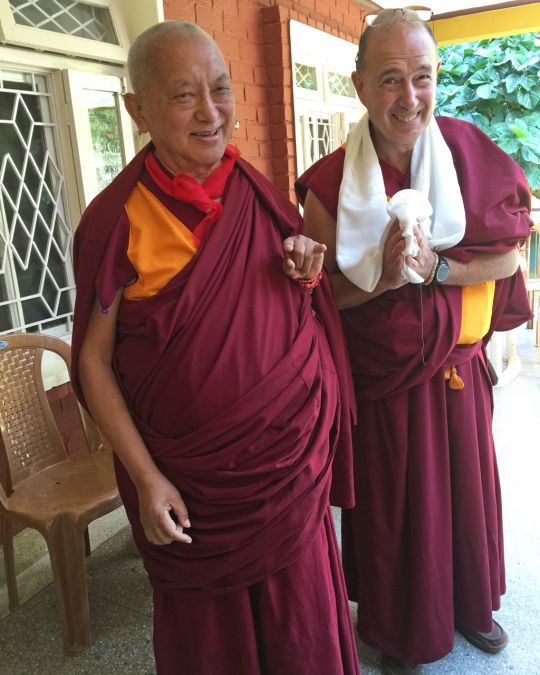
We are sad to share the news that the French monk Ven. Thubten Kunsang (Henri Lopez) passed away on Sunday, July 24, at 11:46 a.m. in India due to cancer. Ven. Kunsang traveled with Lama Zopa Rinpoche for many years, recording Rinpoche’s talks and spontaneous teachings for the Lama Yeshe Wisdom Archive and taking thousands of photos that have been shared on FPMT.org and in Mandala magazine. He was a familiar and friendly face within the international FPMT community, known for his incredible warmth, generosity and kindness. He will be missed by many, many people around the world.
Lama Zopa Rinpoche with Ven. Thubten Kunsang, Sera Monastery, India, January 2016. Photo by Ven. Roger Kunsang.
Lama Zopa Rinpoche sent the following message to ordained Sangha after Ven. Kunsang had passed away.
Dear Sangha,
We believed there was real Kunsang and now that real Kunsang is not there, but that’s the reality, and like that all the phenomena, yourself, action and object, all phenomena, samsara and nirvana are like that.
Please right now when you get this, please to do the short Medicine Buddha sadhana and Padmasambhava prayer Sampa Lhundrupma.
Dedicated to Ven. Kunsang (Henri Lopez) who has just passed away in India at 11:46 a.m.
Dedicate that he may be immediately born in a pure land where he can achieve enlightenment as quickly as possible or to receive at least a perfect human rebirth, meet the Mahayana teachings, meet a perfectly qualified Mahayana Guru, who reveals the path to enlightenment and by pleasing the holy mind of the virtuous friend, then by himself to achieve enlightenment as quickly as possible.
With much love and prayers,
Lama Zopa
Lama Zopa Rinpoche with Ven. Thubten Kunsang, Sera Monastery, India, January 2016. Photo by Ven. Roger Kunsang.
Jean Yves took care of Ven. Kunsang in the last few months of his life and sent a photo of Ven. Kunsang, his brother Emile and Jean Yves to Lama Zopa Rinpoche, who asked his attendant Ven. Sherab to Photoshop Rinpoche into the picture. Ven. Sherab did and sent the photo back to Ven. Kunsang, his brother and Jean Yves with the message: “Rinpoche looking after Kunsang , JY and brother Emile from behind and above!”
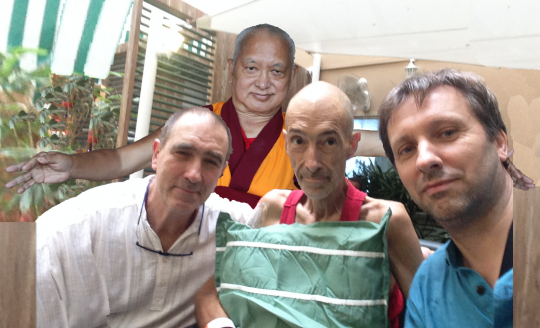
Lama Zopa Rinpoche added to a photo of Emile, Ven. Kunsang and Jean Yves, India
Many pujas were arranged for Ven. Kunsang. In addition, Nalanda Monastery is making 400 long-life tsa-tsas and Peter Iseli will make a White Tara thangka.
Links to text recommended by Rinpoche, Medicine Buddha Sadhana:
https://fpmt.org/wp-content/uploads/education/prayers/medicine_buddha_sadhana_c5.pdf
“Sampa Lhundrupma”:
http://www.tibetanbuddhistaltar.org/wp-content/uploads/2013/12/SAMPA-LHUNDRUP-5x8k.pdf
There will be an obituary for Ven. Kunsang in the next issue of Mandala magazine.
For more on practices recommended by Lama Zopa Rinpoche at time of death and other resources to support yourself and loved ones at time of death, please visit fpmt.org/death/.
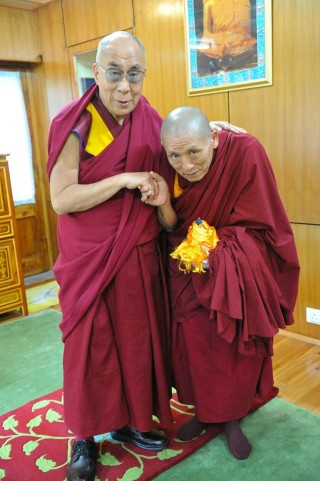
His Holiness the Dalai Lama with Khensur Rinpoche Lobsang Palden
Sera Je Khensur Rinpoche Acharya Geshe Lobsang Palden manifested passing beyond his coarse body on the evening of May 1, 2016, in Taipei, Taiwan, and subsequently remained in the clear light meditation (thuk-dam) until May 6.
His holy body was finally cremated on the morning of May 12 amidst fervent prayers entreated by many of his students from Sera Je who had traveled abroad for the event as well as local devotees. It was the culmination of a life spent in earnest service of the Dharma and others.
Khensur Rinpoche was born within the Kardze district of Tehor Kham in eastern Tibet in around December 1935. At age 11 he entered nearby Dhargyey Monastery, and later at 17 he moved to Sera Je Monastery in Lhasa. Fleeing to India in 1959, he finally achieved the rank of Lharampa Geshe in 1980.
His fame as a scholar and practitioner quickly attracted many hundreds of students, and besides the many formal teachings and initiations he bestowed along the way, he taught Buddhist philosophy to students of the debate program more or less daily for more than 20 years. He was later approved by His Holiness the Dalai Lama as the 73rd Abbot of Sera Je Monastery, a position which he held for seven years (2005-2012).
Mandala will have a complete obituary for Khensur Rinpoche Lobsang Palden in the January-June 2017 issue.
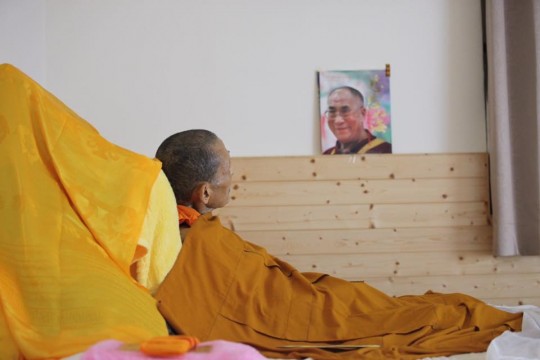
Khensur Rinpoche Lobsang Palden’s body while in clear light meditation, May 2016. Photo courtesy of Ven. Jampa Khedrub.
FPMT.org brings you news of Lama Zopa Rinpoche and of activities, teachings and events from nearly 160 FPMT centers, projects and services around the globe. If you like what you read, consider becoming a Friend of FPMT, which supports our work.
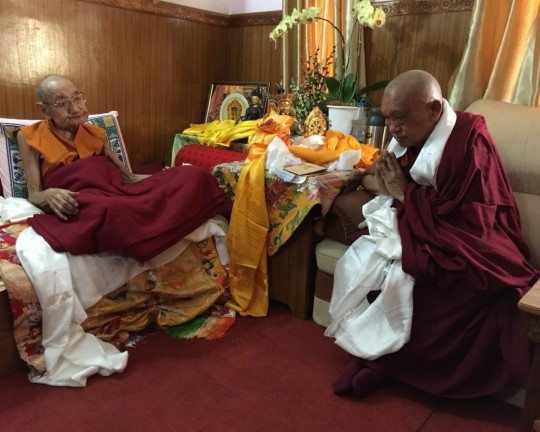
Dhakpa Tulku Rinpoche being visited by Lama Zopa Rinpoche, India, December 2015. Photo by Ven. Roger Kunsang.
We are sad to announce that on February 13, 2016, Dhakpa Tulku Rinpoche passed away peacefully while in meditation at his residence in Kalimpong, India. Dhakpa Rinpoche was one of Lama Zopa Rinpoche’s gurus, was an FPMT touring lama, and had given Lama Zopa Rinpoche many oral transmissions over the years. He will be greatly missed.
Dhakpa Rinpoche was born in 1926 in Kongpo, Tibet and later recognized by His Holiness the 13th Dalai Lama as the reincarnation of the 49th Ganden Tripa Lobsang Dhargye Rinpoche, who was the head of the Gelug school from 1708 to 1715. He studied in Tibet eventually earning his Geshe Lharampa degree at the age of 26 and completing further studies in tantra. When the Chinese communists invaded Tibet in 1959, Rinpoche fled to India.
In 1962, His Holiness the 14th Dalai Lama appointed Rinpoche as the abbot of Sera Me Monastery, the first abbot of the Sera Me in exile. Rinpoche served as abbot for three years, but left the monastery and went to Kalimpong for medical treatment.
Until 1990, Rinpoche led a very quiet life in Kalimpong and spent much of his time in retreat and meditation. Although Rinpoche was one of the most precious and valuable spiritual teachers living in India, due to his humble nature, he was little known outside the area. However, he was in fact one of the very rare teachers holding teachings from the most valuable and precious secret lineages from Pabongka Rinpoche and many other highly realized lamas in Tibet.
Throughout his life Rinpoche actively sought out teachings from spiritual masters from other Tibetan Buddhist traditions, adding to the richness of his understanding and own teachings. Rinpoche was requested to pass on all those teachings and other tantric initiations to the young rinpoches at Sera Me, which he did for three months every winter. His Holiness the Dalai Lama praised Dhakpa Rinpoche for his dedication to his practices and the generosity of his teachings.
Mandala will have a complete obituary for Dhakpa Tulku Rinpoche in the July-December 2016 issue.
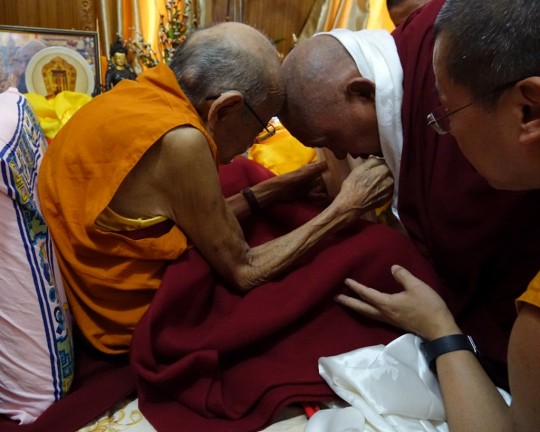
Dhakpa Rinpoche and Lama Zopa Rinpoche, India, December 2015. Photo by Ven. Roger Kunsang.
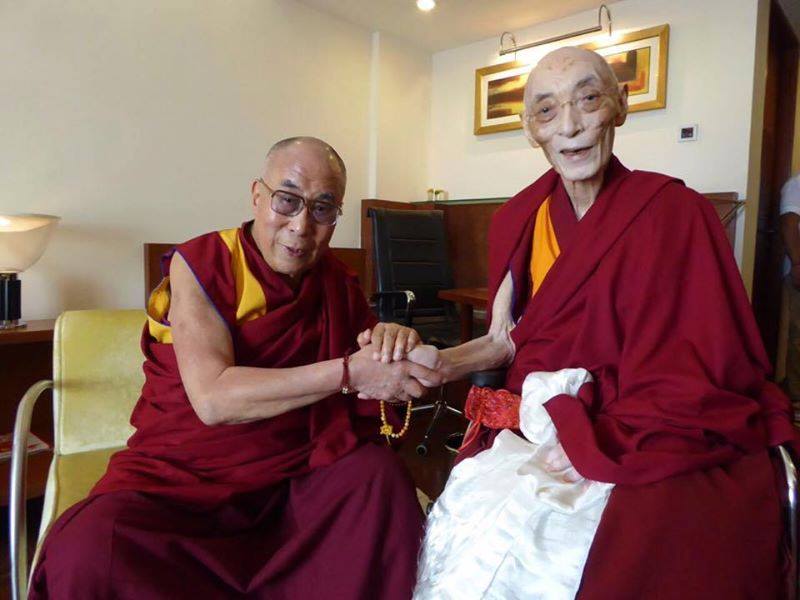
His Holiness the Dalai Lama and His Eminence Choden Rinpoche, New Delhi, India, August 29, 2015. Photo courtesy of Sera Je Monastery.
We are very saddened to share the news that His Eminence Choden Rinpoche passed away on September 11 at 1:30 a.m. India time at Sera Je Monastery in South India. Choden Rinpoche was a highly respected Buddhist master and a much loved teacher, who taught at many FPMT centers over the years.
Choden Rinpoche was born in 1933 in eastern Tibet and was recognized at age three. At age eight he entered Rabten Monastery, and at age fifteen he went to Sera Je Monastery, where he studied the five main texts. Choden Rinpoche became an expert on the teachings on Vinaya – monastic discipline. He was a highly respected scholar and was chosen as one of two Sera Je monks to debate with His Holiness the Dalai Lama during His Holiness’ geshe exams.
During the communist Chinese takeover of Tibet in 1959, Choden Rinpoche stayed in Tibet and went into solitary retreat. He never left his small, dark room in Lhasa from 1965 to 1985, and was virtually unknown in his monastery for this reason. In 1985 he was allowed to leave Tibet for India and has since taught for many years at Sera Je Monastery in South India as well as at Dharma centers throughout the world, including many FPMT centers.
On August 29, 2015, His Holiness the Dalai Lama met with Choden Rinpoche in New Delhi. His Holiness told Choden Rinpoche that he remembered the first time that Choden Rinpoche came to his attention. It was many years ago during an audience with monks at Norbulingka, the summer palace of His Holiness in Tibet. His Holiness said that he remembered seeing how the rays of the sun were falling on Rinpoche’s head and how a bee landed on his head. Choden Rinpoche said he had no memory of that. His Holiness said that at the time he thought that Choden Rinpoche was a magnificent lama. [Photos and translated English text provided by Ven. Tenzin Gache and Ven. Tenzin Namdak of Sera IMI House at Sera Je Monastery. Rebeca Cuan Corral provided a Spanish language translation of the meeting.]
His Holiness also said that since arriving in India, Rinpoche has done his best in many ways such as giving teachings, imparting philosophy lessons to the monks and sharing the Buddhadharma with students throughout the world. His Holiness said that it is important to rejoice in this work.
If you would like a more detailed description of the event of his transition, as well as the collection of prayers that were advised by Choden Rinpoche himself before he showed the aspect of passing away, for all of his students to offer at this time – please click here.
Read updates on the Facebook page set up for this.
See “The Life of a Hidden Meditator: Choden Rinpoche” from Mandala July 2000 to read more about Choden Rinpoche’s experiences in Tibet at Sera Monastery and in Lhasa after 1959. The complete multi-part feature “The Life of a Hidden Meditator” is available as a PDF. You can also read more recent stories about Choden Rinpoche on FPMT.org.
Mandala will have a complete obituary for His Eminence Choden Rinpoche in the January-June 2016 issue.
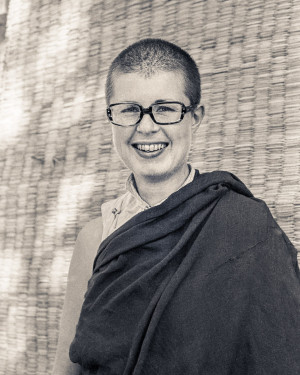
Ven. Margaret McAndrew at Kopan Monastery, Nepal, 1976. Photo courtesy of Lama Yeshe Wisdom Archive.
We are sadden to share the news that Ven. Margaret McAndrew has passed away of cancer In Australia. Affectionately know as Ani Marg, she was a long-time student of Lama Yeshe and Lama Zopa Rinpoche, first arriving at Kopan in Nepal in 1974.
Ven. Margaret ordained in 1976. After spending time in Nepal and India, she returned to Australia in 1978, where she lived at both Tara Institute and Chenrezig Institute for several years (and worked as a cook in both places). She spent six months in the Dorje Phagmo Nunnery in France before finally settling at Chenrezig Institute in the late ‘80s. She was one of the founding members of Chenrezig Nuns’ Community (CNC), which was formally established in 1990. Since then she has been resident there apart from stints as a visiting teacher in Taiwan as well as in Adelaide, Gosford and Sydney in Australia. For several years, she served as the CNC gekyö (disciplinarian). She was diagnosed with bile duct cancer in 2012.
You can read more about her early experiences with the Lama Yeshe and Lama Zopa Rinpoche in “I Realized That My Life Couldn’t Be the Same Again”:
https://fpmt.org/mandala/archives/mandala-for-2013/october/ani-margaret-mcandrew/.
While reading obituaries we can also reflect on our own death and impermanence prompting us to live our lives in the most meaningful way. More advice from Lama Zopa Ripoche on death and dying is available, see Death and Dying: Practices and Resources (fpmt.org/death/).
To read more obituaries from the international FPMT mandala, and to find information on submission guidelines, please visit our new Obituaries page (fpmt.org/media/obituaries/).