
 receive our newsletters
 join Friends of FPMT

Obituaries
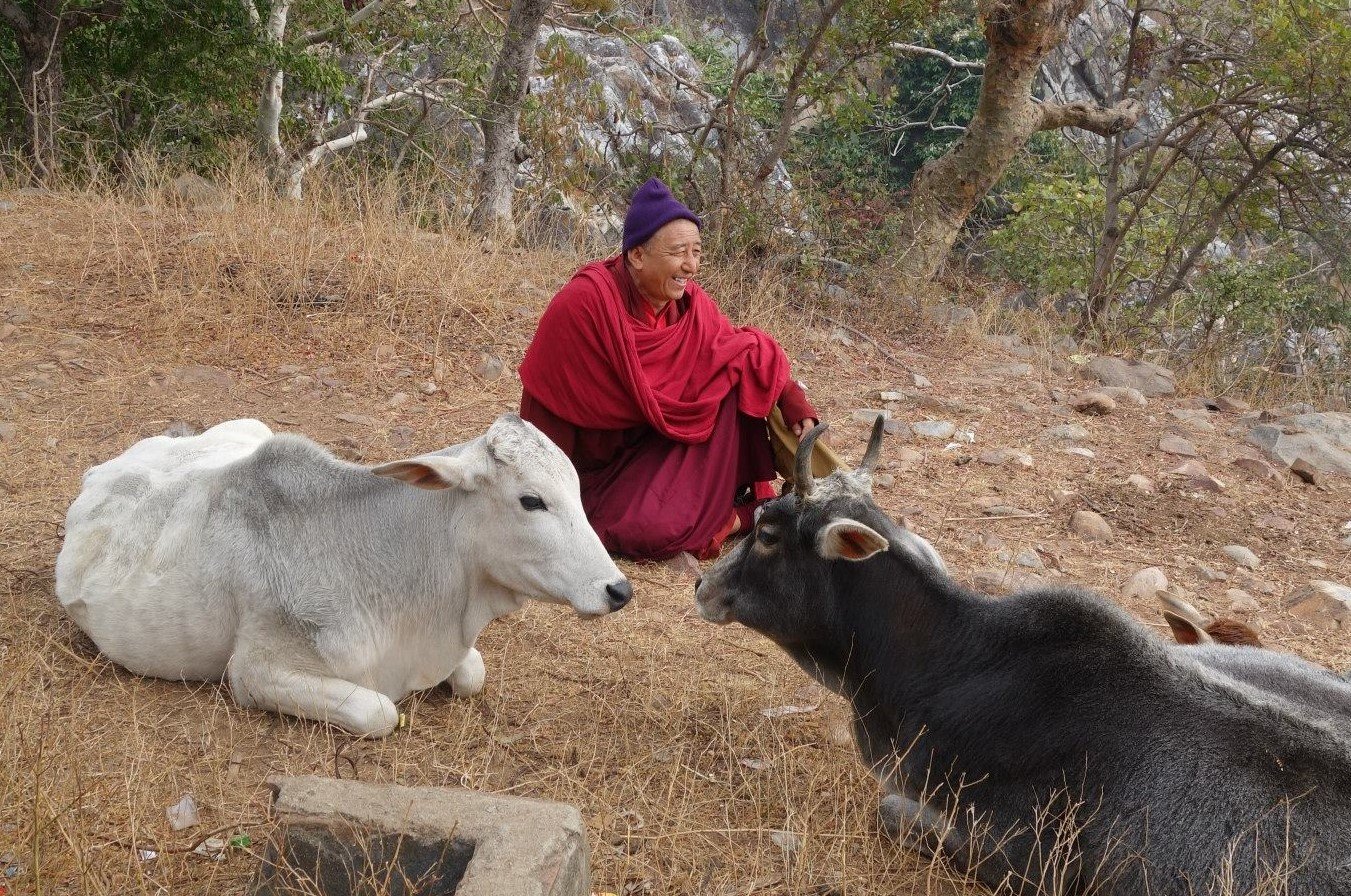
Geshe Thubten Soepa sitting with some friends near Vulture Peak Mountain, Rajgir, India. Photo courtesy of Geshe Thubten Soepa Facebook page.
Geshe Thubten Soepa. 67, passed away at a hospital in Mysore, India, on November 2, 2022 from a heart attack.
Geshe Soepa was well regarded as a scholar with extensive knowledge about both sutra and tantra, and not only well versed in the Gelugpa texts, but also in those of the Nyingma, Sakya, and Kagyu schools. A cremation ceremony occurred on November 7, 2022. We share a brief account of his life below for rejoicing and inspiration:
Geshe Thubten Soepa was born in Zanskar, India in 1955. As a young child he and his mother were advised by His Holiness Ling Rinpoche and His Holiness Dilgo Khyentse Rinpoche that it would be good if he ordained, and he soon followed their guidance. Geshe Soepa began his Dharma studies at age 14 at Domo Geshe Rinpoche’s monastery in Kalimpong, India, where he studied and learned ritual for four years. From there he transferred to Sera Je Monastery in Bylakuppe, India, where he would complete his geshe studies 21 years later, earning the highest honor of Geshe Lharampa, in 1993.
In his first three years serving as a geshe, he taught philosophy and Tibetan grammar at Sera Je and Dzongkar Chose monasteries. Geshe Thubten Soepa then received a request from Lama Zopa Rinpoche to teach in the West. Geshe Soepa agreed to Rinpoche’s request and moved to Munich, Germany. For ten years he continuously taught at FPMT centers in Germany, Austria, and Switzerland, while also traveling to other centers around Europe to offer teachings. After his time in Europe, the next decade of his life was mostly spent in North America, offering teachings at FPMT centers in Canada, Mexico and the United States.
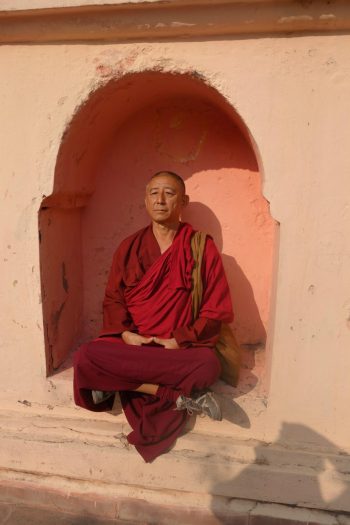
Geshe Thubten Soepa meditating at the Mahabodhi Temple in Bodhgaya, India. Photo courtesy of Geshe Thubten Soepa Facebook page.
Recognized as a Tulku
In his short autobiography, Geshe Soepa shared that he was told that he was the reincarnation of a high lama on three separate occasions. The first declaration was made by His Holiness Trijang Rinpoche in 1974, then again by His Eminence Zong Rinpoche in 1978. The last affirmation came from the great yogi Choden Rinpoche, during a public teaching Rinpoche was giving on the Six Yogas of Naropa in Munich, 2004. Geshe Soepa shared his shock and disbelief at hearing the news each time, even asking Choden Rinpoche if he was teasing him. Choden Rinpoche looked at Geshe Soepa and forcefully confirmed it was not a tease! Despite being recognized, Geshe Soepa was never formally enthroned or named after the particular teacher. In 1974, His Holiness Trijang Rinpoche shared with Geshe Soepa that a formal enthronement would not be necessary, foretelling that Geshe Soepa would “spontaneously be doing well at Dharma, and that [he] would like it.”
Promoting Vegetarianism and Protecting Life
Geshe Thubten Soepa was deeply passionate about promoting vegetarianism, especially to those living a monastic life. He would go on to write a number of books and articles on the practice of not eating meat, relying on sources such as the Lankavatara Sutra, Great Cloud Sutra, Great Nirvana Sutra, and the Anguli Mala Sutra, to communicate the Buddha’s teachings. His first book was titled Protecting the Lives of Helpless Beings: The Udamwara Lotus Flower, which is now available as an ebook through the Lama Yeshe Wisdom Archive. In 1996, while His Holiness the Dalai Lama was visiting Munich, Geshe Soepa was able to offer His Holiness a copy of his book. His Holiness told Geshe Soepa that he read the whole book, was very pleased by the text, and encouraged Geshe Soepa to continue his efforts on the topic.
In the years following, he would write four texts on vegetarianism that were translated in five languages and distributed freely. In 2012, Geshe Soepa published a short text on the Hinayana Vinaya teachings on monastics refraining from eating meat. During the 2017 Kalachakra initiation offered by His Holiness the Dalai Lama in Bodhgaya, India, Geshe Soepa was able to meet with Lama Zopa Rinpoche and offer Rinpoche this short text. Lama Zopa Rinpoche was also quite pleased by Geshe Soepa’s writing. Geshe Soepa told Rinpoche that he was planning to write another text to clarify further points, and Rinpoche expressed that the text should be translated into English, in order to be easily translated into many languages later. Geshe Soepa would go on to publish another text in Tibetan in 2018 for monastics. The text included teachings on performing animal liberations and advice for working to free people who were wrongly imprisoned.
Geshe Soepa concluded the short telling of his life story with the message: “I sincerely wish that all of our mother sentient beings be free from suffering and being killed.”
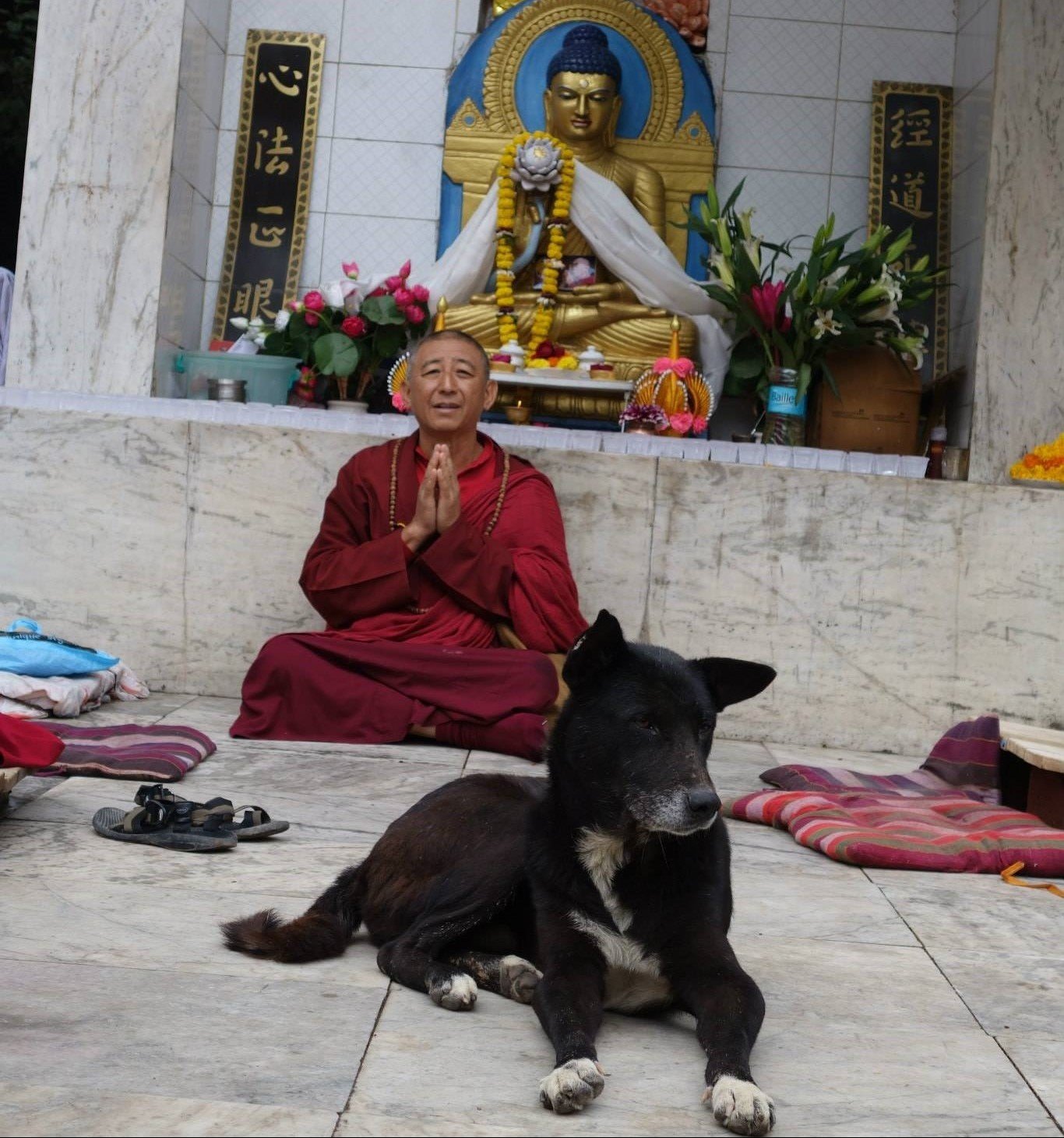
Geshe Thubten Soepa at the Mahabodhi Temple, Bodhgaya, India. Photo courtesy of Geshe Thubten Soepa Facebook page.
Read Geshe Thubten Soepa’s short autobiography, dictated to Robert Baptist, from which the above obituary was based, courtesy of Land of Compassion and Wisdom FPMT study group in Austin, Texas, who had a strong connection with Geshe Soepa and have hosted him often.
We invite you to download the ebook, Protecting the Lives of Helpless Beings: The Udamwara Lotus Flower, through the Lama Yeshe Wisdom Archive, and read an article by Geshe Soepa called “Protecting Animal Welfare“. A French translation of his text Heart of Joy, Message of the Buddha, is also available as a free PDF.
Lama Zopa Rinpoche requests that students who read obituaries pray that the person mentioned finds a perfect human body, meets a Mahayana guru, and becomes enlightened quickly, or be born in a pure land where the tantric teachings exist and they can become enlightened.” While reading obituaries we can also reflect on our own death and impermanence prompting us to live our lives in the most meaningful way. More advice from Lama Zopa Ripoche on death and dying is available, see Death and Dying: Practices and Resources (fpmt.org/death/).
To read more obituaries from the international FPMT mandala, and to find information on submission guidelines, please visit our new Obituaries page (fpmt.org/media/obituaries/).
Jo Marie Galt, 71, died in Santa Cruz, US, on September 1, of cardiac arrest resulting from various contributing health factors.
By Elaine Jackson
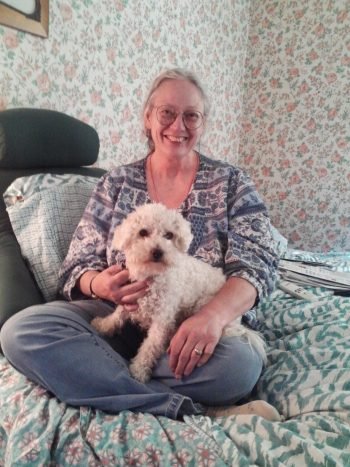
Jody Galt with dog Dawa. Photo courtesy of Shasta Wallace.
Jo Marie Galt (Jody) was loved by her Dharma family at Vajrapani Institute where we met in the late seventies and early eighties. She is remembered as always being the first one to volunteer for the hard jobs with a smile and determination. She will be deeply missed.
Jody was born on March 31, 1951, in Missouri, but most of her childhood, which she described as really difficult, was spent in Spokane, Washington. She was fourteen when her mother took her own life. Then, at sixteen, Jody ran away from home making strong prayers for answers.
Traveling in Mexico, Jody met Jim Ezell, her first husband and father of her daughter, Alicia, who was born in May, 1970. After Jody and Jim separated, Jody settled in Selma, Oregon where, together with Andy Robbins, she built a log cabin. It was here that their son, Ben, was born in 1978.
Jody had prophetic dreams. She described one dream where a book fell from the sky with one word on the page: “Vipassana.” She had no idea what that meant but became curious, went to the library, and began to read Dharma books.
In May 1980, Lama Yeshe led a Chenrezig retreat at Grizzly Lodge near Mount Shasta. It was sponsored by Vajrapani Institute. Jody sold her trailer to raise money to attend that course. It was there that she met Diney Woodsorrel and George Galt. After that course, Jody and her family moved to Berkeley.
Judy Weitzner recalled, “When Jody and Andy moved to the Berkeley Dharma House just after Grizzly Lodge, Jody was invaluable in her efforts to keep things organized. She was an exceptionally hard worker and contributed with cleaning and cooking. She attended many teachings and classes. Geshe Thardo was the resident teacher, but Lama Yeshe, Lobsang Chonjor, and Zong Rinpoche, as well as others, also offered teachings. It was at the Berkeley Dharma House where Jody first met Shasta Wallace, who was living at Vajrapani Institute at the time.” When the Dharma House closed in 1981, Jody moved to Vajrapani.
Jody said that Berkeley was too wild for her, so she went to Vajrapani. She and Andy had separated by then, but Andy came to Vajrapani from time to time, and eventually settled in Boulder Creek.
Shasta, a founder and long-time Vajrapani resident, recalls that Jody was always willing to jump in and help no matter how daunting the job. Shasta remembers such a job. It was cleaning and restoring a grease-laden, dilapidated-looking, commercial cookstove bought in San Francisco from an old restaurant in the Mission District. It looked like a wreck, but it needed to be functional for a retreat in one week. Jody told Shasta that not only could it be done, but it would be done. She helped take it apart, soak the encrusted parts and scrub it until it shined. It served as the cookstove in the Vajrapani kitchen for many years.
Initially, Jody and her children, Ben and Alicia, lived at Vajrapani in the “Dzome,” a canvas structure originally built by Rick Crangle and Jacie Keeley in 1978. It had an outdoor shower, an outhouse, and a small separate hut used for a kitchen. Jody was no stranger to rustic living. As she recalled, “Ben was three and Alicia was eight when we moved into the Dzome. That’s where I did my retreats – Tara and Vajrayogini. At 3:00 a.m. I would wake up. I loved it there so much. I wanted to be part of the community. I paid my $40.00 every month, hauled cement bags, and did what I could. In those days, we joked that I was living at Vajrapani, where you pay to work.”
Jody remembered working on the trails around the Chenrezig Gompa, while it was under construction, when Bill Kane came down with a terrible case of poison oak. Since Jody seemed to be immune, it became her job to pull the poison oak, and pull it she did, for two or three weeks. She ended up also getting the worst case of poison oak she had ever seen.
Janet Brooke recalls, “I met Jody when she arrived at Vajrapani in early 1981 following Lama Yeshe’s course at Grizzly Lodge. We were both mothers at the time. Her son Ben was a year older than my infant, Lise. There were many other children at Vajrapani who were close in age at the time, so Jody and I inevitably shared a lot of time around children.
“Jody and I also connected with the hard work needed to build this wonderful retreat center. We shared a love of gardening. Jody was very knowledgeable and experienced in this area. I learned so much from her. Together we had the opportunity to plant and create the garden beds around the stupa and surrounding the Vajrapani Gompa. This was all done under Jody’s expert guidance and skill and with great joy at being able to make such a wonderful offering. It was fun and, when working with Jody, it was guaranteed that somewhere along the way, no matter how hard the job, there would be a lot of laughter. Jody had a great sense of humor, and we shared a lot of laughter. There was hard work and there was laughter, and there were difficult times too. It was during the most difficult times in my life that Jody did her best, despite her own difficulties, to be there for me, as much as she was able, and I will be forever grateful.”
Jody had started a landscaping business and employed a few Vajrapani women who needed to make some money. Bev Gwyn remembers that two of Jody’s clients were Dick and Ramona Andre, who bought Lama Yeshe’s house in Rio del Mar (Santa Cruz), after Lama’s passing. Ramona loved Lama Zopa Rinpoche and Jody and maintained a relationship with Bev and Jody until her passing this year. Dick still lives in Lama’s house.
Following torrential rains, Jody’s beloved Dzome became unlivable when the roof collapsed. The family moved to Boulder Creek. Jody refers to Tom Waggoner as her “guardian angel,” who built her a house on Vajrapani land so she could move back about a year later. As she said, “It was the biggest gift of kindness.” Then, as luck would have it, that new house was irreparably damaged by a mudslide the following winter. Jody and the kids had to climb out a bedroom window to escape. They moved back to Boulder Creek.
In 1983, Lama Yeshe gave his last teaching a Vajrapani Institute when he taught the Six Yogas of Naropa. It was attended by so many of his beloved students, including Diney, George, and Jody. Diney was soon diagnosed with terminal cancer and died at the end of that year. Jody helped George as caregiver for Diney and also his three children, Shyela, Bodhi, and Sanje.
In October 1988, George and Jody were married. Jody continued to work in landscaping and engaging in other creative projects. She attributed her creativity to her mother who was an artist. Her parents had lived in Japan and her mother was greatly influenced by her time there. When Jody was living in the Berkeley Dharma House, she was quilting. Judy Weitzner shared that she gave Jody her old dresses which were cut up and returned to Judy in the form of a quilt with the Tara mantra on all four sides. Judy said it was the most heartfelt gift she ever received. Jody responded, “It was because of how much I treasured the gift of Dharma you gave me.”
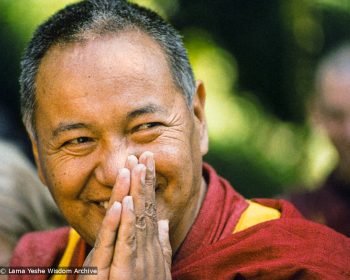
Lama Yeshe at a family gathering at Vajrapani Institute, California, 1983. Photo by Carol Royce-Wilder.
Jody once shared, “Lama told me it was always going to be really difficult for me to see him. I was very shy and had such low self-esteem that I felt I should not be bothering someone for whom I had so much respect. At Grizzly Lodge, on the last day, Lama said that anyone could come in to talk with him. I told myself, ‘OK this is it.’ I was intimidated, but Lama said, ‘I think you have something you wanted to ask me.’ I said, ‘Lama, if you appear in my dream and give me teachings, is that what I should take as the truth?’ Lama replied, ‘Whenever I appear to you, you can believe what I’m telling you, even in a dream form.’ That was so encouraging to me.”
Judy explains, “Vajrapani is a miracle. It is magnificent. Lois (Greenwood) and I were talking about how when Lama spoke, people heard different things. People often took different pieces of his vast vision to make real.”
For the last many years of her life, Jody lived in pain from a degenerative spinal disease which led to half a dozen surgeries. Additionally, Jody’s immune system was attacking her nervous system leading to pain, numbness, and loss of motor control, for which she endured ongoing medical procedures.
About this period, Jody once shared, “Twice when I was in the hospital, very sick, Lama and Rinpoche and Chenrezig appeared in my room. I was delusional. I didn’t know where I was. When I saw them, they weren’t just figures. They were glowing, sparking, alive entities that I could feel radiating love out to me. Then, I knew they were there, whether I could see them or not. I thought, ‘OK, I gotta trust you.'”
Jody continued, “Once when I was in the hospital, they thought I had meningitis in my spine so I was in isolation. The man next to me was dying. I started saying prayers. I asked the nurse if he was going to make it. She told me it was doubtful. When they called a code blue I just said prayers. Ten minutes later he was OK. The nurse said, ‘I don’t know what kind of prayers you are saying, but they are sure powerful.’”
Jody found the practice of tonglen helped her the most. About this practice she said, “Thinking about the suffering of others almost always takes me away from focusing on my own pain and my own problems. I have other meditations, like Tara, but my go-to constantly is tonglen. Rinpoche is always sending me so much energy. He sends beautiful chants and prayers for when the pain gets very bad.”
Once while Rinpoche was visiting Jody in her home and offering advice, Jody asked Rinpoche what karma she had to have so much suffering. Rinpoche told her that by suffering that pain, she was taking it on so Rinpoche did not have to suffer it. Jody relied on Rinpoche’s words for inspiration and consolation.
When asked what practices she did during the difficult times, she said, “It is hard, but I think, if in any way I could take on the suffering of others and relieve them, how great that would be. Every two weeks I go to the hospital. I remember that the blood I get comes from others, and I see others sick with cancer, so I hold that in my mind. I bear the pain for others.”
Jody died peacefully in the hospital surrounded by George, her daughter, Alicia, and Shasta. Often in her decline, Tom Waggoner was also at her bedside. The practices from Lama Zopa Rinpoche’s advice were followed. There was a stupa at her crown, a prayer wheel at the bend of her left arm, a Namgyalma mantra over her heart, and the prayers Rinpoche designed, with all the important mantras to be recited, gently resting on her chest. Breathing evenly and peacefully, when the last breath left her body, Rinpoche was notified, prayers were recited, including Medicine Buddha, The King of Prayers, and many mantras. Medicine Buddha puja was also done at Vajrapani Institute that evening and will be continued every seven days until the forty-ninth day.
We cherish our memories and pray; may Jody be free … at last.
We offer grateful thanks to Elaine Jackson and all of Jody’s dear friends and family who contributed to this obituary.
Lama Zopa Rinpoche requests that students who read obituaries pray that the person mentioned finds a perfect human body, meets a Mahayana guru, and becomes enlightened quickly, or be born in a pure land where the tantric teachings exist and they can become enlightened.” While reading obituaries we can also reflect on our own death and impermanence prompting us to live our lives in the most meaningful way. More advice from Lama Zopa Ripoche on death and dying is available, see Death and Dying: Practices and Resources (fpmt.org/death/).
To read more obituaries from the international FPMT mandala, and to find information on submission guidelines, please visit our new Obituaries page (fpmt.org/media/obituaries/).

Gen Ngawang Namgyal, pictured right, with Lama Zopa Rinpoche and the young Rigsel Rinpoche, November 2021, Kopan Monastery, Nepal. Photo by Ven. Roger Kunsang.
Gen Ngawang Namgyal died in Kathmandu, Nepal, on July 5, 2022.
Gen Ngawang Namgyal was one of the first monks at Lawudo and Kopan Monastery. Before his passing on July 5, Lama Zopa Rinpoche visited him at Karuna Hospital, offering prayers and pujas for him, at his bedside. We invite you to rejoice in his life, living in morality and serving the Dharma. Please offer prayers at this critical time for him, that he may quickly attain enlightenment or be born in a pure land where he can become enlightened quickly.
Gen Ngawang Namgyal was born in Solo Khumbu, Nepal. His father had a close connection with Lama Zopa Rinpoche when both he and Rinpoche were young. He ordained as a child and split his early life between the villages of Thame and Lawudo, sometimes receiving teachings from Lama Zopa Rinpoche when Rinpoche would visit Lawudo in the very early days. He later arrived at Kopan Monastery from Lawudo during Kopan’s very first days, receiving teachings from Lama Yeshe, Lama Zopa Rinpoche, Khensur Lama Lhundrup, and others, as the monastery began to take form.
Gen Ngawang Namgyal shared the following from a June 2020 interview about his time during the founding of Kopan:
“At Kopan Monastery also texts were rare. At night we would copy out Tenets and prayers and other texts on our own notebooks, then Lama Yeshe would teach us how to recite prayers and so forth. We carried on like that. From that time, I’ve stayed at Kopan, for a long time. The number of monks has gradually increased, the studies and facilities and so forth gradually becoming better and better without much trouble. We all work together very well. It’s not that those of us here from the beginning have done everything. Everybody has worked very hard to make it what it is.”
While the monastery was developing, Gen Ngawang Namgyal would continue to travel back to Lawudo. Life was challenging there, and the small group of Lawudo monks had to beg for potatoes at times for food. Eventually, as the number of monks increased at Kopan, and trips to Lawudo became more difficult, he moved to Kopan permanently, where he would spend the rest of his life.
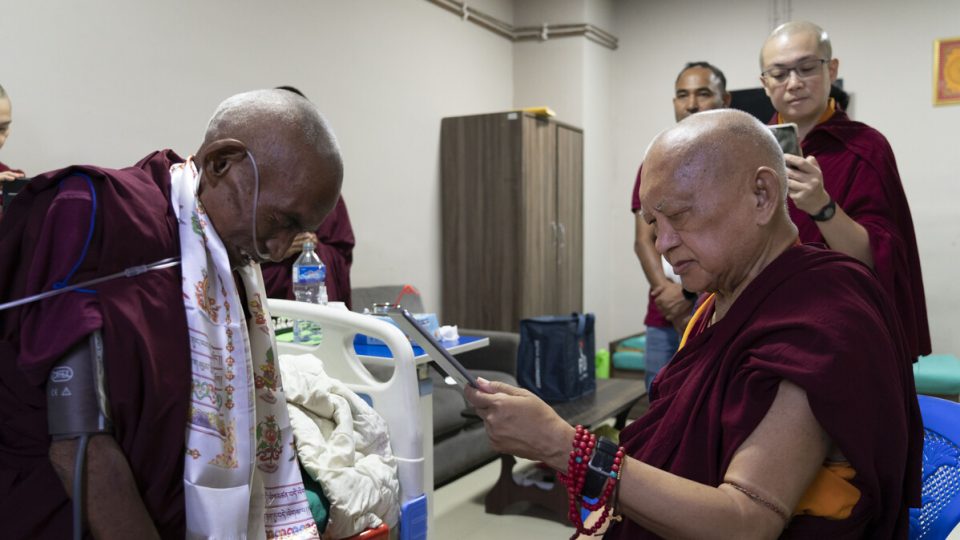
Lama Zopa Rinpoche reciting mantras for Gen Ngawang Namgyal just before he passed away at Karuna Hospital. Gen Namgyal was one of the first monks of Kopan and Lawudo Monasteries. Kathmandu, Nepal, June 2022. Photo by Ven. Lobsang Sherab.
To conclude the 2020 interview about his life at Kopan, Gen Ngawang Namgyal shared:
“In dependence on [the lamas’ and so many supporters’] kindness our monastery has developed and improved. The main improvement is subduing one’s own mind, improving oneself depends on subduing the mind. It’s just as it says in the prayer:
‘Bless me that my mind becomes Dharma, that Dharma becomes the path, and that path be without obstacles.’
“And then if one can make effort until reaching the state of buddhahood that is excellent. Just external development is not development. In order to develop internally we need study, but to study and not understand how to use that to develop internally one becomes very strange. To use the studies one has put within to develop and improve as a person we need to work at using methods to subdue our minds through practice. When we have external needs fulfilled with favorable conditions, these are just external things. The main thing is to improve our minds by improving our studies and improving our practice in order to gradually achieve liberation and enlightenment. You all probably know all this. So, this is what little I have to say.
“May Lama Thubten Zopa Rinpoche have a long stable life, and all his holy activities spread, and whatever Lama Thubten Zopa Rinpoche intends, may this be effortlessly and spontaneously accomplished. Then also, may all the various foreigners who have helped our monastery develop through sponsorship and their efforts caring for the monastery, they have really wonderfully served the monastery, then all the ordained Sangha, and the teachers, for all the benefactors, and for all I offer prayers. We should not pray just for ourselves alone that we achieve the state of enlightenment, that’s not good, but if we can pray for all sentient beings to achieve the state of enlightenment that’s best.”
Lama Zopa Rinpoche requests that students who read obituaries pray that the person mentioned finds a perfect human body, meets a Mahayana guru, and becomes enlightened quickly, or be born in a pure land where the tantric teachings exist and they can become enlightened.” While reading obituaries we can also reflect on our own death and impermanence prompting us to live our lives in the most meaningful way. More advice from Lama Zopa Ripoche on death and dying is available, see Death and Dying: Practices and Resources (fpmt.org/death/).
To read more obituaries from the international FPMT mandala, and to find information on submission guidelines, please visit our new Obituaries page (fpmt.org/media/obituaries/).
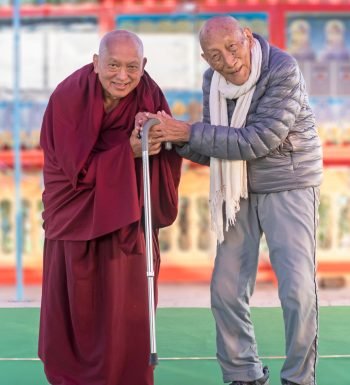
Lama Zopa Rinpoche with Khyongla Rato Rinpoche, Root Institute, Bodhgaya, India, 2018. Photo by Ven. Lobsang Sherab.
We are saddened to share the news that Khyongla Rato Rinpoche peacefully passed away in Dharamsala, India, on May 24, 2022.
Khyongla Rato Rinpoche was a reincarnate lama and scholar of the Gelugpa order of Tibetan Buddhism, who was born in 1923 in the Dagyab region of Kham, in southeastern Tibet. In 1928, senior Gelugpa monks divined that a five-year-old boy living in this remote part of Tibet was the reincarnation of the ninth Khyongla. On his sixth birthday, monks on horseback took him from his parents’ home to a monastery some distance away where he was installed as its spiritual head.
For over three decades, he lived the life of a monk, studying at the most famous monasteries in Tibet and earning the Lharampa Geshe degree. In 1959, along with thousands of monks as well as His Holiness the Dalai Lama, he fled the Chinese army on foot over the Himalayas to safety and to a radically different life in India, Europe, and eventually the United States.
In 1975, Khyongla Rato Rinpoche founded The Tibet Center, in New York City, US.
On May 24, 2022, The Tibet Center shared the following announcement:
“Venerable Khenpo Rinpoche Nicholas Vreeland is with him and is currently performing prayers along with Rato monks in Rinpoche’s presence. His Holiness’ office has been informed and [His Eminence] Venerable Ling Rinpoche is advising Venerable Vreeland. Venerable Vreeland asks us to kindly say prayers on Rinpoche’s behalf and we will have a further statement in the near future.”
Khyongla Rato Rinpoche was a teacher of FPMT Spiritual Director Lama Zopa Rinpoche, who received many oral transmissions from him over the years. In recent years, Khyongla Rato Rinpoche also visited FPMT’s Root Institute and Tushita Meditation Centre, both in India.
On May 24, 2022, Lama Zopa Rinpoche and Kopan Monastery offered Lama Chopa puja for the fulfillment of all the wishes of Khyongla Rato Rinpoche.
The passing of this highly respected teacher is a great loss for his students and the world. Please pray for the continuation of his good works far, far into the future.
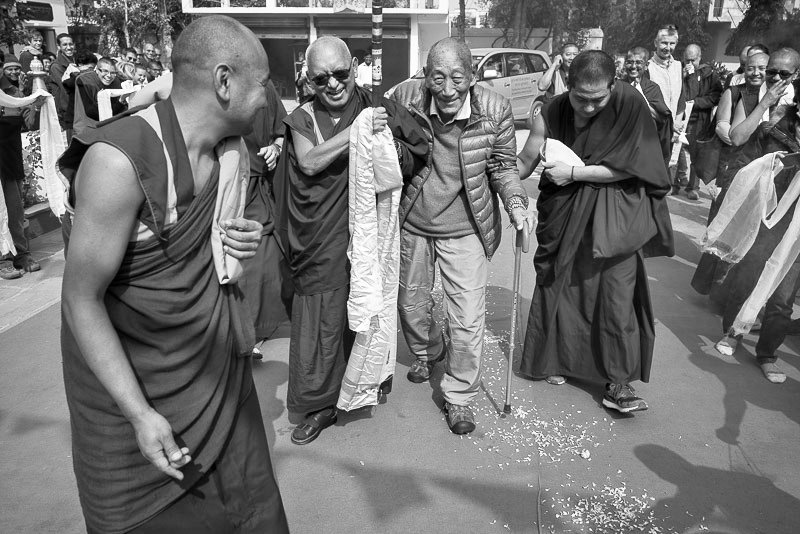
Lama Zopa Rinpoche with Khyongla Rato Rinpoche, Root Institute, Bodhgaya, India, 2018. Photo by Khen Rinpoche Nicholas Vreeland.
UPDATE: Khen Rinpoche Nicholas Vreeland shared photos of Khyongla Rato Rinpoche’s passing in the post “Rinpoche Has Departed” on his website.
FPMT.org brings you news of Lama Zopa Rinpoche and of activities, teachings, and events from over 150 FPMT centers, projects, and services around the globe. If you like what you read, consider becoming a Friend of FPMT, which supports our work.
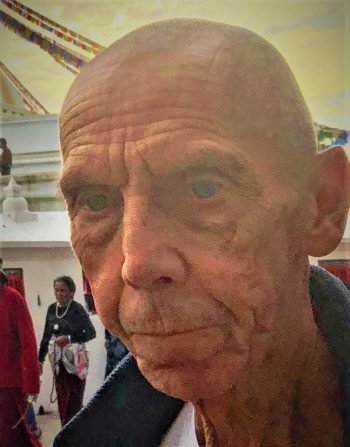
Dr. Giorgio Armato.
Dr. Giorgio Armato, 74, died at home in Genoa, Italy, on January 21, of cancer.
Dr. Giorgio Armato graduated from the Faculty of Medicine and Surgery in Genoa, Italy, and specialized in oncology. He met Lama Zopa Rinpoche in 1975 and spent many years at Kopan Monastery in Nepal. Among his many achievements, he first built an emergency room in Kopan itself and another at the foot of the hill. He then built a small three-story hospital there, thanks to his own work and donations from friends.
In his practice in Genoa, Giorgio helped and cared for the poor and needy, and he went on missions to offer surgical operations in Zaire, Burundi, Madagascar, Guatemala, and Nepal.
Friend Ven. Siliana Bosa shared, “Giorgio was very devoted to Lama Zopa Rinpoche, and he loved Kopan. He had a strong connection also with the Catholic church and often, during his summer holiday, went to Africa with a Franciscan organization to do surgical operations in areas of great conflict.”
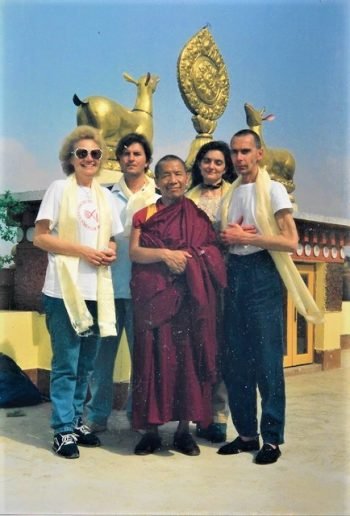
Dr. Giorgio Armato at Kopan Monastery, Nepal, with Khensur Rinpoche Lama Lhundrup, his sister Graziella, a doctor, and a nurse, 1999.
“He put others before himself and helped many people with acupuncture and gave all the offerings he received to people in need. Giorgio had a good sense of humor. Because of his broken English, he would say [the Italian word] ‘allora’ every few words, and so in Kopan they called him Doctor Allora. His main practices were Medicine Buddha and Vajrayogini, which helped him to face the last months of his sickness with serenity. He actually told me that he was not afraid to die, so he had a peaceful departure,” Ven. Siliana said.
Ven. Lucia Bani shared, “Giorgio has been a dear Dharma friend for many years and for many years he was my sponsor. Giorgio was a man of few words but many actions. He was honest and sincere, and totally dedicated to help others. He was an example of great strength especially for how he faced his illness and death. He never complained, remained serene, and had a mind always ready to ask, ‘How are you?’ Giorgio had a meaningful life and left with great dignity and courage. What a wonderful gift!”
With thanks to Dr. Giorgio’s sister, Graziella Armato, for providing details for this obituary.
Lama Zopa Rinpoche requests that students who read obituaries pray that the person mentioned finds a perfect human body, meets a Mahayana guru, and becomes enlightened quickly, or be born in a pure land where the tantric teachings exist and they can become enlightened.” While reading obituaries we can also reflect on our own death and impermanence prompting us to live our lives in the most meaningful way. More advice from Lama Zopa Ripoche on death and dying is available, see Death and Dying: Practices and Resources (fpmt.org/death/).
To read more obituaries from the international FPMT mandala, and to find information on submission guidelines, please visit our new Obituaries page (fpmt.org/media/obituaries/).
Rowena Mayer, 81, died in Santa Fe, New Mexico, United States, on January 26, 2022, of cancer
By Don Handrick
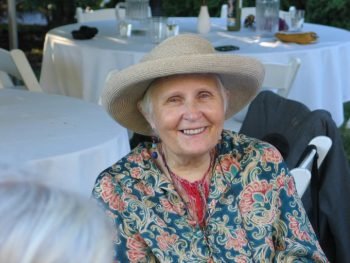
Rowena Mayer, 2010. Photo courtesy of Rowena’s Facebook page.
Rowena Mayer met the Dharma for the first time in the early 1980s when she attended a teaching with His Holiness the Dalai Lama in Santa Cruz, California. After that she started going to Vajrapani Institute in Boulder Creek for classes and retreats while raising her family in Big Sur. One of her California Dharma friends David Molk recalled Rowena’s cheerful perseverance in her practice as she worked as a school teacher. She lived right at Pacific Valley School in Big Sur in chaotic, cramped circumstances, which might have discouraged or distracted a less stable and persistent practitioner.
Rowena moved to Santa Fe, New Mexico, in 2002, and shortly afterward connected with Thubten Norbu Ling Tibetan Buddhist Center(TNL), where she served as the center director from 2006 until early 2018, guiding the development of its programs and events, and helping the community to grow into one of the largest Buddhist centers in Santa Fe. As the “mommy” of the center, Rowena was a constant presence, greeting and welcoming nearly everyone who came through its doors.
During her years as center director, she persisted in inviting Geshe Thubten Sherab to return to New Mexico, where he had worked at FPMT’s International Office when it was located in Taos from 2001-2003. It was her strong wish that Geshe Sherab become the center’s first resident geshe, and in 2013 he agreed to do that on a part-time basis, sharing the teaching duties for half of each year with TNL’s other resident teacher, myself.
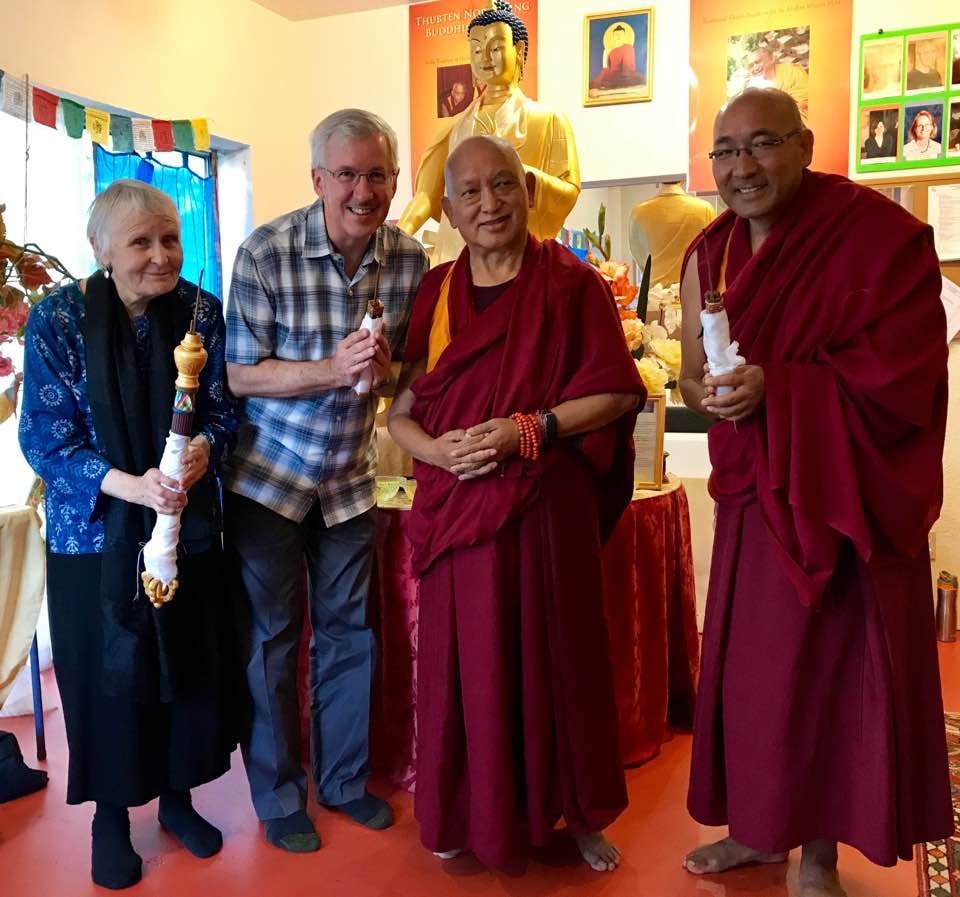
Rowena with Lama Zopa Rinpoche, Geshe Thubten Sherab, and Don Handrick at Thubten Norbu Ling, Santa Fe, 2017. Photo by Ven. Sarah Thresher.
She also continually invited Lama Zopa Rinpoche to come to Santa Fe. And her years of dedication to TNL, the FPMT organization, and Rinpoche resulted in his weeklong visit in August 2017, which included several teachings and initiations that were attended by over 200 people. The blessings of Rinpoche’s visit continue to benefit TNL in that it has grown into a large community of practitioners with an expanded program and a new building that is set to open later in 2022.
Nearly a hundred members of the TNL and FPMT community who knew Rowena joined an online Medicine Buddha puja that was conducted for her by Geshe Sherab on the evening of January 26, 2022. Rowena’s daughters and other family members watched the puja that night with her, and she took her last breath shortly before the puja ended. A few days before she passed, she had mentioned to one of her daughters that Medicine Buddha had visited and spoke with her, so it seemed most auspicious that her final moments came during that particular puja.
Rowena will be remembered for her incredible kindness and the loving concern she showed to so many. Moreover, as a practitioner, she demonstrated a genuine enthusiasm for the Dharma that will continue to inspire all those who practiced with her. What a blessing it was to have had her in our lives!
*After reading this obituary, Lama Zopa Rinpoche commented: “From the person’s side, to live the life as a very good human being and from Medicine Buddha’s side, the most powerful is to make prayers to and practice in degenerate times (from sutra and from tantra). Hence Rowena had no worries at the time of death. Whoever one practices in the life can therefore appear to oneself at death time.”
Lama Zopa Rinpoche requests that students who read obituaries pray that the person mentioned finds a perfect human body, meets a Mahayana guru, and becomes enlightened quickly, or be born in a pure land where the tantric teachings exist and they can become enlightened.” While reading obituaries we can also reflect on our own death and impermanence prompting us to live our lives in the most meaningful way. More advice from Lama Zopa Ripoche on death and dying is available, see Death and Dying: Practices and Resources (fpmt.org/death/).
To read more obituaries from the international FPMT mandala, and to find information on submission guidelines, please visit our new Obituaries page (fpmt.org/media/obituaries/).
Eléa Redel, 74, died of rheumatoid polyarthritis, on January 7, 2022, in Lavaur, France
By Christian Charrier
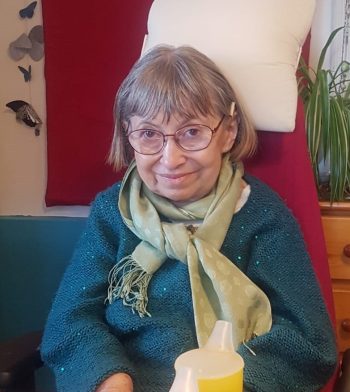
Eléa Redel, 2021. Photo courtesy of Institut Vajra Yogini.
Eléa Redel was finally released from her long-term physical suffering on January 7, 2022, at Institut Vajra Yogini, France. Geshe Loden, our resident teacher, was at her side and informed Lama Zopa Rinpoche, who responded immediately. Instructions were given and Eléa, lying on her bed, entered straightaway into meditation while Geshe-la and IVY director Nicolas Brun offered practices. She remained absorbed for five days without showing any external sign of death. A message came from His Holiness the Dalai Lama’s secretary expressing that Chenrezig was taking care of the departure of our dearest friend.
Eléa was born in France in 1947. She met Lama Yeshe in 1979 in Dharamsala and became actively involved in the FPMT organization. In France, she served as a translator and founder of Vajra Yogini Publications (now “Editions Mahayana”). In India, she was the director of Lotsawa Rinchen Zangpo Translator Program, one of the leading schools in the training of specialized interpreters and translators from Tibetan.
Eléa was a charismatic and sensitive person, and people enjoyed her company. She was also an intelligent student, who got her inspiration and wisdom from her kind heart. Although she never studied in a strictly academic way, her knowledge of Dharma was both very thorough and practical. She had an unwavering devotion to His Holiness the Dalai Lama, Lama Yeshe, and Lama Zopa Rinpoche, whose words she translated or helped to translate into French. She was a reliable and meticulous translator and copy editor.
Eléa was the first person I met when I arrived at Institut Vajra Yogini in 1981 during Lama Zopa Rinpoche’s visit. She immediately struck me as being a leading figure there. At this time, she would wear rainbow-colored woolen gloves with cut-off fingers as she spent her days typing on an old machine. (We did not have computers or even heaters in those days.) I soon discovered that behind her rainbow gloves were fingers that had started to swell and take on a deformed aspect. Day by day, as her whole body slowly transformed, pain and infirmity became more and more vicious. But she was brave and did not let her crippling disease stop her from serving the community and the Dharma. She also continued to travel to India and Nepal for teachings and retreats, and went on a pilgrimage to Tibet with Rinpoche.
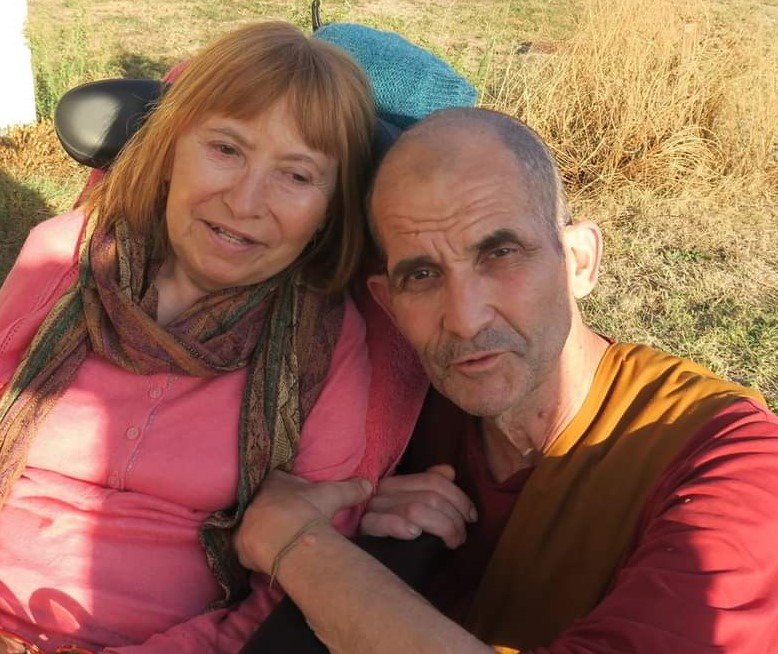
Eléa with Ven. Charles Trebaol. Photo courtesy of Institut Vajra Yogini.
Although tortured physically, her inner rainbow light continued to shine through and illuminate her environment and friends. Her suffering gradually became a catalyst for spiritual growth. And her way of accepting her illness, with forbearance and patience, revealed a true bodhisattva heart. Her courage was indeed a source of admiration and inspiration for many of us.
In the last years of her life she could not eat, drink, stand up, walk, go to bed, or get up by herself. She needed assistance every time she moved and had to cope mentally with her dependence on others for whatever activity she had to perform or anything she wished to do. Very tough to take for such an independent person!
Gradually she had to let go of her work as a translator and copy editor. In the last years, she concentrated mainly on doing her practices and advised whoever came to visit her. During one of my last visits, she told me that if she had the chance to find another precious human life, she would like to come back as a graceful and sensuous lady whose practice of Dharma would benefit others by “mere sight.” Isn’t it strange that we all wish to be what we already are! Eléa was indeed a beautiful lady, wearing the armor of patience and perseverance, and exemplifying a bodhisattva training in the six perfections. Remembering her, my yo-yo heart fluctuates between sadness and joy.
You can read “Changing Suffering into Happiness” written by Eléa Redel in 1999 for Mandala magazine. This piece has also now been translated into French.
Lama Zopa Rinpoche requests that students who read obituaries pray that the person mentioned finds a perfect human body, meets a Mahayana guru, and becomes enlightened quickly, or be born in a pure land where the teachings exist and they can become enlightened.” While reading obituaries we can also reflect on our own death and impermanence prompting us to live our lives in the most meaningful way. More advice from Lama Zopa Ripoche on death and dying is available on Lama Zopa Rinpoche’s advice page.
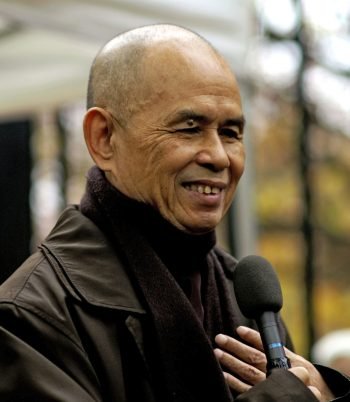
Thich Nhat Hanh, Paris, 2006. Photo by Duc (pixiduc) from Paris, France, CC BY-SA 2.0 via Wikimedia Commons.
Buddhist monk, Vietnamese Zen Master, engaged-buddhism proponent, and peace activist Thich Nhat Hanh passed away on January 22, 2022, at the age of 95. Spiritual leaders as well as FPMT students and centers around the world have been sharing the deep appreciation they had for this teacher of non-violence and mindfulness.
His Holiness the Dalai Lama released the following message of condolence:
“In his peaceful opposition to the Vietnam war, his support for Martin Luther King and most of all his dedication to sharing with others not only how mindfulness and compassion contribute to inner peace, but also how individuals cultivating peace of mind contributes to genuine world peace, the Venerable lived a truly meaningful life. I have no doubt the best way we can pay tribute to him is to continue his work to promote peace in the world.”
His Eminence the 7th Kyabje Ling Rinpoche encouraged everyone to rejoice and to be inspired by Thich Nhat Hanh’s exemplary life of tireless service to the Buddhadharma and to promoting non-violence, peace and harmony in Vietnam and throughout the entire world.
We invite you to read two teachings from Thich Nhat Hanh previously published in Mandala magazine, Embracing Anger, and Going Home to Yourself.
For more on Thich Nhat Hanh and his passing, please visit the Plum Village website.
FPMT.org brings you news of Lama Zopa Rinpoche and of activities, teachings, and events from FPMT centers, projects, and services around the globe as well as from students, teachers, and others in the FPMT community. If you like what you read, consider becoming a Friend of FPMT, which supports our work.
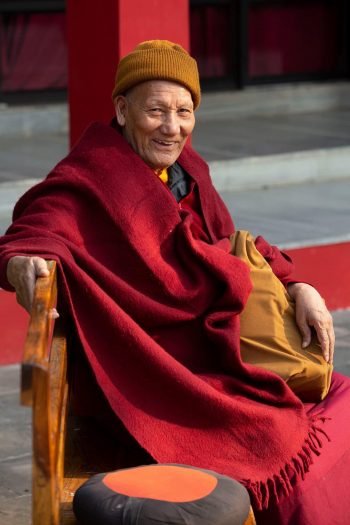
Ladakhi Lama at Root Institute for Wisdom Culture, Bodhgaya, Gaya District, Bihar, India. Photo by Paolo Regis (@paoloregisphotography).
We are saddened to share the news that Ven. Thupten Tsewang (also known as Ladakhi Lama and Baling Lama), born in Ladakh, India, passed away at the age of 92, at Kalpataru Buddha Vihar, Nagpur, Maharashtra, India, on April 25, 2021, of natural causes.
Ladakhi Lama had been an attendant to Indian Buddhist master Khunu Lama Tenzin Gyaltsen Rinpoche (1894–1977). In his later years he was a part-time resident at Root Institute for Wisdom Culture in Bodhgaya, Gaya District, Bihar, India.
Geshe Ngawang Rabga, the FPMT resident geshe at Root Institute from 2016–2020, wrote a kind remembrance of Gen-la, as Ladakhi Lama was sometimes called, to share with the international FPMT community:
“Gen-la was very respectable and close to me. His demise has saddened me deeply. He lived his life as a fully ordained monk and received Dharma teachings from many great masters like His Holiness the Dalai Lama and Kyabje Zopa Rinpoche. Therefore, he made his life a meaningful one. I truly appreciate the life he lived. I pray from my heart that he returns in his next life as a great teacher of the Buddhadharma in general, and especially of the teachings of Lama Tsongkhapa.”
In his younger days, before he ordained, Ladakhi Lama worked as a radio broadcaster at All India Radio in Ladakh. Ven. Tenzin Paldron, center director at Root Institute from 2015–2019, and Annie McGhee, who volunteered at the center, remembered him as an avid reader of The Times of India. “Lama loved to read the newspaper on a daily basis and was very well versed in political affairs in India and loved to discuss politics with the guests that visited,” Ven. Paldron said. Annie added, “He loved a good debate and engaged in many animated discussions over meals at the dining table.”
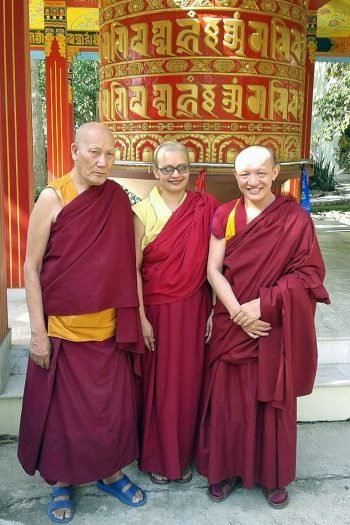
Ladakhi Lama, Ven. Tenzin Paldron, and Geshe Ngawang Rabga at Root Institute for Wisdom Culture, Bodhgaya, Gaya District, Bihar, India. Photo courtesy of Root Institute.
Ladakhi Lama met Khunu Lama in Varanasi in 1954, and Khunu Lama ordained him shortly after their meeting. After six years of being a devoted disciple, he became Khunu Lama’s attendant in 1960. Ven. Paldron said, “He often regaled many of us in the dining hall with stories of the times he spent serving high lamas like Khunu Lama and Denma Locho Rinpoche, and of the rich and varied experiences that he had living as an ordained monk in various temples.”
Annie recalled, “One story which really moved me was when Ladakhi Lama was making lunch—probably rice and dhal—and Khunu Lama told him, ‘Stop cooking now; we have to practice.’ So they had half-cooked rice for lunch! If only we had that dedication and commitment to study and practice the Dharma in the most beneficial way and not waste time on trivialities like food.”
Ladakhi Lama lived in various places, such as Mumbai and Nagpur, before going to Bodhgaya, which is where he met Lama Zopa Rinpoche. Rinpoche requested that Ladakhi Lama stay at Root Institute. “When I became director of Root Institute in June 2015, the first task given to me by Rinpoche was, ‘Take good care of Ladakhi Lama,’” Ven. Paldron said.
He became a much valued presence at Root Institute. “He was like a fatherly figure to us in many ways, often giving us teachings and advice, including making predictions such as who would get ordained,” Ven. Paldron said.
Vicki Taylor, another volunteer at the center, said, “Gen-la was a quiet and friendly presence for several years, bringing humor and cheer to our guests—especially in the dining hall. Despite his advanced age, Gen-la retained the fresh perspective and cheeky sweetness of a child, and I’m sure this gentle presence radiating Dharma contentment benefited many people.”
Indian monk Ven. Tashi Choedup first met Ladakhi Lama at Root Institute in 2017 and had many fond memories of him to share:
“Newly ordained myself, I hadn’t met many Indian ordained Sangha, Himalayan or otherwise; Lama was one of the first. His welcoming nature, warmth, love, and our ability to communicate in Hindi helped us establish a connection from our very first meeting. Lama was generous, sharing stories from his life experiences during our mealtimes. No matter how brief a guest’s visit to Root Institute was, all were touched by Lama’s infectious smile and kindness.
“Lama took me to my first ever Sangha dana ceremony and to many more such gatherings in Bodhgaya thereafter. I fondly remember making a trip to Patna Museum with Lama to pay respects to Buddha relics there.
“I also had the fortune of living in the room next to Lama’s and had the blessing of waking up to Lama’s prayers as early as 3 A.M. every morning. Although we only knew each other for a few years, Lama inspired me to practice Dharma more diligently and gave me the confidence to live an ordained life until the very end.
“Of Lama’s many qualities, one that was always visible was his giving nature. He was always giving away whatever money, food, or resources he had with him. He would never keep anything for himself—except maybe for the packets of Yippee instant noodles, his favorite.”
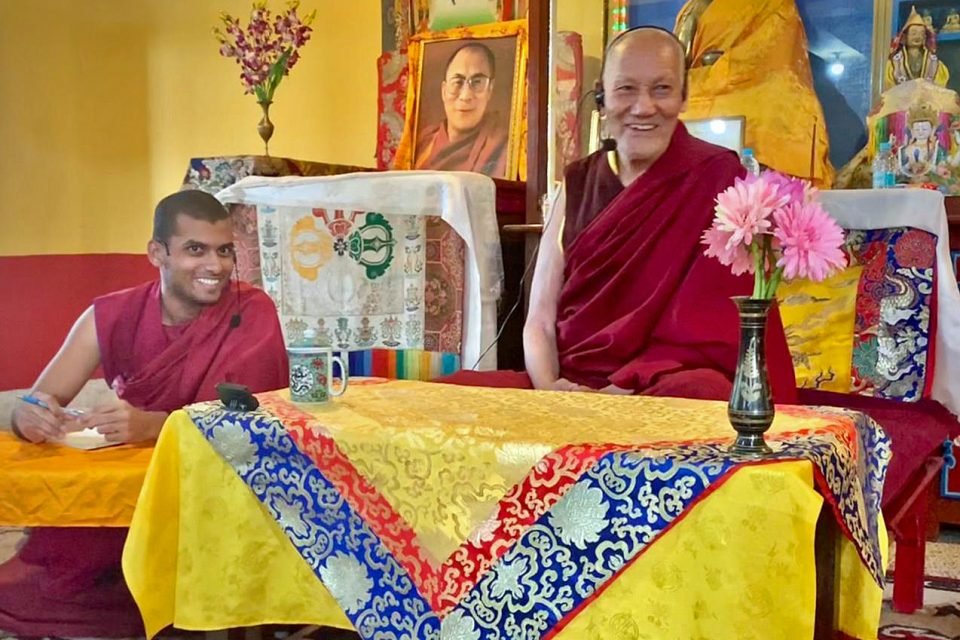
Ven. Tashi Choedup and Ladakhi Lama at Root Institute for Wisdom Culture, Bodhgaya, Gaya District, Bihar, India, November 2019. Photo by Ven. Thubten Munsel.
Inder Kant, who met Ladakhi Lama in 2016 in Bodhgaya, commented on his kindness and humor as well as his profound generosity, recalling a story about visiting a very sick 102-year-old lama at a Tibetan monastery in Bodhgaya with Ladakhi Lama. “We gave the lama some food we had brought for him,” Inder said. “Ladakhi Lama used to visit the elderly lama, looking after him. The lama’s room was messy so Ladakhi Lama and I cleaned the room and made his bed with a new bed sheet. It was overwhelming to see the kindness of Ladakhi Lama.”
Ven. Paldron recounted another quality of Ladakhi Lama: “He was not afraid to challenge someone’s authority, no matter what their position was, if Lama thought they were behaving unethically or inappropriately. He shared various stories of how he had confronted bullies—including some lamas in temples—to make sure that the vulnerable and needy were treated fairly and justly. Lama did not care about his reputation or what would happen to him. If something needed to be corrected, he spoke out against it very fiercely.”
Ladakhi Lama was also very knowledgeable about the history of Bodhgaya and the Mahabodhi Stupa, as well as the significance of many of the small and large stupas around the main temple. He also knew all the main pilgrimage sites.
“In early October 2016, I arrived at Root Institute to volunteer for the winter season,” Annie McGhee said. “I had longed to go to Vikramashila, the home monastery of Lama Atisha. This pilgrimage site is in northeastern Bihar, a region unsafe to travel to as a single woman. I had made many prayers to go and had mentioned this to two friends. One morning I was standing in the breakfast queue when Ladakhi Lama came up to me and said, ‘You want to go to Vikramashila? OK, I will take you.’ I was overjoyed but a little concerned for Lama because it would be a long journey with rough conditions.
“A few of us from Root Institute made the trip together, traveling for ten hours one way by Jeep. At the entrance we stopped to take it all in, as it was a large and important monastic university in its time. Lama remarked, ‘Here is what is left of stupas that would have held the 108 arhats who resided at Vikramashila.’ He was quiet and reflective at other places but led us in many practices and prayers at some of the holy sites.”
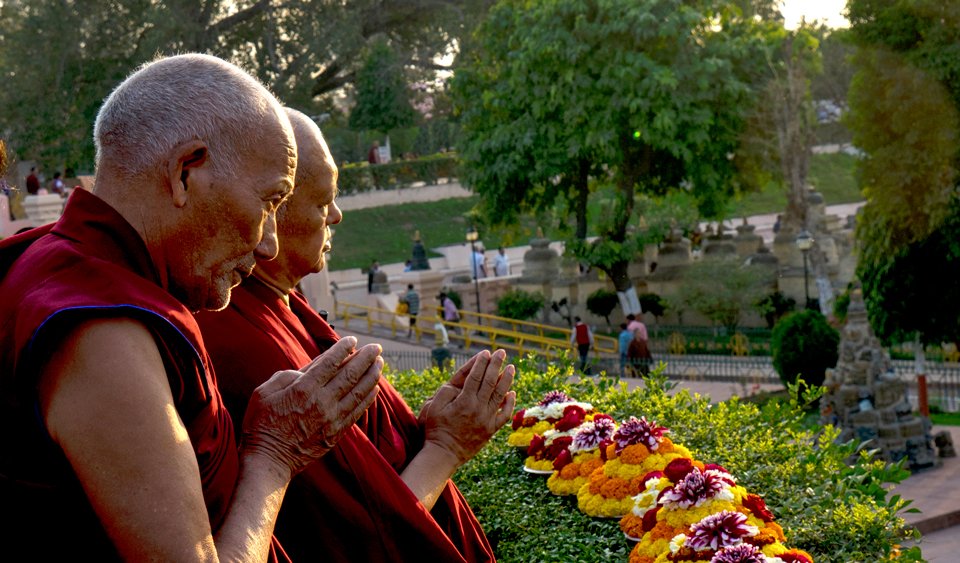
Ladakhi Lama and Lama Zopa Rinpoche at the Mahabodhi Stupa, Bodhgaya, Gaya District, Bihar, India, 2015. Photo by Andy Melnic.
Sharing her favorite memory of Ladakhi Lama, Vicki Taylor said, “Lama Zopa Rinpoche had requested from Gen-la the oral transmission of Gampopa’s classic lamrim text The Jewel Ornament of Liberation, which he himself had received from Khunu Lama. The transmission took more than one session, and a few of us were gathered in the Root Institute’s small gompa, about to start a subsequent session. When Rinpoche arrived, he showed great respect to Gen-la by trying to prostrate to him before we resumed. Gen-la could not bear to see Rinpoche struggle to prostrate to him, due to Rinpoche’s manifesting signs of a stroke and especially because of Gen-la’s deep respect and appreciation for Rinpoche. So Rinpoche was trying to prostrate, and Gen-la was trying to hold one of his arms to prevent him, all the while politely imploring Rinpoche not to prostrate. I remember the two of them, in a sort of ‘battle of politeness,’ intent on showing great respect to each other. It was beautiful to see.”
The practice of bodhicitta was very close to Ladakhi Lama’s heart. At Root Institute, he also gave the transmission of the verses from Jewel Lamp: A Praise of Bodhicitta, written by Khunu Lama.
Because it was his wish to go to Tushita Pure Land once he departed his body, a butter lamp is being offered in honor of Ladakhi Lama at Tushita Meditation Center, the FPMT center in Dharamsala, India, over the forty-nine day period along with daily prayers and dedications. May all of Lama’s wishes be fulfilled and may he quickly return to guide us on the path to attain enlightenment for the benefit of all sentient beings.
For more on practices recommended by Lama Zopa Rinpoche at time of death and other resources to support yourself and loved ones at time of death, please visit fpmt.org/death/.
FPMT.org and Mandala Publications brings you news of Lama Zopa Rinpoche and of activities, teachings, and events from over 160 FPMT centers, projects, and services around the globe. If you like what you read, consider becoming a Friend of FPMT, which supports our work.
Chandramani Kumar, 55, died in Patna, Bihar, India, on May 17, 2021, of COVID
By Root Institute for Wisdom Culture former director Ven. Tenzin Paldron and former volunteer Ven. Tashi Choedup
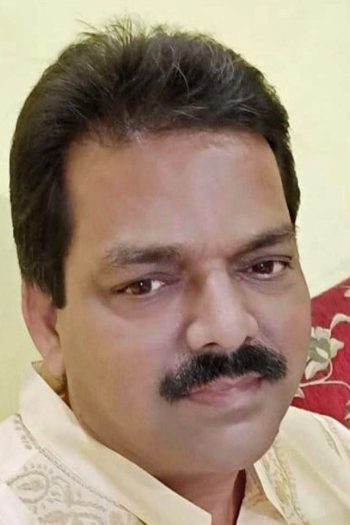
Mr. Chandramani Kumar; photo courtesy of his family
Chandramani Kumar, fondly known as Chunnu ji, was one of the most respected and well-known people in Bodhgaya. He was the founder of two grocery stores that catered to the needs of several of the monasteries and pilgrims visiting the holy town. The Root was one of the institutes that Chunnu ji devotedly served for almost fifteen years. Previous director Ven. Thubten Labdron (Trisha Donnelly), who passed away in 2015, was cautious in trusting many people in Bodhgaya. She considered Chuunu ji to be a trusted loyal friend and advisor of Root.
Ven. Tashi Choedup recalled that when the first lockdown began in March 2020, twenty guests became stranded at Root. The Root staff were sent off-duty as a precautionary measure, leaving Root in a vulnerable and challenging situation. Chunnu ji, who had reliably supplied Root with groceries during busy and off-seasons, once again came through by delivering all the needed groceries and goods right to the Root front gate in his personal vehicle.
Ven. Tenzin Paldron said Chuunu ji was a soft spoken gentleman who was trustworthy, loyal, and reliable. He will be remembered by many people in Bodhgaya as a caring, compassionate, and conscientious gentleman who served others with a gentle kind heart and warm smile. He leaves behind his wife and two sons.
Lama Zopa Rinpoche requests that students who read obituaries pray that the person mentioned finds a perfect human body, meets a Mahayana guru, and becomes enlightened quickly, or be born in a pure land where the teachings exist and they can become enlightened.” While reading obituaries we can also reflect on our own death and impermanence prompting us to live our lives in the most meaningful way. More advice from Lama Zopa Ripoche on death and dying is available on Lama Zopa Rinpoche’s advice page.
Atul Chopra, 61, died in Gorakhpur, Uttar Pradesh, India, on May 7, 2021, of COVID-19
By Marcel Bertels, director of FPMT project Maitreya Buddha Kushinagar
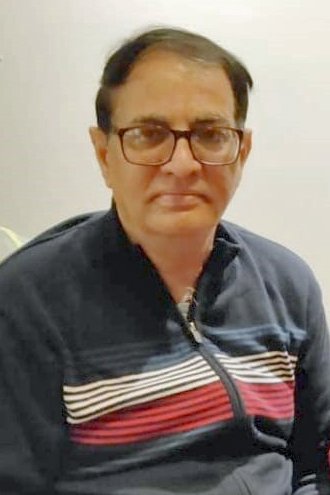
Mr. Atul Chopra; photo courtesy of the family
I met Atul in 2001. After deciding to relocate the Maitreya Project from Bihar, India, it was concluded that we should explore the availability of land at other holy sites outside of Bihar. The most promising lead came from the Government of Uttar Pradesh, a state in northeast India. The government expressed they were very keen to host the Maitreya Project and promised to provide free land at any holy site we desired.
When a team from Maitreya Project visited Kushinagar, they were greeted by a welcome party that included Atul Chopra. The government had asked Atul to assist because he had been active in Buddhist projects in the Kushinagar area for quite some time.
After His Holiness the Dalai Lama confirmed Kushinagar as the best place for the project, boots on the ground were needed quickly. Atul presented himself as the natural person to help us coordinate with the Government of Uttar Pradesh.
It turned out Atul was very skillful at this task. He was extremely determined, persistent, hardworking, and would generally never take “no” for an answer. He told me during one of our many road trips that he just loved challenges! Not only that, he was tireless. Atul’s many trips away from his home base in Gorakhpur—to the Uttar Pradesh State Capital of Lucknow, the project site in Kushinagar, and New Delhi—must have run into the hundreds over his seventeen years with the project. He was a very pragmatic and simple person who was quite satisfied with budget hotels and run-of-the-mill train travel.
Atul called upon all of his resources in the government, bureaucracy, and judiciary, as well as his friends, for lobbying and expert advice on behalf of the Maitreya Project. His critical accomplishments include the drafting of an excellent Memorandum of Understanding with the Government of Uttar Pradesh; the finalization of the land site; the execution of the Lease Agreement; and the subsequent taking possession of the land. He held the fort for seventeen years and remained a mainstay of the project until his resignation in late 2017. Atul also showed his kindness by assisting other FPMT projects in India when asked for his advice.
Atul and his wife were both struck by COVID in April 2021 and were admitted to the intensive care unit in Gorakhpur. Atul seemed to be recovering well, but suddenly passed away from a heart attack on May 7. He is survived by his wife Geetu, son Utkarsh, and daughter Sanjoli.
Lama Zopa Rinpoche requests that students who read obituaries pray that the person mentioned finds a perfect human body, meets a Mahayana guru, and becomes enlightened quickly, or be born in a pure land where the teachings exist and they can become enlightened.” While reading obituaries we can also reflect on our own death and impermanence prompting us to live our lives in the most meaningful way. More advice from Lama Zopa Ripoche on death and dying is available on Lama Zopa Rinpoche’s advice page.
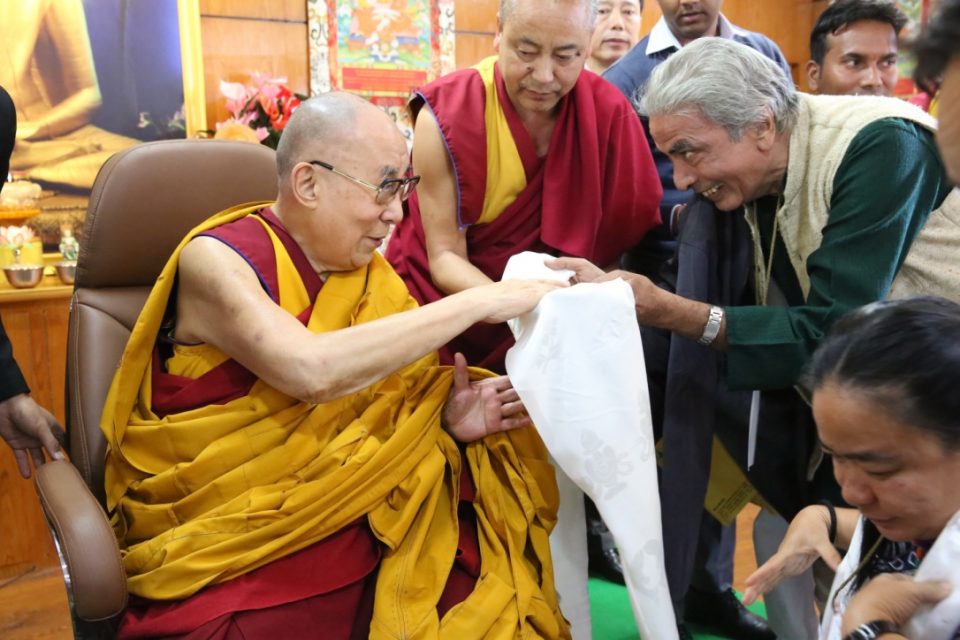
His Holiness the Dalai Lama with Naresh Mathur. Photo courtesy of the Office of His Holiness the Dalai Lama.
We are saddened to share the news that Naresh Sahai Mathur passed away at the age of 67, in New Delhi, India, on April 25, 2021, of COVID-19. Naresh was an early student of FPMT founders Lama Thubten Yeshe and Lama Zopa Rinpoche, and a long-time FPMT volunteer. Kabir Saxena, also a long-time FPMT student who currently serves as the spiritual program coordinator at Tushita Mahayana Meditation Centre in New Delhi, wrote a personal remembrance of Naresh to share with the international FPMT community.
By Kabir Saxena
With the recent untimely passing away of Naresh Mathur—another victim of the second murderous wave of COVID-19—the Indian Buddhist sangha, his friends worldwide, as well as the Tibetan community, have lost an invaluable supporter, legal advisor, and much beloved friend.
Naresh was born in Old Delhi in 1954, close to where some twenty-five years later the pioneers of Tushita Mahayana Meditation Centre would be living. It’s a testimony to his great intellectual and spiritual thirst that he was willing and able to seek beyond his quality education in sociology and law at two of Delhi’s esteemed establishments and find himself at the doors of both Tushita Mahayana Meditation Centre and Tibet House in Delhi.
While the practice of law provided his bread and butter, it was Buddhist studies that quickly established their prominence in Naresh’s heart and mind. Early on he had the great good fortune to receive personal, one-on-one teachings on lamrim and Madhyamaka from the renowned Geshe Palden Drakpa, who became a lifelong friend of the family and a recipient of Naresh’s generous medical help. It was, I believe, this deep experience of the teachings with Geshe-la that made Naresh a lifelong proponent of the sublime Nalanda parampara (tradition), with its emphasis on the guru-disciple relationship, logical inquiry, and debate. It was to these teachings that Naresh returned again and again; even in the last decade of his life, he was an important part of the core group of students at Geshe Dorji Damdul’s Tibet House Nalanda Masters Course.
Naresh was a lover of knowledge, a philosopher in the true sense of the word, and all his life he combined that with his work as a lawyer in the High and Supreme Courts in Delhi.
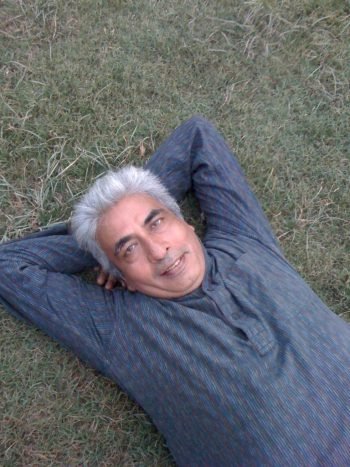
Naresh Mathur
When I first met him in 1980, he was a bright and extremely handsome young man, much impressed by his contact with Lama Thubten Yeshe and Lama Zopa Rinpoche. Naresh went on to be a director of Tushita Mahayana Meditation Centre, an organizer of the Dharma Celebrations with His Holiness the Dalai Lama in Delhi, and the creator of Root Institute for Wisdom Culture’s Trust Deed in 1984 in Bodhgaya. He remained a trustee until a few months before his death.
His dedication to the cause of bringing the Dharma back to Indian people was profound and lasting. He participated in the teachings His Holiness gave to small groups of Indian students in the early 1980s and despite his heavy workload would, almost thirty years later, travel to Bodhgaya for the weekends to give teachings in Hindi to local students.
Naresh unstintingly helped the Tibetan cause with his legal talents and the list of his efforts on their behalf would be too long to include here. As an example, it was largely due to his legal actions that the Tibetan Colony of Majnu Ka Tila in Delhi was saved from destruction. Tenzin Geyche Tethong, former secretary to His Holiness, recalled how he had known Naresh since 1980 and how he greatly admired his interest in and knowledge of Buddhism, and also appreciated Naresh’s contribution to the Dalai Lama Trust of which he was a trustee.
In addition to his connection with Lama Yeshe, Lama Zopa Rinpoche, and FPMT, Naresh had a close connection with Dzongsar Jamyang Khyentse Rinpoche and his Deer Park Institute in Bir, as well as with Samdhong Rinpoche, whose Gandhian vision, critique of modernity, and Dharma advice were like nectar for Naresh.
Naresh was a lover of the meditative dhrupad style of Indian classical music, and we also spent many happy moments listening to Bob Dylan together. He could also be quite mischievous, and we would especially enjoy making silent and secret fun of speakers at conferences whom we considered not up to the mark.
He was a practitioner, especially of the Madhyamaka and the Kalachakra, and was increasingly drawn to extended practice in the last year of his life, according to his wife, Antonella. Throughout his life he had inspired and encouraged a younger generation of students by his example.
For me, and I am sure for many others, including his dear circle of Italian and international friends, Naresh was like family. His deep soulful eyes were those of the eternal seeker and lover; they grabbed you. My father, to whom Naresh was very loving and generous, used to say that going by Naresh’s piercing gaze, he was always in a state of otherworldly intoxication!
In his last year, during long walks together in the woods near his home in south Delhi, Naresh would always steer the conversation to the Dharma, the importance of a grounding in lamrim, and his great love and obsession: the presentation of emptiness in the Gelug tradition. Despite his allegiance to many lamas of different schools of Tibetan Buddhism, he always seemed to be happily and no doubt karmically tethered to the pole of Lama Tsongkhapa’s works and Geshe Palden Dragpa’s teachings.
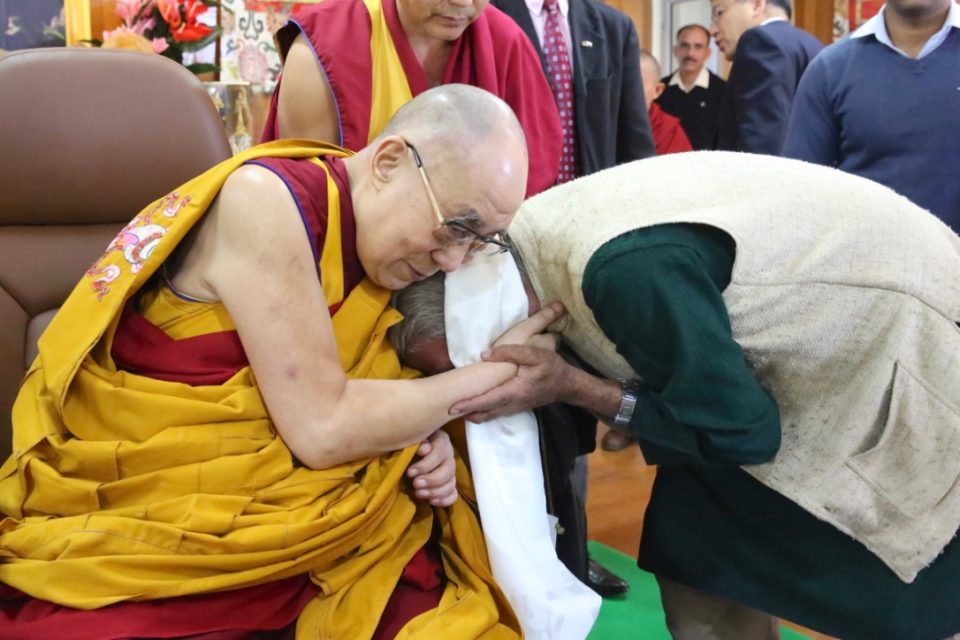
His Holiness the Dalai Lama with Naresh Mathur. Photo courtesy of the Office of His Holiness the Dalai Lama.
After his passing, His Holiness the Dalai Lama made the encouraging pronouncement that Naresh was his disciple, that we should not worry, and that he would take a good rebirth and would remember this life of his. The passing of this kind-hearted and generous man, still somewhat unreal and unbelievable to some of us, leaves a big void in many lives. Naresh is survived by his wife, Antonella, a gifted healer; daughter, Mudita, a talented graphic designer; and son, Atisha, a profound, upcoming teacher of the Dharma, especially of Buddhist logic, the subject matter his dear departed father so admired and communicated so readily to those fortunate enough to cross his path.
The FPMT India community organized a moving online prayer meeting and memorial for Naresh Mathur on May 5, 2021, with Naresh’s family and many long-time students around the world joining in. You can watch the two-hour recording of the Zoom call:
https://www.facebook.com/1652241455007411/videos/457118005515720/?__so__=channel_tab&__rv__=all_videos_card
For more on practices recommended by Lama Zopa Rinpoche at time of death and other resources to support yourself and loved ones at time of death, please visit fpmt.org/death/.
FPMT.org and Mandala Publications brings you news of Lama Zopa Rinpoche and of activities, teachings, and events from over 160 FPMT centers, projects, and services around the globe. If you like what you read, consider becoming a Friend of FPMT, which supports our work.