
 receive our newsletters
 join Friends of FPMT

Advice from Lama Zopa Rinpoche
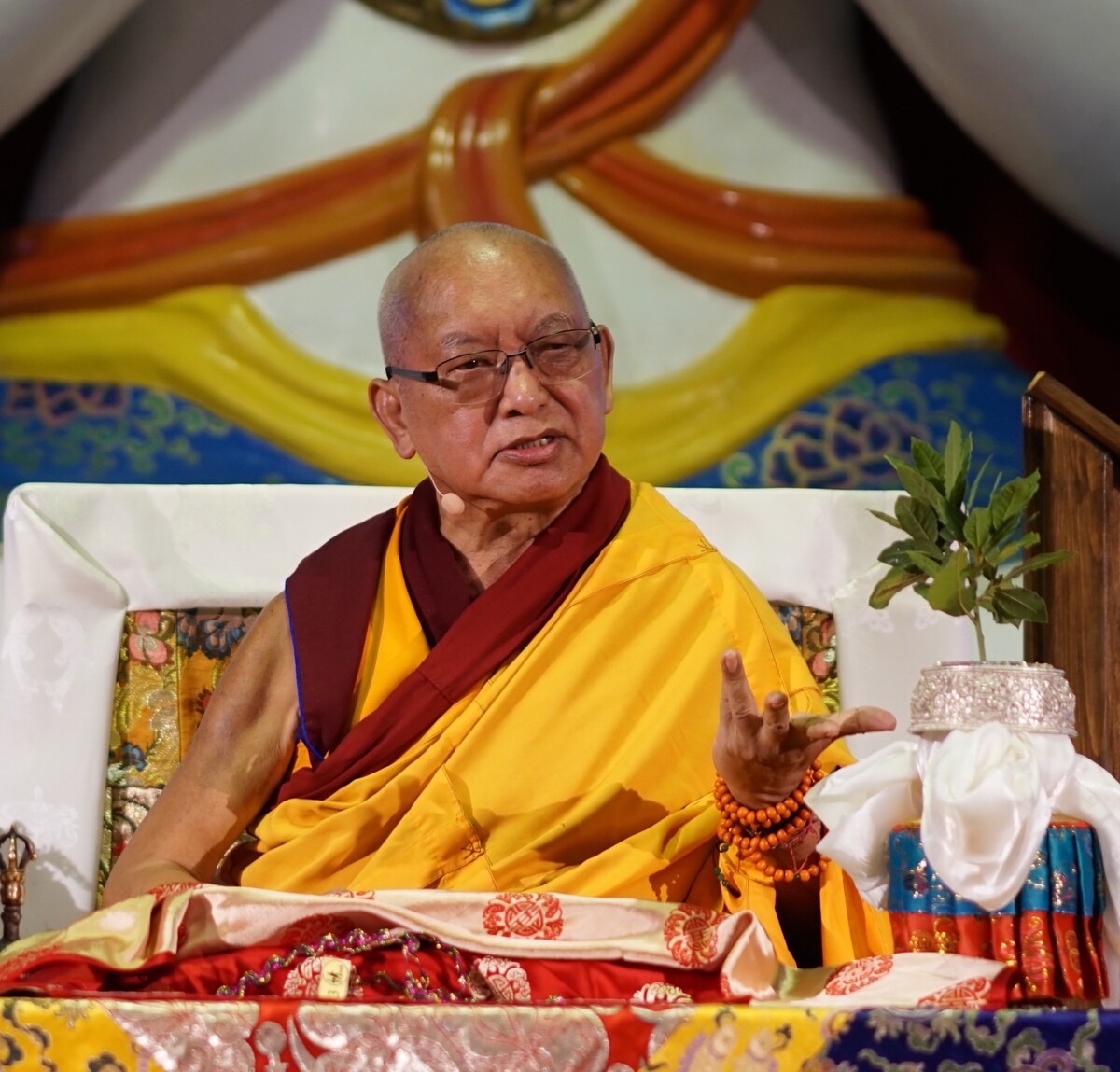
Lama Zopa Rinpoche teaching at 100 Million Mani Retreat, Istituto Lama Tzong Khapa, Italy, 2017. Photo by Lobsang Sherab.
The FPMT Global Mani Retreat is in its final month! Since its start on May 17, the retreat has included teachings from Khen Rinpoche Geshe Thubten Chonyi, a rare oral transmission and commentary from His Eminence Ling Rinpoche, and a teaching on bodhichitta from Serkong Tsenshap, among many other highlights. Regional teachers have also led regular online Chenrezig group practices on Zoom and YouTube. Recently, Ven. Robina Courtin led the group practice ( you can watch the video here ),and Kabir Saxena, representing FPMT in India, led the Chenrezig sadhana, with an introduction of Dr. Nick Ribush about the unique FPMT history (you can watch the video here)
A recent cause for rejoicing related to this retreat was the 14th annual 100 Million Mani Retreat held at Idgaa Choizinling Monastery in Ulaanbaatar which drew about 150–250 people a day and ended in the accumulation of 109,208,246 mantras, passing its 100 million goal.
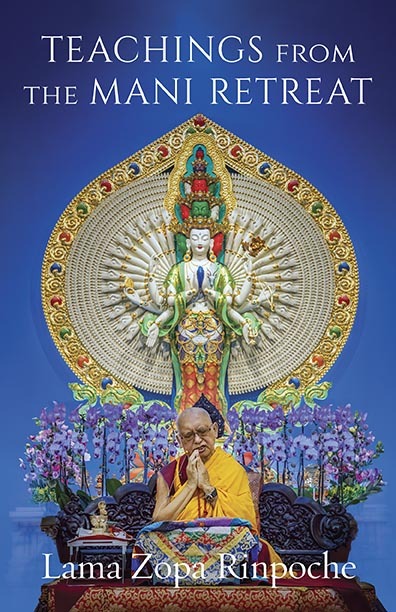
To celebrate the ongoing FPMT Global Mani Retreat which has brought together students of Lama Zopa Rinpoche from around the world to help fulfill one of Rinpoche’s most cherished wishes, we are sharing this excerpt from the revised second edition of Teaching from the Mani Retreat by Lama Zopa Rinpoche: recently released from the Lama Yeshe Wisdom Archive.
This is another way to generate a motivation of bodhicitta before reciting the mantra, to make the recitation of mantra and the meditation on Compassion Buddha become not only Dharma but most beneficial not only for you but for every single hell being, hungry ghost, animal, human being, asura, sura and intermediate state being. Each realm has numberless beings. In the human realm there are numberless human beings. We can understand that there are numberless beings in the animal realm. Even regarding one type of insect, ants, there are numberless ants. In the same way, there are many other different types of animals, the number of which is uncountable. This is without mentioning the sentient beings in the other realms. All these beings, who are the source of all your own past, present and future happiness, are continuously suffering; totally overwhelmed by delusions and karma, they do not have any freedom at all. Even though there are numberless buddhas and bodhisattvas working for sentient beings, there are many sentient beings—people, and even animals—who received help only through meeting you. They had some problem they couldn’t resolve until they met you and you were able to help them. Or they didn’t meet Dharma until they met you. You have had many such experiences of sentient beings being dependent upon your help. There are numberless beings with whom you have a karmic connection and who depend upon you. Their being free from suffering, from samsara, and their achieving liberation and enlightenment depend on you, on your help. You can understand from your experiences in this life with the many beings who depend on your help that there are also numberless other beings who depend on your help to free them from samsara. They depend on you to meet, understand and practice Dharma, and to achieve enlightenment.
Now think, If I had generated bodhicitta much earlier, this one hell being who is dependent on me wouldn’t have to experience this unimaginable, unbearable suffering, the heaviest suffering in samsara. One tiny spark of the fire of the hot hells is seven times hotter than the fire at the end of the world, which can melt rocky mountains and concrete. And the fire at the end of the world is sixty or seventy times hotter than the fire energy of our present human world.
For one hell being to be suffering now in the hell realm even for one second is like eons-it is unbearable. If I had generated bodhicitta much earlier, that hell being would already have been enlightened. Now we are talking about just one hell being, but there are numberless other hell beings who could have already been enlightened by me, so that they wouldn’t now have to suffer. They have been suffering up to now because I have been following the selfcherishing thought, the ego. Therefore, even when I think of this one hell being who is experiencing unimaginable suffering, it becomes urgent that I generate bodhicitta without even a second’s delay. Now there are numberless hell beings; therefore, I need to generate bodhicitta without the delay of even a second. Because there are numberless hell beings who are suffering, the need for me to generate bodhicitta is much more urgent.
If I had generated bodhicitta much earlier, this one animal who has been suffering so much up to now-being extremely foolish, experiencing hunger and thirst, heat and cold, being tortured, used for food—would already have been enlightened a long time ago. There are numberless animals, and they would all have already been enlightened if I had generated bodhicitta much earlier. It is because I didn’t generate bodhicitta but followed the ego that they have been suffering up to now. Therefore, the need for me to generate bodhicitta, to change my mind, is unbelievably urgent, not only for this one animal but for the numberless animals who have been experiencing so much suffering.
And it is the same with human beings. If I had generated bodhicitta, if I had changed my mind, a long time ago, this one human being, who is constantly suffering, would already have been enlightened. Instead, they are experiencing the suffering of pain; if not that, the suffering of change; and if not that, pervasive compounding suffering, by having these aggregates, this samsara, the nature of which is suffering. These aggregates are caused by karma and delusions and are contaminated by the seed of disturbing thoughts, so this person constantly, without the break of even one second, experiences pervasive compounding suffering. In this way, this human being is totally overwhelmed by delusion and karma, living in a total hallucination, with piles of wrong concepts, and suffering in that way. If I had generated bodhicitta earlier, this most precious and kind human being who has been suffering up to now and who is the source of all my own past, present and future happiness, would already have been enlightened and not have to suffer. And there are numberless human beings. Because I did not change my mind but followed the ego, not only this one human being but numberless human beings have been suffering during time without beginning up to now. Therefore, without the delay of even a second, I must change my mind into bodhicitta, into cherishing others.
It is similar with the suras. If I had generated bodhicitta much earlier, this one sura being who has been suffering so much would have been enlightened a long time ago. The sufferings of the suras are similar to those I mentioned for human beings. Suras are also totally distracted by objects of desire; they cling to and are distracted by sense pleasures. No matter how many eons they live, their life is totally overwhelmed by desire. In this way, they suffer so much and are constantly creating the cause of suffering, the cause to again be reborn in the lower realms. Their having great enjoyments is just temporary. How wonderful it would have been if this one sura being could have been enlightened a long time ago. And there are numberless sura beings who would have been enlightened a long time ago. How fantastic if that could have happened. Because I didn’t change my mind, but instead followed only the ego, not only this one being but numberless sura beings have been suffering up to now. And it is similar with the asuras.
My kind mother sentient beings have been suffering from time without beginning; they have never had a break for even one second from the suffering of samsara, from pervasive compounding suffering. Therefore, without delay, I must generate bodhicitta. Generating bodhicitta depends on receiving the blessing of the special deity of compassion. Trying to develop bodhicitta just by remembering the words of the teachings is not enough. Even meditation alone is not enough. I need to receive the blessings of the special deity of compassion. For that reason, I need to meditate on Compassion Buddha and to recite the mantra that persuades Compassion Buddha’s holy mind. I need to recite the mantra that brings me closer to the deity of compassion, that causes me to receive the blessings of the deity of compassion. Therefore, I’m going to do the meditation-recitation of Compassion Buddha.
Excerpt from Lama Zopa Rinpoche’s book Teachings from the Mani Retreat bestowed at Chenrezig Institute, December 2000, Lama Yeshe Wisdom Archive. You can also read this book online, or listen to an audio recording from the retreat.
To keep up on all details related to the FPMT Global MANI Retreat, please refer to our webpage, and join the Facebook Group.
Foundation for the Preservation of the Mahayana Tradition (FPMT) is a Tibetan Buddhist organization dedicated to the transmission of the Mahayana Buddhist tradition and values worldwide through teaching, meditation, and community service.
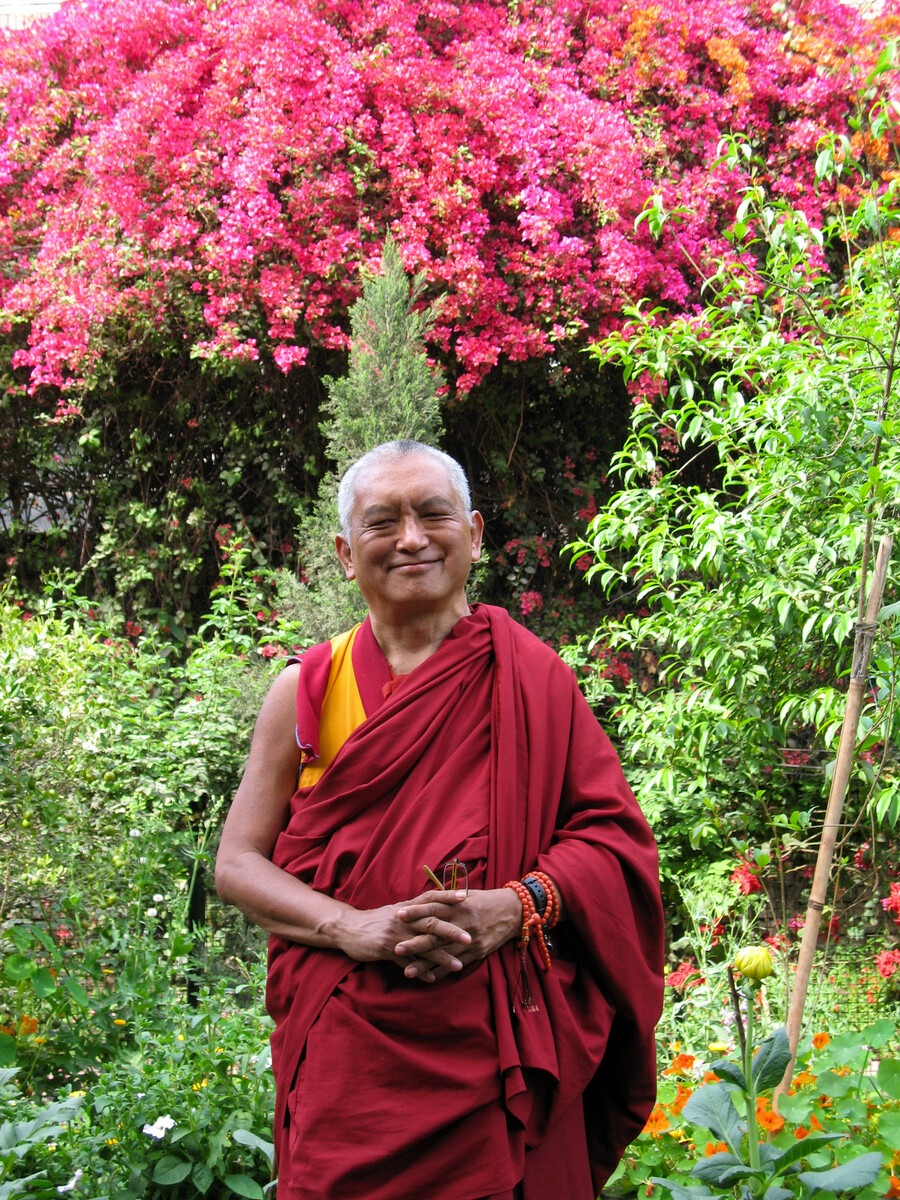
Lama Zopa Rinpoche in India, March 2008, Photo by Thubten Kunsang (Henri Lopez)
In 2008, Lama Zopa Rinpoche gave this advice to a student who was about to give birth, outlining the five attitudes and qualities to teach a child. This is timeless advice for all who are in the position of raising children.
Since you have directed your life in this way, to have a child, you have a great responsibility now to bring up your child. Without saying many words, I just want to inform you that you should plan to lead the child’s life in the style of Universal Education (UE). First, if you can study the UE subjects I put together. There are five very basic attitudes and qualities to teach the child, so that your child can bring happiness to this life, from life to life, bring happiness to all sentient beings, cause less harm to others, and eventually bring all sentient beings to full enlightenment. This means knowing Buddhadharma and educating others, and then bringing your child in the path to enlightenment.
These five very basic attitudes are very important to keep in one’s mind. This is the cause of inner peace and happiness for your child, also to give peace and happiness in everyday life to others. In this way, wherever your child is, in whatever part of the world, he or she still brings happiness to so many sentient beings, human beings, animals, and all other beings.
These five basic attitudes are:
1. Kindness
Have kindness not only towards friends, but to strangers, especially to one’s enemies, and to everyone. Generate kindness day and night for everybody, every human being, animal, etc. Practice kindness all the time, sincerely, from your heart. Think of others’ happiness and cherishing others. This makes all your actions very pure Dharma. Even if you don’t explain all this to your child, you can educate through example. This creates a good, happy life, and it becomes pure Dharma against the self-cherishing thought. This is the antidote, the medicine, for all the sicknesses, and the chronic disease of the self-cherishing mind, which has been affecting us from beginningless rebirths and harming us all the time, from time without beginning. If you don’t generate this mind in this life, when you have all the opportunities, then it means you will continue to suffer forever. This practice is unbelievably beneficial. By practicing kindness, there is always joy and happiness in your life, always fulfillment. It makes your life so meaningful when you practice kindness to others. It always makes your life fruitful, meaningful, and useful. Then, one has no time, no space for depression or suicidal thoughts; one is always able to enjoy unbelievable happiness.
2. Rejoicing
Whenever you see good things happening to others, for instance, you see someone has a better house or car than you, you rejoice. If someone has found a friend, found great success in business, any good thing that happens to others that you hear or see, all the time, rejoice. Think how wonderful it is that this sentient being had this happen. Rejoice in others’ wealth, beauty, education, power, etc. It doesn’t mean you are desiring or wanting these things. This is a bodhisattva’s attitude, when good things happen to others, to rejoice. Rejoicing is the antidote to jealousy. The delusion jealousy is an obstacle to your own success and happiness in this life and future lives, including liberation and enlightenment. It is not only an obstacle to your own happiness but also an obstacle to the happiness of others. The antidote to this is rejoicing in every single success.
When you rejoice it becomes an unbelievable source of success for you. The result of rejoicing once is success in one’s life and for many hundreds and thousands of lifetimes. You can also practice rejoicing when you do the seven limbs or in the lamrim. Rejoicing is such an easy way to collect the most extensive merits. Every second that you rejoice in your own merits you collect limitless skies of merits. Also, when you rejoice in others’ merits, you collect even more merit, and all the merit collected since beginningless rebirths is doubled. If you rejoice in bodhisattvas’ merit, and there are numberless bodhisattvas, this is unbelievable, unbelievable, unbelievable; you can’t imagine the merit one can create. From rejoicing in numberless Buddhas’ merits, even just the merits they create in one day, you collect more merit than normally it would take ten thousand years to create (without rejoicing). This is just to give you an idea how important this practice is. Rejoicing always keeps one’s mind happy. It fills one’s heart with inner peace and happiness.
3. Tolerance
Anger is more harmful than all the dangers of the wind, earth, and fire put together. These dangers just separate one’s consciousness from one’s body (cause death), but the real harm, the real danger, is anger. It can destroy all one’s merits, all the causes of enlightenment, all one’s causes for liberation from samsara, and it can destroy the cause of happiness in this life, future lives, and all one’s successes. Anger causes harm to sentient beings, as well as to oneself, from life to life. Also, it causes other sentient beings to get angry, which then causes them to experience heavy suffering. Being tolerant always keeps one’s mind in peace: peace for one’s family, husband, wife, child, neighbor, country, and the whole world; from life to life there is peace and tolerance for all sentient beings.
4. Contentment
Without contentment, one follows desire. By following desire one generates negative minds and other negative emotions. This causes negative karma, which causes harm to oneself as well as to others. It also causes other sentient beings to create negative karma, which creates the cause for them to suffer; it brings other sentient beings to the lower realms, besides oneself. So, having contentment is very important. Otherwise, without contentment, you can become crazy. Following desire is only the cause for continuous suffering, not only for individual sentient beings but for the society, country, and globally, for all sentient beings.
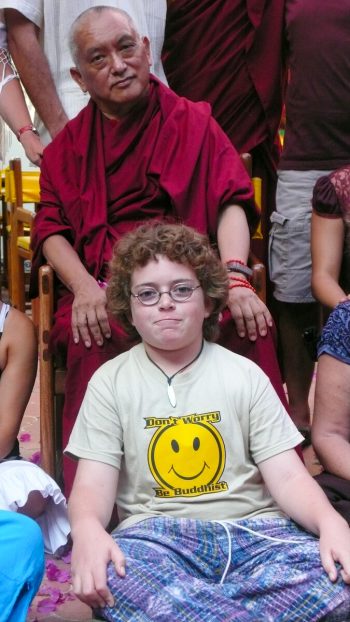
Lama Zopa Rinpoche in Mexico, April 2008, photo by Thubten Kunsang (Henri Lopez)
Many millions of billionaires have everything, so much wealth, but all of this is created by following desire, so they can never be satisfied, always wanting to be wealthier, and then engage in harming others and cheating others; their life becomes like a prison. This is without mentioning the result that they are creating which will take them to the lower realms or future human rebirths, suffering for many hundreds and thousands of lifetimes. You can see that this is very important, particularly to educate about and teach this. Also, it is important that you don’t destroy your life with drugs, alcohol, and many other things. Without contentment one can get depressed, one isn’t able to find meaning in one’s life, and one causes more suffering. So, it is very dangerous, because thinking in this way can destroy your most precious human life, that gives one all the opportunities for all happiness up to enlightenment, liberation from samsara, as well as the happiness of all future lives, including this life.
Developing contentment gives the opportunity to totally change one’s mind and develop bodhicitta, loving kindness, and compassion for all living beings, numberless beings in each realm. It becomes the cause of happiness in all future lives, liberation from samsara, everlasting happiness, and brings you to full enlightenment. Along the way it causes happiness even in this life. You can see that in one second of this precious human life one can actualize this, so to not do this is a very foolish thing. One’s mind is not thinking of Dharma, of the purpose of life, the real meaning of life, which is to benefit others, to free others from all sufferings, and bring them to enlightenment, everlasting happiness.
Not generating a good heart, not thinking of others, only thinking of oneself, one’s own happiness, is completely the wrong way to think. By thinking of others’ happiness, it is unbelievable what you can achieve, all the happiness, not only happiness in this life, now, today. Cherishing the “I” causes all the problems that one experiences now. It completely occupies the mind, and then one can become suicidal, even kill oneself, for no reason at all. By not thinking of the real cause of the problems, one’s mind is full of problems, and one continues to create more suffering and the causes of the lower realms. Whether one is reborn in hell or as a happy migratory being depends on one’s karma; the answer is karma. If one kills oneself, one just goes to the lower realms, the hell realms, where there is the most unbelievable suffering, and where one experiences the heaviest suffering in samara for an unimaginable length of time. Then, when one’s karma is finished there, one is reborn again in the lower realms. You can see how one can totally deceive oneself. Thinking incorrectly can cause one to kill oneself, as if that will take you away from these problems. Thinking that way is totally deceiving oneself.
5. Forgiveness
If someone harms you, angers you, abuses you, or disrespects you, whatever happens, forgive this person. Practice forgiveness immediately, then there is peace in your heart and also in the heart of the other person. This is the cause of world peace, bringing peace to one person, because that person is part of the world. By harming any person in the world, you are causing harm to the world; this is the opposite of world peace. By bringing peace to just one more person you are bringing more and more peace into the world. That is unbelievable. Then, from life to life, one will have no anger towards sentient beings, only peace and happiness. Gradually, you have more peace and happiness, also in one’s future lives, then liberation and enlightenment, and then you are able to liberate and enlighten all sentient beings. There is more peace in your heart, in your family, in the world, and for all sentient beings. In the same way, if you cause harm to others, then immediately apologize to the other person. Again, this brings more peace to you and to that person immediately. And this brings world peace.
As much as possible, try to teach these five attitudes, seeing that suffering is the result of bad actions, so as much as possible to develop good actions, a good heart, and then you are able to help others. In this way, as much as possible, increase the good qualities, peace, and happiness in this life, and then you are able to achieve enlightenment, and to liberate numberless sentient beings from the oceans of samsaric suffering and bring them to enlightenment. These are the very basic things, the real education, and the best education for your child. Also, if you can, study the 16 human dharmas. Bring the real Dharma attitude to your child, in order to bring your child to enlightenment and to have limitless skies of qualities. To be able to cause that is the best gift, the real meaning of having a child, from the parents’ side. There is also benefit for you, everyone can use these attitudes, especially if there are people in the past that we have had difficulties with.
The most important thing in life to bring benefit to you and others, including one’s enemy, is to practice Dharma.
Lama Zopa Rinpoche
Please read more advice from Lama Zopa Rinpoche regarding raising children from the Lama Yeshe Wisdom Archive.
Foundation for the Preservation of the Mahayana Tradition (FPMT) is a Tibetan Buddhist organization dedicated to the transmission of the Mahayana Buddhist tradition and values worldwide through teaching, meditation, and community service.
In this extract, Lama Zopa Rinpoche offers practical guidance for couples on how to transform daily life with a partner into a Dharma practice. This teaching is from Joyful Parents, Successful Children, “Making a Relationship Meaningful.” Edited by Venerable Joan Nicell and published in 2015 by Amitabha Buddhist Centre. Please look for an updated version of this book coming soon from the Lama Yeshe Wisdom Archive!
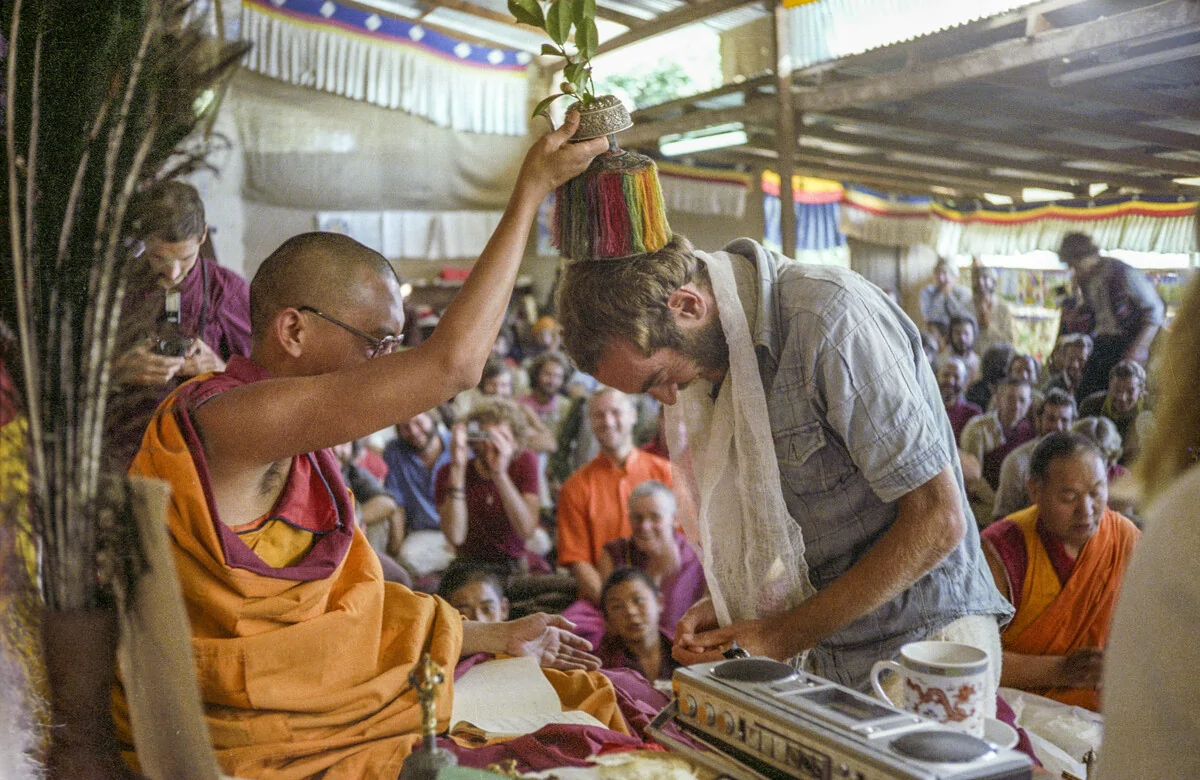
Lama Zopa Rinpoche and Lama Yeshe during a wedding blessing at the 12th Meditation Course, 1979, Kathmandu, Kopan Monastery, Nepal. Photo by Ina Van Delden. Photo courtesy LYWA
People think, “To be with them is all I need in life.” They never think about the possible problems, and instead, see a life filled with beauty and bliss. They think, “If I could only be with this person, I could kiss the rest of the world goodbye. Whatever happens after that, even if the world were to be destroyed by fire, it wouldn’t matter? It is very interesting to investigate how the mind thinks, and in particular, ‘the trip’ that attachment takes us on. Attachment sees only beauty, only bliss. It considers that particular person to be absolutely wonderful and the most important and best thing in life. Even before you meet someone, you hope to encounter such a person and imagine how the relationship will be, including the holidays you will go on together. Mentally you make up stories or daydream about how nice it will be. Then at the beginning of an actual relationship, there is a lot of excitement. You are attracted to each other and meet for an hour or so here and there, perhaps in a park or at a restaurant. You meet more and more often and come to think, “How wonderful it would be if we could live together.” Eventually, you either get married or move in together. But only then do you begin to really see the other person. As the days pass, you gradually begin to get angry when the other person behaves in ways or says things that you don’t like. You begin to notice many previously unnoticed things about them, such as the unpleasant smell of their body and excrement. Gradually you come to see many faults. You begin to see the selfish mind of the other person, that they don’t want to do what you want them to do and that they only want to do whatever they want. Your unhappiness starts to grow and then gets stronger and stronger.
Whereas at the beginning, there were no problems and you were completely absorbed in bliss, now that bliss is like a cloud or a rainbow disappearing from the sky. First, there is just a trace left and then it is completely gone. The days pass and there are more and more problems. Eventually, your heartfelt wish comes to be expressed in the thought, “When can I be rid of them?” At this point, your way of thinking is completely opposite to what it was at the beginning of the relationship. Now what you wish and pray for from the bottom of your heart is to be free from this person! That becomes the most important thing in your life-to be rid of them is what would make you the happiest person alive. Day and night, while you are at work and when you return home, you continually ask yourself, “When am I going to be free?” You look for a way to make this happen and as a result, there is more and more fighting and quarrelling. Your life becomes filled with tears and misery. You blame each other, saying, “You did this” and “You did that.” Finally, either you leave them or the other person leaves you. And then what you want is to never see that person again! While at one time, the best thing imaginable was to be with that person forever, now the best thing would be to never encounter them ever again.
One time I was in Singapore and an Indian couple came to visit me. They told me that they couldn’t wait for their daughter to get married and asked me to pray for this to happen quickly. I advised them to be careful, to take their time and to not rush, but I didn’t go into any detail about the possible problems that could arise. They seemed to have no idea what marriage implied; it was as if they were completely hallucinating. For them, their daughter’s marriage was the most important thing in their lives and they seemed oblivious to the fact that marriage is not always sun-shining bliss. This showed me that not only young people but also their parents never actually think about what can happen; everyone just takes it for granted that couples will always have a good life together. Even though everyone sees and hears about the problems that occur in relationships,people never think that this will happen to them. However, sooner or later, there will be problems; for example, some couples end up fighting over money and other possessions to the point of ending up suing each other.
Lama Zopa Rinpoche’s book: Joyful Parents – Successful Children.
When the experience of being together starts to become unpleasant, you see more and more problems, and at the same time, your attachment diminishes more and more until the excitement is completely gone. But even before that relationship is over, you get into another relationship with the thought, “This person loves me more than my present partner. You start the same mental story all over again, “This person is fantastic; they only love me. If we could be together, there won’t be any problems, only bliss. This time there won’t be any darkness, just sun-shining happiness.” Then, the same story starts all over again. You move in together and gradually the other person learns more about what you are like, and you also begin to see things that you didn’t notice before. You find more and more faults in each other and gradually lose interest in each other. Once again the relationship ends. Then again you meet someone new and think, “This person loves me so much more.” If on top of everything else you have children, this can create additional problems as then all the attention tends to become focused on them. If that happens, you can easily come to feel that your partner doesn’t love you anymore.
For all these reasons, you should consider having a relationship to be an opportunity to practice Dharma and to free yourself from worldly thoughts, just like having children. In particular, you should make sure that being together with someone becomes a cause of enlightenment by keeping in mind the motivation of bodhicitta. You should cherish, serve and dedicate your life to your partner in the same way that you aspire to do for all sentient beings.
You can use your relationship to practice morality by, for example, observing the five lay vows of abstaining from killing, stealing, adultery, lying and mind-altering substances. Likewise, having a partner provides an opportunity for you to practice the other five perfections of giving, patience, perseverance, concentration and wisdom. If you can do this, they will give you enlightenment just like your children.
You can also think about your partner in exactly the same way as your children, “I have received every happiness experienced throughout beginningless lives from this person.” Just that kindness is unimaginable, but on top of that, you also receive all your future happiness from them. In addition, you also receive liberation from every suffering, which is much more precious, from them. Then, you also receive enlightenment, which is even more precious, from that person. Thinking in this way, the conclusion is that your partner is the most precious, most dear and most kind person in your entire life.
You should also keep in mind that in past lives, your present partner was your mother and at that time was kind to you in the four ways. By recognising the vast kindness you’ve received from them, you will come to see yourself as their servant. Thinking in this way, your living together will become an opportunity to practice Dharma. With the attitude that the other person is most precious and kind, every single action you do will become a means of collecting extensive merit. If you also act with bodhicitta, you will collect limitless skies of merit and your actions will become the cause to achieve enlightenment for the benefit of all sentient beings. By thinking, “I am going to offer service to this person who is a most precious sentient being” you will collect a huge amount of merit every day and also purify defilements collected throughout beginningless lives. Since you will constantly create the cause for the biggest success-full enlightenment for all sentient beings, your life will be filled with happiness and hope.
When trying to understand the things that happen in a relationship, you need to take past karma into account. Everything that you expect to happen doesn’t necessarily happen because the way things go depends on the karma that you and your partner created in the past. If you always remember to relate events to karma by thinking, “This is my karma” and “This is their karma, a potential problem doesn’t even become a problem because you accept the situation. It does not bother you and there is peace in your heart. But if you don’t think of or don’t accept karma, you will feel as though you are crushed beneath heavy mountains of problems. However, it’s your own faulty way of thinking that makes you feel like that.
If you remember karma, then even if one day your partner leaves you, there will be no problem at all. You will respect their decision by seeing how they are the most precious, dearest and kindest sentient being from whom you receive all your past, present and future happiness. Thinking like this, you won’t have any clinging or attachment, and even if your partner decides to leave you, you will be able to mentally offer them whatever is best for them. If a relationship begins with this way of thinking, it will also end well. On the other hand, if the motivation at the beginning is faulty, then at the end when separation occurs, there will be intense suffering even to the point of contemplating suicide.
If you are able to make use of all your relationships to practice Dharma, you will lead a very healthy life. Whether you have a partner or children, whether you are taking care of other people’s children, the elderly or your own parents, you should practice seeing yourself as their servant and the sentient beings you are taking care of as your lord or boss. Then serve them by working to free them from suffering and to bring them happiness. This is the attitude of a bodhisattva towards all sentient beings.
By thinking in the ways that I have explained here, you will be able to fully enjoy life. You will find satisfaction and fulfillment and you will experience inner peace and happiness. Otherwise, no matter the excitement and no matter how many good things happen to you, your heart will always be empty and you will be miserable.
This teaching is drawn from Joyful Parents, Successful Children, edited by Venerable Joan Nicell (Amitabha Buddhist Centre, 2015).
You can read the book here
Foundation for the Preservation of Mahayana Tradition (FPMT), is a Tibetan Buddhist organization dedicated to the transmission of the Mahayana Buddhist tradition and values worldwide through teaching, meditation and community service.
Kyabje Lama Zopa Rinpoche returned to the Sutra of Great Liberation more than once over the years, offering the oral transmission and commentary of this text to students facing hardship — in Singapore in 2018, and again from Kopan Monastery during the difficulty of the COVID-19 pandemic in 2020. Rinpoche held this sutra especially close, describing it as a teaching for any dangerous or uncertain times.
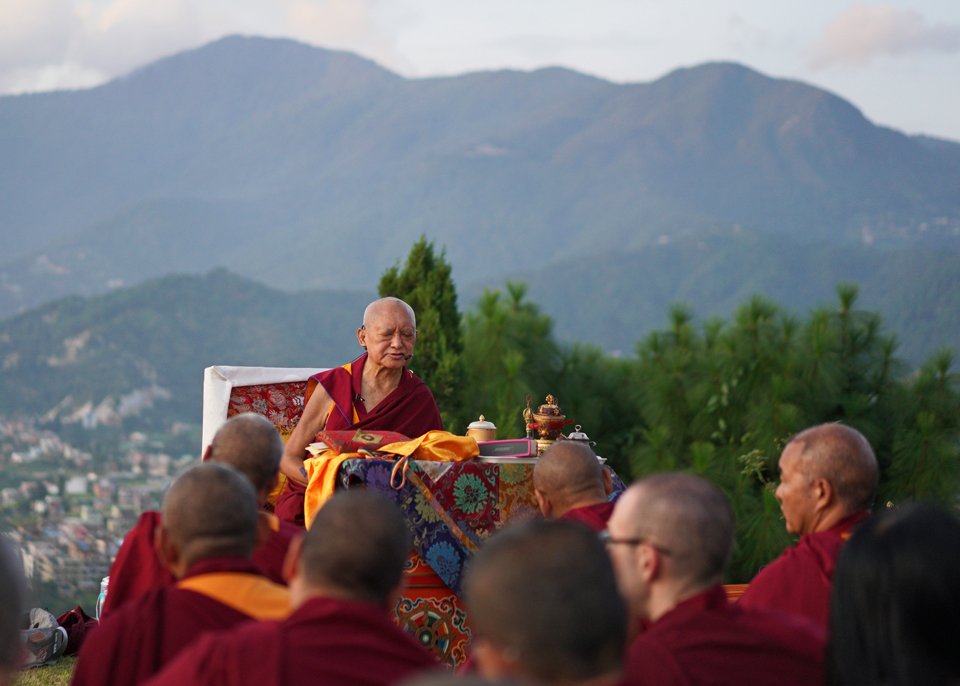
Lama Zopa Rinpoche offering a teaching, Kopan Monastery, Nepal, September 2020. Photo by Ven. Lobsang Sherab.
The Sutra of Great Liberation is formally entitled The Arya Mahayana Sutra Called “Arya All-Expansive Great Liberation, Purifying Negative Deeds through Cleansing Remorse, Perfectly Arranged Accomplishment of Buddhahood.” The Tibetan text, found in the Kangyur, is a translation of the Chinese rendition, the Sanskrit source text having been lost over the course of time. This powerful sutra, which was expounded just before the Buddha’s parinirvana, covers a wide variety of topics, including the three vehicles, the three refuges, how to confess and purify, proclamation of names of many buddhas and bodhisattvas, descriptions and causes of the thirty-two marks of an enlightened being, extensive advice on how to practice the Dharma, instructions on how to do the actual purification, and the signs of purification.
Rinpoche emphasized that engaging with this sutra in any way, even unintentionally, has “unimaginable benefits.” He said that anyone who hears even the name of the sutra, writes, reads, prints, or keeps a copy of it collects unimaginable merit. Reciting it is an easy method to purify all the very negative karmas. Furthermore, anyone who memorizes, holds, or keeps a copy of it will become free from suffering, will never be reborn in the lower realms, and become enlightened. The same is true for anyone who simply hears its powerful mantra. Because of these benefits, Rinpoche recommended that we recite the sutra when we are able, and that it would even be beneficial to “keep the sutra.” Rinpoche noted that wherever a copy of this sutra is kept, this is a place where the Buddha himself resides.
Benefits explained from the sutra itself:
Whoever sees this sutra sees the face of the Buddha.
Whoever holds this sutra holds the body of the Buddha.
Whoever practices this sutra practices the activities of the Buddha.
Lama Zopa Rinpoche stressed the importance of this sutra and kindly offered the oral transmission.
“I want to give one mantra from the Liberation Sutra [Sutra of Great Liberation]. It is most unbelievably precious. By just hearing it or reciting it one time, your life always goes toward enlightenment. The Sutra of Great Liberation itself has most unbelievable benefit. So in the future, we should get the oral transmission of that text […] I received the oral transmission of the mantra from Kyabje Khyongla Rato Rinpoche, a very high lama from Drepung Loseling. For the motivation, think, ‘The purpose of my life is not just to achieve happiness for myself but to free the numberless kind mother sentient beings from the oceans of samsaric sufferings and bring them to peerless happiness, the state of enlightenment. For that, I must achieve buddhahood. Therefore, I’m going to take this oral transmission of the mantra.’ […] By hearing this mantra with devotion or even if you recite it only one time a day, you will never be reborn as a hell being, hungry ghost, or animal until you achieve enlightenment. This was said by the unbetraying Victorious One.”
— Lama Zopa Rinpoche, during the oral transmission of the Mantra from “The Sutra of Great Liberation” to students at Amitabha Buddhist Centre, Singapore, October 2018.
Rinpoche gave instruction on the correct motivation for listening to the oral transmission and commentary of the Sutra of Great Liberation in 2020, when he bestowed this lung over many months of teachings in his video series Teachings on Thought Transformation during the Time of COVID-19 in the teachings titled “Sutra of Great Liberation” Is Exactly What Is Needed at This Dangerous Time.
“The purpose of life is not to just avoid the lower realms and receive a higher rebirth, or to be free from the oceans of samsaric suffering forever. The main purpose of life is to achieve full enlightenment, buddhahood, the total cessation of gross and subtle obscurations and the completion of realizations, for all sentient beings. This is for every single sentient being—including every hell being; every hungry ghost; every animal such as tiny insects, dogs, goats, birds, etc.; every single human being including those speaking different languages in different countries, those who are your enemy, friends, or strangers, those who are your parents, brothers, sisters; and every sura and asura. Your purpose is to free them from the oceans of samsaric sufferings and bring them to enlightenment, to buddhahood, by yourself alone. Therefore, you are listening to the teachings, listening to the oral transmission of Sutra of Great Liberation, for this purpose.
The world is so full of problems, including contagious diseases, wars, fighting, and disasters of the elements such as landslides, typhoons, tornadoes, and fires. The Sutra of Great Liberation is exactly what you need at this dangerous time.”
— Lama Zopa Rinpoche, during the oral transmission of the “Sutra of Great Liberation” Is Exactly What Is Needed at This Dangerous Time. The oral transmission begins at 0:41:16 in the video.
You can access the mantra from the Sutra of Great Liberation in PDF and audio; as well as print or PDF from the Lama Yeshe Wisdom Archive.
The Tibetan pecha of the Sutra of Great Liberation is also available for printing.
Explore a larger collection of Sutras & Dharanis
Watch Lama Zopa Rinpoche’s teaching “‘Sutra of Great Liberation’ Is Exactly What Is Needed at This Dangerous Time”:
Or read the transcript of Rinpoche’s teaching
Watch an extract of Lama Zopa Rinpoche recite the Mantra from “The Sutra of Great Liberation,” with additional commentary
Foundation for the Preservation of the Mahayana Tradition (FPMT) is a Tibetan Buddhist organization dedicated to the transmission of the Mahayana Buddhist tradition and values worldwide through teaching, meditation, and community service.
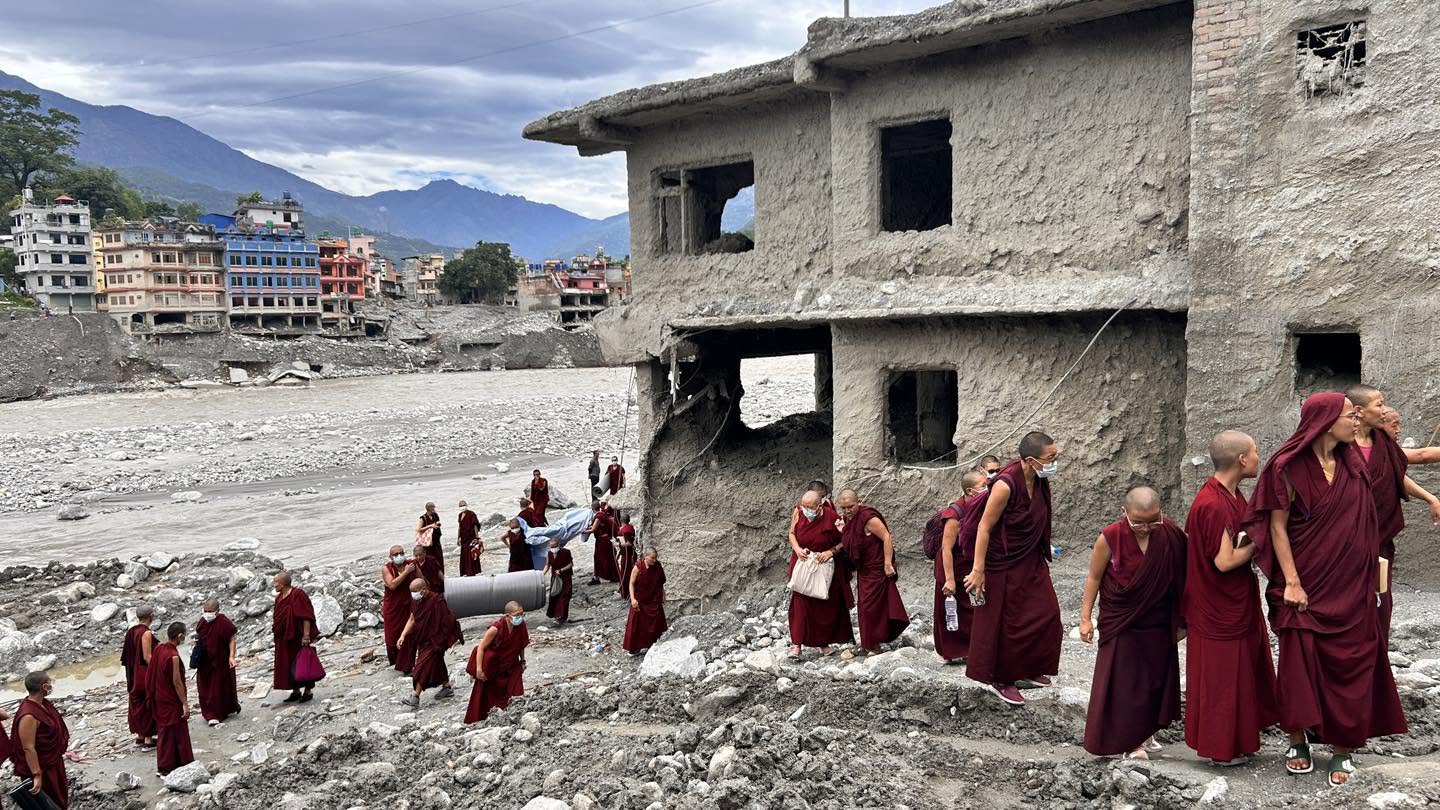
Over the years, Kyabje Lama Zopa Rinpoche offered various pieces of advice for prayers and practices to turn to when facing natural disasters. In light of the recent flash flood and mudslide along the Nepal–Tibet border, which struck the Rasuwa district north of Kathmandu and is believed to have been triggered by an earthquake-induced avalanche and snowmelt entering the Bhote Koshi River, we share the following collection of Rinpoche’s advice, offered in the hope that it may be of benefit.
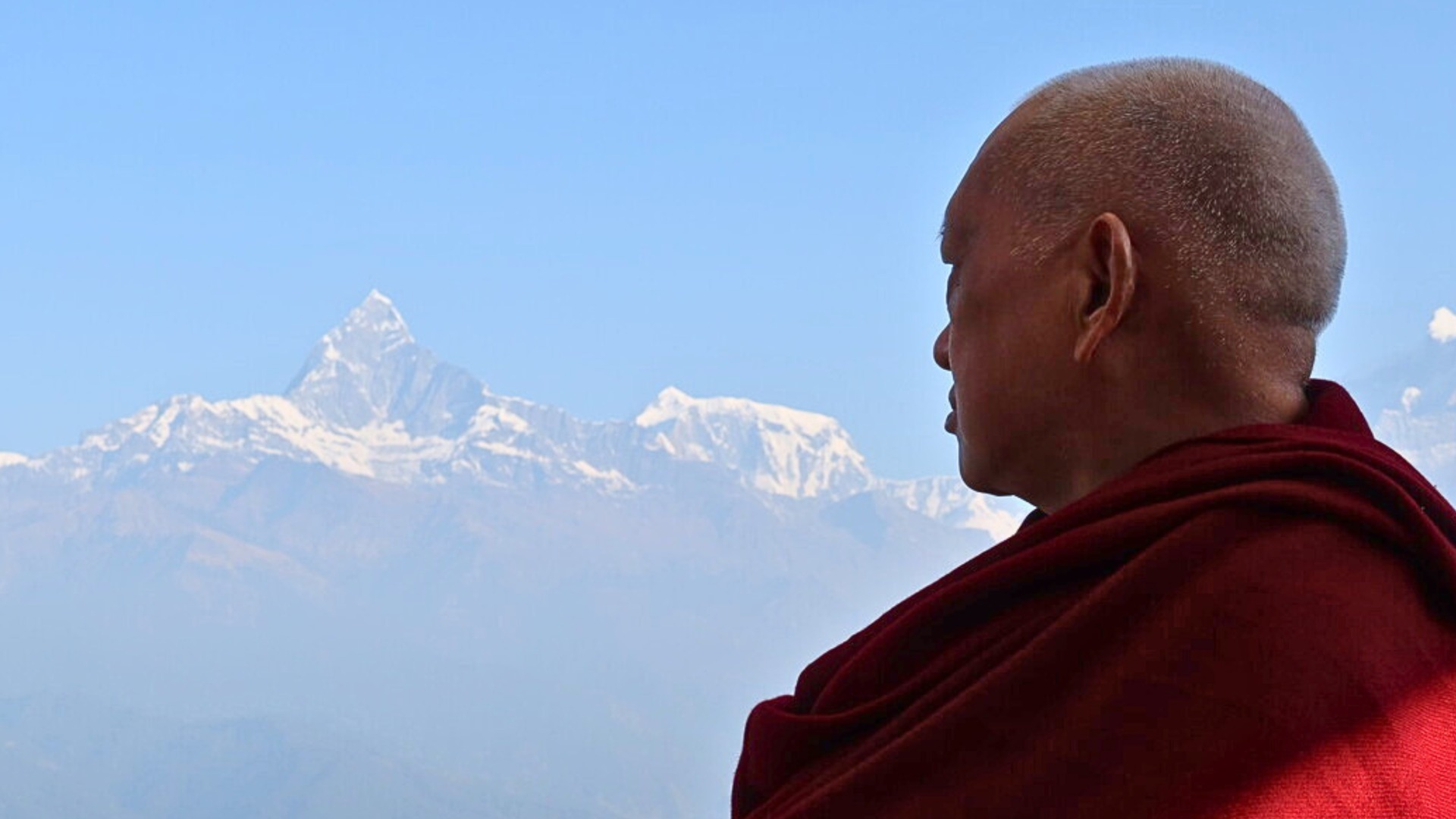
Rinpoche in Pokhara, Nepal, 2021.
“My dear loving compassionate readers,
You may wonder what to do, what prayers to make, when there are disasters such as tornados, hurricanes, heavy rain, storms, floods, earthquakes, or fires, as well as disasters that destroy crops; disasters that destroy entire towns and cities within one hour; disasters that cause so many billions of dollars of damage, and so much money is spent to rebuild the towns; disasters where so many hundreds and thousands of people die or become homeless, have no homes, no food or clean water, and so forth.
So here I am offering some suggestions on what to do so that you can help the country and save so many peoples lives; some suggestions to prevent the destruction of houses, villages, and cities that are caused by the elements (fire, water, wind, and earth).
Even though these kinds of problems are so big, even though there are numberless buddhas, yet if someone with a very sincere heart takes refuge one-pointedly, without doubt, in even one buddha such as Chenrezig (Compassionate Eye Looking One), Padmasambhava, or Medicine Buddha, if someone takes strong refuge and prays to even just one buddha and recites the mantras (such as the name mantra), by doing this it can change the situation completely, it can change natural disasters and prevent war. Whatever problems there are can be loosened and even completely stopped.
The weather can change in that very hour or in the next hour by the power of one person making prayers.”
Read the full version of Letter From Lama Zopa Rinpoche Regarding the Disasters of the Elements
What you can do right now:
- Medicine Buddha Practices
- King of Prayers
- Kshitigarbha Practice to Pacify Earthquakes
- The Practice of Ksitigarbha to Avert Danger and Purify Obstacles
To follow the complete list of prayers and practices suggested by Lama Zopa Rinpoche over the years:
-
- Advice from Lama Zopa Rinpoche: Practices for Earthquakes and Natural Disasters
- Lama Zopa Rinpoche’s Advice for Severe Weather Conditions
- Advice from Lama Zopa Rinpoche: Earthquakes
- Lama Zopa Rinpoche Advises Urgent Practices for Pacifying an Earthquake in California
- Tsunami and Earthquakes
- Mitigating Severe Conditions of the Elements
- Preventing Earthquakes
- Natural Disasters
- Sutra Golden Light for earthquakes, natural disaster and wars
More advice from Rinpoche on this topic is also available on the Lama Yeshe Wisdom Archive:
https://lamayeshe.com/advice/natural-disasters
Foundation for the Preservation of the Mahayana Tradition (FPMT) is a Tibetan Buddhist organization dedicated to the transmission of the Mahayana Buddhist tradition and values worldwide through teaching, meditation, and community service.
To celebrate the ongoing FPMT Global Mani Retreat which has brought together students of Lama Zopa Rinpoche from around the world to help fulfill one of Rinpoche’s most cherished wishes, we are sharing this excerpt from Teaching from the Mani Retreat by Lama Zopa Rinpoche
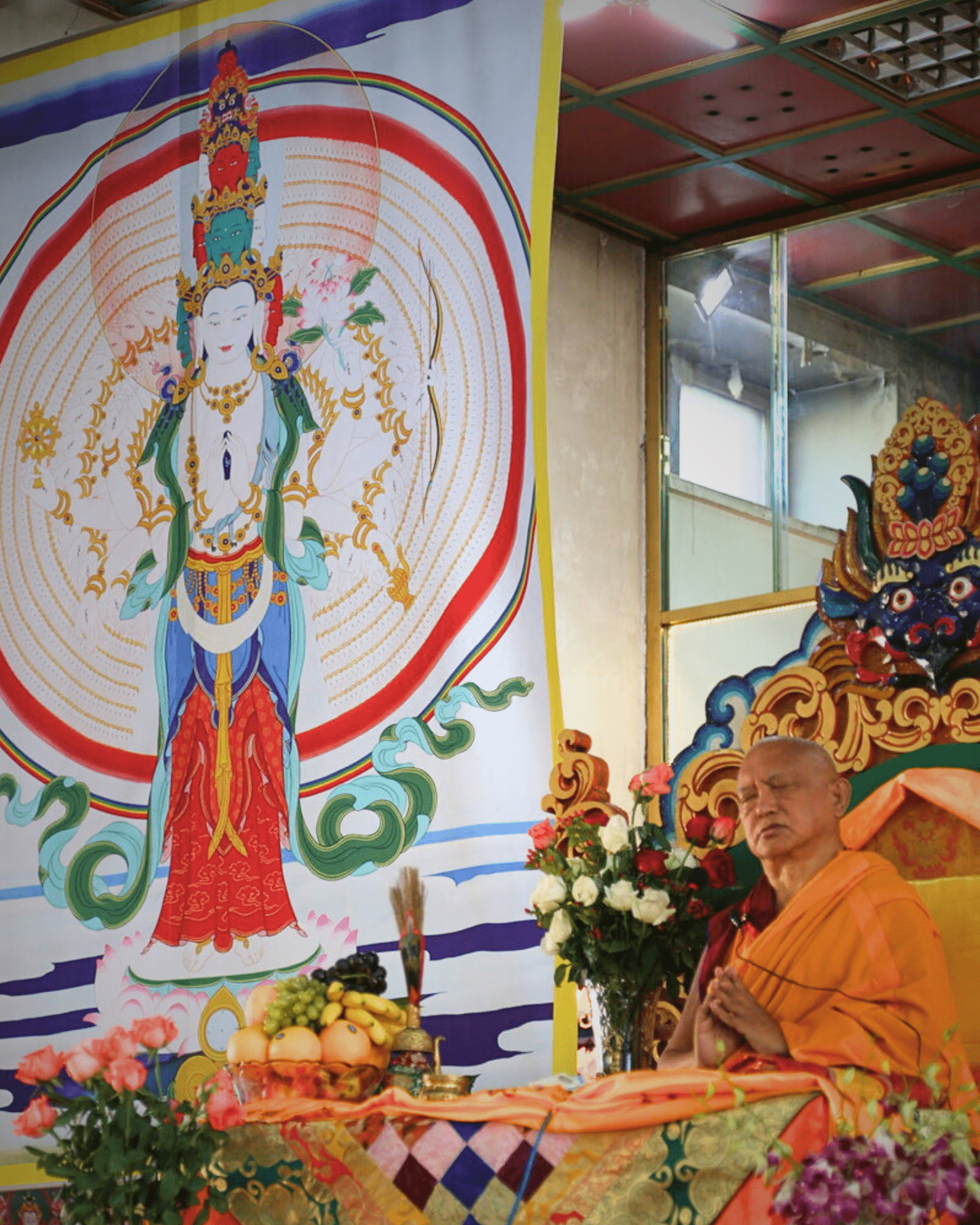
Lama Zopa Rinpoche teaching at the 100 Million Mani retreat, Ulaanbaatar, Mongolia, August 2014. Photo by Ven. Roger Kunsang.
It is also good to ask yourself, “Why do I have to do this?”
There are two reasons.
One very important reason is that sentient beings do not want suffering and want happiness. The other reason is that this is the purpose of your life.
It is for this purpose that you put so much effort into surviving in every hour, every minute, of your life.
The conclusion is that there are two reasons: this is what sentient beings need, so you should help them; and this is the meaning of your life.
Excerpt from Lama Zopa Rinpoche’s book Teachings from the Mani Retreat bestowed at Chenrezig Institute, on December 2000. Lama Yeshe Wisdom Archive Publications. You can also read this book online, or listen to an audio recording from the retreat.
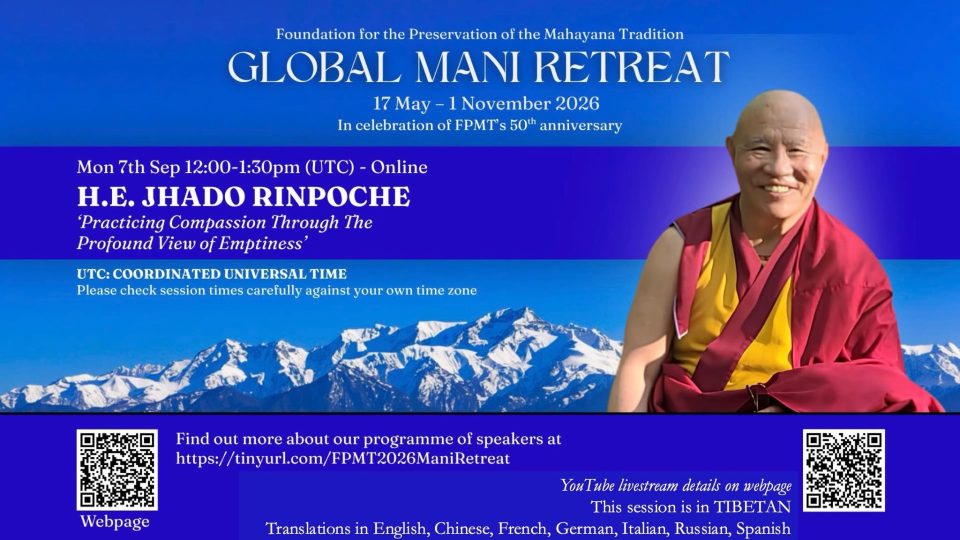
Upcoming Major Teaching
Foundation for the Preservation of the Mahayana Tradition (FPMT) is a Tibetan Buddhist organization dedicated to the transmission of the Mahayana Buddhist tradition and values worldwide through teaching, meditation, and community service.
To celebrate the ongoing FPMT Global Mani Retreat, which has brought together students of Lama Zopa Rinpoche from around the world to help fulfill one of Rinpoche’s most cherished wishes, we are sharing this excerpt on the Benefits of the Mani Retreat from Teachings from the Mani Retreat by Lama Zopa Rinpoche.
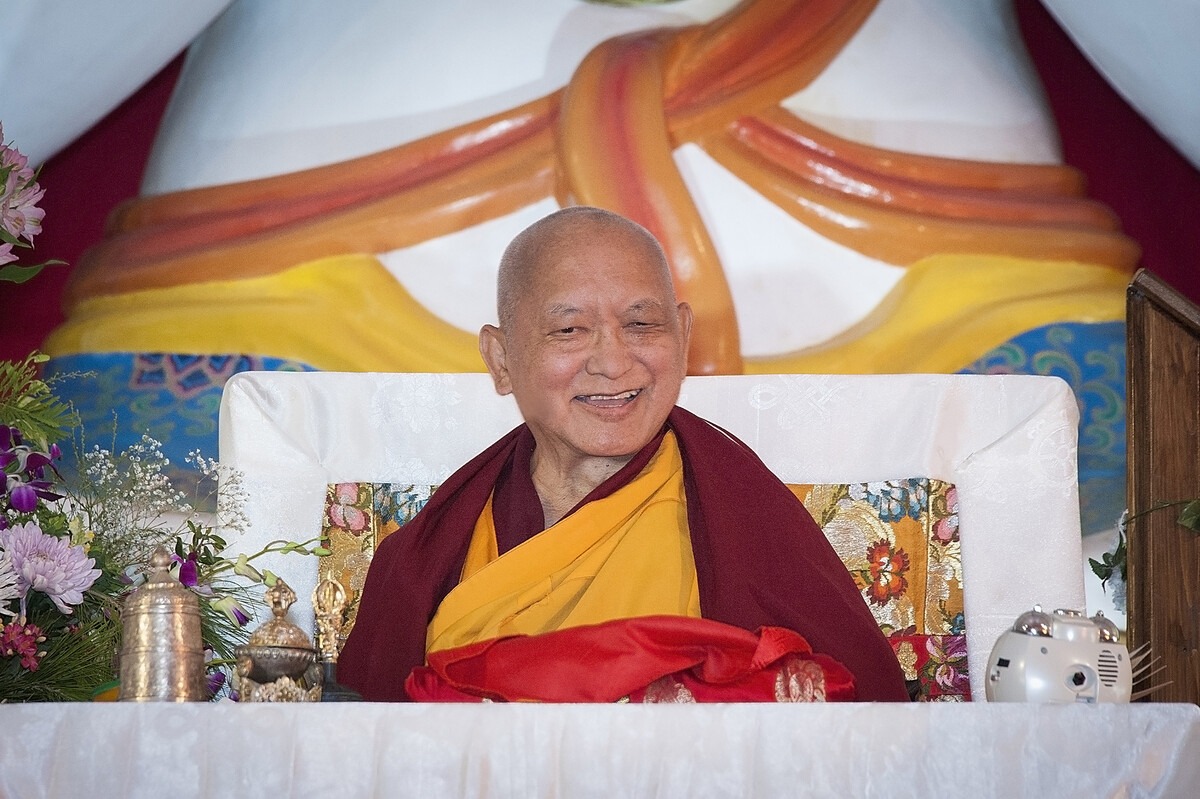
Rinpoche teaching during the 100 Million Mani Retreat 05-Oct-2017 ILTK. Italy Photo by Lobsang Sherab
Benefits of the Mani Retreat
By Lama Zopa Rinpoche
This is such a wonderful time, especially doing practice to develop compassion and bodhicitta. Without compassion you can’t have the realization of bodhicitta, you can’t enter the Mahayana path, you can’t achieve enlightenment, you can’t achieve the infinite qualities of the holy body, holy speech and holy mind of Buddha. Without great compassion you can’t do perfect work for sentient beings, bringing them to enlightenment. I mentioned this the other night when I arrived, but maybe it was difficult to hear so late at night . . . . Those who can make the time should come to the retreat. Even if you cannot come for all three months, you should come for some weeks—or at least for one week. If you do not give yourself the time, the freedom, to do this, it is very poor, very sad. Of course, it would be best to come for the whole time, until the end of the retreat, but if you cannot do that, while you can give yourself the time and the freedom, you should come for one month or for a minimum of one week. You should attempt to do this. If you have a family, of course it’s not possible for all the family members, the whole assembly of parents and children, to come for the Mani Retreat, but maybe you could take turns. Do whatever you can, whatever days you can do. Give yourself the time to come again and again. Even if you cannot do one week straight, come again and again. Do at least one day, then come another day, then another day. At least come quite often in this way.
We should especially think of death. When the thought of death comes, when we remember death, there’s nothing else that makes sense; everything else is total nonsense. When we think of death, so much of what we do in life doesn’t make sense; it’s all just nonsense. The only thing that makes sense is Dharma practice. Only Dharma will benefit us at the time of death and after death. The only thing that we can carry with us and enjoy in our future life is Dharma—nothing else. This practice of the meditation- recitation of the Buddha of Compassion will especially benefit us.
Reciting oṃ maṇi padme hūṃ has merit as limitless as the sky. Even Buddha can never finish explaining the unbelievable purification and collection of extensive merit brought by reciting oṃ maṇi padme hūṃ. This is a special means to develop compassion. Intellectual study alone cannot bring you the realization of compassion and bodhicitta. With the intellectual understanding, you then have to purify your mind and collect extensive merit. On the basis of those preliminary practices, you then receive this special deity’s blessings by reciting oṃ maṇi padme hūṃ. It is through this that the realizations of great compassion and bodhicitta then come. Reciting oṃ maṇi padme hūṃ is one of the most powerful means of developing compassion and bodhicitta.
Doing specific meditation on the Buddha of Compassion and reciting the mantra are like soil and water, the conditions that together enable a seed to produce a sprout, or like all the pieces that are put together to enable a clock or watch to show the time. The mind works in a similar way. The preliminary practices and the meditation- recitation of Compassion Buddha persuade the Compassion Buddha’s holy mind. Purifying negative karmas, or obstacles, and collecting extensive merit enable us to receive the blessings of Compassion Buddha, and through these blessings we then receive realizations.
And the benefits of compassion are as limitless as the sky. After hearing the lamrim and having studied it and also other teachings, we can understand the benefits of compassion. Compassion has limitless benefits for oneself and for all other sentient beings.
Excerpt from Lama Zopa Rinpoche’s book Teachings from the Mani Retreat bestowed at Chenrezig Institute, on December 2000. Lama Yeshe Wisdom Archive Publications. You can also read this book online, or listen to an audio recording from the retreat.
Upcoming for the Global Mani Retreat
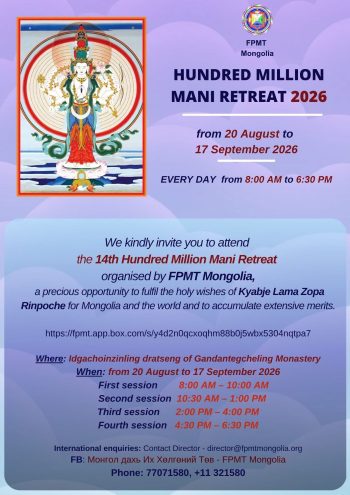
FPMT Mongolia’s 14th 100 MILLION MANI RETREAT in Ulaanbaatar has begun! This retreat is part of the official Global Mani Retreat program and will take place from August 20 – September 17 2026. Participation onsite is entirely optional.
Ven. Tenzin Drachom will lead the eighth Chenrezig Group practice on August 22.
To keep up on all details related to the FPMT Global Mani Retreat, please refer to our webpage, and join the Facebook Group.
Foundation for the Preservation of the Mahayana Tradition (FPMT) is a Tibetan Buddhist organization dedicated to the transmission of the Mahayana Buddhist tradition and values worldwide through teaching, meditation, and community service.
In this extract, Kyabje Lama Zopa Rinpoche explores why living beings, though they long for happiness, so often create the very causes of suffering instead. The teaching is drawn from a weekend seminar Lama Zopa Rinpoche and Lama Thubten Yeshe offered during their first trip to Europe in 1975, based on the Kopan meditation courses. Following a public lecture on meditation by Lama Yeshe at Kensington Town Hall, the seminar was held at Royal Holloway College, Surrey, and contained the entire Buddhist path to enlightenment. From Freedom Through Understanding, edited by Nicholas Ribush, Lama Yeshe Wisdom Archive.
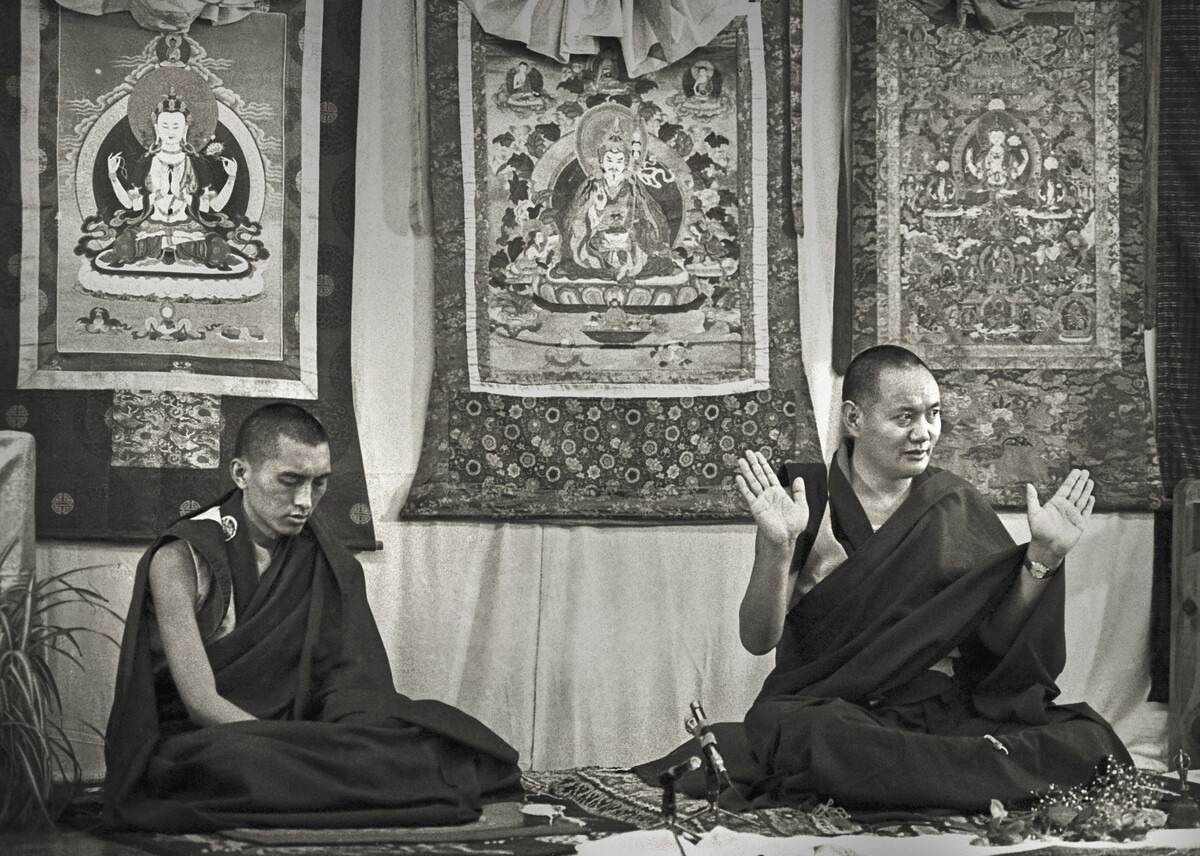
Lama Yeshe and Lama Zopa Rinpoche teaching at Royal Holloway College, UK, 1975. Photo by Dennis Heslop. From the LYWA Collection.
Happiness Comes from the Mind, Not from Outside
By Lama Zopa Rinpoche
All human beings and even the tiniest of creatures desire happiness and freedom from suffering. But our biggest problem is that although we desire happiness, we don’t know what actually causes it; although we don’t want suffering, we don’t know what causes that either. That’s our biggest problem. Most living beings, no matter how much they wish for happiness, spend most of their time destroying the cause of happiness; and no matter how much they do not want suffering, they constantly rush to create its cause. All this comes about because sentient beings lack method and wisdom.
Earth’s original human inhabitants did not have minds as negative and cruel as those of today. As a result, the actions of their speech and body were not as violent and harmful as those of the people we see around us now, and life was much more peaceful then. But gradually, as their delusions of anger, attachment, pride and jealousy arose more frequently and strongly, their minds became increasingly cruel, negative and harmful, and the actions of their speech and body became more violent and destructive. And no matter how much we have progressed in external development since those times, life has simply become busier and more dangerous; no matter how many material things, such as nuclear weapons have been developed, instead of bringing true peace, all they have brought is more danger. However, we can’t blame external things for all these problems; the actual cause is the internal factor—the unhealthy, dissatisfied mind, attachment, hatred and so forth. Even though people have undertaken external development with the expectation that it will bring happiness, that’s a wrong conception.
Happiness does not arise principally from external things but from the internal factor, the mind. For example, people who have all the material things they need and desire—gourmet food, beautiful clothing, a luxurious apartment and so forth-are not necessarily happy. They get unhappy and depressed because they feel dissatisfied and don’t know why; and since they also don’t understand the meaning of human life, some of them think there’s nothing left to enjoy, get completely despondent and kill themselves.
All such problems come from the mind, the internal factor, attachment. Instead of bringing satisfaction and happiness, all these desirable external things bring only more dissatisfaction. Similarly, with respect to the suffering that arises from problems caused by other people-enemies, family members, countrymen—even if we were to kill all the other human beings on earth, even all other living beings, and remain here alone, still we would not experience happiness or peace. Stopping suffering and receiving happiness does not depend on making all other humans, all other living beings on earth, non-existent. Since doing so would not bring peace or happiness to the mind it shows that this is not the right method, not the way to receive happiness. By being alone with no other people, friends or other living beings around, we would feel lonely and very unhappy. Those problems also arise from within, from the internal factor, attachment.
Even when we get the material objects or close friends we desire, after a while we get bored and lose interest. That also comes from the internal factor, the dissatisfied mind, attachment. Our physical body dying, becoming non-existent, does not mean that our suffering is over; the mind does not stop when the body does. Even though our body no longer exists, our mind is still in suffering—as long as our mind is under the control of the delusions of ignorance, attachment and anger, it is not free from suffering. The delusions themselves are the worst suffering, the root of every problem people and animals experience; The delusions are like the root of a tree if there were no root there’d be no branches, leaves or fruit, which produce more seeds. So if there were no root of the delusions-ignorance, attachment and hatred-there wouldn’t be any of the problems that we and other living beings experience, such as sickness, old age, death and so forth.
Excerpted from a teaching by Lama Zopa Rinpoche, published in Freedom Through Understanding. Edited by Nicholas Ribush, Lama Yeshe Wisdom Archive. You can also read this book online, access translations, watch on YouTube and experience the teachings in multimedia format.
Foundation for the Preservation of Mahayana Tradition (FPMT), is a Tibetan Buddhist organization dedicated to the transmission of the Mahayana Buddhist tradition and values worldwide through teaching, meditation and community service.
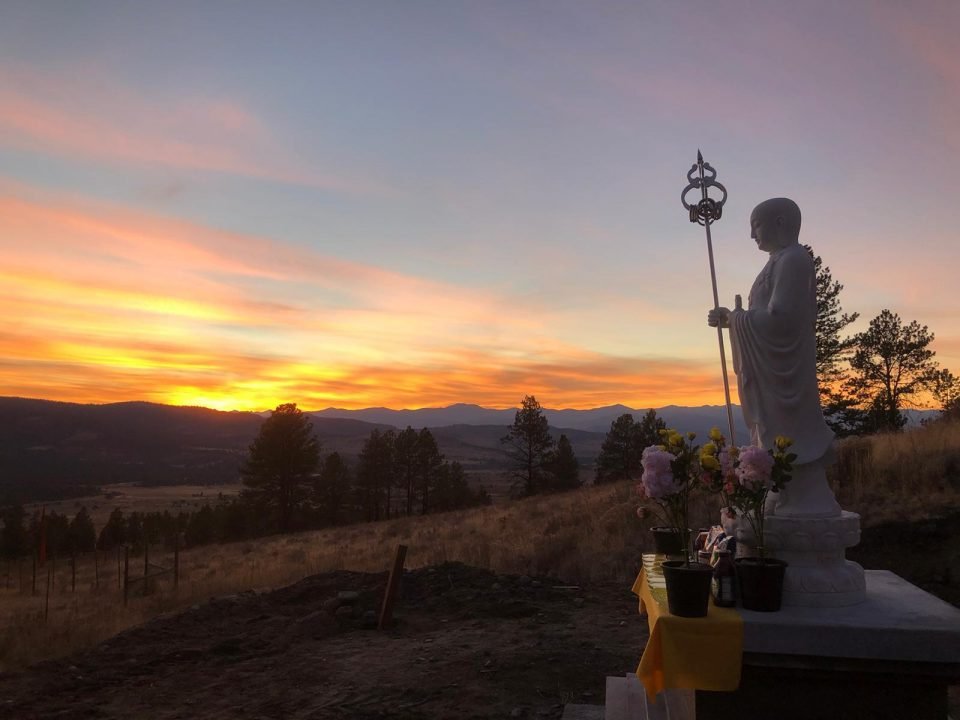
Ksitigarbha statue at Buddha Amitabha Pure Land, WA, USA
Over the years, Kyabje Lama Zopa Rinpoche offered various pieces of advice for prayers and practices to turn to when facing natural disasters. In light of the recent earthquakes in Latin America—in Venezuela on June 24, 2026 and in Colombia on August 10, 2026, as well as recent fire emergencies in Southern Europe, North Africa, and North America—we share the following collection of Rinpoche’s advice, offered in the hope that it may be of benefit.
“Buddha Ksitigarbha is another unbelievably powerful practice for success, I think especially when there’s an earthquake but also when there is any danger of fire, water, earth or wind. If there are any of those dangers, it’s very good to recite this Buddha Ksitigarbha mantra. It’s extremely powerful. You make offerings to Buddha Ksitigarbha and then make the prayer. It’s one hundred million times more powerful for success than praying to other bodhisattvas. If you read the Ksitigarbha sutra, it brings unimaginable benefit for sentient beings.” – Lama Zopa Rinpoche
All are welcome to download the Ksitigarbha Practice eBook & PDF. Please also listen to Lama Zopa Rinpoche reciting the mantra.
To follow the complete list of prayers and practices suggested by Lama Zopa Rinpoche over the years:
- Advice from Lama Zopa Rinpoche: Earthquakes
- Lama Zopa Rinpoche Advises Urgent Practices for Pacifying an Earthquake in California
- Tsunami and Earthquakes
- Mitigating Severe Conditions of the Elements
- Preventing Earthquakes
- The Practice of Ksitigarbha to Avert Danger and Purify Obstacles
- Natural Disasters
- Sutra Golden Light for earthquakes, natural disaster and wars
More Ksitigarbha Resources:
Through the generosity of a dedicated benefactor, each FPMT center, project, and service around the world has been offered a Ksitigarbha statue. We are deeply grateful for this generous offering and for the support it provides to the FPMT family. We invite all centers, projects, and services that have received a statue to share a photo with us, if you haven’t already, so we can celebrate and showcase these precious statues throughout our community.
Lama Zopa Rinpoche teaching extract from The Path to Ultimate Happiness: Lamrim Teachings from Kopan 2009 No. 42, Lama Yeshe Wisdom Archive publications
Foundation for the Preservation of the Mahayana Tradition (FPMT) is a Tibetan Buddhist organization dedicated to the transmission of the Mahayana Buddhist tradition and values worldwide through teaching, meditation, and community service.
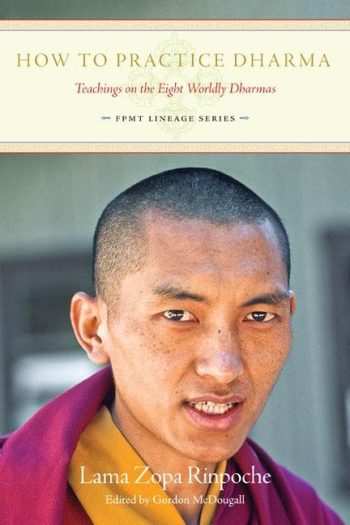
Lama Zopa Rinpoche’s book How to Practice Dharma: Teachings on the Eight Worldly Dharmas deals with the eight worldly dharmas, essentially how desire and attachment cause us to create problems and suffering and how to abandon these negative minds in order to find perfect peace and happiness. This excerpt below is from Chapter 8, “Turning Away from Worldly Concern.”
Happiness Starts When We Renounce This Life
By Lama Zopa Rinpoche
The terms “renouncing this life” or “renouncing suffering” both mean renouncing the mind that is the cause of the problems, the thought of the eight worldly dharmas. Therefore “Dharma” includes even pragmatic, transient techniques to stop attachment from arising. This is the actual Dharma, the method that immediately solves our confusion and mental illness. Bringing clarity and lack of confusion to our mind is the best way of bringing happiness to our life. Renouncing suffering doesn’t mean we’ll never have stomach or knee pain, a headache or a cold. It doesn’t mean wishing to be free of all pain but wishing to be free from the very cause of all suffering.
It has been the experience of these great yogis that we don’t have to wait until our future lives to experience this happiness. As soon as we stop the dissatisfied mind, immediately—immediately—there’s the result, happiness.
At first we might be nervous about letting go of desire because we normally equate desire with happiness. In fact, it’s exactly the opposite. As soon as we let go of desire we achieve inner peace, satisfaction and happiness; we become independent. Before, we were dictated to and controlled by desire but now we have achieved real freedom.
We can see in the biographies of the great yogis Tilopa, Marpa, Milarepa, Lama Tsongkhapa and many of those other highly realized beings whose holy minds passed into enlightenment how, even without material possessions, they generated great tranquility and peace and through that were able to realize the great achievements of the path. They didn’t have even the scent of the eight worldly dharmas about them but by completely renouncing desire for this life, they received everything—the best reputation, perfect surroundings and sufficient material comfort.
In Milarepa’s Hundred Thousand Songs he often says how renouncing this life’s worldly activities automatically stops all the thousands of problems associated with the worldly life and brings great bliss.
Without any possessions at all, he led an ascetic life in solitary places. Although he lived like an animal, he spent his life in great happiness, his mind always peaceful, without confusion or problems. He didn’t have even one sack of tsampa but lived on nettles alone. Living without food, clothing or reputation didn’t cause him any problems because of his Dharma practice. He achieved all the high realizations and then enlightenment in that one lifetime, all due to the power of his pure Dharma practice of renouncing suffering, renouncing this life. His mind was incomparably happier than that of the king who has great power and many bodyguards, soldiers and weapons.
Therefore, it’s completely wrong to think that Dharma only brings happiness in future lifetimes but not in this one. We experience peace and happiness the very moment we begin to practice and live in the Dharma. We feel its effects immediately. Continue to read the full Chapter.
From How to Practice Dharma: Teachings on the Eight Worldly Dharmas, by Lama Zopa Rinpoche, Chapter 8. Edited by Gordon McDougall and published by Lama Yeshe Wisdom Archive.
You can order a print copy from the Lama Yeshe Wisdom Archive online store. You can also read this book online, access translations, or order the audiobook from Audible.com. LYWA Members can download the ebook for free.
Foundation for the Preservation of Mahayana Tradition (FPMT), is a Tibetan Buddhist organization dedicated to the transmission of the Mahayana Buddhist tradition and values worldwide through teaching, meditation and community service.
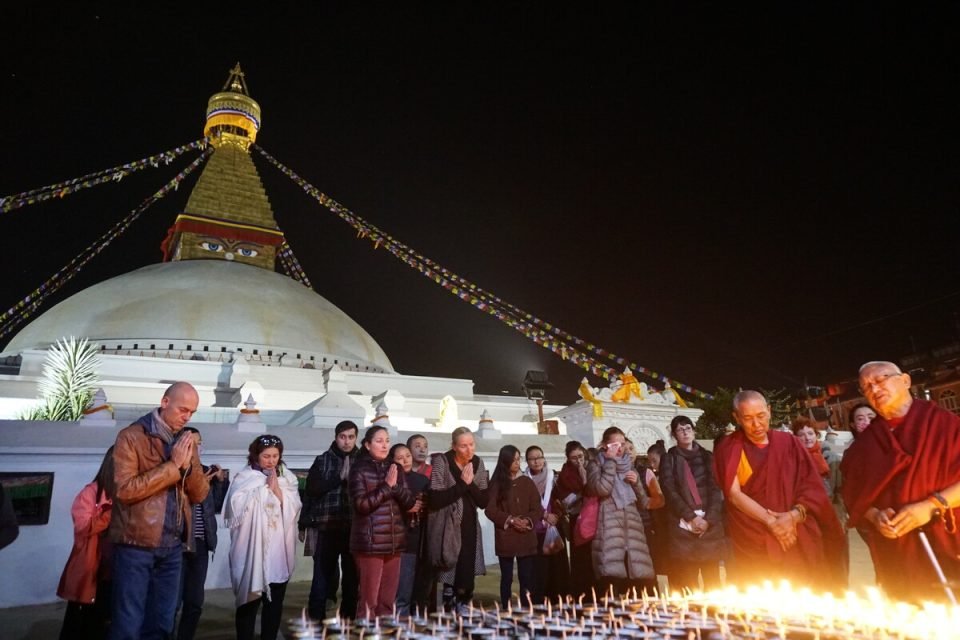
Light offerings at Boudhanath Stupa at night, with Khen Rinpoche and Lama Zopa Rinpoche, December 2016. Photo by Lobsang Sherab.
The great stupa of Boudhanath in Kathmandu, Nepal, was extremely important for Lama Zopa Rinpoche. It was in Boudha that Rinpoche first settled upon returning to Nepal in the late 1960s with Lama Thubten Yeshe. While staying at Samtenling Monastery, located behind the circumambulation path around the stupa, Lama Yeshe could see a hill from the monastery and felt drawn to it. Later that hill would become Kopan Monastery, the first FPMT center established by Lama Yeshe and Lama Zopa Rinpoche.
Whenever Rinpoche returned to Kopan, he would often circumambulate the Boudha Stupa in the evenings together with a couple of attendants, while making offerings and reciting prayers and mantras. By the time the circumambulations were completed, a crowd would often have formed, following Rinpoche around the stupa. At the very end, Rinpoche would lead everyone present in offering five-colored khatags to the stupa, followed by extensive dedications.
During the second COVID lockdown in 2021, Rinpoche, together with other high lamas, including Tsoknyi Rinpoche, Mingyur Rinpoche, Khadro Rinpoche (Rangjung Neljorma Khadro Namsel Dronme), and the abbots of Shechen Monastery and Kopan Monastery, reconsecrated the three great stupas of Nepal—Swayambhu, Boudha, and Namo Buddha—for the benefit of all sentient beings. At the end of the consecrations and after taking the bodhisattva vow, Rinpoche led the assembled lamas in an offering practice based on the offering objects described in chapter three of The Legend of the Great Jarung Kashor Stūpa
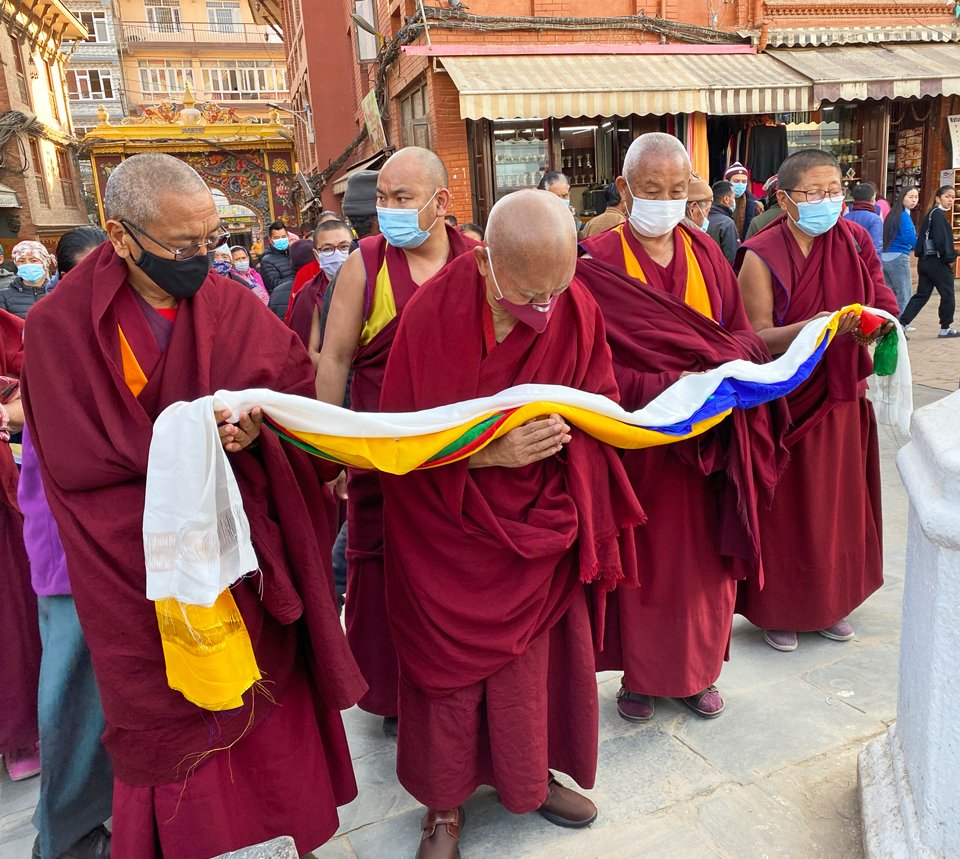
Khen Rinpoche Geshe Chonyi, Lama Zopa Rinpoche, Gen Tenpa Choden, and Ani Jangsem offering five-colored khata to the Boudha Stupa with prayers, Nepal, February 2021. Photo by Ven. Roger Kunsang.
The Benefits of Making Offerings to the Boudha Stupa
After COVID ended, Rinpoche continued to perform the offering practice to the Boudha Stupa, and the practice grew increasingly elaborate over time. Rinpoche himself performed the practice at the stupa several times in a room with extensive offerings located on the circumambulation path, and at least twice from his room in Kopan. Rinpoche would quote the Great Guru, Padmasambhava, on the benefits of serving the great stupa of Boudha:
“Listen! Great king, generate strong devotion. All the buddhas and bodhisattvas of the three times actually absorbed into and abide in this holy object of the holy mind. Any requests and prayers made to the great stupa will be effortlessly and spontaneously accomplished; it is like a wish-granting jewel. The benefits for any transmigratory being who, with a totally pure attitude, prostrates to it, circumambulates it, or makes offerings to it cannot be expressed or counted even by the numberless past, present, and future buddhas.”
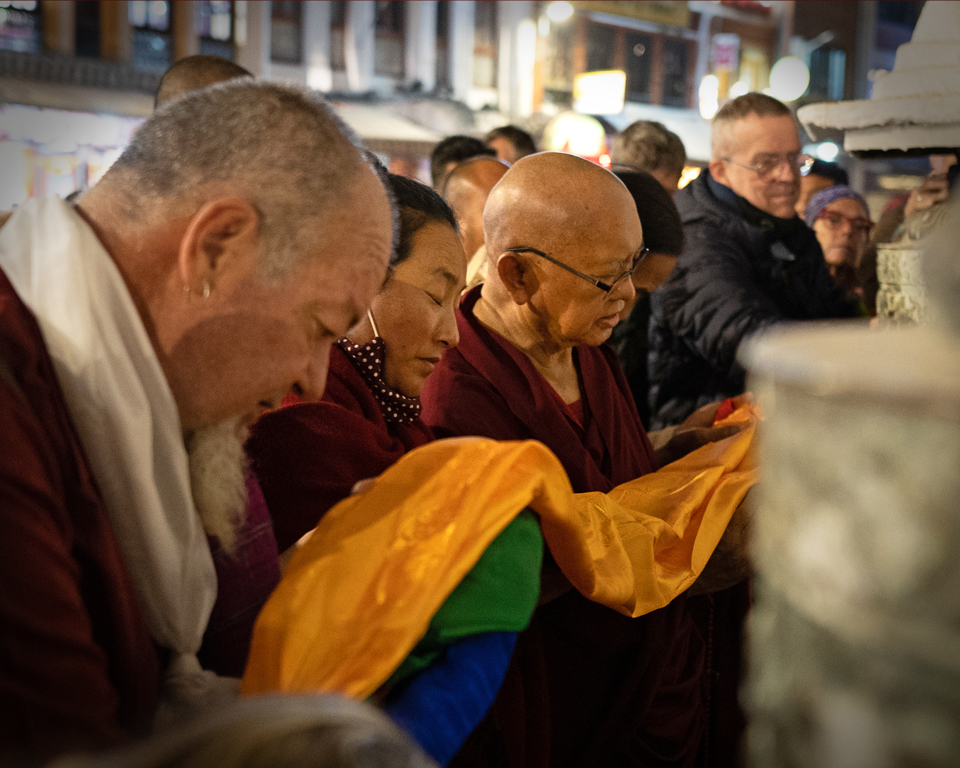
Lama Zopa Rinpoche and Khadro Rinpoche at Boudha Stupa, Nepal, November 2019. Photo by Harald Weichhart.
To collect “the most unbelievable merit” when making offerings to the stupa, Rinpoche says in Offerings to the Boudha Stupa, “Think that all these offerings belong to sentient beings and then, on their behalf, make offerings to the stupa. It is not just a stupa. To me, for example, it’s in essence His Holiness the Dalai Lama, which means it’s all the past, all the present, and all the future buddhas. You can think like that for whoever your own root guru is, which means your root guru is all the three-time and ten-direction buddhas. […] There’s no question how much merit you will collect with each offering you make to the stupa while thinking that in essence it is your root guru. You collect the most unbelievable merit, and it becomes purification as well. Please think this with any offering you make to the stupa, and then offer it on behalf of all sentient beings.”
Eventually, Ven. Sarah Thresher requested Rinpoche to compose a formal offering practice for his students to use. Rinpoche responded by suggesting that she transcribe one of the extensive practices he had led at Kopan and compile a booklet from that. After Rinpoche showed the aspect of passing away, Ven. Joan Nicell completed the transcript that Ven. Sarah had initiated and, with the help of Ven. Ailsa Cameron, arranged it into a practice format so that the practice could be done during the forty-nine days of prayers in Rinpoche’s honor. The resulting practice booklet, Making Extensive Offerings to Boudha Stupa, also lists the specific benefits of making each kind of offering.
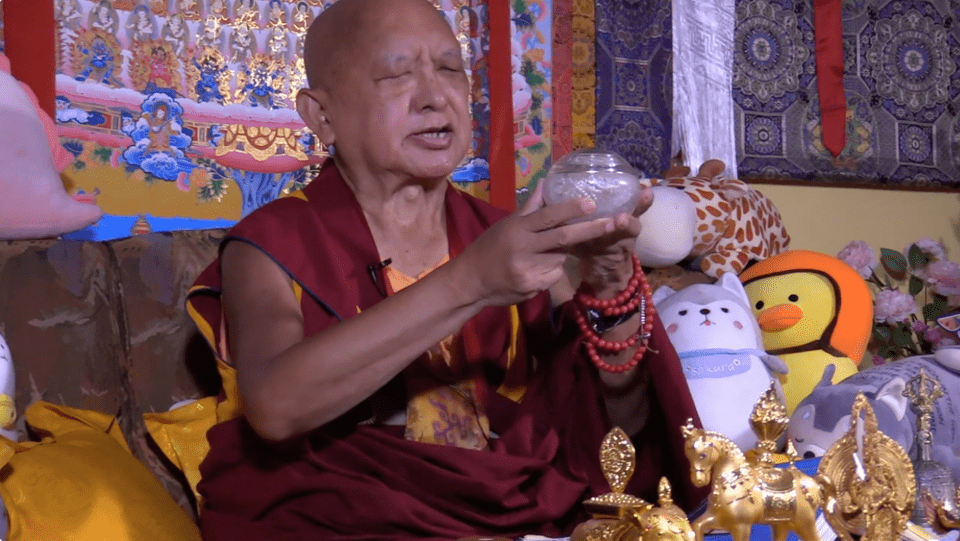
Lama Zopa Rinpoche offering wish-granting jewel to the Boudha Stupa from his room in Kopan Monastery, September 2021.
Rinpoche’s Offering Room at the Boudha Stupa
The offering room was originally set up and continues to be maintained by Dechog, a Chinese lay student of Lama Zopa Rinpoche. Dechog started off by arranging many offerings on tarpaulins laid out along the circumambulation path of the stupa, and then spending hours offering them. Eventually, with the help of some Chinese students, he rented a disused restaurant overlooking the stupa where he could permanently set up his extensive array of offerings. Rinpoche rejoiced greatly in Dechog’s offerings of huge water bowls and large butter lamps and his insistence on offering only the finest quality substances and, over time, Rinpoche contributed many auspicious offerings and statues to the offering room.
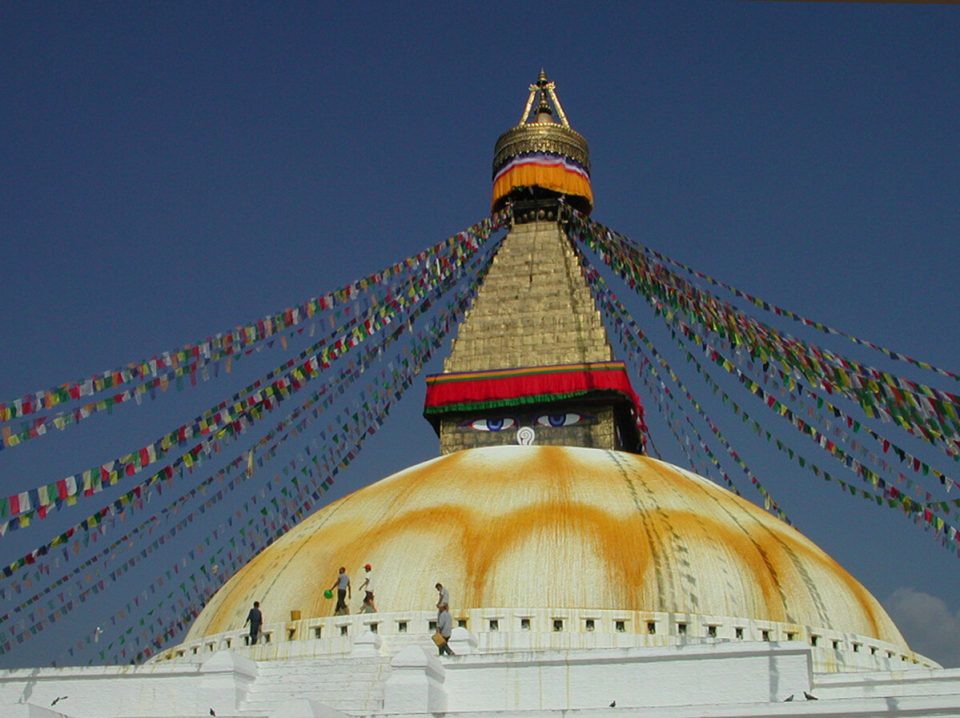
Offering of saffron at Boudha Stupa.
After Dechog offered a set of keys to Rinpoche, the room gradually became known among FPMT students as “Rinpoche’s offering room at Boudha.” A simple throne, sponsored by a group of Chinese students, was set up for Rinpoche to use whenever he did the offering practice there. Rinpoche would lead the practice himself, reading from his copy of The Legend of the Great Jarung Kashor Stūpa and explaining the benefit of each offering, followed by the recitation of the Offering Cloud Mantra, with instruments being played while visualizing the offerings being made.
In January 2022, Lama Zopa Rinpoche gave advice on how to make the best use of the offering room so as to collect “the most unbelievable merit” when making offerings to the stupa. This advice, which was published as Offerings to the Boudha Stupa,was also printed, framed, and hung in the room as a reminder to students.
Students Perform the Offering Practice
Besides performing the offering practice once during the forty-nine days after Rinpoche’s passing, it has since been done at major FPMT gatherings in Kathmandu: following the Light of the Path retreat at Kopan in 2023, the Heart Sutra retreat in 2024, and the CPMT meeting in 2025, and most recently in March 2026 when a number of FPMT students visited Nepal for the inauguration of Khadro Rinpoche’s new monastery.
Students participating in this extensive practice have been deeply moved. Maria Damsholt from the FPMT Center for Wisdom and Compassion in Denmark, who took part in the March 2026 offering practice, shared: “It is a very beautiful offering practice to do. It felt exactly like making offerings and prayers with Rinpoche himself—because it really is in the spirit of Rinpoche. Thank you so much for letting me practice with you. I intend to buy as many offering substances as possible so that we can do it in Denmark too.”
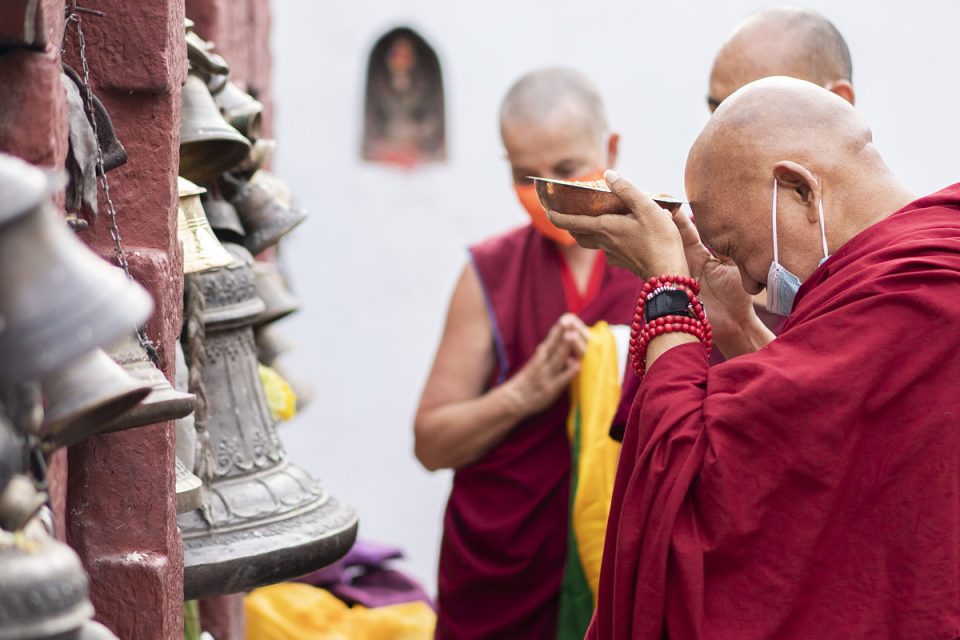
Rinpoche making offerings at Boudha Stupa, Nepal, July 2021. Photo by Ven. Lobsang Sherab.
Claudia Czuba from the FPMT center in Vienna was so deeply inspired that she purchased jewels and medicines in Boudha in 2025 and performed the practice twice in Austria. She said, “We did this offering practice at Panchen Losang Chogyen center in Vienna by setting up an offering table with a big picture of the Boudha Stupa and nicely arranged offerings. It is a simple yet very powerful practice, and also very joyful. To arrange beautiful offerings, visualize them as extensively as possible, share them with all sentient beings, and offer them to the stupa indivisible from the guru makes the heart and mind very happy. It seemed like people felt the ‘skies of merits’ they created with this practice. And, for sure, it pleased the holy mind of our precious guru Kyabje Lama Zopa Rinpoche.”
Malaysian monk Ven. Sonam Yeshe was equally inspired and is planning to bring the practice to Rinchen Jangsem Ling Retreat Centre in Triang, Malaysia. He shared, “Experiencing the elaborate offerings in front of the holy Boudha Stupa for the first time was profoundly moving. It felt incredibly special to participate in the same ritual that Lama Zopa Rinpoche performed so many times at the stupa. I couldn’t help but imagine how beautiful it would be to replicate these elaborate offerings at Rinchen Jangsem Ling, Malaysia. By facilitating a program where participants take turns performing the offerings themselves, we can provide a highly engaging and meritorious experience that resonates with all those who attend.”
We invite all of Rinpoche’s students and centers to do this offering practice to the Boudha Stupa from their homes or centers and in this way help preserve Rinpoche’s very special practice lineage while at the same time creating skies of merits!
Resources
In September 2021, Rinpoche recorded a Thought Transformation Teaching video entitled “Making Offerings to Boudha Stupa” in which he speaks about performing a tsog offering practice at the Boudha Stupa and the benefits of making offerings to stupas. You can follow along with the offering practice by watching the video.
Find Offerings to the Boudha Stupa as a PDF in the Foundation Store.
Find Making Extensive Offerings to Boudha Stupa as a PDF in the Foundation Store.
Foundation for the Preservation of Mahayana Tradition (FPMT), is a Tibetan Buddhist organization dedicated to the transmission of the Mahayana Buddhist tradition and values worldwide through teaching, meditation and community service.
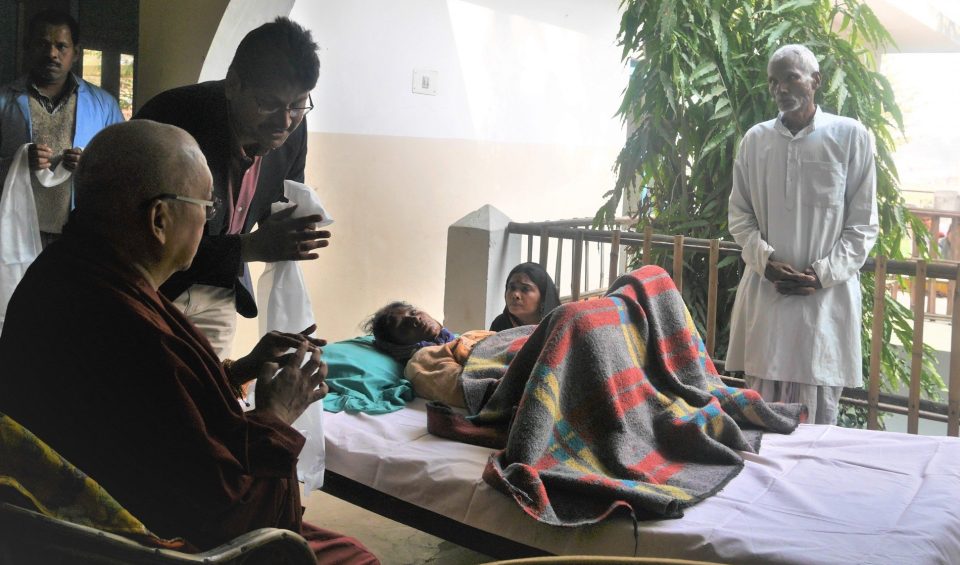
Lama Zopa Rinpoche blessing a patient of Shakyamuni Health Clinic in 2017.
Helping someone pass away in the most auspicious way possible is one of the greatest gifts we can offer at the most critical time of a person’s life. The FPMT Death and Dying Heart Practices and Advice webpage is a compilation of Lama Zopa Rinpoche’s advice and materials on death and dying, available for all to use
In 2017, Lama Zopa Rinpoche shared important advice at Istituto Lama Tzong Khapa, Italy, when the center was considering starting a hospice. We are happy to share this guidance with the broader community, as it carries significant meaning for those who wish to support others at the time of death.
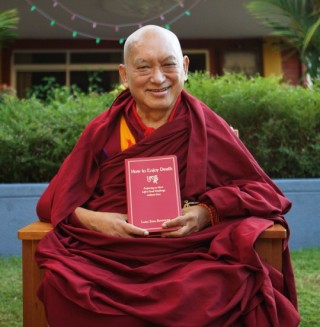
Lama Zopa Rinpoche with ‘How to Enjoy Death,’ Osel Labrang, Sera Monastery, India, December 2015
- Have Dharma books available, such as How to Enjoy Death: Preparing to Meet Life’s Final Challenge Without Fear, Practicing the Five Powers Near the Time of Death, and other books on tonglen, Eight Prayers to Benefit the Dead, and anything else that supports at the time of death. Keep not just one copy of each book, but many.
- Have prayers and mantras available for recitation, such as the Namgyalma mantra, and also prayers such as The Three Principal Aspects of the Path, Calling the Guru from Afar, and similar texts. Have all relevant prayers on hand so that those present can recite them.
- Have recordings playing throughout the day — such as Calling the Guru from Afar, The Confession of Downfalls to the Thirty-Five Buddhas , A Hymn of Experience by Lama Tsongkhapa, and different mantras, such as Namgyalma, Medicine Buddha, Chenrezig Mantra and Request, and others. These should be played approximately 6 times a day, for about 10 to 20 minutes each time. Recordings of mantras by His Holiness the Fourteenth Dalai Lama and Khandro Rinpoche are especially beneficial for those who are dying to hear them. Additional recordings may include mantras from the dying person’s own guru, verses about bodhicitta, the Vajrasattva mantra, and so forth.
- Have thangkas depicting different pure lands — such as Padmasambhava Pure Land, Amitabha Pure Land, Chenrezig Pure Land, and Tara Pure Land. Choose beautiful thangkas and arrange the space so that it is uplifting and beautiful, bringing joy rather than depression to those who are there. If thangkas are not available, large framed images of the pure lands may be used instead.

- Affix large printed versions of mantras such as Namgyalma mantra, the Takdrol, and the Pema Ushnisha mantra, on the ceilings of the rooms, so that those who are dying can see them and may be protected from rebirth in the lower realms.
- Have powa pills available, so when breathing stops, the pills can be mixed with honey and butter and placed on the crown of the head.
- Have a copy of Lama Tsongkhapa’s Lamrim Chenmo, present in the room.
- Have many copies of the Liberation Card — the card Rinpoche compiled for people to look at when dying.
- Have Mantra Water blessed by His Holiness the Dalai Lama and Khandro Rinpoche.
- Have prayer wheels and stupas.
- In each room, have holy statues — ideally from Nepal.
- On the roof of the house or center install a statue of Kṣitigarbha — ideally beautiful and newly made, not an old one. The aspect should be the standing form, holding a monk’s staff. The statue could be commissioned from Chinese craftspeople or obtained from Vietnam. The ideal size is one story tall. This is so that those in the house may be guided by Kṣitigarbha. The statue could be blessed by His Holiness the Dalai Lama. A smaller Kṣitigarbha statue may also be placed inside the house.
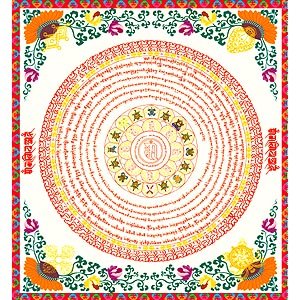
Scribed by Ven. Holly Ansett at Istituto Lama Tzong Khapa, Italy, 2017.
As a reminder Wisdom Publication’s 2025 release, How to Live and Die: The Transformative Power of Meditating on Impermanence by Lama Zopa Rinpoche offers an overview of meditating on death and impermanence. From the book:
“A complete education about death is the most important education we can have. What death is, how we die, what minds we need at death, and what happens after death—only by knowing about death and rebirth can we actually fully understand what life is and so learn how to live fully.”
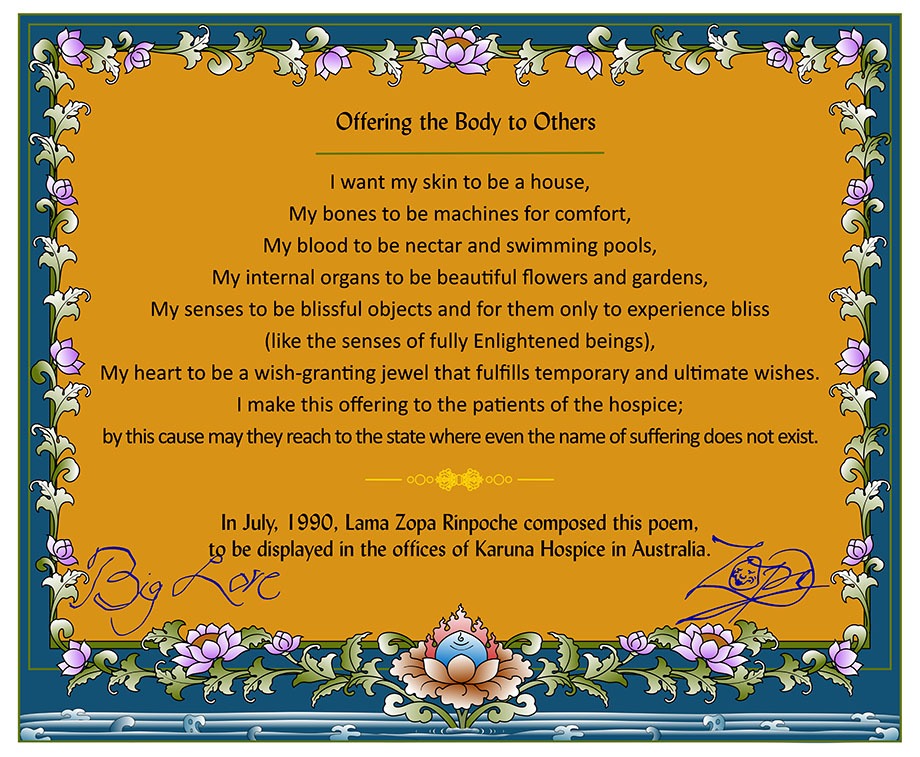
In July 1990, Lama Zopa Rinpoche composed this poem to be displayed in the office of Karuna Hospice in Australia. It can be downloaded and displayed at any hospice.
Foundation for the Preservation of Mahayana Tradition (FPMT), is a Tibetan Buddhist organization dedicated to the transmission of the Mahayana Buddhist tradition and values worldwide through teaching, meditation and community service.