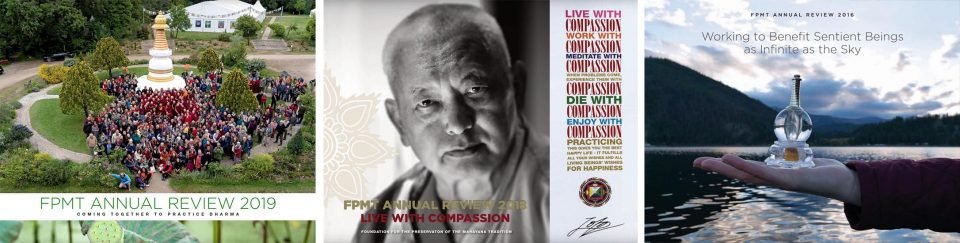
Foundation for the Preservation of the Mahayana Tradition
The FPMT is an organization devoted to preserving and spreading Mahayana Buddhism worldwide by creating opportunities to listen, reflect, meditate, practice and actualize the unmistaken teachings of the Buddha and based on that experience spreading the Dharma to sentient beings. We provide integrated education through which people’s minds and hearts can be transformed into their highest potential for the benefit of others, inspired by an attitude of universal responsibility and service. We are committed to creating harmonious environments and helping all beings develop their full potential of infinite wisdom and compassion. Our organization is based on the Buddhist tradition of Lama Tsongkhapa of Tibet as taught to us by our founders Lama Thubten Yeshe and Lama Thubten Zopa Rinpoche.
Die Stiftung zur Erhaltung der Mahayana Tradition (FPMT) ist eine Organisation, die sich weltweit für die Erhaltung und Verbreitung des Mahayana-Buddhismus einsetzt, indem sie Möglichkeiten schafft, den makellosen Lehren des Buddha zuzuhören, über sie zur reflektieren und zu meditieren und auf der Grundlage dieser Erfahrung das Dharma unter den Lebewesen zu verbreiten.
Wir bieten integrierte Schulungswege an, durch denen der Geist und das Herz der Menschen in ihr höchstes Potential verwandelt werden zum Wohl der anderen – inspiriert durch eine Haltung der universellen Verantwortung und dem Wunsch zu dienen. Wir haben uns verpflichtet, harmonische Umgebungen zu schaffen und allen Wesen zu helfen, ihr volles Potenzial unendlicher Weisheit und grenzenlosen Mitgefühls zu verwirklichen.
Unsere Organisation basiert auf der buddhistischen Tradition von Lama Tsongkhapa von Tibet, so wie sie uns von unseren Gründern Lama Thubten Yeshe und Lama Thubten Zopa Rinpoche gelehrt wird.
La Fundación para la preservación de la tradición Mahayana (FPMT) es una organización que se dedica a preservar y difundir el budismo Mahayana en todo el mundo, creando oportunidades para escuchar, reflexionar, meditar, practicar y actualizar las enseñanzas inconfundibles de Buda y en base a esa experiencia difundir el Dharma a los seres.
Proporcionamos una educación integrada a través de la cual las mentes y los corazones de las personas se pueden transformar en su mayor potencial para el beneficio de los demás, inspirados por una actitud de responsabilidad y servicio universales. Estamos comprometidos a crear ambientes armoniosos y ayudar a todos los seres a desarrollar todo su potencial de infinita sabiduría y compasión.
Nuestra organización se basa en la tradición budista de Lama Tsongkhapa del Tíbet como nos lo enseñaron nuestros fundadores Lama Thubten Yeshe y Lama Zopa Rinpoche.
A continuación puede ver una lista de los centros y sus páginas web en su lengua preferida.
L’organisation de la FPMT a pour vocation la préservation et la diffusion du bouddhisme du mahayana dans le monde entier. Elle offre l’opportunité d’écouter, de réfléchir, de méditer, de pratiquer et de réaliser les enseignements excellents du Bouddha, pour ensuite transmettre le Dharma à tous les êtres. Nous proposons une formation intégrée grâce à laquelle le cœur et l’esprit de chacun peuvent accomplir leur potentiel le plus élevé pour le bien d’autrui, inspirés par le sens du service et une responsabilité universelle. Nous nous engageons à créer un environnement harmonieux et à aider tous les êtres à épanouir leur potentiel illimité de compassion et de sagesse. Notre organisation s’appuie sur la tradition guéloukpa de Lama Tsongkhapa du Tibet, telle qu’elle a été enseignée par nos fondateurs Lama Thoubtèn Yéshé et Lama Zopa Rinpoché.
L’FPMT è un organizzazione il cui scopo è preservare e diffondere il Buddhismo Mahayana nel mondo, creando occasioni di ascolto, riflessione, meditazione e pratica dei perfetti insegnamenti del Buddha, al fine di attualizzare e diffondere il Dharma fra tutti gli esseri senzienti.
Offriamo un’educazione integrata, che può trasformare la mente e i cuori delle persone nel loro massimo potenziale, per il beneficio di tutti gli esseri, ispirati da un’attitudine di responsabilità universale e di servizio.
Il nostro obiettivo è quello di creare contesti armoniosi e aiutare tutti gli esseri a sviluppare in modo completo le proprie potenzialità di infinita saggezza e compassione.
La nostra organizzazione si basa sulla tradizione buddhista di Lama Tsongkhapa del Tibet, così come ci è stata insegnata dai nostri fondatori Lama Thubten Yeshe e Lama Zopa Rinpoche.
Di seguito potete trovare un elenco dei centri e dei loro siti nella lingua da voi prescelta.
“护持大乘法脉基金会”( 英文简称:FPMT。全名:Foundation for the Preservation of the Mahayana Tradition) 是一个致力于护持和弘扬大乘佛法的国际佛教组织。我们提供听闻,思维,禅修,修行和实证佛陀无误教法的机会,以便让一切众生都能够享受佛法的指引和滋润。
護持大乘法脈基金會”( 英文簡稱:FPMT。全名:Foundation for the Preservation of the Mahayana Tradition )是一個致力於護持和弘揚大乘佛法的國際佛教組織。我們提供聽聞,思維,禪修,修行和實證佛陀無誤教法的機會,以便讓一切眾生都能夠享受佛法的指引和滋潤。
The Foundation Store is FPMT’s online shop and features a vast selection of Buddhist study and practice materials written or recommended by our lineage gurus. These items include homestudy programs, prayers and practices in PDF or eBook format, materials for children, and other resources to support practitioners.
Items displayed in the shop are made available for Dharma practice and educational purposes, and never for the purpose of profiting from their sale. Please read FPMT Foundation Store Policy Regarding Dharma Items for more information.
Advancing Our Gurus’ Vision of a World Guided by Compassion and Wisdom
Welcome to FPMT International Office’s 2025 Annual Review. What a powerful year this has been! Not only did FPMT representatives from around the world come together to participate in the 2025 CPMT Summit at Kopan Monastery, the FPMT also reached its 50th anniversary as an organization.
A most joyous aspect of 2025 was receiving news that His Holiness the Dalai Lama had observed that the reincarnation of our most precious spiritual director, Kyabje Lama Zopa Rinpoche, who showed the aspect of passing away in 2023, has been reborn in Nepal.
We invite you to take your time with these various reports and to join us in rejoicing in another year of working together for the future success of the entire FPMT organization, now, and long into the future.
Joyful News from His Holiness the Dalai Lama
During the CPMT Summit in April, a message from His Holiness the Dalai Lama was shared with participants. In this message, His Holiness confirmed that the reincarnation of our most precious spiritual director, Kyabje Lama Zopa Rinpoche, has been reborn. According to His Holiness’s observation, the reincarnation has taken rebirth in Nepal.
All are encouraged to continue reciting Chanting the Names of Noble Manjushrias well as Migtsema practice as advised by His Holiness, and we must continue to pray that Rinpoche’s reincarnation has good health, a sharp mind, and good conditions for the fulfillment of all Lama Zopa Rinpoche’s works and wishes.
CPMT Summit 2025
Lively discussions at CPMT 2025. April 8, 2025. Photo by Capucine T. Dekyong.
In April of this year, 195 individuals from 70 FPMT centers, projects, and services greeted each other with hugs and huge smiles upon arriving at Kopan Monastery, Nepal, from 25 different countries for the 2025 CPMT Summit: Advancing Our Gurus’ Vision of a World Guided by Compassion and Wisdom. It had been eleven years since the last CPMT meeting was held at the Great Stupa of Universal Compassion in Bendigo, Australia.
For six agenda-packed days, participants energetically discussed, debated, dreamed, shared struggles and successes, commiserated and rejoiced, collaborated, planned, and strengthened connections old and new. We invite you to read a full report of this momentous event, including photos, videos, and details from each day.
FPMT Turns 50!
Lama Zopa Rinpoche and Lama Yeshe, New Jersey, USA, 1974. Photo by Jeff Nye.
December 2025 marked 50 years since Lama Yeshe famously said, “We need an organization to keep this together.” Lama was reflecting on the success of a recent eight-and-a-half-month tour of nine countries, the most extensive Lama Yeshe and Lama Zopa Rinpoche would ever undertake. Lama asked nine of his senior students to discuss how to coordinate the rapidly growing collection of centers and students, which would soon be known as the Foundation for the Preservation of the Mahayana Tradition (FPMT).
What an unbelievable achievement the last 50 years have been for everyone who has served the FPMT organization in any way. We invite all of our friends in the FPMT Mandala–old students, new students, centers, projects, services, study groups, donors, teachers, board members, volunteers, and anyone who has benefited from FPMT in any way or offered their very kind service–to please join us over the next year to truly rejoice in what has been accomplished from the most humble beginnings.
At the end of 2025, we compiled a resources page with information about the lives of our lamas, some history of the organization, and several ways individuals and FPMT centers can get involved in this collective celebration, which we plan to encourage throughout 2026. We are hoping to collect as many stories as possible from all of those generous students who have helped shape the last fifty years in big and small ways. We are also hoping to receive as much center history as possible, as well, as this is a wonderful opportunity to celebrate all of the activities that have been established around the world.
MENU
Advice From our Lamas
As we reflect back on FPMT turning fifty years old, we are sharing what our late founders, Lama Yeshe and Lama Zopa Rinpoche, had to say about the origins of the organization, which contains timeless advice for all serving within the FPMT.
Lama Yeshe
In 1983, Lama Yeshe discussed FPMT’s objectives, structure and function during a talk given to the CPMT meeting at Istituto Lama Tzong Khapa, Italy, in January, 1983.
“The most important thing is for the students to be well educated. That is why we exist.” – Lama Yeshe
Why have we established the FPMT? Why are we establishing these facilities all over the world? I think we are clean clear as to our aim – we want to lead sentient beings to higher education. We are an organization that gives people the chance to receive higher education. We offer people what we have: the combined knowledge of Buddha’s teachings and the modern way of life. Our purpose is to share our experiences of this.
We know that people are dissatisfied with worldly life, with the education system and everything else; it is in the nature of our dualistic minds to be dissatisfied. So what we are trying to do is to help people discover their own totality and thus perfect satisfaction.
Now, the way we have evolved is not through you or me having said we want to do these things but through a natural process of development. Our organization has grown naturally, organically. It is not “Lama Yeshe wanted to do it.” I’ve never said that I want centers all over the world. Rather, I came into contact with students, who then wanted to do something, who expressed the wish to share their experience with others, and who then put together groups in various countries to share and grow with others.
Personally, I think that’s fine. We should work for that. We are human beings; Buddhism helps us grow; therefore, it is logical that we should work together to facilitate this kind of education. And it is not only us lamas who are working for this. Actually, it is you students who are instrumental in creating the facilities for Dharma to exist in the Western world. True. Of course, teachers help. But the most important thing is for the students to be well educated. That is why we exist.
When we started establishing centers there was no overall plan – they just popped up randomly all over the world like mushrooms, because of the evolutionary process I’ve just mentioned and the cooperative conditions. Now that all these centers do exist, we have to facilitate their development in a constructive, clean-clear way; otherwise, everything will just get confused. We have to develop properly both internally and in accordance with our twentieth-century environment.
In October 1982, Lama Yeshe was interviewed about the origins of FPMT as well as his vision for the organization. Please watch the video, which contains two interviews:
Lama Zopa Rinpoche
Lama Zopa Rinpoche discussed the origins of FPMT, as well as many reasons for rejoicing in the good work of the organization, at the end of the long-life puja at Chenrezig Institute, Australia, in June 2006.
“It was started with the good heart.” – Lama Zopa Rinpoche
Any good thing the FPMT organization has been able to offer and the numberless sentient beings have been able to receive—every understanding of Dharma we have and every Dharma practice we have done so far, every purification we have done and every merit we have collected—comes first by the kindness of His Holiness the Dalai Lama and second by the kindness of Lama Yeshe, whose holy name is difficult to express. First, we exist basically by the kindness of His Holiness, the only object of refuge for all sentient beings and the source of all the happiness of sentient beings. Second, Lama Yeshe, who is kinder than all the buddhas and bodhisattvas of the three times, is the founder of this organization. Even though many of you didn’t meet Lama or hear teachings directly from him, he started the centers. The purification of every single negative karma, the collecting of every single merit, the planting of the seeds of enlightenment, and every understanding of Dharma received from this organization—here at Chenrezig Institute, for example—also came from Lama, from Lama’s kindness. This also applies to anyone who has met Dharma in any other center in the FPMT.
The organization has come a very long way. Like a baby growing up with a lot of life experiences and difficulties, it has now reached this high. [Rinpoche indicates a height of a foot or so.] Now there’s so much more to go. With much hardship we have come a long way, a very long way, like on a road. It all started with the sincere hearts of the young students who came to Nepal and India looking for a spiritual life and a guru. During those times there was an explosion of Buddha sticks, LSD, and other things that break the fixed concepts of the materialistic mind and give you a chance to see something new and to have a new life. You then learn more about the mind. Rather than looking more at the external world, you look more at the inside world, the mind, which is very extensive. You can only understand external phenomena if you understand the mind. Without understanding the mind you have no way to understand external phenomena.
It was started with the good heart. The students found the lamrim, the heart of the 84,000 teachings of Buddha, meaningful. I’d just say a few words about lamrim—not that I know anything about lamrim. In my case, I would just repeat the few words of lamrim I knew over and over: impermanence, impermanence, impermanence, lower realms, lower realms, lower realms, attachment, attachment, attachment. I didn’t have any realization but I would just repeat the same things about attachment and karma and hell over and over to the people who came to Nepal. This is usually how it is in my case. Anyway, those few words repeated over and over did something for their minds. Somehow those few words benefited them, I think. Because it benefited them, showing them the real meaning of life and what you are supposed to accomplish and what you should abandon to be free from suffering, the students basically wanted to benefit the people in their own countries, so they started the centers. So, it was started with the good heart.
This is how the organization happened. These young people broke their fixed ideas about a materialistic life and about there being just one life. Due to their karma—or maybe it was Buddha’s holy action—through these plants they broke their stubborn concepts and then opened their minds to a new life. Seeing that the mind can exist without the body, they opened their hearts and accepted reincarnation and karma and then liberation and enlightenment. With the good heart, they continued with the organization, even though most of these young people weren’t professionals and didn’t have any experience of business. Some of them had not completed university. Others might have finished university but didn’t have any work experience. However, with the good heart and with patience through many difficulties and hardships, they continued to benefit others. This is how the organization has grown up to now. Only a very few centers have dissolved in emptiness, like a deity and its mandala dissolving in the clear light. It’s not sure when they will rise back up….
I think it’s very good, because things were done with a pure heart, and that’s the most important thing. Whether or not things succeed, everything should be done with as pure a heart as possible. With compassion, you try to help as much as possible. Even though you might have very little experience, I think the most important thing is to do everything with a good heart. Because of limited facilities for people to come to listen to teachings or to do retreats and other practices, it has not been possible to spread the Dharma in a very broad professional way, in the sense of what could be accomplished by a wealthy business. Even though that is not happening and what we’re doing is kind of simple, everything is being done with a good heart. We have developed and come a very long way and learned a lot during these many, many years. So, I think it’s very good.
Sometimes an organization might look very wealthy, but then you ask, Where did the money come from? If you check, you find much harm was given to other sentient beings and many negative karmas were committed to get the money. It appears as if everything is going well, with lots of money, but if you check how the money is earned, you find there’s a lot of negative karma involved. That’s not good, because if you get wealthy by creating a lot of negative karma, there’s no Dharma, and you will have to experience all the resultant sufferings.
We don’t need the kind of success that comes by creating negative karma. It is better to try to do everything purely and then gradually have success. This is the safe way of developing. Many organizations look very good financially, but if you really analyzed what they are doing, you would be shocked. I never mentioned that before, but I just thought to mention it now. I remember I also mentioned here [at Chenrezig Institute] last time at a long-life puja that I see there has been development in terms of the Dharma. There has also been external development. We have come a long way. Many centers are now functioning more easily and people have much more experience of how to do things. Anyway, the most important developments are having more devotion to the Triple Gem and more compassion for sentient beings. Those two are very, very important and what make this life very meaningful. They are important for your own development, for you to achieve enlightenment for sentient beings, as well as for numberless sentient beings not to receive harm from you and to receive peace and happiness, including both temporary happiness and the ultimate happiness of enlightenment, from you. Generally speaking, I see these two things developing more and more, and I think it’s the best thing.
Of course, being able to serve sentient beings in many different ways through the organization and the centers is also an excellent thing. It really gives meaning to your own life and to the lives of the many other people in the center and of the many other people who come to the center. It’s a really wonderful thing. So, I think that we’re able to do many, many things because there has been the development of more capacity, more compassion, more knowledge, wider thinking, and the taking of more responsibility. I just eat, go to the toilet, and sleep, but I think the people in the organization, Lama’s students, have developed more compassion, more devotion, more knowledge, and more experience to benefit others. …
Giving people food, medicine, and shelter is very good and something we must do, but if we don’t help them to change their mind, if we don’t educate them about removing their negative karma and delusions, they will engage in the same negative karmas again and again. They will then again be born in the same place and experience all the same poverty and fighting again and again. Even if they are born as a human being in their next life due to another good karma, they will experience the same problems again and again. Helping such people materially is a good thing to do, but it doesn’t really remove the cause of their suffering.
Now, a Dharma organization like ours … which offers not only extensive lamrim teachings but extensive teachings on philosophy, brings unbelievable benefit. There is unbelievable benefit in just the lamrim itself. It causes sentient beings to actualize the three principles of the path, true cessation, and so forth. Just the graduated paths of the lower and middle capable being, just talking about the four noble truths, help them to remove the cause of suffering, their karma and delusions, especially the root delusion, ignorance, and to achieve liberation. They’re able to learn and to leave imprints, and then able to achieve that in the future.
We are able to offer sentient beings unbelievable benefit, limitless skies of benefit. Therefore, we must rejoice all the time. All the staff of the general FPMT organization and of each center should remember this deep and extensive benefit that we are offering to sentient beings. We should remember this every day. You will then enjoy your life and see that your life is most meaningful there. As I usually say, there is a big difference between working in a factory and working at a center. Of course, you can get plenty of money working in a factory, but it doesn’t spread Dharma. It doesn’t teach Dharma to others; it doesn’t educate others about how to get out of samsara and achieve enlightenment. Without talking about the extensive philosophical teachings, even the lamrim offers this. There is a huge difference, like the difference between the earth and the sky, between working in a factory and offering service at a center. There’s a huge difference when you think about the benefits that sentient beings receive, and it makes so much difference to your own life.
We have to do this together. As I often say, one person cannot do everything. One person cannot teach Dharma, translate, be the director, be the secretary, and so forth. To do everything you need the help of all the staff: the resident teacher, the translator, and all the rest of the staff. Together you can benefit other sentient beings in an extensive way.
Therefore, we must rejoice. Don’t think only about the problems of the center. If you think only of the problems and don’t think of all the benefits, you will then see only problems. If you think only of the problems, you will see only problems. The next point is that some other centers even of the Tibetan tradition don’t have much teaching because it’s difficult for their monasteries to produce qualified teachers. Even though there might be many centers, they have programs with more rituals, pujas, or simple meditation. There’s not really much education happening. It’s very difficult for them to have even lam-rim teachings, the essence of the path to enlightenment. Due to the kindness of His Holiness and Lama Yeshe, here and in other FPMT centers, there’s some merit to be able to receive many qualified teachers. It is also due to Lama Tsongkhapa’s kindness. Lama Tsongkhapa and his disciples established monasteries with an incredible system for studying all of the extensive Buddhadharma. Lama Tsongkhapa set up the system in such a way that these monasteries are able to produce many qualified teachers. And in the FPMT we have some merit to receive many qualified teachers. Whether or not there’s a resident teacher, there are generally a lot of teachings in the centers in our organization. Some people might say, “Oh, maybe there’s too much teaching and we need more meditation.” However, I think one great development in the organization is the learning of philosophy. Understanding the philosophical teachings makes the understanding of lamrim very deep and very vast.
From a talk given by Lama Zopa Rinpoche at Chenrezig Institute in 2006. Transcribed and edited by Ven. Ailsa Cameron with further light editing by FPMT International Office.
In 2018 Lama Zopa Rinpoche discussed the origins of FPMT and how the Kopan Courses started from Rinpoche reading a lamrim text by Kachen Yeshe Gyaltsen! Please enjoy this wonderful story:
Letter From CEO Ven. Roger Kunsang
Our CEO, Ven. Roger Kunsang, always provides extremely meaningful letters for our Annual Review, overviewing the organization's progress each year. In this year's letter, he reflects on some of the major achievements of the past year, and provides an update on his changing role within the organization.
Read Ven. Roger's Letter
Dear Friends,
FPMT has existed for more than 50 years, a worldwide community that benefits others through the Dharma. We are now more than 136 centers in 31 countries and have many highly qualified teachers. In over 50 years imagine how many people have been introduced to the Dharma around the world and have had their lives changed. This means, more wisdom, more compassion and kindness. This is worth rejoicing in – what we have done together under the wise and compassionate guidance of Lama Yeshe and Lama Zopa Rinpoche.
The world faces many serious challenges, and we as individuals also face many challenges. But having met the Dharma we can make a difference in how we face these challenges. This is due to the kindness and great compassion of Lama Zopa Rinpoche and Lama Yeshe. Putting the teachings into practice with a brave and kind heart makes it possible to face such challenges. It is due to Lama Yeshe and Lama Zopa Rinpoche that we have this opportunity to make a real difference for ourselves and for others. What an incredible opportunity we have been given!
A very important responsibility we have in FPMT International Office is fulfilling Rinpoche’s and Lama’s holy wishes. This is also the responsibility of the lamas’ students to repay the kindness of the Guru by fulfilling their wishes and practicing what they taught. In 2025 we continued to do this to the best of our ability.
Below are some highlights of what we are doing – with your help and support, to fulfill Rinpoche’s and Lama Yeshe’s holy wishes, which is a key responsibility that we have.
Rinpoche always had a big vision like Lama Yeshe. One manifestation of that is the Vast Visions which cover Dharma education and retreats; creating holy objects, expanding and developing Universal Education; social work for the young and elderly; as well as support for the Sangha. This is a big vision with practical steps, not just for this life but for future lives. Rinpoche’s wish was that we share this vision. Students and centers can take on what they would like to commit to, and together we can fulfill the guru’s wishes. This is a golden opportunity – and an important responsibility. This is the key to our success as an organization as well as individuals – this is our practice!
Every morning since Rinpoche showed the aspect of passing and continuing through 2025, several Kopan Lama Gyupas offer puja in front of Rinpoche’s Holy Body. The salt is changed for the drying of the Holy Body regularly. In the beginning, this was done every two days, and now it is done once a month. We expect this process to finish at the end of 2026. At which time the Holy Body will be placed in a life-like statue of Rinpoche and kept at Kopan.
During the last months of 2025 we have been able to finalize the Maitreya statue to be built in Bodhgaya on the original Maitreya land site that Lama Zopa Rinpoche offered to His Holiness the Dalai Lama in 2020. This statue will be built alongside His Holiness’ s project on several acres of the original property. The statue will be made of sandstone and will stand approximately 40 feet, built on a foundation that will house a gompa holding holy objects including the Twenty-One Taras, Sixteen Arhats (life sized and made in Tibet). The statue will stand in a garden of trees and flowers. The statue and gompa will be maintained by a group of Kopan nuns who will live there as a branch of Kopan nunnery. The statue will take approximately 36 months to build.
On December 3 we hosted the annual Guru Rinpoche Bumtsok Puja which is now held on Rinpoche’s birthday each year – Dec 3. Many years back, Rinpoche initiated the creation of a huge tangka of Guru Rinpoche in South India, and since its completion, Rinpoche has been offering this puja annually for the success and removal of obstacles for the entire FPMT organization. In the past, it has been monks from Shechen Monastery or Thame monastery who have been invited to lead the puja. In the future, it will be Kopan monks and nuns who will lead – soon they will be receiving the lineage of this practice from Jhado Rinpoche, who received it from H.H. Tulshik Rinpoche.
Lama Yeshe gave Rinpoche the responsibility to complete the retreat of Most Secret Hayagriva each year – this is for the success and removal of obstacles for the entire FPMT. We are now continuing the commitment to Lama Yeshe by arranging a group retreat each year. Nalanda Monastery hosted the retreat in 2025 and also will in 2026, and then from 2027 onwards the retreat will be hosted at Kopan Monastery in the gompa underneath Rinpoche’s stupa.
Work on Rinpoche’s Stupa of Complete Victory continues here in Kopan. H.E. Zong Rinpoche advised it to be a Namgyalma stupa for the future flourishing of Lama Zopa Rinpoche’s activities. The base of the stupa is a gompa for group retreats; it can comfortably hold 160 people. Rinpoche’s stupa will be completed by December 2026, and on December 11, 2026, there will be the consecration of Rinpoche’s stupa.
A long-term great wish of Rinpoche’s was to build Zangdog Palri – the Pure Land temple of Guru Rinpoche, in Lawudo. Preparations have been made; all the building materials have been sourced and carried to Lawudo. The plan is to finish the construction over the next two to three summers, as it is not possible to work in the winter. On the main level of the 3-story Zangdog Palri will be a life-size Kalachakra statue – following Rinpoche’s wish.
Below Lawudo, local sherpas have also established The Lama Zopa Rinpoche Memorial Park in memory of Rinpoche’s compassionate activities around the world.
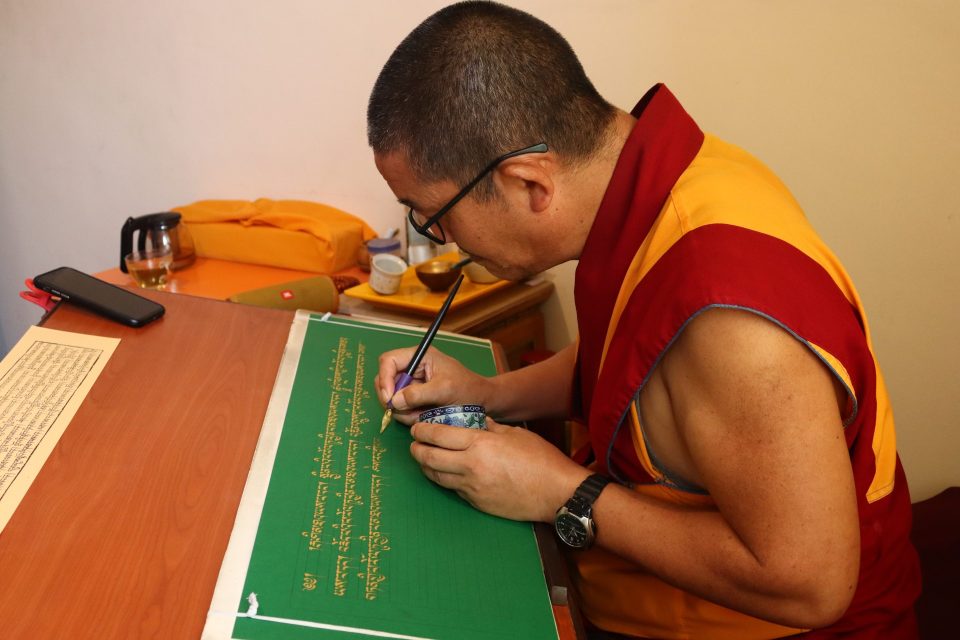
The writing of the Prajnaparamita Sutra in gold continues and was a very important project of Rinpoche’s, and Rinpoche wrote it himself for many years, while on the road, usually after midnight, on large sheets of archival paper, writing in pure gold. At Rinpoche’s request Ven. Thubten Tsering (a senior Kopan monk) has been writing the Prajnaparamita in gold, five days a week, for the last 25 years. We also have Jane Seidlitz in the USA writing the sutra, and recently Ani Tsen-la has also started to write it – a collective effort to complete the writing of the Prajnaparamita Sutra. Please take a moment to rejoice!
It is so important at this time that we do more to preserve and integrate Lama Yeshe and Lama Zopa Rinpoche’s teachings into our education programs by emphasizing our Lamas’ experiential approach to Dharma, particularly through retreats.
We continue to make and offer each year 100 Buddha statues to His Holiness the Dalai Lama, and this year we were able to present them to His Holiness during a long-life puja.
We are coming up to three years since Rinpoche showed the aspect of passing away and His Holiness has said that Rinpoche has been born in Nepal. According to His Holiness, we are waiting a little longer before we start the search for Rinpoche’s incarnation.
I would like to take this opportunity to thank everyone for your very kind support, in so many ways, in fulfilling Rinpoche’s and Lama Yeshe’s wishes to benefit sentient beings in bringing about a kinder and more compassionate world.
This is my last year as CEO. I will remain on the FPMT Inc. Board of Directors and will continue to work and support fulfilling Rinpoche’s projects. I am handing over my responsibilities of managing the FPMT International Office to Peeyush Agarwal, who is well-suited to help us in this transition and the next phase of continuing the compassionate activities of the FPMT organization.
Sincerely,
roger
Message From Our Board of Directors
FPMT Inc. Board with members of FPMT International Office at Kopan Monastery, Nepal, April 2025.
Read a Letter from our Board of Directors
With my heart going out in all ten directions,
Where the supreme jewel-like Dharma has declined or not spread,
Moved by the powerful force of great mercy,
May I reveal the great treasure bringing pleasure and aid.
Dear Friends,
We would like to warmly welcome you to this year’s Annual Review.
This beautiful and profound verse above, composed by Lama Tsongkhapa, is one of the final lamrim dedication prayers, still often recited today after the Lama Chöpa (Guru Puja). It is a prayer that has been passed on through the centuries by great masters, all the way down to His Holiness the Dalai Lama and our exceptional teachers, Lama Thubten Yeshe and Kyabje Lama Zopa Rinpoche. The verse expresses the deeply felt sentiments that inspired them in every aspect of their lives, including their visions for the organization that they created 50 years ago, the FPMT.
Before he passed away in 2023, Kyabje Lama Zopa Rinpoche mandated this board to retain oversight of the organization in his absence. Of course, we understand that we are not the spiritual leaders of the organization and are grateful that Rinpoche named advisors to help us with this aspect – His Holiness the Dalai Lama, His Eminence Ling Rinpoche, Zong Rinpoche, and Serkong Tenshap Rinpoche. Nevertheless, preserving this precious lineage, especially as it was taught by our Lamas, is central to our mission. Preserving also entails helping to develop the organization appropriately and planning for the future.
In 2025, we strove to do just that and worked hard to actualize the Lama’s supreme motivation as we transitioned into our next phase. We have found it helpful to categorize this as FPMT 3.0. (Lama Yeshe’s era was FPMT 1.0. and Lama Zopa Rinpoche’s era was 2.0).
CPMT Summit
Our most meaningful and impactful work this year was on the CPMT Summit, which started in 2024 and culminated in the meeting held at Kopan in April 2025. Spearheaded by Board member Dale Davis and aided by International Office (IOF) staff, Robyn Brentano, Karuna Cayton, and others, it began with a survey that was sent to 500 FPMT family members, followed by four Regional Consultations held on different continents and attended by hundreds of center and project directors, coordinators, and others in the organization. The material generated from all this work informed the agenda for the Summit, which was created with the help of professional facilitator and consultant Jennifer Kim. It was an amazing and impressive gathering, an expression not only of the strong cohesion and dedication of the FPMT family but also of the enormous talent and energy present in all those inspired by our two unique Lamas. For a detailed, first-hand account of the CPMT Summit, with great photos, please read the full story on the FPMT website.
The goal of the Summit was to generate material and data to help formulate a Strategic Plan for the FPMT organization over the next five or more years. This process will continue in the spirit of co-creation, using the results from the input from the 175 participants at the Summit, as well as the considerable experience of the IOF and others. One short-term goal of the Summit was to find a Strategic Planner who could help us with this planning well.
Strategic Plan and Strategic Planner
Working with Francois Lecointre from IOF, we recruited a Strategic Planner with years of professional experience in this area and within the FPMT. You can read more about Susan Roe in our recent update, who was selected for the position and is already hard at work on the Plan that we hope to have ready in a few months. We have every confidence in her abilities and in the result.
After creating a Strategic Plan, comes its implementation. Toward this aim, we recently appointed another valuable member to IOF, our first-ever Executive Director, Peeyush Agarwal. We are delighted to welcome Peeyush to the team.
New Executive Director
All applicants were required to have extensive experience in the FPMT to have gained firsthand knowledge of the organization. The recruitment procedure for an ED was rigorous, and we were impressed by the high level of professionalism of the applicants. That is why it took some time to make a final decision, but when it was finally completed, the selection fell to Peeyush.
Peeyush has an MBA from the Indian Institute of Management, Bangalore (IIMB) and an MBA from the Anderson School of Management, UCLA. He brings over twenty years of professional business experience gained while living and working in multiple countries in Asia and Australia, and has been involved in various projects across Europe and Africa.
He has expertise in finance and has managed digital-led technology initiatives within large-scale programs. Peeyush also has experience in strategic management with major companies and consulting firms, including McKinsey and Ernst & Young, where he focused on solving key strategic and operational problems. With this breadth and depth of experience, we believe he can enrich the FPMT organization in our next phase of development and co-create and help roll out the Strategic Plan currently being designed.
For the past 23 years, the Executive Director of the International Office has effectively been the Chief Executive Officer (CEO), Ven. Roger Kunsang. In recent years, Ven Roger has been working with the assistance of Chief Operating Officer (COO), Francois Lecointre. Both Ven. Roger and Francois have been fulfilling these roles along with their many other responsibilities in the organization.
Immeasurable Thanks to Ven. Roger Kunsang
The new ED will take over the work previously done by Ven. Roger at the International Office. Ven. Roger will ensure a smooth transition, after which he will be able to dedicate more time to committed projects related to Kyabje Lama Zopa Rinpoche and his legacy. Ven. Roger will remain on the FPMT Inc. Board. We are currently discussing an appropriate title for Ven. Roger’s new unprecedented position, and we will share that with you once we conclude on this.
His responsibilities on the board and his other important commitments within the organization will ensure that Ven. Roger’s vast knowledge and years of experience, gained through selfless service to Lama Zopa Rinpoche, will continue to have a positive impact for a long time to come. Ven. Roger’s dedication to Rinpoche and the FPMT is, and always will be, a source of great admiration and gratitude from us all. We thank Ven. Roger, from our hearts, for all he has done to help get this organization where it is today. His contributions are incalculable.
Preserving the Past and Preparing for the Future
In 2025, the FPMT Inc. Board worked not only to preserve what has already been done, written, and taught, but also to find ways to ensure this wonderful legacy endures. The organization that has evolved from the enlightened motivation of our teachers is precious, and our goal is that it continues to inspire all those who wish to practice a good heart and develop wisdom in order to benefit all living beings, as stated in the verse at the beginning of this letter.
We will continue to pray that, following the advice of His Holiness the Dalai Lama, who confirmed he has been reborn in Nepal, we may find the unmistaken reincarnation of our holy guru, Kyabje Lama Zopa Rinpoche, and be among those fortunate to be his students in the future!
All Best Wishes,
The FPMT Inc. Board of Directors: Khenrinpoche Geshe Chonyi
Ven. Pemba Sherpa
Ven. Roger Kunsang
Karuna Cayton
Dale Davis
Paula de Wys
Who We Are & What We Do
The Foundation for the Preservation of the Mahayana Tradition (FPMT) is devoted to preserving and spreading Mahayana Buddhism worldwide by creating opportunities to listen, reflect, meditate, practice, and actualize the unmistaken teachings of the Buddha, and based on that experience, spread the Dharma to sentient beings. Every organization has its own distinctive culture, and in FPMT centers, projects, and services, reflected in policies, charitable giving, and education programs, FPMT “Wisdom Culture” remains at the heart of all our activity.
FPMT, Inc. is a nonprofit Buddhist organization incorporated in the State of California, US. There are currently 136 centers, projects, study groups, and services around the world that have entered into or are in the process of entering into affiliation agreements with FPMT, Inc. or FPMT International Office, and provides the necessary framework for all FPMT activity; develops and delivers high quality education programs and materials; maintains several primary channels for communication; manages charitable projects key to FPMT’s mission; coordinates communication between the Board of Directors and the larger organization; and provides support to FPMT centers, projects, and services.
Students of Maitreya School visiting the Root Institute for Wisdom Culture.
Our Charitable Work
FPMT’s Charitable Projects continue to bring compassion into action by benefiting beings in profoundly meaningful ways.
In 2025, US$2,708,905 was offered to support a wide range of initiatives, including care for monks and nuns, education for children and young monastics, healthcare and essential aid for the elderly and disadvantaged, animal liberation, the creation of holy objects, and the sponsorship of prayers and practices for the peace and happiness of all beings.
Guided by the compassionate vision of Kyabje Lama Zopa Rinpoche, these projects transform generosity into tangible benefits: alleviating suffering, preserving the Buddhadharma, and creating vast merit for sentient beings worldwide.
Please join us in rejoicing in the collective impact of this work, made possible through the kindness of our sponsors and benefactors. To our dear supporters: Thank you so much. Your generosity enables all these auspicious activities!
In addition to the photos you will find in each section of our reports for Charitable Projects, you can find many more photos of our work in 2025 in the “Our Year in Photos” gallery.
Highlights of 2025
Schools
Students at Gaden Jangtse School.
In 2025, the Social Services Fund (SSF) supported eight schools across Nepal and India, reaching over 1,400 children and young monastics in some of the most remote and underserved communities in the world.
Through grants totaling US$220,892, we helped cover nutritious meals, teacher salaries, learning materials, boarding facilities, and values-based education rooted in Buddhist principles. Of the eight schools supported, four are directly connected to FPMT, either situated at an FPMT center or linked to Kopan Monastery, so these grants also shoulder expenses that would otherwise fall to Kopan.
Students of Shree Sangka Dechholing Gonpa School
In Nepal:
Sagarmatha Secondary School in Solukhumbu enrolled 69 new students and saw impressive results in national examinations, while students also participated in community service and spiritual pilgrimage.
Rolwaling Sangag Choling Monastery School, serves as a lifeline for local Sherpa children as the only free, community-run educational institution in the area. This year they completed a new classroom and library building designed to enhance winter schooling.
Shree Sangka Dechholing Gonpa School in Taplejung, supports 172 students and in 2025, the school celebrated a remarkable achievement when several Grade 10 students excelled in the Secondary Education Examination, earning top positions in the district.
In India:
Children at Sambhota School studying together.
Ngari Institute of Buddhist Dialectics in Ladakh. Founded in 2010, the institute blends modern schooling with traditional monastic education and debate. The grant supports meals for 72 boarding students who have achieved excellent academic results.
Maitreya School in Bodhgaya provides free, value-based education to 300 students from one of the most underserved communities. This year the school expanded to Class 9 and introduced meditation and yoga.
Gaden Jangtse Monastic College ensured educational stability for 500 monks through the grant offered for the teacher salaries.
Sambhota Tibetan School in Bylakuppe continued its vital work preserving Tibetan language and culture, with the grant supporting the students’ midday meal program.
Thubten Shedrubling Foundation in Tawang is poised to begin a full year of SEE Learning classes, Tibetan language, and after-school programs in March 2026, following the completion of long-needed infrastructure renovations.
Across all eight institutions, there is a commitment to nurture not only students’ academic achievements but also their compassion.
Residents of Rabgay Ling Old Age Home, Hunsur, India.
Since 2016, the Social Services Fund has stood alongside Tibetan elder refugees living in care homes across India, many of whom have no remaining family, ensuring their basic needs are met with dignity, compassion, and spiritual care.
In 2025, grants totaling US$202,715 were provided to nine elderly care homes, helping 273 elders with food, accommodation, medical care, and facility improvements for some of the most vulnerable members in the community.
This work continues to reflect the compassion of Kyabje Lama Zopa Rinpoche, and this year’s support was offered in honor of His Holiness the 14th Dalai Lama’s 90th birthday, who has been a lifelong source of refuge for all these Tibetan elders.
Each home offered essential care for elders who are most vulnerable.
Offerings in front of Lama Zopa Rinpoche’s photo at Lugsam elderly home.
Jampaling Old People’s Home — McLeod Ganj, Dharamsala. The largest Tibetan elderly home, established in 1991, Jampaling houses 75 residents cared for by 13 staff. The 2025 grant covered running expenses, ensuring nutritious meals, medical care, and a spiritual environment.
Kalimpong Old People’s Home — Darjeeling District, West Bengal. Opened in 2012 in a historic hill town that has sheltered Tibetan refugees since the 1950s, this home serves 12 elders — drawing residents from Darjeeling, Gangtok, and Bhutan — with capacity for 35 and a team of five.
Dhonden Old People’s Home — Bir Tibetan Settlement. Home to 18 elders and staffed by five caregivers, Dhonden received support for both running expenses and a meaningful furniture upgrade. Prayer and dining halls were transformed with new shelving, a big-screen TV for Dalai Lama teachings, a patient bed, and modern kitchen fittings.
Lugsam Samduling Old People’s Home — Bylakuppe. Cared for 36 elders at the heart of Lugsam Tibetan Settlement, this home offers structured daily care — nutritious meals, afternoon prayer gatherings, and weekly health check-ups in partnership with Men-Tse-Khang and Tso-Jhe Hospital. The grant covered food, medical support, salaries, and utilities, while enabling the home to welcome additional residents.
Doeguling Old and Infirm People’s Home — Mundgod. One of the fund’s longest-standing partners, Doeguling cares for 50 residents (27 men, 23 women) — 28 over age 80, nine bedridden — supported by eight staff. This year included cataract surgeries, cancer radiation therapy, and compassionate palliative care. A highlight: in January, 46 residents traveled to Bylakuppe to receive blessings from His Holiness the Dalai Lama.
Rabgayling Old People’s Home — South India. Since 2015, Rabgayling has provided a home for 12 elders, and this year’s grant was essential in covering food, medical care, staff wages, and administration, so each resident continues to live with dedicated care.
Phuntsokling elderly home resident with local children.
Dhondenling Old People’s Home — Kollegal. The 20 residents benefited from three projects that the grant was offered for: a new concrete road improving safety during monsoon season, a fresh nutrition program boosting immunity and energy, and urgent kitchen and prayer wheel maintenance.
Phuntsokling Old People’s Home — Odisha. This community home cares for 13 elders, including four who are bedridden, through a team of five. In May, a powerful rainstorm tore open the roof and the previously approved renovation grant was reallocated toward the roof replacement, ensuring the safety of the residents.
Dhargyeling Old People’s Home — Tezu, Arunachal Pradesh, with 16 residents and more expected as the region becomes a regional hub for elder care, Dhargyeling is undergoing vital reconstruction. Intense summer heat and monsoon rains prompted the installation of CGI sheet roofing across 12,348 square feet. This will dramatically reduce indoor temperatures, prevent water damage, and protect residents from heatstroke and respiratory risks.
Across all nine homes, the work is a living expression of the Buddhist values of care, respect, and interdependence. Many of these elders dedicated their lives to preserving their culture and faith through displacement and hardship. We are privileged to support them in their final years.
In 2025, the Social Services Fund distributed US$181,271 across seven initiatives in India, Nepal, and Mongolia, reaching nearly 44,000 individuals — children, the elderly, the sick, and the extremely poor. From mobile clinics in remote villages to soup kitchens in Mongolia. This work embodied the Buddhist commitment to alleviating suffering wherever it is found.
The breadth of impact was remarkable. Two of the seven initiatives were based at FPMT centers, allowing the Social Services Fund to support these vital projects and help shoulder the costs of the lifesaving work offered.
Staff of Shakyamuni Buddha Community Health Care Clinic.
In Bihar, the Shakyamuni Buddha Community Health Care Clinic brought essential healthcare to 39,065 people through mobile services, three major health camps, and the reopening of its Community Dental Clinic.
In Bodhgaya, Maitri Charitable Trust identified 525 new TB cases, supported 982 patients with food rations during treatment, registered 318 pregnant women, and celebrated 221 healthy births.
In Ulaanbaatar, Mongolia Lamp of the Path served 14,199 hot meals through its soup kitchen, distributed over 9,000 items of winter clothing, and expanded its children’s program, while its vegetable garden produced over 900 kilograms of fresh produce for the soup kitchen.
Maitri’s doctor checks on twins in the mobile clinic.
In Delhi, Patient Care Trust served 10,506 Tibetan refugee patients and reached a landmark milestone: a formal three-year partnership with AIIMS (All India Institute of Medical Sciences), one of India’s leading public hospitals. This partnership opened access to over 50 Delhi government medical centers and established a new clinic in Majnu-ka-Tilla.
The Tibetan Heart Foundation facilitated over 2,000 cardiac screenings, reached 1,000 people through awareness sessions, and provided temporary accommodation for over 80 patients receiving cardiac care.
Beyond healthcare, the Social Services Fund also responded to crises and long-term needs.
In Thame, the birthplace of Kyabje Lama Zopa Rinpoche, seven families who lost everything in the devastating 2024 floods received direct support.
Seven families received essential aid after their houses were destroyed by the Thame floods.
The Integrated Indigenous Tribal Children Ministry in Manipur moved closer to completing its orphanage shelter, now 85% finished, which will provide homeless and orphaned children with a safe home, education, and healthcare.
When severe floods struck Sri Lanka in November, the SSF joined Amitabha Buddhist Centre in Singapore to provide immediate assistance for displaced families.
Across every initiative, we were moved to help alleviate suffering with practical and compassionate action.
In 2025, the Community Support Fund, launched in 2024 to carry forward the beloved legacy of the International Merit Box Project, awarded US$10,150 in grants to nine FPMT Dharma projects worldwide.
From retreat centers in Vermont and California to study groups in Romania and Spain, these grants reflect our commitment to keeping Dharma accessible within our FPMT family around the world, offering direct, tangible support to centers and groups.
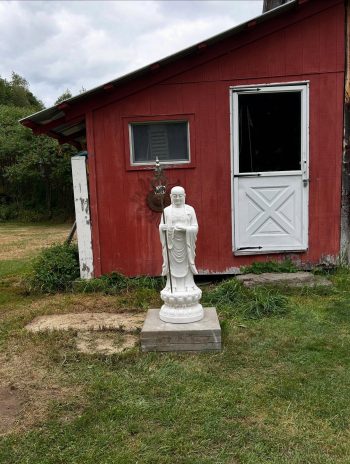
Ksitigarbha statue at Milarepa Center.
In the UK, Land of Joy in Northumberland received support for flooring and heating upgrades, deepening the comfort of its retreat house.
Jamyang Buddhist Centre Leeds secured essential roof repairs to protect its gompa and the community that gathers there.
In Romania, the Center of White Mahakala Study Group, fulfilling a vision that was inspired by Lama Zopa Rinpoche and completed its gompa in time for the upcoming retreat season.
Milarepa Center in Vermont received two grants: one to ensure financial constraints does not prevent sincere students from attending retreats, and another to protect their new Ksitigarbha statue from the harsh winter weather.
On the California coast, Land of Calm Abiding retreat center used its grant for road repairs and erosion control to safeguard the stupa meadow and the stupa built there under Lama Zopa Rinpoche’s guidance in 2013.
In Melbourne, Tara Institute received support to transport its magnificent four-story Twenty-one Taras thangka, exquisitely painted by Peter Iseli, to Melbourne’s Vesak celebration at the iconic Melbourne Town Hall, ensuring this precious object continues to bless all who see it.
Twenty-one Taras thangka display at Melbourne Town Hall, May 2025.
A grant was also offered to bring to completion a documentary on the founding of Chenrezig Institute, the first center established by Lama Yeshe and Lama Zopa Rinpoche in Australia and a living piece of FPMT history. The documentary: Chenrezig: The Origin of Tibetan Buddhism in Australia was created by Małgorzata Dobrowolska
In Spain, Tekchen Chöeling in Valencia received support for the renovation of its gompa in a newly purchased property, strengthening its presence and accessibility after nearly 40 years of service.
These nine grants are an expression of the wider FPMT community caring for our own centers, projects and study groups, to have the practical support to keep their Dharma activities thriving.
Supporting monks and nuns is at the heart of FPMT’s mission — without the Sangha, the Buddhadharma cannot be preserved and passed on.
In 2025, the Supporting Ordained Sangha Fund disbursed US$944,091 across twelve grants. The Lama Tsongkhapa Teachers Fund contributed a further US$174,568 across six initiatives, together reaching over 1,500 monastics across different traditions and regions, ensuring that Sangha could live, study, and practice with stability and dignity.
Four of the twelve grants went directly to FPMT Sangha communities, reflecting the organization’s commitment to caring for our own monastics.
The year’s most extraordinary milestone was the completion of the Gyudmed Food Fund endowment. Over four installments totaling US$681,942, FPMT fulfilled Lama Zopa Rinpoche’s vision of a US$2.1 million endowment for Gyudmed Tantric Monastery, that has upheld the tantric tradition for generations. This endowment now ensures sustainable food support for over 600 monks in perpetuity. This is something to truly rejoice in.
Support was also given to monasteries and nunneries across Nepal, India, France, and Mongolia.
The nuns of Tashi Chime Gatsal Gumba.
Monks of Thame Dechen Chokhorling Monastery
In Nepal’s Solu Khumbu, the 22 resident monks of Thame Monastery continued to receive meal sponsorship first established in 2017. The grant covers three daily meals, food transport, and cook salaries.
Tashi Chime Gatsal Gumba, a small Drikung Kagyu nunnery in the hills of Bigu, Nepal, has carried out 100 million mani retreats once or twice a year since Lama Zopa Rinpoche personally initiated this arrangement over 14 years ago — completing 26 retreats to date, totaling 2.6 billion recitations of OM MANI PADME HUM. The grant offered supported the nunnery’s 150 million mani retreat this year, along with medical care for the nuns and salaries for six teachers who provide secular education within the nunnery.
In India, food support continued for the monks of Zigar Thupten Shedrupling Institute, fulfilling Rinpoche’s pledge of US$200,000 towards their food fund.
Shalu Monastery received a grant to cover the monks’ annual food needs. Since 2018, this support has helped the Sangha continue their studies and practice without concern for their daily meals.
Idgaa Choizinling Monastery in Ulaanbaatar serves as a monastic college for young Mongolian monks with ties to Sera Je Monastery in India. For the last ten years the grants have provided the 32 monks with daily meals and a full-time cook throughout the year.
Nalanda Monastery in France received support for health insurance for six monks and emergency assistance through its Poor Monks Fund.
Osel Labrang at Sera Je Monastery received a grant covering annual expenses for 2025 and 2026, ensuring the smooth functioning of the Labrang, which will provide housing for Rigsel Rinpoche and other incarnate Lamas.
Thirty sets of robes were offered to FPMT resident and touring teachers at the CPMT meeting, honoring Lama Zopa Rinpoche’s wish to express gratitude for their service.
The year also brought meaningful investment in the future of Dharma transmission.
The International Mahayana Institute received a grant for its Video Sharing Experience Project, producing short films of ordained practitioners sharing their experiences — bridging the gap between Sangha and laypeople in four languages.
In London, Jamyang Buddhist Centre received support for its Sanctuary Project, modernizing its historic Grade II-listed building with expanded monastic accommodation and eco-friendly upgrades.
Through the Lama Tsongkhapa Teachers Fund, monthly stipends were offered to 141 senior Geluk teachers, sponsorship was provided for the annual Winter Debate bringing together nearly 500 monks from eight monasteries, and 119 monks were honored with new robes for memorizing a key Dharma text.
Annual Geluk Exam.
In addition, we administered three grants from funds previously raised: supporting the Research and Training of Specialist Geshes and Geshemas project, guided by His Holiness the Dalai Lama since 2020; the Third Research and Training Project, engaging scholars from over ten major monasteries in the study of key Buddhist philosophical texts; and a Men-Tsee-Khang observational study exploring how Traditional Tibetan Medicine can complement modern cancer care.
These grants were offered to benefit our Sangha and create conditions in which the Dharma can flourish for generations to come.
Kopan monks in puja, June 10, 2025. Photo by Kopan Monastery.
Initiated by Lama Zopa Rinpoche in 1995, the Puja Fund sponsors prayers and practices performed by ordained Sangha on the most powerful days of the Buddhist calendar, when merits are magnified, for the healing, success, and removal of obstacles for all beings — especially those within the FPMT organization and our kind donors.
In 2025, US$122,602 was offered to monasteries and nunneries that undertook these practices. Throughout the year, many powerful practices were offered with sincere prayers and dedications for the entire organization.
Extensive offerings at the base of the large Padmasambhava thangka during Guru Rinpoche Bumtsog event.
On the four Buddha Days, thousands of ordained Sangha gathered across monasteries and nunneries in India and Nepal to offer extensive prayers, including Kangyur and Prajnaparamita recitations, 100,000 Praises to the Twenty-One Taras, and 1,000 sets of offerings to Buddha Namgyalma offered by 5,000 monks of Sera Je and Sera Mey Monasteries.
Monthly practices included the Most Secret Hayagriva tsog offering and Extensive Medicine Buddha Puja, along with offerings of saffron and umbrellas to the holy stupas of Swayambunath and Boudhanath.
Monthly recitations of the Guhyasamaja Root Tantra, Ksitigharba Sutra and other precious sutras dedicated to peace and the protection of the world.
On December 3 — Lama Zopa Rinpoche’s birthday — the annual Guru Rinpoche Bumtsog at Khachoe Ghakyil Ling brought together more than 1,000 participants before a magnificent 75-foot Padmasambhava thangka, filling the day with sacred dance, collective offering, and deep rejoicing.
The Prajnaparamita Project continued its sacred work, with three practitioners writing the Prajnaparamita Sutra in pure gold Tibetan calligraphy.
The 108 nyung näs retreat at Institut Vajra Yogini in France was supported for its fourteenth consecutive year.
Ven. Lobsang Tsering writing out the Prajnaparamita Sutra.
All of these practices were dedicated to the success, peace, and harmony of the FPMT organization, to all who have passed away, to the long life of His Holiness the Dalai Lama and all our teachers, and above all, to the swift return of our incomparably kind Kyabje Lama Zopa Rinpoche.
The Shakyamuni Buddha statues offered to His Holiness the Dalai Lama on behalf of the entire FPMT organization.
Lama Zopa Rinpoche held a profound wish for FPMT to build as many holy objects as possible around the world — so that countless beings can purify negative karma and generate merit.
A highlight of the year was the offering of one hundred gold-gilded Shakyamuni Buddha statues to His Holiness the Dalai Lama on the auspicious occasion of his 90th birthday — crafted in Nepal, filled with mantras, and consecrated. Five FPMT representatives attended a long-life puja in Dharamsala, where thirteen statues were offered personally, three placed directly into His Holiness’s hands. The offering of at least one hundred Buddha statues will continue annually, in accordance with Lama Zopa Rinpoche’s wishes.
Stupa of Complete Victory at Kopan Monastery, September 2025. Photo by Tenzin Tsultrim.
At Kopan Monastery, the 42-foot Stupa of Complete Victory — dedicated to Rinpoche’s swift return and symbolizing the Buddha’s victory over death — continued to take shape. In February, sacred texts and a life tree inscribed with mantras were installed, followed by ongoing work on the intricate decorations that grace every level of the stupa as well as interior work in the gompa below. Construction of 32 smaller sandstone stupas is also underway that will surround the main stupa.
Completion of Ama Chhoyoling Monastery in Khajilung, Sindhupalchok, Nepal.
In France, the Sangha at Nalanda Monastery maintained the daily practice of crafting stupas and tsa-tsas dedicated to those who have passed or face illness.
In Spain, Nagarjuna FPMT Centre moved toward completing Rinpoche’s final advice by installing Twenty-One Taras statues on its altar.
In San Francisco, Tse Chen Ling initiated a stupa installation in its backyard garden.
In Crestone, Colorado, a Padmasambhava Stupa originally built in 1981 underwent careful restoration.
Ama Chhoyoling Gumba in Nepal completed its interior and exterior painting, already welcoming Dharma teachings and sangha gatherings.
Naropa Center in Tahiti received a grant to construct a prayer wheel over water — its axis touching the ocean, spreading the blessings of millions of mantras across the Pacific and beyond.
Altar holding Lama Zopa Rinpoche’s holy body, Kopan Monastery, Nepal, May 13, 2023. Photo by Ven. Lobsang Sherab.
Supporting our lamas is a core priority for FPMT, and in 2025, US$339,903 was disbursed for this purpose — primarily through the Lama Zopa Rinpoche Bodhichitta Fund, with additional grants from the Long-Life Puja Fund and the Unmistaken Incarnation Fund, which supports pujas and sacred objects dedicated to Rinpoche’s swift return. Through these offerings, may the organization always have perfect guidance and an unbroken connection with our lamas.
On July 5th, five FPMT representatives attended the long-life puja for His Holiness the Dalai Lama in Dharamsala, making a significant monetary offering on behalf of the entire FPMT community — the day before His Holiness’s 90th birthday. One hundred gold-gilded Shakyamuni Buddha statues were also presented, with thirteen offered directly and three placed personally into His Holiness’s hands. In honor of His Holiness’s birthday, three young buffaloes were liberated from slaughter and now live under the care of Kopan Monastery’s Animal Liberation Sanctuary.
His Holiness the Dalai Lama, during the long-life puja on July 5, 2025.
Amitabha festival day at Buddha Amitabha Pure Land, 2025.
Through the Unmistaken Incarnation Fund, two artists are crafting a statue of Kyabje Lama Zopa Rinpoche to hold his holy body relic, as well as a life-size statue from which ten-inch replica statues will be produced.
The Lama Zopa Rinpoche Bodhichitta Fund carried out a wide range of offerings and commitments previously initiated or requested by Rinpoche: completing offerings to all of his gurus and their incarnations, fulfilling his pledge of support for retreat land for Khenpo Thinley Dorje in Nepal, supporting the 108 Nyung Na retreat at Institut Vajra Yogini, contributing to electricity for Kopan Monastery and Khachoe Ghakyil Nunnery, sponsoring the enthronement of Tenzin Khechok Rinpoche, and supporting the Dharma education of several young incarnate lamas in India. Ongoing support was also provided to Buddha Amitabha Pure Land for its daily offering practices and annual festival, in accordance with Rinpoche’s wishes.
FPMT International Office provided ongoing monthly support to Tenzin Osel Rinpoche.
Ven. Lekdron with His Holiness the Dalai Lama who gave his blessing for her for the documentary film project, Five Prominent Historical Mahayana Buddhist Sites in Sri Lanka.
In 2025, the Education and Preservation Fund awarded US$68,393 in grants to preserve and share the profound teachings of the Mahayana tradition – nearly all the grants went directly to FPMT projects and centers. These contributions supported scholarships, translation, publication, teacher development, and multimedia initiatives, making the Dharma accessible for people of all cultures and generations.
Scholarship support ensured continuity for the FPMT Masters Programs at Istituto Lama Tzong Khapa in Italy and Nalanda Monastery in France, covering Teaching Assistant and Tutor positions and providing students with uninterrupted access to their studies.
The team of Bengali translators at Visva-Bharati University.
In Italy, Nalanda Edizioni undertook the translation of Lama Zopa Rinpoche’s The Six Perfections into Italian.
At Visva-Bharati University, a project led by two scholars translated Ācārya Aśvaghoṣa’s Vajrasūcī — a text affirming the universal potential for spiritual awakening — into Bengali for the first time.
In Sri Lanka, a project led by Ven. Tenzin Lekdron and the Tara Lanka FPMT Study Group worked to document and illuminate the country’s rich Mahayana Buddhist heritage.
Through the Translation Fund, key practices were supported including the Most Secret Hayagriva sadhana, the Kalachakra Mind Mandala sadhana, and two pilgrimage guidebooks for Nepal and India.
In July, we provided a grant to support Maitripa College’s Teacher Development and Support Seminar, equipping the next generation of Buddhist teachers to meet the diverse needs of today’s global community.
These grants reflect our commitment ensuring that the Mahayana tradition is preserved and continues to reach new people, new languages, and new generations.
For more details on the various offerings made through the Education and Preservation Fund this year, please read our extensive report.
The Animal Liberation Fund continues to manifest Lama Zopa Rinpoche’s vision of loving-kindness and compassion for all living beings, by rescuing animals from suffering and offering them the opportunity to receive imprints of the Dharma through blessings, hearing mantras or going around holy objects.
In 2025, the fund granted US$183,403 across four FPMT center initiatives spanning Washington State, Mongolia, Nepal, and France.
At the heart of this work is the Animal Liberation Sanctuary near Kopan Monastery, which currently cares for 61 goats, five cows, four buffalo, several dogs, and three ducks — including the three young buffalo rescued from slaughter in Kathmandu in honor of His Holiness the Dalai Lama’s 90th birthday. After fourteen years of searching, new animal liberation land has been secured in a supportive Tamang Buddhist community four hours away, and construction of a goat shelter and manager’s room is already underway, marking a significant step forward for animal welfare.
Bird feeder at Buddha Amitabha Pure Land in Washington State, USA.
Songbird nesting boxes with mantras at Nalanda’s workshop.
At Buddha Amitabha Pure Land in Washington State, Sangha members liberated 41,238 animals over the past year, offering prayers at each liberation and providing blessed food and water for ants, fish, and birds — creating opportunities for these beings to encounter the Dharma and accumulate merit.
In Mongolia, the grant was used to support 96 liberated animals roaming in the Bulgan Aimag landscape, cared for by local herder Jigmed, specifically supplementing food and shelter through harsh winters and annual visits from staff and nuns for prayers and rituals.
At Nalanda Monastery in France, the Animal Care Project provided veterinary treatment for stray and injured cats, winter care for bees, and new wildlife structures including nesting boxes and bat roosts — a beautiful expression of how Dharma practice naturally extends to ecological and community care.
These initiatives reflect the understanding that every being, however small, deserves care, protection, and the imprints of Dharma.
View Financial Charts for 2025 Charitable Project Grants
Charitable Projects Disbursements
The table and chart outline the direct grants of US$2,708,905 4 during 2025 to FPMT’s Charitable Projects.
4. The disbursement figures do not include expenses for administration fees and credit card merchant fees and are inclusive of some interfund disbursements which will be subject to audit adjustments during our annual independent financial review.
FPMT Education Services offers a wide range of programs and materials to support introductory to advanced Buddhist study and practice. This includes our FPMT Education Programs, available in FPMT centers and online; our prayers and practice materials, offered in digital formats; and our translations of key Buddhist texts, created by translators and editors around the world.
Highlights for 2025
Programs
Introductory Level Courses
FPMT’s introductory courses provide accessible entry points for students to explore different meditation techniques, learn the basics of Tibetan Buddhism, and discover practical guidance for navigating life’s challenges and preparing for death.
Buddhist Mind Science: Activating Your Potential
In 2025, the Buddhist Mind Science course further consolidates its reach with 29 newly qualified facilitators across three continents: the Americas (USA, Mexico), Europe (Austria, France, Romania, Spain, and the Netherlands) and Asia-Pacific (Australia, New Zealand). This experiential course brings together ancient Buddhist wisdom and contemporary science by presenting key Buddhist concepts—mental balance, warm-heartedness, and wisdom—alongside relevant scientific perspectives. Offered both in-person and online, with an emphasis on active participation, the course is becoming more accessible with Spanish and French translations of the course materials in progress.
Foundational Level Programs
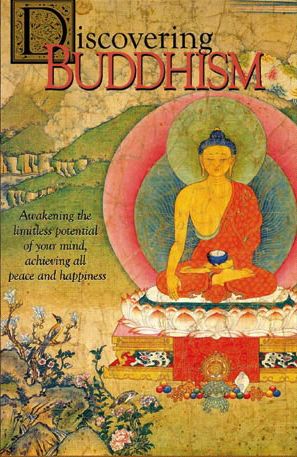
Our signature programs, Discovering Buddhism (DB) and Exploring Buddhism (EB), offer curricula rooted in the Stages of the Path (lam rim) teachings, enriched with an introduction to more advanced Buddhist topics including Buddhist tenets, Middle Way view, reasoning and debate, sutra grounds and paths, and preliminary practices (ngöndro). The DB program continues to serve as the cornerstone for students following Lama Tsongkhapa’s tradition, while the EB program has significantly enhanced our foundational level offerings with expanded accessibility: it is now available in French through Kalachakra Centre (France), in Italian through Istituto Lama Tzong Khapa (Italy), and in English at centers in the US, UK, France, and Australia.
In-Depth Education
During 2025, our In-Depth level education, which previously consisted of the FPMT Basic Program (BP) and the FPMT Masters Program (MP), was enriched with two important additions:
The Abridged FPMT Masters Program (AMP) gives students in non-residential centers the option to study the MP subjects with their own teacher, in their own center, complete with certification. Guidelines that indicate flexibility and suggested requirements, plus completion cards for each subject and an example of the completion certificate, were added to our web materials pages and sent to relevant centers.
The FPMT In-Depth Meditation Training (IDMT) offers meditators long-term support and personal guidance. During the 4-year course, students’ needs and practice levels are addressed, and participating FPMT centers benefit from well-organized collaboration. By visiting different regions, personal contact is made with the highly qualified IDMT teacher, and a large supporting community of practitioners with a worldwide presence is created.
MP students and staff enjoying a picnic, October 2025. Photo courtesy of Nalanda Monastery.
The FPMT Basic Program (BP) added sets of meditations and retreats for each BP subject, in English, French, and Spanish, complete with instructions for use, making it easy for center staff to include meditations and short retreats with each BP subject.
For the FPMT Masters Program (MP), the French translation for the second subject, Middle Way, was completed and made available for its start at Nalanda Monastery; the French translation of the forthcoming subject of Pramana was commissioned, and work on it has begun. The final draft of the English MP Study Manual for Treasury, another forthcoming subject, was made available as a rich resource for students, MP Tutor and Teaching Assistant alike.
Teacher Registration Policies
We extended our Teacher Registration policies with a set of auxiliary studies and practices, addressing a longstanding request to enable Geshe Program students from Sera Je’s IMI house to become registered teachers before they complete their geshe studies. The requirements outline how to become familiar with the contents of our programs, how they are set up, where the materials are to be found, and other information.
FPMT Education materials are essential resources for our students worldwide. In addition to creating new materials, we regularly review and update existing items in keeping with the advice of Lama Zopa Rinpoche and to be aligned with the highest standards in translation. Being an international Tibetan Buddhist organization, we also provide translations of materials into various languages, which is essential for the success of our students and the preservation of our lineage.
New Materials and Publications in 2025
Translations and Other Publications
The Body Mandala Rite of the Display of the Combined Peaceful and Wrathful Kagye
The Great Compassionate One Embodying the Three Roots
A Concise and Complete Sadhana of Bhagavan Wrathful Glorious Most Secret Hayagriva
The Melodious Laughter of the Mighty One: An Activity Manual for Wrathful Most Secret Lotus Based on “The Compendium of the Heart Essence”
Additional Confession Verses
The Excellent Vase of All Siddhis: A Mind Mandala Sadhana of Glorious Kalachakra
A Prayer for the Swift Return of Ganden Trizur Lozang Tenzin Rinpoche
The Staircase Proceeding to Liberation: An Uncommon Guru Yoga Based on Chittamani Tara
Inner Job Description Cards
Translations and Works Published on the Advice of Lama Zopa Rinpoche
A Detailed Commentary on the Practice of the Six Yogas of Naropa
A Bouquet Which Gathers Together All Excellent Actions
Essentials at the Time of Death
Updates, Revisions, and New Formats
Lama Zopa Rinpoche’s Composition and Translations
Recognizing the False I
Prayers for the Long Life of Rangjung Neljorma Khandro Tseringma Rinpoche
Updates on Essential Practices
Shakyamuni Buddha Puja
Hayagriva Praise and Mantra
Amitayus Praise and Mantra
Dedication Prayers
Complete Dedication Prayer Book
Six-Session Guru Yoga
Tara Chittamani Uncommon Guru Yoga
The Kalachakra Six-Session Guru Yoga together with An Extensive Review of the Three Vows and An Extensive Aspirational Prayer
The Sutra of Great Liberation
Minor Revisions
Yamantaka Short Sadhana
Vajrapani Mahachakra Daily Practice
Statues and Stupas – Part 2: Building and Blessing Holy Objects
Ebooks Update:
Prostration Instructions, Mantras, and Meditation
The Sutra of Great Liberation
Ongoing Works in Progress
Work continues on several other major translation projects listed below.
Currently Active Translation Projects
Refuge and lay vow ritual
Damtsig Dorje’s Most Secret Hayagriva sadhana
Lama Zopa Rinpoche and Ngulchu Dharmabhadra’s mandala offering commentary
Wheel of Life card commissioned by Lama Zopa Rinpoche
The 21, 29, and 31-chapter Sutra of Golden Light
Extensive Hevajra sadhana and supplementary ritual
Changkya Rolpai Dorje’s pilgrimage guide to Wutaishan
Trijang Rinpoche’s Heruka Body Mandala commentary
Dragpa Gyaltsen’s commentary on the Bodhicharyavatara
Gyaltsab Je’s Ornament of the Essence
Vajrayogini self-initiation and sadhanas update
Sadhana and extensive four mandala offering ritual of Chittamani Tara and their related materials
The Foundation Store is FPMT’s online shop with a vast collection of Buddhist study and practice materials written or recommended by our lineage gurus. We offer printed copies of a selection of Foundation Store titles through Amazon’s print-on-demand service in Australia, Canada, France, Germany, Italy, Japan, Netherlands, Poland, Spain, Sweden, UK, USA. In the item description, click on the Amazon market closest to you. Foundation Store also offers a selection of prayers and practices available for 1-click download.
The Foundation Store continued to distribute PDFs, ebooks, and audio from FPMT translation groups, the Lama Yeshe Wisdom Archive, Kopan Monastery, FPMT nunneries, Wisdom Publications, Ediciones Dharma, the Foundation for Developing Compassion and Wisdom, and Happy Monks Publications, among others. A total of 2,406 of their titles were downloaded.
FPMT Education materials are also distributed on third-party platforms like Kindle, Apple, Spotify, and others.
A total of 1,570 ebooks were ordered through Kindle, Draft2Digital, and Google Play
Students ordered 1,013 FPMT titles through Print-On-Demand
A total of 44,517 mantras and meditations were streamed
The Foundation Store processed 14,228 orders from 6,373 customers, totaling 32,110 individual items. This generated a total of $61,391 in Foundation Store donations and an additional $6,162 for charitable projects. Proceeds from Dharma items totaling $51,914 were offered to various holy objects and Dharma services.
Online Learning
The FPMT Online Learning Center (OLC) continues to serve as a vital gateway for students seeking FPMT Education beyond our physical centers. The OLC provides an opportunity for students from around the world to study Buddhism online, tailored to their interests and needs. Courses and programs are available in English, French, and Spanish, as well as FPMT online service trainings.
A total of 786 new accounts were created at the FPMT Online Learning Center (OLC). This brings the total number of registered users to 27,915.
Users initiated 254 new discussion posts.
The OLC website received approximately 499,000 visits from 11,000 visitors.
In 2025, our most popular Introductory and Foundational courses—Buddhism in a Nutshell, Buddhist Meditation 101, and Discovering Buddhism Online—awarded over 60 certificates of achievement, showing strong engagement with foundational Buddhist teachings in a more accessible digital format.
Foundation Service Seminar participants at IVY, France, September. Photo by Capucine T. Dekyong.
Supporting Centers & Teachers
Working closely with five regional and six national coordinators, Center Services assists FPMT centers, projects, services, and study groups (which are probationary centers, projects, and services) in establishing and sustaining a good governance structure to support the preservation of the Mahayana tradition now and into the future. We facilitate communication between the board of FPMT Inc. and FPMT centers, projects, and services, and facilitate the placement of resident geshes and teachers at centers.
The Teacher Services department oversees different matters relating to teachers. This work includes overseeing the registration process for non-Tibetan teachers, updating the FPMT Registered Teacher List and the Tibetan Teacher List, handling grievances and complaints, addressing safeguarding issues specific to teachers, and exploring ways to improve support for teachers across all fields of their activities.
Snapshot of the Organization
During 2025, many centers, projects, services, and probationary entities (study groups) continued the ongoing reflection on their operations and the new hybrid of onsite and online activities, which have become the norm.
At the end of 2025, there were 112 centers, projects, and services, and 24 study groups, in 32 countries. Since Rinpoche’s passing in April 2023, the number of centers and study groups has actually very slightly increased: Tara Lanka Study Group in Sri Lanka was revived after a few years on pause; Machig Lapdron Nunnery, in Bendigo (Australia), and Thubten Kunkyen, in Napoli (Italy), have successfully made the transition from study group to center; and a new study group, Garden of Maitreya, was created in Bucharest (Romania).
There are 42 geshes and 9 registered teachers resident in FPMT centers. The FPMT Registered Teacher List includes 269 teachers: 167 Foundational Buddhism teachers and 102 In-Depth Buddhism teachers. In 2025, we registered 11 new Foundational-level teachers and 3 new In-Depth Buddhism teachers, coming from all regions.
As you will read in other sections of this Annual Review, there were many highlights from this past year, including the successful CPMT Summit at Kopan Monastery, FPMT celebrating its 50 year anniversary, one hundred Buddha statues offered to His Holiness the Dalai Lama on behalf of the entire organization, as well as the joyous news that His Holiness has confirmed that Lama Zopa Rinpoche’s reincarnation has been born in Nepal.
Here we share a few other highlights from within the organization that are truly worth rejoicing in:
Second Gelug Monlam Festival at Nalanda:the Second Gelug Monlam Festival was held at Nalanda Monastery in France in March. Lama Zopa Rinpoche had expressed the wish to bring this special tradition to the West and the geshes and monks at Nalanda are making that wish a reality.
Wheel of Sharp Weapons Retreat in Kopan Monastery: fifty-three participants have completed a powerful Wheel of Sharp Weapons retreat at Kopan Monastery, led by Geshe Legtsok (USA), from April 17-23, following the CPMT Summit, this fulfilling Lama Zopa Rinpoche’s wish that his students engage in such a retreat.
Second Year Commemoration of Rinpoche’s Passing into Parinirvana: April 13th marked the two-year anniversary of Lama Zopa Rinpoche passing into parinirvana. Around the world students gathered for collective prayers and practice, and to sincerely remember with immense gratitude the great kindness of our most precious spiritual guide.
Most Secret Hayagriva Retreat at Nalanda Monastery: As Ven. Roger Kunsang, who participated in the retreat, explained, “The Most Secret Hayagriva retreat is the practice/commitment that Lama Yeshe gave to Lama Zopa Rinpoche to do every year for the protection and success of the entire FPMT organization. And now this is a commitment the whole organization is taking on.” This most auspicious and powerful retreat took place for the first time in Nalanda Monastery in July.
LRZTP 9 Program Successfully Completed: the latest interpreters training course, LRZTP 9, successfully finished with eleven new graduates in June! LRZTP’s 10th translator program has started in October.
A successful Foundation Service Seminar (FSS) Retreat was hosted by Institut Vajra Yogini, France, in September, with around 40 participants from different European FPMT affiliates.
Eleven new geshemas: eleven nuns from Khachoe Ghakyil Ling Nunnery (Kopan Nunnery) in Nepal successfully completed over 20 years of rigorous Buddhist studies and achieved the geshema degree.
Fourteen Years of Nyungnes at Institut Vajra Yogini: Institut Vajra Yogini hosted its fourteenth series of 108 Nyungne retreats from November 2024 to June 2025, thus contributing once again to fulfill one of Lama Zopa Rinpoche’s Vast Visions for the FPMT organization to support people who make a serious commitment in this life to complete 1,000 Nyungne retreats.
Planetary Crisis Summit 2025: In September, six European FPMT centers joined forces to offer a Planetary Crisis Summit. This hybrid event, with a combination of a shared online program and local events at the participating centers, built upon the summit hosted by the London Jamyang Buddhist Centre, created for those who feel touched—sometimes overwhelmed—by the state of the world.
Over 150 Million Mani Mantras Offered to His Holiness the Dalai Lama: Yeshin Norbu, the FPMT center in Stockholm, Sweden, organized the recitation of over 56 million Mani mantras which were offered to His Holiness, following their Mani Retreat Initiative, held with various FPMT centers and students around the world from Losar till May. And for the thirteenth year, FPMT Mongolia hosted in September a 100 Million Mani Retreat, including online participation! Almost 102,000,000 manis were accumulated and offered to His Holiness.
Opportunities to Connect with High Lamas in FPMT Centers: many FPMT centers got the great fortune of hosting three high lamas who are very close to FPMT and had the great kindness to visit several of our regions, His Eminence Kyabje Yongzin Ling Rinpoche, His Eminence Khensur Jhado Tulku Rinpoche, and Serkong Tsenshab Rinpoche.
Continued Prayers for Rinpoche’s Swift Return: as advised by His Holiness the Dalai lama after he shared the news that Rinpoche’s reincarnation has been born, students of Lama Zopa Rinpoche have continued reciting Chanting the Names of Noble Manjushri as well as Migtsema practice.
The work of our communications department helps foster a sense of connection within the FPMT organization and provides inspiration, updates, news, and advice to FPMT centers, projects, services, and all students of Lama Yeshe and Lama Zopa Rinpoche.
This work includes creating digital communications (blogs, emails, e-newsletter, social media posts) that share news on: FPMT activities—both International Office and the greater organization; progress on Lama Zopa Rinpoche’s vast visions and holy wishes; reminding or announcing resources for study and practice; newly available or archived teachings of Lama Zopa Rinpoche including teaching events, newly available photos and videos, etc.; teachings of Lama Yeshe; updates and news regarding His Holiness the Dalai Lama; updates from the Board of Directors; obituaries within the community; release of photo galleries and webpages; and may other areas as needed and requested.
The Communications department supports the various departments of the International Office by publishing communications at their request, including:
Charitable Projects: creating awareness of projects, transparency around how donations are used, and inspiration to support projects and rejoicing for donors, benefactors, potential donors, and FPMT students.
Education Services: promoting new and existing materials, translations, and programs. We also promote advice for merit-multiplying days and other particular situations or events.
Center Services: helping with various communications priorities necessary for supporting affiliates or related to the future of the organization.
Development: helping support and edit fundraising campaigns and messaging on the website and blogs.
Media: We work with the Media department very closely on publishing teachings of Lama Zopa Rinpoche, which include the website, transcripts, blogs, teaching events (Rinpoche available now), podcasts, and YouTube work.
Support any department that needs to communicate with the wider organization.
Keeping In Touch
Through our robust website, daily blogs, our monthly digital e-newsletter, the e-groups, and various social media accounts, we keep in touch with the FPMT global community and foster a sense of connectedness.
Highlights from 2025:
Our daily online blog, FPMT News, published 167 stories in 2025. This included teachings and advice from Lama Zopa Rinpoche and Lama Yeshe; news and updates from FPMT centers, projects, and services; information on new and updated practice materials and study opportunities; updates from the FPMT Inc. Board; and many other topical stories and opportunities of interest to the FPMT community.
International Office’s website, FPMT.org, had over 1.1 million page views and 457,000 unique visitors in 2025.
The daily and weekly email digests of FPMT News reached more than 3,095 subscribers.
Our monthly e-newsletter, the FPMT e-News (International Office News), was sent to over 56,544 email recipients (an increase of 1,892 since last year) and included news, updates, and opportunities from FPMT International Office and the broader FPMT organization.
Hundreds of thousands of people around the world connected with FPMT and Lama Zopa Rinpoche’s pages on Facebook, YouTube, Instagram, Bluesky, Threads, and X (formerly Twitter).
FPMT Education Services continued offering a regular Spiritual Program Coordinator Newsletter, which is sent out to SPCs, Directors, Registered Teachers, and Study Group Coordinators to keep these groups updated on the latest news from FPMT Education Services.
Our CPMT e-group shared information with nearly 700 people working in service within the FPMT organization.
Our most popular pages in order of most visits were: Dharma Practice Dates, FPMT’s Homepage, and A Most Joyful Announcement Regarding the Reincarnation of Lama Zopa Rinpoche.
In 2025, Media Resource Management continued to strengthen the accessibility, reach, and long-term value of FPMT’s teaching archive. Through a combination of AI-supported workflows and careful human oversight, major historical teaching series were enhanced and republished, podcast reach expanded significantly, and the YouTube channel maintained strong engagement despite the absence of new teachings by Lama Zopa Rinpoche. In parallel, strategic groundwork was laid for a central digital hub to better support FPMT centers worldwide.
Highlights from 2025:
Building on last year’s successful pilot of providing YouTube descriptions with chapter markers—allowing viewers to quickly navigate to the sections of the teachings most relevant to them—we published the 2004 Ganden Lha Gyäma teachings from Istituto Lama Tsong Khapa. This achievement was made possible through a combination of AI-generated drafts and careful human review and verification. We aim to extend this valuable service to many more previously published videos over time.
Another major body of work was released with the Mahamudra 2004 retreat in Australia, comprising 51 teachings. The complete series was also added to the full-length teachings podcast, enabling comfortable listening on the go, including with mobile devices in screen-lock mode. Together, these releases provided a full year of teachings and resulted in more than 8,000 downloads of the full-length teaching podcasts in 2025—a 30% increase over the previous year.
Media Resource Management also provided substantial support for CPMT presentation videos, including on-site recording, post-production, and transcript creation.
The CPMT preparation survey and associated meetings identified the most pressing technical need for centers as the creation of a central online hub that presents all center offerings in one place, alongside comprehensive information about centers and teachers. In collaboration with Mindful Design, development of the LOTUS system is underway, and a working prototype was presented at CPMT.
Despite no longer publishing new teachings by Lama Zopa Rinpoche, the YouTube channel continues to perform strongly, with approximately 300,000 views. Notable examples of popular videos include:
Popular Videos:
Mystic Tibet – approximately 65,600 views in the past year and 650,000 views over its lifetime
International Office’s website, FPMT.org, is the landing page for those interested in the FPMT organization in general and the resources, materials, and opportunities provided by the FPMT International Office specifically. With well over 1 million visits annually, it is imperative that our infrastructure remains secure and optimized, and that we stay up to date with the latest technologies and offerings.
In 2025 Adam Payne, who has been our web developer for 20 years, transitioned into the new role of web producer. This role is focused on content and production. We contracted with Matt McArthur and his team at Mindful Design to fill the web developer role.
Website Highlights for 2025
Automated Lama Zopa Rinpoche’s Advice page by writing a custom shortcode function that pulls in posts from the Lama Zopa Rinpoche’s Advice blog category and then by the specified blog tag. The advice page is organized by topic, so the shortcode is inserted into each topic using a variable that contains a string of comma-delimited tags specific to that topic, making it easier for students to find the advice they need.
Created an Affiliates Area menu that displays only on mobile devices and only if you are logged in as an affiliate. This menu includes the Affiliates Area Search Bar, My Account link, Logout link, and the full Affiliates Area menu.
Conducted a thorough review of the website’s plugins, identifying and removing those that were unused or redundant to improve site performance and reduce potential security risks.
Cleaned up the website’s underlying code, streamlining CSS stylesheets and PHP functions for improved performance and easier long-term maintenance.
Strengthened website security by implementing new security headers, resolving vulnerabilities, like replacing the login-logout plugin used for the affiliates area with a custom-built secure alternative.
Updated the Online Learning Center (Moodle) platform and its Lambda theme to ensure students have a smooth and secure learning experience.
Migrated Google reCAPTCHA to Google Cloud, ensuring continued protection of website forms against spam and automated abuse.
Resolved display and functionality issues across the site, including YouTube video playback problems on the streaming page and mobile browsing bugs.
Began initial research and planning for an SEO (Search Engine Optimization) project to improve FPMT.org’s visibility in search engines.
Developed a strategic roadmap for a future website rebuild, and commenced early preparation work, including content audits, code migration planning, and migrating the website’s custom styling code into an organized snippet-based structure.
Performed regular maintenance throughout the period, including weekly plugin and security updates, backup verification, and ongoing security monitoring via Wordfence.
Information Technology
The Information Technology infrastructure supporting FPMT International Office provides consistent, dependable access to essential resources across our digital ecosystem, including the FPMT News blog, the FPMT website, educational offerings through the FPMT Online Learning Center, digital materials available via the Foundation Store, and FPMT Charitable Projects.
Beyond serving our external community, the IT department delivers secure, privacy-focused digital tools and systems that empower the International Office and our global staff network to effectively advance Lama Zopa Rinpoche’s vision while supporting centers, projects, and services worldwide.
Working collaboratively with colleagues and community members, our IT department has made progress implementing several priority systems identified by our international community, initiatives designed to strengthen our organizational capacity to fulfill Lama Zopa Rinpoche’s vision.
IT Highlights from 2025:
Infrastructure modernization: Transitioned both production and development web servers to enhanced hosting environments featuring expanded resources and current operating systems, improving performance and reliability.
Unified collaboration platform: Deployed an integrated system combining document management, spreadsheet functionality, custom application capabilities, and AI-powered features into a single collaborative workspace. This platform supports internal operations and powered the CPMT 2025 digital workspace, housing session materials, recordings, agendas, transcripts, and more.
Ongoing security and maintenance excellence: Maintained our commitment to weekly system maintenance and security updates across critical IT infrastructure, ensuring all software remains current with essential security patches and functionality improvements. Additionally, we refreshed IT policy documentation to reflect current best practices and completed our annual disaster recovery procedure review, ensuring business continuity capabilities remain robust should system restoration or recovery become necessary.
FPMT International Office is responsible for managing and supervising the finances of the Foundation for the Preservation of the Mahayana Tradition, Inc. (FPMT, Inc.) as directed by its Board of Directors. Finances are divided between general funds (unrestricted) and funds designated for specific charitable projects (restricted funds). The FPMT Development department serves the supporters of the FPMT mission and works to ensure that FPMT International Office activities and projects have the financial resources needed for their fruition. In 2025, donations and legacies to FPMT-managed funds came from over 3,259 supporters in 81 different countries.
Fundraising
Fulfilling Our Lamas’ Wishes Fund
Created at the end of 2024, this fund honors the guidance and inspiration of our founding lamas, Lama Thubten Yeshe and Lama Zopa Rinpoche, in raising support for the fulfillment of their intentions, projects, and wishes for the organization to preserve the Mahayana tradition, create greater access to the Dharma, and benefit sentient beings as much as possible. The focus of our annual year-end campaign, this fund received US$ 44,612 from kind supporters in 2025.
Friends of FPMT
In the 25 plus years of the Friends of FPMT program, our Friends supporters have offered a steady and significant ground of funding support to the Foundation. We rejoice in the immense generosity of the many thousands of Friends of FPMT contributors over the years.
The program in turn provides Friends of FPMT supporters complimentary access to our FPMT Education online study programs and published prayer and practice materials, as well as the Mandala online archives, print-quality photos, the Liberation Calendar, and special gifts from our friends at Lama Yeshe Wisdom Archive.
In 2025, 909 Friends of FPMT supporters generously contributed US$ 220,058 for FPMT International Office’s projects and activities.
Give Where Most Needed Fund
This unrestricted fund was established to offer supporters a simple way to contribute to the FPMT mission. The Give Where Most Needed Fund can aid any projects in urgent need, or cover any budget shortfalls that were unplanned. In 2025, the fund received US$ 71,202 in generous donations from 432 supporters.
FPMT International Office has the responsibility of managing and supervising the finances of the Foundation for the Preservation of the Mahayana Tradition, Inc. (FPMT, Inc.) as directed by its Board of Directors.1 Finances are divided between general funds (unrestricted), and funds designated for specific charitable projects (restricted funds).2
In 2025, total unrestricted operating income for International Office was US$1,229,471 and total operating expenses were US$1,161,212 resulting in an operating surplus of US$68,259. 3
In 2025, the total restricted income for the Charitable Projects was US$4,722,422 and the total disbursements for grants and expenses for credit card and administration fees were US$2,689,382. Please view the Disbursement Chart for Charitable Projects in Our Charitable Work section.
FPMT Inc. also processes and manages funds on behalf of others and in 2025 these funds had income of US$1,991,227 and disbursements and expenses of US$484,453
1. Foundation for the Preservation of the Mahayana Tradition, Inc. (abbreviated as FPMT, Inc.) is the legal entity of FPMT International Office. The terms FPMT, Inc. and International Office are interchangeable.
2. Restricted funds include all the charitable projects of FPMT, Inc. as outlined on our website in addition to certain other charitable projects as initiated by Lama Zopa Rinpoche and the Board of Directors.
3. Operating income and expenses exclude any unrealized gains or losses on investments and any exceptional items.
Unrestricted Funds
Unrestricted funds do not have any donor-imposed restrictions and are used to fulfill the various activities and operations of International Office. The table and charts give a summary of income and expenses for 2025.
Our Year in Photos
Please explore more highlights from 2025 in this photo gallery of our activities around the world. We invite you to rejoice along with us through this beautiful visual presentation. View the gallery »
Heartfelt Thanks to All!
All of our 2025 accomplishments are due to the kindness of the FPMT centers, projects, services, teachers, students, volunteers, and benefactors who supported us this year.
We would also like to sincerely thank everyone who made prayers for Lama Zopa Rinpoche's swift return; dedicated any prayers and practices to the success of the FPMT organization and actualization of our lamas' wishes; the Sangha at Buddha Amitabha Pure Land who offered service, extensive offerings and prayers for those who are sick or have passed away; the Sangha at Nalanda Monastery who make tsa tsas for those who are sick or have passed away, the Sangha and students who offered extensive offerings and prayers for the FPMT organization and all beings at Root Institute, Kopan Monastery, and Ganden Do Ngag Shedrup Ling; and the Sangha and students who recite sutras monthly and make prayers for FPMT and to pacify the elements and protect those harmed by disasters of earth, wind, fire, and water.
FPMT Education Services would like to extend huge thanks to all our online elders and assessors, who skillfully respond to comments in our online forums and painstakingly review student assessments and points for reflection. They provide the personal human touch that continues to make these online programs work so well.
Additionally, Education Services relies on many dedicated and generous people who offer time and support to various projects. We offer heartfelt thanks to: Kyabje Jhado Rinpoche, Gyume Khensur Rinpoche Lobsang Jampa, Kopan Geshe Losang Sherab, Sera Je Geshe Thubten Sonam, Geshe Tenzin Legtsok, Geshe Tenzin Namdak, Ven. Steve Carlier, Ven. Gyalten Lekden, Ven. Joan Nicell, Ven. Tenzin Gache, Ven. Tenzin Gyurme, Ven. Tenzin Namjong, David Gray, Laura Haughey, Koh Zi Yen, Lorne Ladner, Doris Low, May Ng, Tubten Pende (Jim Dougherty), Rhona Sawyer, Toh Sze Gee, and Aki Yeo.
We offer sincere thanks to the following: Regional and National Coordinators present and in the recent past: Ven. Tashi Choedup, Bengu Fetzer, Selina Foong, Lara Gatto, Steff Hill, Frances Howland, Ramon Lara, Melissa Kaye, Irina Roldan, Peter Stickels; FPMT Service Seminar Coordinator Wendy Ridley; and Service Seminar registered facilitators: Amy Cayton, Annelies van der Heijden, Charlotte Elliot, Francois Lecointre, Drolkar McCallum, Martha Portillo, and Gilda Urbina.
Dedications at the pujas sponsored by the FPMT Puja Fund at the great monasteries throughout the year are made especially for purifying obstacles and creating merit for Dharma activity to flourish in FPMT as well as for all students, supporters, and FPMT friends who are ill or have died, and for all those who have worked tirelessly and sacrificed so much to benefit the organization in different ways.
In 2026, may you have perfect happiness and be free from every suffering!

 receive our newsletters
 join Friends of FPMT